
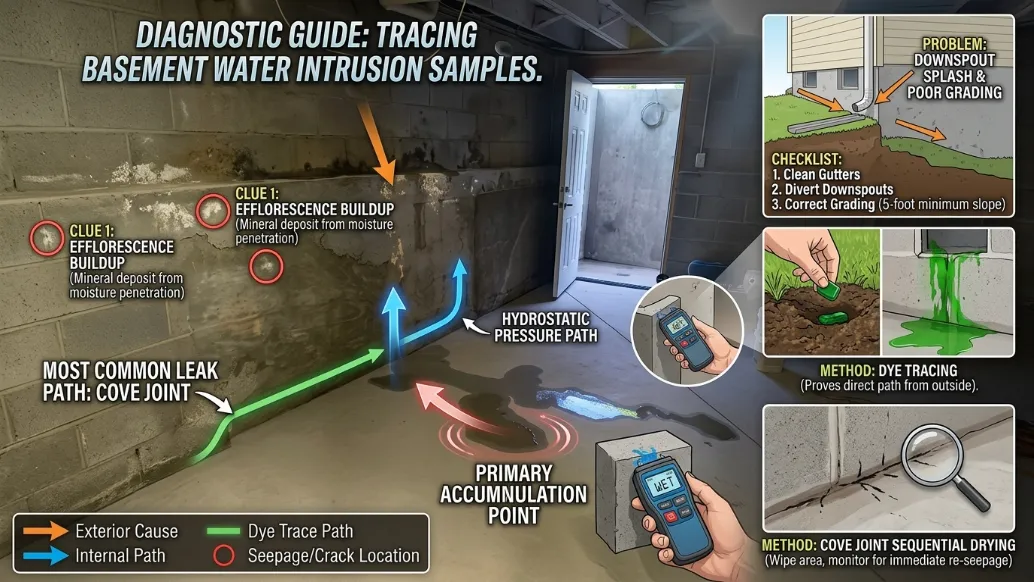
A diagnostic sequence used by licensed contractors, so you buy the repair you need instead of the one that gets sold most often. Most homeowners discover basement water intrusion the same way: a damp corner after a storm, a stain that keeps coming back, or a puddle that appears with no obvious source. The instinct is to call for waterproofing quotes immediately. That instinct costs people thousands of dollars every year, because water reaches a basement through at least seven different mechanisms, and each one has a different correct repair. Sealing a crack will not stop water arriving through the slab. A sump pump will not stop condensation. Regrading will not fix a failed cove joint.
This guide gives you the diagnostic order a technician uses on a first visit. You identify where the water appears, then when it appears, then confirm the mechanism. By the end you will know which of the seven sources you are dealing with, what the correct basement water intrusion repair actually is, and which repairs are commonly sold to homeowners who did not need them.
In Nassau or Suffolk County, NY? Call for a Free Assessment Now!
What Basement Water Intrusion Actually Is, and What It Is Not
Water intrusion means liquid water crossing your foundation envelope from the outside. That covers seepage through concrete pores, flow through cracks and joints, and water pushed upward through the slab by pressure in the soil below. It does not include water your house generated on its own.
This distinction matters more than any other point on this page. A significant share of wet basements in the New York metro area are not intrusion cases at all. They are condensation cases, where humid summer air meets cool foundation surfaces and deposits moisture on them. The symptoms overlap almost perfectly: damp walls, wet floors, musty odor, and eventually mold. The repairs do not overlap at all.
Waterproofing a condensation problem produces a dry-looking wall and a still-wet basement, and homeowners in that situation usually conclude the contractor failed rather than that the diagnosis was wrong from the start.
Basement Water Intrusion vs Condensation: The 24 Hour Test That Settles It
Tape a square of aluminum foil flat against a damp section of wall or floor, sealing all four edges with tape. Leave it for a full day, then peel it back.
- Moisture on the room side of the foil: humid indoor air is condensing on a cold surface. This is a humidity control problem. Start with basement humidity control, not excavation.
- Moisture trapped behind the foil, against the concrete: water is moving through the assembly from outside. This is genuine basement water intrusion and the rest of this guide applies.
- Both: common in older Brooklyn and Queens housing stock, and it means you need moisture control and a drainage correction, in that order.
Why this test comes first: it takes 24 hours and costs nothing, and it eliminates the single most expensive misdiagnosis in residential waterproofing. Any contractor who quotes a full perimeter system without establishing this distinction is quoting a product, not a solution.
Step One: Where the Water Appears Tells You the Mechanism
Water follows the path of least resistance and then shows itself at the first opening it finds. That location is diagnostic. Walk the perimeter with a flashlight and note the highest point of visible staining, not just where the puddle sits.
| Where you see it | Likely mechanism | Correct repair | Commonly oversold instead |
|---|---|---|---|
| Seam where wall meets floor, all around | Hydrostatic pressure lifting water through the cove joint | Interior perimeter drain to a sump | Crack injection, wall coatings |
| A single vertical crack, water tracking down it | Foundation crack under water load | Injection plus exterior drainage correction | Full perimeter system |
| Middle of the slab, bubbling up through floor cracks | High water table under the slab | Sub-slab drainage and sump with backup | Floor sealers, epoxy paint |
| Upper wall, near grade level, streaking downward | Surface water, grading or gutter failure | Regrading, downspout extensions | Interior drainage |
| Around window wells or hatchways | Pooling at the opening, failed drain | Window well drain, cover, regrade | Wall waterproofing |
| Ceiling or upper wall, no rain correlation | Plumbing supply or drain leak | Licensed plumber | Any waterproofing work at all |
| Even dampness on every cool surface, no source | Condensation | Dehumidification and air sealing | Excavation |
Two of the seven rows above are not waterproofing jobs. That is the point. If your water traces to plumbing or condensation, the most expensive quote in your stack of estimates would have solved nothing.
For the cove joint case specifically, which is the most frequently misdiagnosed of the group, read the full cove joint water intrusion guide. For the pressure mechanic underneath it, see hydrostatic pressure explained.
Step Two: When It Happens Narrows It Further
Location tells you the entry point. Timing tells you the driver. Keep a note on your phone every time the basement gets wet, with the date and what the weather did. Three or four entries is usually enough to identify the pattern.
| Timing pattern | What it indicates | Where to look next |
|---|---|---|
| Within an hour of rain starting | Surface water reaching the foundation fast | Gutters, downspouts, grade slope within ten feet |
| 12 to 48 hours after heavy rain | Soil saturation and rising water table | Sub-slab and perimeter drainage capacity |
| Only during spring thaw | Snowmelt with frozen ground blocking absorption | Grading, snow piling against the house |
| Hot humid weather, no rain | Condensation on cool surfaces | Dehumidifier sizing, vent sealing, insulation |
| Constant, regardless of weather | Plumbing leak or a permanently high water table | Water meter test, then professional assessment |
| Worse each year at the same intensity of rain | Progressive drainage failure or neighborhood runoff change | Exterior system condition, municipal drainage |
That last row deserves attention across Long Island and the outer boroughs. Rainfall intensity and impervious surface coverage have both increased, which means a drainage system that performed adequately for twenty years can be genuinely undersized today without anything having broken. We covered that pattern in why New York backyards flood worse every year, and the same math applies below grade.
Step Three: Confirm Before You Commit
Before accepting any quote, run these confirmations. Each one takes under an hour and each one has changed the recommended scope on real jobs.
Run the hose test
Isolate one section of exterior wall. Run a hose at the base for fifteen minutes while someone watches inside with a light. If water appears, you have confirmed the entry point and the surface water pathway in one step. Move around the house methodically rather than soaking everything at once.
Check the meter
Shut every fixture in the house and photograph the water meter. Wait two hours with no water use and photograph it again. Any movement means a supply leak, and no amount of exterior work will fix it.
Read the mineral trail
White chalky residue marks where water evaporated and left dissolved salts behind. It maps the path water has been taking, even on days the basement looks dry. Our guide to efflorescence on basement walls explains how to read those deposits, and moisture mapping covers the meter readings a professional will take to find water inside wall assemblies.
Verify the sump actually works
Pour five gallons into the pit. The pump should start, clear the pit, and stop cleanly. A pump that hums without pumping, cycles rapidly, or discharges to a line that dumps water back near the foundation is a system failure waiting for the next storm. See broken sump pump symptoms and sump pump sizing and backup options.
Matching the Diagnosis to the Right Repair
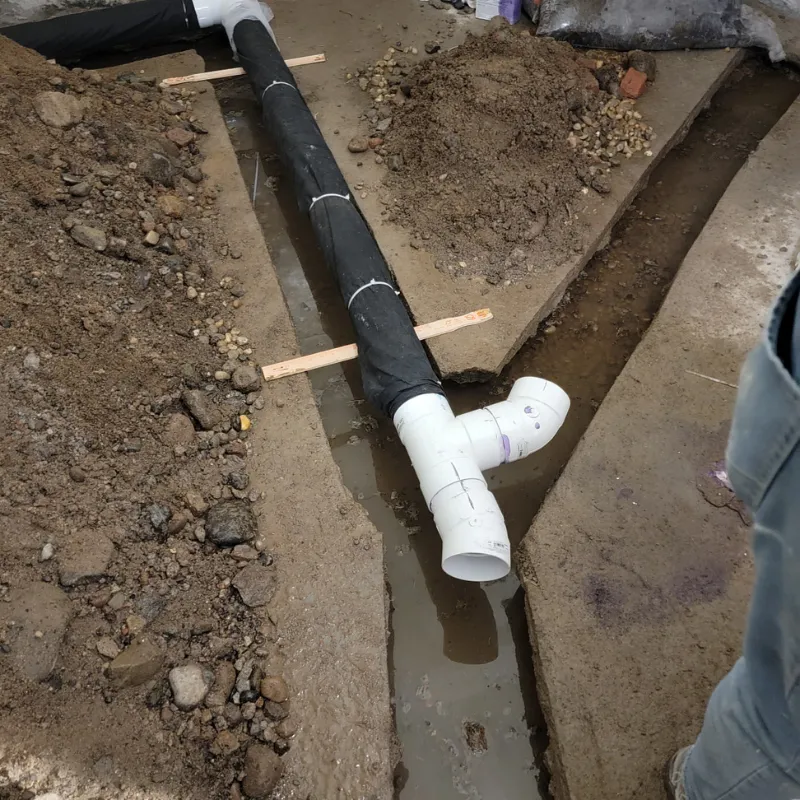
Once you know the mechanism, the repair category follows directly. Surface water problems are solved outside, at the cheapest end of the range, through downspout and gutter correction, regrading, and exterior drainage solutions. Pressure driven problems are solved by giving water a managed path, either through interior basement drainage systems or a weeping tile installation at the footing. Comparative pricing for each route is laid out in the basement waterproofing cost guide, and the full menu of approaches is compared side by side in all basement flooding solutions explained.
Where the water intrusion connects to a structural symptom, such as bowing walls or stair step cracking in block, the repair sequence changes and the structural work leads. That work is handled by our foundation and structural division at Zavza Seal.
Not sure which of the seven mechanisms you are dealing with? A diagnostic inspection identifies the source before anyone quotes a repair.
Why Untreated Water Intrusion Becomes a Mold Problem
Mold needs moisture, a food source, and time. Basements supply the second two permanently, which means moisture is the only variable you control. Colonization begins within 24 to 48 hours on wet organic material, and the EPA guidance on mold, moisture, and your home is direct on this point: controlling moisture is the only durable mold control strategy. The New York State Department of Health guidance on mold reaches the same conclusion for residents statewide.
This is why remediation performed without correcting the water source fails. The visible growth is removed, the wall is rebuilt, and the same water returns on the same schedule. If you already have growth alongside the water, read signs of mold in a basement and is mold in my basement dangerous before scheduling any remediation work, and confirm the contractor is correcting the source as part of the scope.
Why Homeowners Choose Zavza Seal for Basement Water Intrusion
Every company on your quote list can install a perimeter drain. The difference shows up before the quote, in whether anyone confirmed you needed one.
We inspect the full envelope first and name the mechanism before we name a price. If your foil test comes back with moisture on the room side, we will tell you that you have a humidity problem and what it costs to fix, even though that is a smaller ticket than the system we could have sold you. If your meter moves with every fixture off, we will tell you to call a plumber.
Two of the seven sources of basement water intrusion are not waterproofing jobs at all, and we would rather lose that job than sell you a repair that leaves the water exactly where it was.
Basement water intrusion is diagnosed on site, not over the phone. Any quote given before someone has walked your perimeter is a product estimate, not a diagnosis.
What a Zavza Seal Basement Water Intrusion Inspection Includes
- A full perimeter walk with staining height, mineral trail mapping, and moisture meter readings on wall assemblies, not just visible surfaces
- Isolation testing with a hose at the sections your evidence points to, so the entry point is confirmed rather than assumed
- Grade, gutter, downspout, and window well assessment at the exterior, because the cheapest correct repair is usually out there
- Sump pit and discharge line verification, including where the discharge actually terminates
- A written finding that states the mechanism, the recommended scope, and what we ruled out and why
Local Conditions Are Not a Footnote Here
Long Island, Brooklyn, Queens, and the Bronx are not one water table. Sandy South Shore soil drains differently than Brooklyn clay, prewar block foundations fail differently than poured slabs, and rainfall intensity has outpaced drainage systems that were correctly sized when they went in. We work these foundations weekly and read the patterns accordingly, rather than applying a national playbook to a hundred year old house.
Our structural division handles bowing walls, stair step cracking, and movement in block, so when water and structure appear together, the sequencing is decided by one team instead of negotiated between two contractors. Work is warrantied, crews are licensed and insured, and financing is available if the correct repair is larger than this month allows.
Get the mechanism identified first. Then compare quotes knowing what you are comparing.
Basement Water Intrusion: Final Thoughts
The order matters more than the tools. Establish whether you have intrusion or condensation, then locate the entry point, then correlate the timing, then confirm with a hose test and a meter check. Homeowners who work through basement water intrusion in that sequence consistently buy smaller, more targeted repairs than homeowners who start by collecting waterproofing quotes, because they can tell which quotes actually address their mechanism and which ones are simply the largest system the company sells.
If your water is arriving faster than you can diagnose it, or the pattern crosses more than one category, our team inspects the full envelope and identifies the source before recommending scope. Financing is available through our financing program for homeowners across Long Island, Brooklyn, Queens, and the Bronx.
Get the source identified before you spend anything on repairs.
Frequently Asked Questions About Basement Water Intrusion
How do I tell if water is coming through the wall or the floor?
Look at the highest point of staining and the direction of mineral trails. Water entering through walls leaves downward streaks and deposits on the wall face. Water arriving through the slab shows up as damp patches in the middle of the floor or seepage from floor cracks, usually with no wall staining above it.
My basement only gets wet in summer with no rain. Is that a leak?
Almost certainly not. Wetness in hot humid weather without rainfall is condensation, where warm moist air meets cool concrete. The foil test confirms it in 24 hours. The fix is dehumidification and air sealing, not waterproofing.
Can I fix a leaking foundation crack myself?
Hairline cracks in poured concrete can be injected by a competent homeowner, and that will stop water at that specific crack. It will not address why the crack is under water load. If cracks keep appearing or widening, the drainage or the structure needs attention.
Why does my basement flood a day after the rain stops instead of during it?
That delay indicates a rising water table rather than surface runoff. Soil absorbs the storm, saturates, and the water level under your slab rises afterward. Delayed flooding usually calls for drainage and pump capacity rather than exterior grading work.
Is a sump pump enough on its own?
A sump pump only removes water that reaches the pit. Without a drainage path routing water to it, the pump sits idle while the basement floods around it. Pumps and drainage are one system, not alternatives.
How much does it cost to fix water in a basement?
Grading and downspout corrections typically run in the hundreds to low thousands. Interior perimeter drainage with a sump generally runs several thousand and up depending on linear footage. Exterior excavation is the highest tier. The correct answer depends entirely on which mechanism you have, which is why diagnosis precedes pricing.
Does homeowners insurance cover this?
Standard policies usually exclude groundwater seepage and gradual water entry, while covering sudden accidental discharge such as a burst pipe. Coverage varies by policy and carrier, so read your exclusions before assuming either way.
How fast does mold start after water gets in?
Growth can begin within 24 to 48 hours on damp organic materials such as drywall paper, wood framing, and cardboard. Drying quickly is the highest leverage action after any water event.
Should I finish my basement if it has had water?
Should I finish my basement if it has had water?
Not until the source is corrected and the space stays dry through a full wet season. Finishing over an active moisture path traps water behind wall assemblies, where it feeds mold growth out of sight and turns a modest repair into a demolition.
Who do I call first, a waterproofer or a plumber?
Run the meter test first. If the meter moves with everything off, call a plumber, because that is a supply leak and not basement water intrusion. If the meter does not move and the water correlates with weather, the problem is exterior and a waterproofing assessment is the right next call.