
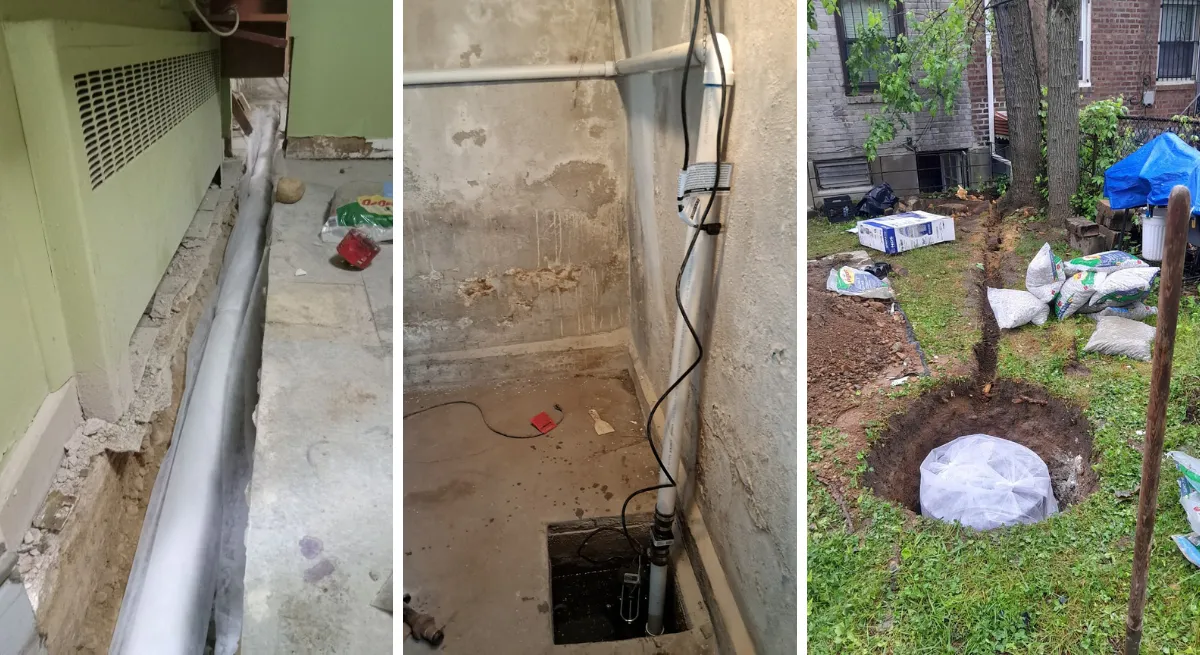
If you’ve got water in your basement and you’re trying to figure out how to actually fix it, this guide is for you. We’re going to walk through every legitimate basement flooding solution, what each one does, what it costs, what it’s actually good for, and what it can’t fix.
The honest truth about basement flooding solutions: there is no single right answer. The right solution depends entirely on what’s causing the flooding. A homeowner who tries the wrong solution for their specific problem ends up spending money twice once on the wrong fix, then again on the right one. This guide helps you avoid that.
We’re going to be direct. Some popular DIY solutions don’t work and will cost you more in the long run. Some expensive solutions are unnecessary for your situation. And some solutions only work if they’re properly combined with others. By the end of this guide, you’ll know which combination is appropriate for your home.
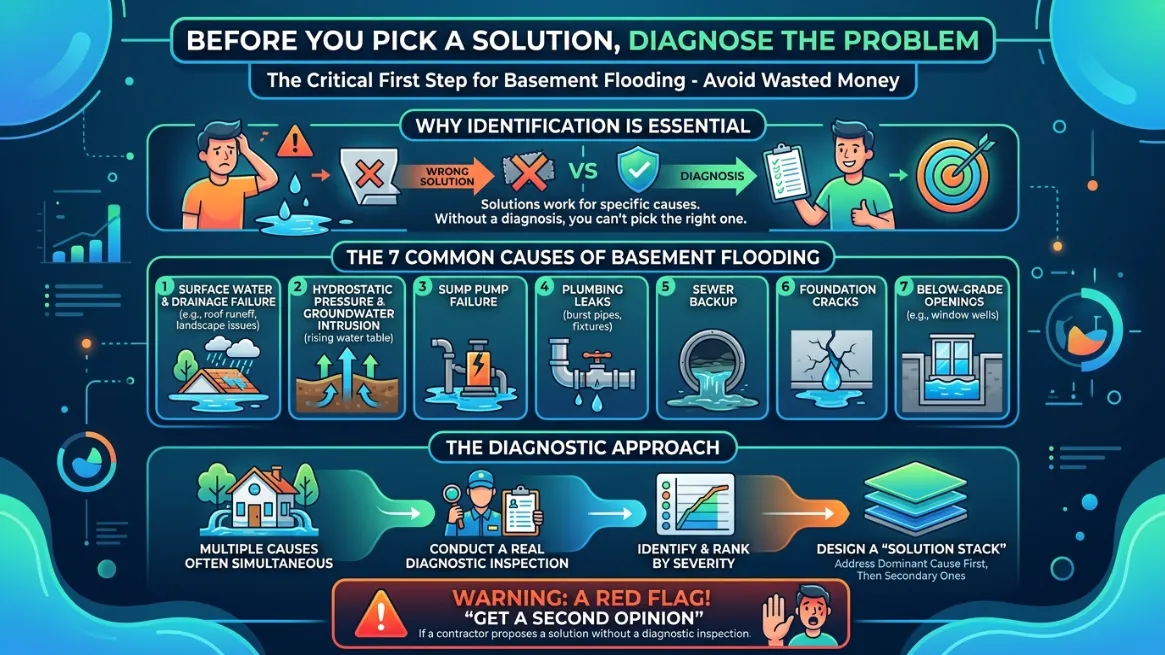
Before You Pick a Solution, Diagnose the Problem
This is the single most important section of this entire guide. Every basement flooding solution we describe below works for some causes and not others. If you don’t know what’s causing your basement flooding, you can’t pick the right solution.
The seven causes of basement flooding are surface water and drainage failure, hydrostatic pressure and groundwater intrusion, sump pump failure, plumbing leaks, sewer backup, foundation cracks, and below-grade openings like window wells. We cover each in detail in our what causes basement flooding guide.
Most basements have more than one cause happening simultaneously. The right solution stack addresses the dominant cause first, then accounts for the secondary ones. A real diagnostic inspection identifies which causes are present and ranks them by severity before any repair work begins. If a contractor proposes a solution without first diagnosing your specific cause, get a second opinion.
With that understanding in place, here’s every real basement flooding solution and what it actually does.
Before You Pick a Solution, Diagnose the Problem
This is the single most important section of this entire guide. Every basement flooding solution we describe below works for some causes and not others. If you don’t know what’s causing your basement flooding, you can’t pick the right solution.
The seven causes of basement flooding are surface water and drainage failure, hydrostatic pressure and groundwater intrusion, sump pump failure, plumbing leaks, sewer backup, foundation cracks, and below-grade openings like window wells. We cover each in detail in our what causes basement flooding guide.
Most basements have more than one cause happening simultaneously. The right solution stack addresses the dominant cause first, then accounts for the secondary ones.
A real diagnostic inspection identifies which causes are present and ranks them by severity before any repair work begins. If a contractor proposes a solution for basement flooding without first diagnosing your specific cause, get a second opinion.
With that understanding in place, here’s every real basement flooding solution and what it actually does.
Solution: Gutter Repair and Replacement
Clogged, undersized, or damaged gutters dump rainwater directly against the foundation. A single 1,000 square foot section of roof in a one-inch rainstorm sheds more than 600 gallons of water, and if the gutter system can’t manage that load, the water lands within inches of the house.
What It Costs: $100 to $500 for thorough cleaning and minor repair. $1,500 to $4,000 for full gutter replacement on a typical home. Add gutter guards for $500 to $2,500 if you have heavy tree cover.
What It Fixes: Surface water flooding caused by overflow at the gutter line. It does not resolve hydrostatic pressure, plumbing leaks, or structural foundation problems.
Realistic Timeline: Same day to one week. Among the fastest and most cost-effective fixes available.
Solution: Downspout Extensions
Downspouts that discharge within a few feet of the foundation concentrate water exactly where you don’t want it. Extending downspouts to discharge 6 to 10 feet from the home, onto properly graded soil, moves that water away before it can infiltrate around the foundation.
What It Costs: $50 to $300 per downspout for basic extensions. $1,000 to $3,000 for buried discharge pipe routed to a dry well or daylight outlet.
What It Fixes: Water concentration at downspout discharge points. Often resolves recurring basement flooding when paired with functional gutters.
Realistic Timeline: Same day for surface extensions. One to three days for buried discharge systems.
Solution: Regrading Around the Foundation
Soil should slope away from the foundation at a minimum of 6 inches of drop over the first 10 feet. Many older homes have experienced decades of soil settlement toward the structure, creating channels that funnel rainwater directly toward basement walls.
What It Costs: $500 to $3,000 depending on access conditions and the amount of grading required. Landscaping removal and replacement may increase cost.
What It Fixes: Surface water pooling against the foundation before entering the basement. One of the highest ROI solutions available for exterior drainage problems.
Realistic Timeline: One to three days for most residential regrading projects.
Solution: Repairing Hardscape Failures
Driveways, patios, sidewalks, and walkways that have settled toward the home create direct water pathways to the foundation. Failed expansion joints and cracked concrete can also allow water intrusion beneath slabs adjacent to the house.
What It Costs: $500 to $5,000 depending on project scope. Concrete leveling and joint sealing fall on the lower end. Full hardscape replacement is significantly higher.
What It Fixes: Concentrated surface water flow caused by improperly sloped or deteriorated hardscape areas.
Realistic Timeline: One day to one week depending on scope and materials.
Solution: Window Well Drainage and Covers
Window wells that fill during heavy rain can overflow directly through basement windows. Properly installed drains tied into the perimeter drainage system, along with secure covers, prevent water accumulation inside the well itself.
What It Costs: $200 to $800 per window well for drainage improvements and protective covers.
What It Fixes: Basement flooding caused specifically by window well overflow. It will not address broader groundwater or hydrostatic pressure issues.
Realistic Timeline: Same day to two days for most installations.
Exterior Drainage Solutions: When Surface Fixes Aren't Enough
If surface water solutions don’t fully resolve the problem, the next layer is exterior subsurface drainage. These solutions intercept water before it ever reaches the foundation.
Solution: Exterior French Drain
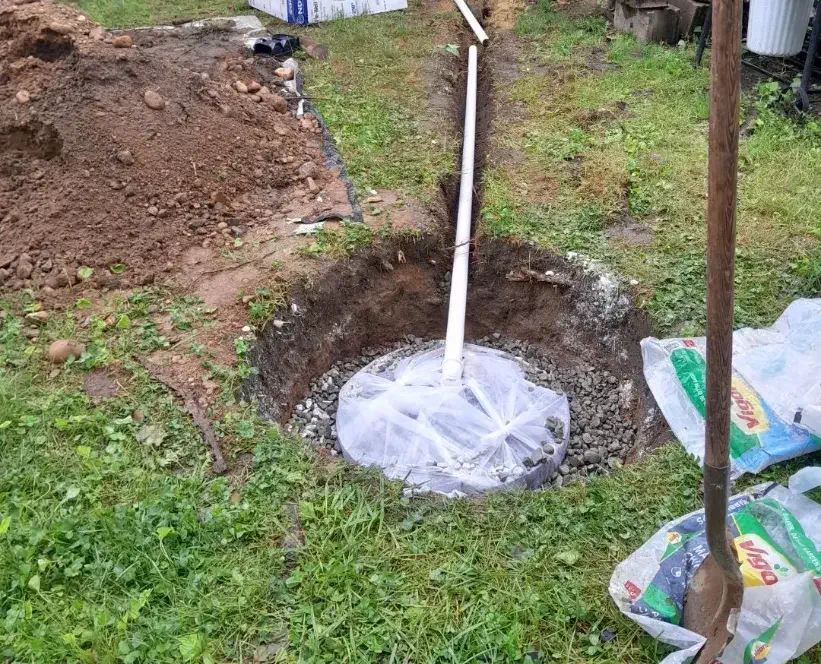
A French drain is a trench filled with gravel that contains a perforated pipe. Water that enters the soil flows into the trench, gets collected by the pipe, and discharges to a daylight outlet or a sump system. An exterior French drain installed at the foundation footing intercepts groundwater before it can reach the foundation wall.
What It Costs:
$50-$150 per linear foot installed. A typical perimeter installation runs $5,000-$20,000 depending on length, depth, and access conditions.
What It Fixes:
Subsurface water that’s saturating the soil around the foundation. Highly effective for chronic hydrostatic pressure issues. Less helpful for sudden surface water events.
Realistic Timeline:
One to three weeks depending on scope and weather.
A “French drain” installed inside the basement is technically an interior drain tile system, not a French drain. They’re related but distinct solutions.
Solution: Curtain Drain
A curtain drain is a shallower French drain installed uphill of the foundation to intercept surface water and subsurface flow before it reaches the house. It’s used when a sloped lot directs water toward the foundation.
What It Costs:
$30-$100 per linear foot. Total cost depends on length needed.
What It Fixes:
Surface and shallow subsurface water from upslope. Particularly valuable on lots with significant grade differences.
Realistic Timeline:
Three days to two weeks.
Solution: Exterior Waterproofing Membrane
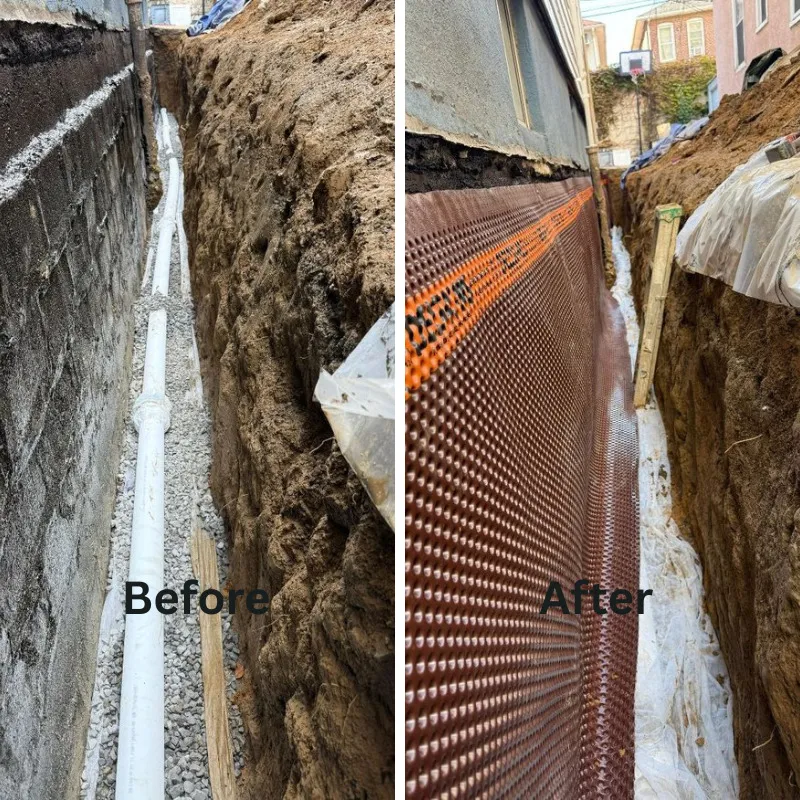
The most thorough exterior solution. The foundation is excavated, the existing exterior surface is cleaned and prepped, and a waterproofing membrane is applied to the exterior of the foundation wall. Drainage board is typically installed over the membrane, and a French drain runs at the footing.
What It Costs:
$15,000-$30,000+ for a typical residential installation. The cost is driven primarily by excavation depth and access.
What It Fixes:
Hydrostatic pressure and foundation wall water entry, treated at the source. This is the most permanent waterproofing solution available, but the cost reflects the labor involved.
Realistic Timeline:
One to three weeks depending on scope and weather.
Severe chronic flooding, significant existing foundation damage, or situations where interior solutions can’t fully address the problem. For many homes, interior solutions are more cost-effective.
Interior Waterproofing Solutions: Working from Inside
Interior solutions don’t stop water from reaching the foundation. They manage water that has reached the foundation by collecting it and pumping it out before it causes damage. Interior solutions are typically less expensive than exterior solutions and don’t require landscape disturbance.
Solution: Interior Drain Tile System
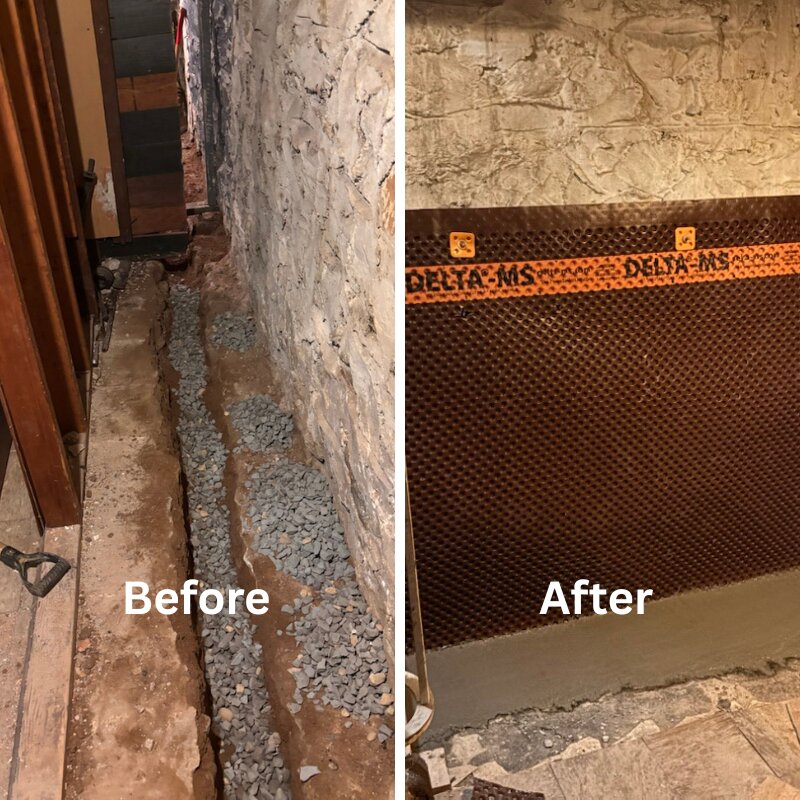
The interior version of a French drain. A channel is cut at the perimeter of the basement floor, perforated drainage pipe is installed in the channel, and the channel is filled with gravel and capped with concrete. The drain tile collects water that has entered through the cove joint, wall cracks, or hydrostatic upthrust, and routes it to a sump pump.
What It Costs:
$5,000-$15,000 for a typical perimeter installation. Cost depends on basement size and floor condition.
What It Fixes:
Water entering through the cove joint, foundation wall cracks, or hydrostatic upthrust through the floor. Highly effective for hydrostatic pressure situations.
Realistic Timeline:
Three days to two weeks.
Surface water above the foundation wall. It also won’t help with window well overflow or plumbing problems.
Solution: Sump Pump Installation
A sump pump installed in a basin in the basement floor collects water from the drainage system or groundwater seepage directly and pumps it out and away from the foundation. Sump pumps are essential to interior drainage systems and extremely valuable in many homes.
What It Costs:
$500-$2,500 for pump installation.
What It Fixes:
Water that’s already entered the basement by removing it before it accumulates. It doesn’t prevent water entry — it manages it.
Realistic Timeline:
One day for a straightforward installation.
Solution: Sump Pump Battery Backup
Power outages during storms are when sump pumps are needed most and most likely to fail. A battery backup sump pump or water-powered backup ensures the system keeps operating even when grid power is lost.
What It Costs:
$300-$1,500 depending on backup capacity and type.
What It Fixes:
Power-related sump pump failures during storms. One of the highest ROI investments for homes with sump pumps.
Realistic Timeline:
Same-day installation.
Solution: Vapor Barrier Wall Systems
Some interior waterproofing systems include a vapor barrier installed on basement walls that channels seeping water down to the interior drain tile system. This helps manage minor wall seepage without requiring exterior excavation.
What It Costs:
$20-$60 per linear foot. Typically $2,000-$8,000 for a full installation.
What It Fixes:
Minor wall seepage and condensation. It does not handle major water volumes or structural foundation cracks.
Realistic Timeline:
One to three days.
Solution: Crack Injection
Specific foundation wall cracks can be sealed using polyurethane or epoxy injection. The material is injected into the crack under pressure and expands to fill it completely. This is effective for stable cracks that are not actively widening.
What It Costs:
$300-$1,000 per crack depending on size and accessibility.
What It Fixes:
Water entering through specific foundation cracks. It does not address the underlying cause of the crack or widespread hydrostatic pressure.
Realistic Timeline:
Same-day to one day per crack.
Crack injection on an active or structurally significant crack is treating a symptom, not the cause. Ongoing foundation movement requires structural repair.
Foundation Repair Solutions: When Waterproofing Isn't Enough
Some basement flooding situations involve actual structural problems with the foundation, not just water management failures. In these cases, waterproofing without foundation repair is treating the symptom while ignoring the cause.
Solution: Carbon Fiber Wall Reinforcement
Carbon fiber straps applied to foundation walls reinforce them against lateral pressure. These systems are commonly used when foundation walls show early signs of bowing or cracking from hydrostatic pressure but haven’t experienced major structural movement yet.
What It Costs:
$400-$700 per strap. A typical wall reinforcement project runs $2,000-$8,000.
What It Fixes:
Early-stage wall bowing and lateral pressure damage. Stabilizes walls without requiring major structural reconstruction.
Realistic Timeline:
One to three days.
Solution: Wall Anchors and Helical Tiebacks
For walls that have already bowed or shifted significantly, wall anchors or helical tiebacks connect the wall to stable soil anchors installed in the yard. Over time, these systems can be tightened to gradually pull the wall back toward plumb.
What It Costs:
$800-$2,000 per anchor. Typical installations range from $8,000-$20,000.
What It Fixes:
Moderate to severe wall bowing caused by lateral soil pressure. Helps stabilize and partially correct wall movement.
Realistic Timeline:
One to two weeks.
Solution: Underpinning with Helical or Push Piers
When a foundation has settled or continues moving downward, piers driven deep into stable load-bearing soil can stabilize and potentially lift the structure. Helical piers are screwed into the ground, while push piers are hydraulically driven downward beneath the footing.
What It Costs:
$1,500-$3,500 per pier. Most projects require multiple piers, bringing total project costs to $10,000-$50,000+.
What It Fixes:
Foundation settlement and ongoing structural movement. While it doesn’t directly waterproof the structure, it stabilizes the movement that often contributes to water intrusion.
Realistic Timeline:
One to two weeks.
Solution: Cove Joint Repair
The cove joint where the basement wall meets the floor is one of the most common water entry points in a basement, especially under hydrostatic pressure. Specialized cove joint repair systems combine drainage and waterproofing materials to control seepage at this vulnerable connection point.
What It Costs:
$30-$80 per linear foot.
What It Fixes:
Water entering where the wall meets the basement floor. Commonly used in hydrostatic pressure situations.
Realistic Timeline:
One to three days.
Sewer backups are a different problem requiring different solutions.
Solution: Backwater Valve Installation
A backwater valve installed on your sewer lateral allows wastewater to flow out but prevents municipal sewer backup from flowing into your home. This is one of the highest-value preventive investments for any home in an area with sewer backup risk.
What it costs: $1,500-$4,000 for installation including any necessary excavation.
What it fixes: Municipal sewer backup specifically. Doesn’t address other water sources.
Realistic timeline: One to three days.
Solution: Sewer Lateral Repair or Replacement
If your sewer lateral itself has failed (root intrusion, pipe collapse, joint failure), repair or replacement is needed.
What it costs: $3,000-$25,000+ depending on scope and access.
What it fixes: Lateral failures that cause sewage to back up into the home.
Realistic timeline: Days to weeks.
Plumbing and Mechanical Solutions
If your basement flooding is from internal plumbing rather than foundation water, the solution is plumbing repair, not waterproofing. Common solutions include:
Water heater replacement, typically $1,500-$3,500 for a standard tank water heater. If yours is over 10 years old and you’ve had a flood, replacement is usually wiser than repair.
Plumbing line repair or replacement, varying widely by scope. A burst supply line might be a $500 repair; a failed drain line in a wall could be $3,000-$10,000.
Washing machine supply line replacement with braided steel lines, typically under $100 in materials. This is one of the most preventable basement floods and should be standard maintenance.
HVAC condensate line repair, typically $200-$800.
What Doesn't Work: Solutions to Avoid
The honest contractor view: some popular DIY and budget solutions don’t work and will cost you more in the long run than just doing it right the first time.
- Don’t Trust: Waterproof Paint and Sealant: Waterproof paint applied to interior basement walls is the single most common DIY mistake we see. It rarely works for any source of water beyond very minor surface condensation. It cannot resist hydrostatic pressure, it traps moisture inside the wall (often making mold worse), and it almost always has to be removed before real waterproofing can be installed. Save your money.
- Don’t Trust: Hydraulic Cement on Active Cracks: Hydraulic cement can temporarily plug an active leak but doesn’t address the cause and usually fails over time as the underlying water pressure continues. It has a role in emergency situations as a stopgap, but it’s not a real solution.
- Don’t Trust: DIY Interior Drainage Systems: Cutting your own channel and installing your own drain tile and sump pump is a real engineering project. Done wrong, it creates new problems: backfilling that compromises footings, drainage that redirects water to a worse location, sumps that flood the very area they were supposed to protect, and pumps that fail during the first major storm. The cost savings of DIY interior drainage are usually wiped out by the cost of fixing it within a few years.
- Don’t Trust: “Lifetime” Guarantees Without Specifics: Real waterproofing warranties are specific: what is covered, for how long, under what conditions, and transferable to subsequent owners or not. Vague “lifetime” guarantees from companies that may not be around in five years are not the same as a real warranty. Read the fine print before you sign anything.
- Don’t Trust: Single-Solution Pitches: A contractor who proposes a single solution without diagnosing your specific causes is either inexperienced or selling you the solution they specialize in regardless of fit. Real diagnostic inspections produce repair plans that may include multiple solutions stacked together because most basements have multiple causes contributing to flooding.
What This All Costs in Total
The honest range for a comprehensive basement flooding solution:
Minor situations addressed primarily with surface water management run $1,000-$5,000.
Moderate situations involving interior drainage, sump pump installation, and minor structural work run $8,000-$20,000.
Major situations involving exterior waterproofing, significant foundation repair, or extensive structural work run $20,000-$60,000+.
The range is wide because the diagnosis matters enormously. The right scope for your specific home could be anywhere in that range depending on what’s actually causing the flooding.
Basement Flooding Solutions: Final Thoughts
Basement flooding problems rarely stay small for long. What starts as occasional seepage or minor dampness can gradually turn into mold growth, structural movement, damaged finishes, unhealthy indoor air, and expensive repairs throughout the home. The good news is that nearly every basement water problem can be corrected when the actual cause is identified properly first.
Some homes need only simple drainage improvements, while others require a more comprehensive waterproofing or structural repair strategy. The key is choosing the right combination of solutions instead of relying on temporary patches that fail under real pressure.
If you’re dealing with basement water intrusion, foundation cracks, musty odors, bowing walls, or recurring flooding, the worst thing you can do is wait for the next storm to make the decision for you. A professional inspection can identify where the water is entering, how severe the pressure and damage actually are, and which solutions will protect your home long-term.
Schedule Your Free Basement Waterproofing & Foundation Inspection Today
Frequently Asked Questions About Basement Flooding Solutions:
What is the best basement flooding solution?
There isn’t a single best solution. The right solution depends entirely on what’s causing the flooding. Surface water problems need drainage solutions. Hydrostatic pressure needs interior or exterior waterproofing. Plumbing failures need plumbing repair. A proper diagnostic inspection identifies the cause and produces the right solution combination.
How much does it cost to permanently fix a flooding basement?
Typical comprehensive solutions run $5,000 to $25,000 for most homes, with severe situations going higher. The wide range reflects how different causes require different scopes. A thorough inspection produces a specific cost estimate for your situation.
Does waterproofing a basement increase home value?
Yes, measurably. Waterproofing is a documented improvement that buyers’ inspectors look for. A properly waterproofed basement with documentation typically improves both sale price and likelihood of closing. Unaddressed basement water problems often reduce sale prices by 5-15% or cause deals to fall through entirely.
How long does basement waterproofing last?
Quality interior drainage systems typically last 20-30 years or more. Exterior waterproofing membranes last 20-50 years depending on materials. Foundation repair work is essentially permanent. Sump pumps need replacement every 7-10 years even when the surrounding system is fine.
Will my homeowners insurance cover basement waterproofing?
Generally no. Insurance covers sudden and accidental damage, not preventive improvements. However, insurance may cover damage repair that triggered the need for waterproofing, and some insurers offer premium discounts for homes with documented waterproofing and backwater valves installed.
Can I waterproof a basement myself?
You can address surface water issues yourself. You should not attempt interior drainage systems, exterior waterproofing, sump pump installation beyond simple replacement, or foundation repair. Those require professional execution to perform correctly and to be insurable and warrantable.
Is interior or exterior waterproofing better?
Both have appropriate uses. Interior solutions are typically more cost-effective and don’t disturb landscaping. Exterior solutions address water at the source and are appropriate for severe situations or where interior solutions can’t fully solve the problem. Many comprehensive solutions combine both approaches.
How do I know if my basement needs waterproofing or foundation repair?
The general distinction: if water is coming in but the foundation is structurally sound, waterproofing solves it. If the foundation is showing structural problems (significant cracks, bowing walls, settlement), foundation repair must be part of the solution. A proper diagnostic inspection identifies which category applies. Often, both are needed.
What's the fastest basement flooding solution?
For acute flooding: water removal and emergency drying, which can be done in 24-72 hours by restoration contractors. For long-term solutions, surface water management (gutters, downspouts, grading) can often be completed in days. Comprehensive solutions involving interior or exterior systems take 1-3 weeks.
Do I need a permit for basement waterproofing?
Sometimes. Permit requirements vary by jurisdiction and scope of work. Major waterproofing projects, sump pump installations connecting to municipal drainage, and any foundation work typically require permits. Reputable contractors handle permitting as part of their scope.