
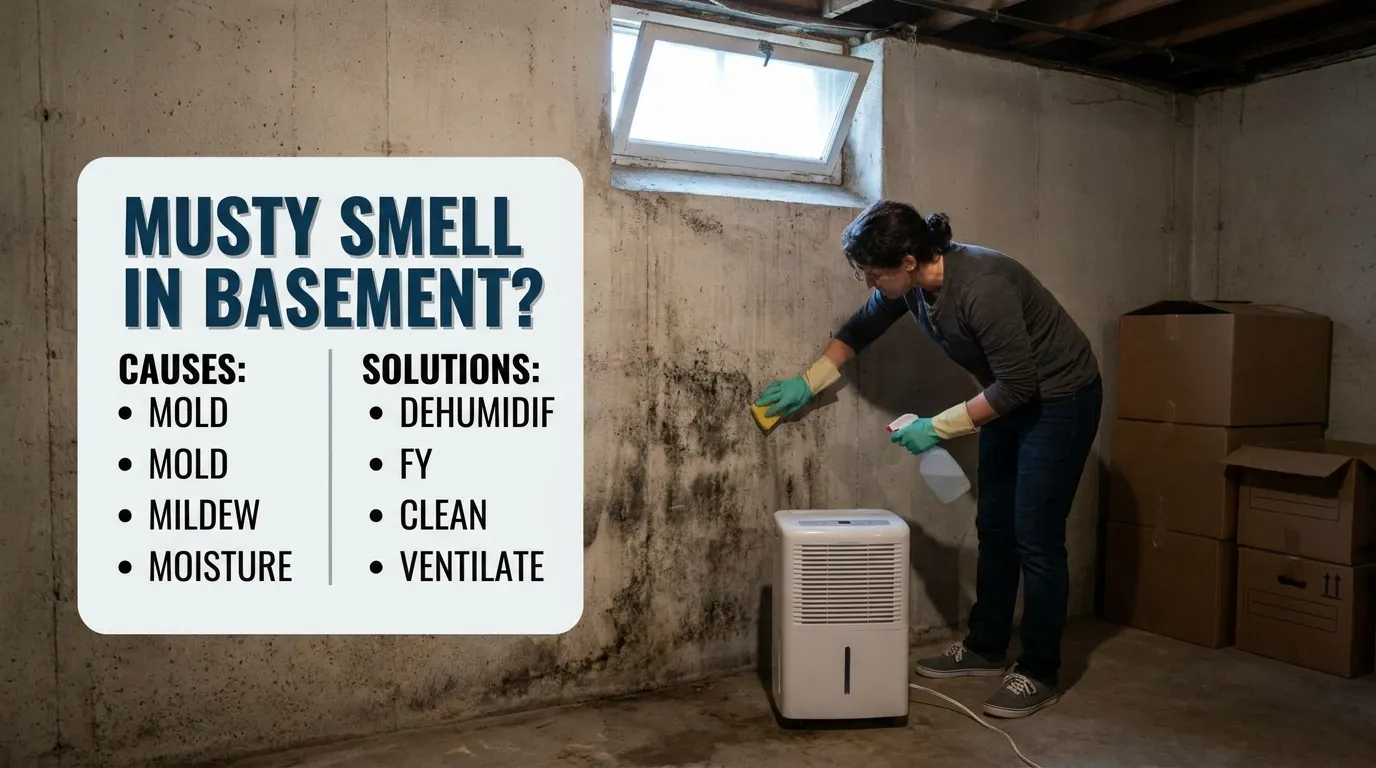
That damp, earthy, slightly sour odor that hits you at the bottom of the stairs has a clear meaning. A musty smell in basement air is not just an old-house quirk you have to live with. It is the smell of microbial growth, usually mold and mildew, feeding on moisture and organic material somewhere below your living space. In almost every case, a musty smell in basement spaces traces back to one thing: excess moisture. Where there is enough dampness to produce that odor, mold is already growing, even if you cannot see it.
The smell travels too, rising into the rest of the house through the stack effect. The reassuring news is that a musty smell in basement areas is solvable once you find and fix the moisture behind it. This guide breaks down the real causes, the health angle, and the order of operations that actually clears the air for good.
What Causes a Musty Smell in Basement Air
The odor itself comes from microbial volatile organic compounds, the gases mold and mildew release as they grow. You smell the byproduct before you ever spot the colony. Behind that, the driver is moisture, and in a basement it arrives through several familiar routes.
- High humidity: Basements run cool, so warm household air condenses on cold walls and floors, raising relative humidity into mold territory.
- Water seepage: Cracks, cove joints, and porous masonry let groundwater wick in after rain or snowmelt.
- Poor drainage and grading: Water pooling against the foundation pushes moisture through the walls.
- Damp organic material: Cardboard boxes, old carpet, wood, and stored fabric hold moisture and feed mold.
- Little air movement: Closed, unventilated basements let humid, stale air sit and grow musty.
The EPA points out that water can enter a home by seeping through basement floors and that condensation forms whenever humid air meets cold surfaces, which is why basements are so prone to this. You can read the federal guidance in the EPA publication A Brief Guide to Mold, Moisture and Your Home.
Is a Musty Basement Actually a Health Concern?
It can be. The CDC notes that being in damp, moldy environments may cause stuffy nose, coughing, wheezing, and eye or skin irritation, and that people with asthma, allergies, or weakened immune systems can react more strongly. The agency is also clear on the priority order: mold in a home signals a moisture problem, and that moisture is the first thing to address. You can review the public health overview from the Centers for Disease Control and Prevention. So while a faint musty note is not an emergency, it is a signal worth acting on, especially in a home with kids, older adults, or anyone with respiratory issues.
The Best Option for Removing a Musty Smell in Basement Spaces
The best option for a musty smell in basement areas is to work in the right order, because masking the odor without fixing the moisture only buys a few days. Start by finding and stopping the water, whether that is seepage through the walls, poor drainage outside, or condensation from high humidity. Next, remove and discard porous materials that are already holding mold, like soaked cardboard and old carpet. Then dry the space and hold humidity down with a dehumidifier or improved ventilation, aiming to keep relative humidity below roughly 50 percent. Only after the moisture is controlled does cleaning and odor removal actually last.
Air fresheners, candles, and ozone gadgets are the popular shortcut, and they are also why the smell keeps coming back. They cover the byproduct while the colony keeps producing it. If the odor returns within days of cleaning, that is your sign the moisture source is still active. Our guide to getting rid of mold smell covers the cleaning side, while long-term control comes from managing moisture at its source.
When to Bring in a Professional
A light, occasional musty note after a rainy week may clear once you dehumidify and ventilate. But there are clear signals that the problem is bigger than a weekend project. If the smell is persistent, if you see visible mold or staining, if walls show water lines or white mineral deposits, or if the odor has spread upstairs, the moisture intrusion is established and needs a real diagnosis. Knowing the broader signs of mold in a basement helps you judge whether you are looking at a surface issue or a structural moisture path that will keep regenerating the odor until it is sealed.
A professional inspection finds the water source, measures humidity and moisture in the materials, and identifies hidden growth behind walls or under flooring that a homeowner simply cannot reach. That is the difference between clearing the smell for a week and clearing it for good.
Musty smell keeps coming back no matter what you try?
Musty Smell in Basement: Final Thoughts
A musty smell in basement air is one of the most honest warning signs your home gives you, because the odor appears long before most people ever see a spot of mold. It tells you moisture is present and that something is already growing on it. Chasing the smell with candles and sprays will never win, because those products hide the byproduct while the source keeps producing more. The path that works is the unglamorous one: find the water, stop it, remove what is already contaminated, dry the space, and hold humidity down. In NY metro homes, where cool basements, clay soils, and wet seasons stack the odds toward dampness, that approach is what keeps the air clean instead of cycling back every spring. If you have done the basics and the musty smell in basement spaces still returns, the moisture source is still open, and that is the moment to have it professionally inspected and sealed.
Frequently Asked Questions About Musty Smells in the Basement:
Does a musty smell always mean mold?
A musty smell usually means there is mold, mildew, or moisture-fed microbial growth somewhere in the home. The odor often comes from damp materials, hidden leaks, wet insulation, basement moisture, crawl space humidity, or mold growing behind walls, floors, cabinets, or HVAC components.
Can mold smell musty even if I cannot see it?
Yes. Mold can create a musty odor before it becomes visible. Hidden mold may be growing behind drywall, under flooring, inside wall cavities, around window framing, in crawl spaces, in basements, or near old leaks.
Will a dehumidifier get rid of a musty smell?
Efflorescence means water is passing through concrete, brick, block, or stone and carrying salts to the surface. You may not see active dripping or standing water, but it is still a sign that moisture is entering or moving through the basement wall.
Why does the musty smell come back after I clean?
A musty smell comes back when the moisture problem has not been fixed. Cleaning the surface may remove visible growth, but mold can return if there is a leak, high humidity, condensation, seepage, damp wood, wet drywall, or moisture trapped behind finished materials.
Can a musty basement make the upstairs smell too?
Yes. A musty basement can make the upstairs smell because air naturally moves upward through the home. This air movement can carry musty odors, damp air, and mold spores from the basement into bedrooms, living rooms, hallways, and HVAC ducts.
Is a musty smell dangerous?
A musty smell is a warning sign that moisture and possible mold growth are present. It should not be ignored, especially if people in the home have allergies, asthma, coughing, headaches, sinus irritation, or symptoms that improve when they leave the house.
What causes a musty smell in a house?
Common causes of a musty smell include mold growth, mildew, water leaks, basement seepage, crawl space moisture, roof leaks, plumbing leaks, condensation, damp carpeting, wet drywall, poor ventilation, and high indoor humidity.
How do I find where a musty smell is coming from?
Start by checking basements, crawl spaces, bathrooms, kitchens, laundry rooms, window areas, under sinks, around HVAC equipment, behind furniture, near old leaks, and anywhere with stains, peeling paint, dampness, or condensation. If the smell is strong but hidden, a professional mold inspection may be needed.
Can HVAC systems spread a musty smell?
Yes. HVAC systems can spread musty odors if mold, dust, moisture, or microbial growth is present in the air handler, ducts, drain pan, coils, filter area, or nearby building materials. If the smell gets worse when the system turns on, the HVAC system should be inspected.
When should I call a mold professional for a musty smell?
Call a mold professional if the musty smell is persistent, keeps returning after cleaning, gets stronger after rain, comes from a basement or crawl space, appears near water damage, spreads through the HVAC system, or exists even when no visible mold can be found. A professional inspection can identify the moisture source and determine whether remediation is needed.