
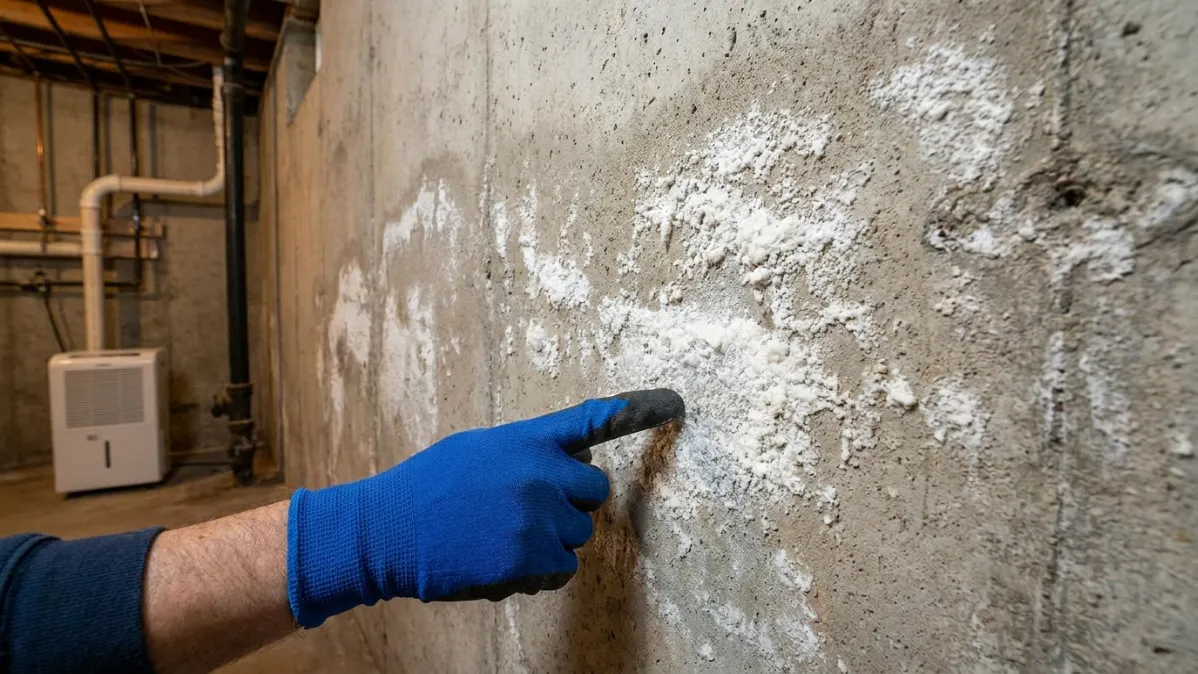
Efflorescence on basement walls is that chalky white, sometimes crystalline, powder you find spread across concrete block, poured walls, or brick down in the basement. It looks alarming, and homeowners often mistake it for mold, but efflorescence on basement walls is actually mineral salt left behind after water moves through the masonry and evaporates at the surface. In plain terms, the powder itself is harmless, yet it is a reliable fingerprint that water is traveling through your walls. That is the part worth paying attention to. Wherever you see efflorescence on basement walls, moisture has a path in, and persistent moisture is what feeds mold, rots framing, and eventually undermines concrete. This guide explains what the white powder is, how to tell it apart from mold, why it keeps coming back, and what the long-term solution for efflorescence looks like for damp basements in our freeze-thaw climate.
Call on Mold Removal Experts for Waterproofing and Mold Remediation Solutions in Long Island, Brooklyn, Queens, or the Bronx! Schedule Your Free Inspection Today!
What Causes Efflorescence on Basement Walls
Three things have to happen at once for efflorescence to form: there must be soluble salts in the masonry, water to dissolve and carry them, and a surface where that water can evaporate. Concrete, mortar, and brick all contain natural salts. When groundwater pushes through the wall by capillary action, also called wicking, it picks up those salts and carries them to the inside face. The water evaporates into your basement air and the salts stay behind as a white deposit.
Certified inspectors describe efflorescence as French for “to flower out,” and note that the moisture driving it usually comes from groundwater, though rainwater is also a common source. You can read how inspectors evaluate it on the International Association of Certified Home Inspectors resource page. The key takeaway: the powder is a symptom, and the cause is water moving where it should not.
Efflorescence vs. Mold: How to Tell the Difference
- Pinch test: Efflorescence crumbles into a fine powder between your fingers. Mold smears and does not turn to dust.
- Surface: Efflorescence forms on inorganic masonry like concrete and brick. Mold grows on organic material such as wood, drywall, and dust.
- Color: Efflorescence is almost always white or grayish. Mold ranges through green, black, and brown.
- Water test: A spray of water dissolves efflorescence. Mold stays put.
This distinction matters because the response is different, but the underlying message is the same. Both point to a moisture problem, and where there is enough water for efflorescence, conditions are often right for mold to grow on concrete nearby on any organic surface it can reach.
How to Tell If Efflorescence Is Bad Enough to Worry About:
On its own, efflorescence does not eat away at concrete. The chalky white residue is mineral salt left behind after water evaporates, not a structural defect. The catch is that the salt only gets there because moisture carried it to the surface, so the real question is never the powder itself. It is whether water is still moving through the wall. These three checks tell you which situation you are dealing with before you spend a dollar on a fix.
The Dry Brush Test
Run a dry, stiff brush across the deposit. True efflorescence is loose and powdery, so it sweeps away with little effort, while mineral staining or a coating that resists the brush is something else entirely. Clean a test patch, then watch it. If the white film returns within a few days, water is still wicking through the wall and depositing fresh salt. A patch that stays clean points to a one-time event that has already dried out.
The Plastic Sheet Test
Tape a square of clear plastic tightly to the wall on all four edges and leave it for 24 to 48 hours. When you peel it back, look at which side holds the moisture. Condensation on the wall side means water is migrating through the concrete from outside, which is an intrusion problem. Moisture on the room side instead points to high indoor humidity condensing on a cool surface, which is an air problem solved differently. This simple version of the ASTM plastic-sheet method separates the two causes that get confused most often.
The Moisture Meter Reading
A concrete moisture meter takes the guesswork out of it. Check several spots, including a dry reference area away from the deposit, and compare. Readings that sit well above your dry baseline, or that stay elevated day after day, indicate water inside the wall rather than a surface that has dried. Consistent high readings around efflorescence are a strong sign the moisture source is still active.
Do not confuse it with mold: Efflorescence is a mineral salt and brushes off as dry crystals. Mold is a living organism, often fuzzy or slimy, and it does not dissolve the same way. If you are unsure what you are looking at, our guide on whether mold can grow on concrete walks through the difference, because the moisture that causes one frequently feeds the other.
Not Sure if What You're Seeing is Efflorescence?
When Efflorescence Is a Red Flag
A faint dusting on an otherwise dry wall is usually harmless. Efflorescence becomes a warning sign when it shows up alongside any of these conditions, because together they tell you water is still finding its way in.
- Walls that feel damp or look wet to the touch
- Paint or wall coverings that bubble, blister, or peel
- Rust stains or corrosion on nearby metal
- A musty smell or visible mold growth
- Deposits that come back every spring or after heavy rain and snowmelt
When efflorescence travels with that company, it is no longer cosmetic. The salt is just the visible marker of a moisture path that needs to be traced and closed. The seasonal pattern is especially telling, since it usually means rising groundwater and hydrostatic pressure are driving water through the wall when the soil saturates.
How to Remove and Fix Efflorescence
The right fix depends entirely on what your tests revealed. Cleaning a surface deposit and stopping an active leak are two very different jobs.
If the Efflorescence Is Surface Only
When the wall is genuinely dry and the deposit does not return, removal is straightforward:
- Sweep the area with a dry nylon brush to lift the loose salt.
- For stubborn spots, work in a mild solution of equal parts white vinegar and water, then rinse.
- Dry the surface fully with fans or a dehumidifier so no new moisture lingers.
- Watch the spot over the next few weeks to confirm it does not come back.
If There Is Ongoing Moisture
If the deposit keeps returning, cleaning alone is a treadmill. You have to correct the water source, and that work falls into a few proven categories:
- Correcting exterior grading and drainage so water runs away from the foundation
- Installing or repairing a sump pump, covered in our sump pump installation guide
- Interior or exterior basement waterproofing
- Crack injection when water enters through a foundation crack leaking water
Adding an interior French drain or weeping tile system to relieve the pressure
The Best Option for Treating Efflorescence on Basement Walls
The best option for efflorescence on basement walls is to treat the moisture source, not just the powder. You can brush or scrub the deposit off, and a mild masonry cleaner will lift it from the surface, but if you stop there it returns with the next wet season because the water path is still open. Lasting control means interrupting the moisture, which usually involves correcting exterior grading and drainage, managing groundwater with an interior drainage system and sump pump, and sealing or encapsulating the walls so capillary moisture can no longer carry salts to the surface.
Think of cleaning as treating the symptom and waterproofing as treating the disease. Because the root cause is water in the soil and through the wall, the durable fix lives in the same family of solutions used for any wet basement. Our overview of what causes moisture problems in basements walks through how these sources stack up and which ones tend to dominate in our region.
Why Ignoring It Costs More Later
On its own, the white deposit is cosmetic. The water behind it is not. The same capillary and groundwater pressure that produces efflorescence can, over time, build osmotic and hydrostatic forces strong enough to flake and crack the concrete, a failure inspectors call spalling. Once the wall surface starts breaking apart, you move from a cleaning task to a repair task. Meanwhile, the persistent dampness raises basement humidity, which is exactly the environment mold needs.
The EPA is direct about this: controlling moisture is the single most effective way to prevent mold and protect a building, and the agency recommends keeping indoor humidity low and fixing seepage at the source. You can review that guidance from the U.S. Environmental Protection Agency. Treating efflorescence as an early warning, rather than a stain to wipe away, is what keeps a small moisture issue from becoming a structural one.
White powder keeps coming back on your basement walls?
Efflorescence on Basement Walls: Final Thoughts
Efflorescence on basement walls is easy to dismiss because the powder wipes away and feels harmless, but that is exactly why it is so useful. It is a free, visible warning that groundwater is wicking through your masonry and evaporating inside your home. The deposit is cosmetic; the water behind it is the real story, and that water is what drives mold, rot, humidity, and eventually spalling concrete. Cleaning the surface treats the symptom for a season.
Correcting the grading, drainage, and waterproofing treats the cause and keeps efflorescence on basement walls from returning year after year. In the NY metro area, where clay soils hold water against foundations and freeze-thaw cycles work moisture deeper into the wall, acting on that early signal is one of the smartest things a homeowner can do. If the white powder keeps coming back no matter how often you scrub, the wall is telling you it is time for a professional look at the moisture source.
Frequently Asked Questions About Efflorescence on Basement Walls:
Is efflorescence dangerous to my health?
Efflorescence itself is not usually dangerous because it is a salt deposit left behind by water moving through masonry. The bigger concern is the moisture causing it, because damp basement walls can also support mold growth, musty odors, and indoor air quality problems.
Will efflorescence go away on its own?
Efflorescence will not go away permanently on its own if moisture is still moving through the wall. You can clean the white powder off the surface, but it will usually return until the water source, seepage path, or humidity problem is corrected.
Does efflorescence mean my basement is leaking?
Efflorescence means water is passing through concrete, brick, block, or stone and carrying salts to the surface. You may not see active dripping or standing water, but it is still a sign that moisture is entering or moving through the basement wall.
Can I just paint over efflorescence?
No. Painting over efflorescence usually traps moisture behind the coating, which can cause peeling, bubbling, flaking, or failed waterproof paint. The wall should be cleaned and the moisture source should be corrected before any coating is appli
What causes efflorescence on basement walls?
Efflorescence is caused by water moving through masonry and dissolving natural salts inside concrete, brick, mortar, stone, or block. When the water reaches the surface and evaporates, it leaves behind a white, chalky, powdery deposit.
Is efflorescence a sign of foundation damage?
Efflorescence is not always a sign of structural foundation damage, but it is a sign of moisture movement through the foundation wall. If it appears with cracks, bowing walls, crumbling mortar, dampness, staining, or repeated seepage, the foundation should be inspected.
How do I remove efflorescence from basement walls?
Efflorescence can often be removed with a stiff brush, dry cleaning, or masonry-safe cleaning methods. However, cleaning only removes the visible salt deposit. It does not stop the water movement that caused it.
Why does efflorescence keep coming back?
Efflorescence keeps coming back because the wall is still absorbing or transmitting moisture. Common causes include poor exterior drainage, hydrostatic pressure, cracks, porous masonry, clogged gutters, short downspouts, high humidity, or water pooling near the foundation.
Is efflorescence the same as mold?
No. Efflorescence is a mineral salt deposit, while mold is living microbial growth. Efflorescence is usually white, powdery, and appears on masonry. Mold may look black, green, gray, brown, or fuzzy and can grow on organic materials like drywall, wood, insulation, and dust.
When should I call a professional for efflorescence?
Call a professional if efflorescence keeps returning, spreads across basement walls, appears near cracks, comes with dampness or musty odors, follows heavy rain, or shows up with peeling paint, wall staining, mold, or water seepage. A professional inspection can identify the moisture source and recommend the right waterproofing or drainage solution.