
Chaetomium Mold Removal for Long Island, Brooklyn, Queens, and The Bronx Properties
Get Your Free Chaetomium Mold Removal in Long Island Today
You and your family have been smelling something for weeks. Musty, dusty, like an old book left in a damp basement. Maybe you found a dark patch behind the baseboard, or the drywall under the window feels soft when you press it. You looked it up and everything told you black mold, so you were bracing for that.
It may not be black mold. Chaetomium is the species most often mistaken for it, and it behaves differently in a way that matters to your house. It does not sit on your drywall. It eats it. Left alone through a New York winter, it turns a repair into a rebuild.
Our specialists have 20+ years experience in Chaetomium mold removal across Long Island, Brooklyn, Queens, and The Bronx. We can help you identify what you actually have, find the water feeding it, remove what cannot be saved, and prove the result with independent clearance testing. The inspection is free.
What Professional Chaetomium Mold Removal Actually Gets You
Chaetomium mold removal is not a cleaning job. It is a demolition, drying, and verification job, and the difference shows up in what you are left holding when the crew drives away.
- The Structure Gets Saved
- You Learn Where the Water Is
- The Air Gets Cleaner & Healthier
- Your Household Is Protected
Signs of Chaetomium Mold in Your Home
Chaetomium rarely announces itself the way people expect. It usually arrives as a smell nobody can place, or as a soft spot in a wall that gets blamed on old construction. By the time there is an obvious dark patch, the material behind it has often been breaking down for a month or more.
These are the signals our crews look for on a Chaetomium mold removal inspection, roughly in the order they tend to show up. Any one of them on its own is worth a look. Two or more together, and you should stop guessing and get it identified.
- A Dusty, Old Book Odor
- Drywall That Gives When You Press It
- A White, Cottony Growing Edge
- A Dry, Powdery Surface
- Peeling Paint or Bubbling Wallpaper
- Dark Staining Along Baseboards and Trim
- Symptoms That Improve When You Leave
- A Past Leak Nobody Confirmed Was Dry
None of these confirm the species on their own. Only laboratory analysis does that, which is why every Chaetomium mold removal project we run starts with sampling rather than a guess. If you want the full side-by-side comparison, read our complete Chaetomium mold guide and our breakdown of how to find hidden mold behind walls.
Where the Mold Is Likely Hiding
Chaetomium needs sustained liquid water against cellulose, which means it grows where water collects and nobody looks. In the housing stock across Long Island, Brooklyn, Queens, and The Bronx, that comes down to a predictable short list. These are the locations our Chaetomium mold removal crews check first, and they are where we find it most of the time.
Inside Wall Cavities
The back face of drywall behind bathrooms, kitchens, and laundry rooms. A weeping supply line or failed shower pan can run for months inside a cavity with nothing visible on the finished side.
Behind Baseboards and Trim
Water sinks to the bottom of an assembly and sits there. The cavity behind shoe molding and base trim stays wet longest and dries slowest, which makes it the most common first location we find growth.
Crawl Spaces and Subfloor
Vented crawl spaces with earthen floors push moisture into joists and subfloor every summer. See crawl space mold prevention for the long-term fix.
Finished Basement Walls
Framed and insulated basement walls trap groundwater moisture against the back of the board. The finish looks perfect while the cavity behind it stays wet all season.
Under Flooring and Padding
Carpet pad, laminate underlayment, and vinyl over a slab hold water against cellulose backing. Anywhere that has flooded once should be treated as suspect even years later.
Attics and Roof Decking
Bath fans venting into insulation, blocked soffits, and slow roof leaks soak sheathing from below. Our attic mold guide covers the whole pattern.
Behind Cabinets and Appliances
Under-sink drips, dishwasher supply lines, and refrigerator ice maker lines. Slow leaks stay hidden behind a toe kick until the cabinet base fails.
Around Windows and in Ductwork
Failed flashing and rotted sill pans let water into the rough opening. Air conditioners take on a lot of condensation and are a regular target for mold.
Not Sure if You Have Mold?
What's Likely Causing It
Chaetomium cannot grow on humidity alone. It requires a water activity around 0.90 and above, which in practice means liquid water in contact with cellulose for weeks. That single fact rules out most of the comfortable explanations and narrows the cause to a handful of real possibilities. Every Chaetomium mold removal job we close ends with the source identified, because remediation without source correction is just a subscription.
- A Slow Plumbing Leak
- Groundwater and a High Water Table
- Poor Exterior Drainage
- An Unencapsulated Crawl Space
- A Roof or Flashing Failure
- A Flood That Was Never Verified Dry
- Ventilation Dumping Into the Structure
- Condensation on Cold Surfaces
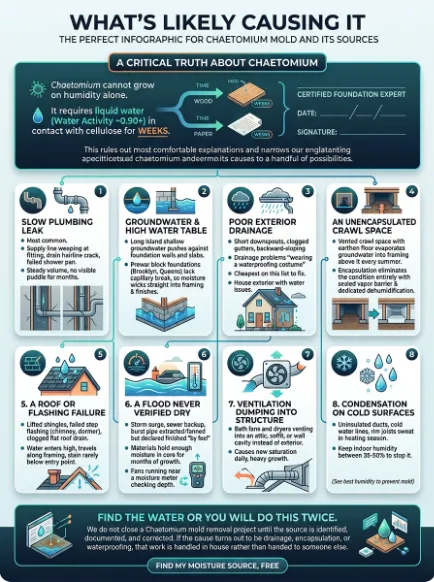
Find the water or you will do this twice. We do not close a Chaetomium mold removal project until the source is identified, documented, and corrected. If the cause turns out to be drainage, encapsulation, or waterproofing, that work is handled in house rather than handed to someone else.
Why Long Island Properties Have Chaetomium Problems
Chaetomium is a mold associated with prolonged moisture exposure and water-damaged building materials, particularly drywall, wood, and other cellulose-based materials. On Long Island, basement moisture, flooding, plumbing leaks, roof leaks, crawl space humidity, and other forms of water intrusion can leave these materials damp long enough for Chaetomium to establish itself. The concern is not simply the visible mold growth. Its presence can indicate that moisture has remained trapped inside the building and that damage may extend into areas that cannot be seen without a closer inspection.
Brooklyn
Brooklyn’s older homes, brownstones, multi-family buildings, and finished basement spaces can create conditions where moisture remains hidden behind walls, beneath flooring, or inside damaged building materials. After plumbing leaks, roof intrusion, condensation, or flooding, Chaetomium can develop in moisture-damaged drywall and wood. When this mold is suspected, the priority is finding how long the material has remained wet and determining whether damage extends beyond what is visible.
Long Island
Long Island homes can experience Chaetomium growth after basement flooding, plumbing failures, roof leaks, crawl space moisture, or other prolonged water intrusion. Finished basements and wood-framed construction provide abundant cellulose materials for mold growth when moisture is allowed to persist. A professional inspection can help determine whether Chaetomium is limited to a visible area or has spread into drywall, subflooring, insulation, framing, or other concealed materials.
Queens
Queens properties range from older attached homes and multi-family buildings to detached houses with basements and crawl spaces. Aging plumbing, roof leaks, basement moisture, window intrusion, and ventilation problems can allow building materials to stay damp long enough for Chaetomium to develop. Because moisture can remain concealed inside walls and floors, identifying the source and mapping the affected area is an important part of determining the full scope of remediation.
The Bronx
In The Bronx, older housing, basements, multi-family properties, and aging building systems can make persistent moisture difficult to detect until mold becomes visible or a musty odor develops. Chaetomium is particularly important to investigate when water damage has affected drywall, wood, flooring, or other cellulose-based materials. Finding the moisture source and checking concealed areas can reveal whether the visible growth is only part of a larger moisture and structural problem.
Suspect Chaetomium Mold? Find The Moisture Source First.
Chaetomium can indicate that building materials have been exposed to moisture for an extended period. Whether the problem started with a leak, flooding, basement moisture, or hidden water intrusion, we inspect the affected area, identify the moisture source, and determine the scope of contamination so the problem can be addressed properly.
Schedule A Chaetomium Mold InspectionSystems, Equipment, and Standards We Work With
Chaetomium mold removal is only as good as the equipment behind it and the standards used to measure the work. Here is what we use and the standards we hold the remediation process to.
Professional Remediation Standard
Our remediation work follows the ANSI/IICRC S520 Standard for Professional Mold Remediation, providing an established framework for containment, removal, cleaning, and remediation procedures.
New York State Requirements
We work within New York State Labor Law Article 32 requirements, including applicable licensing requirements and the separation between mold assessment and remediation.
Air Control and Containment
We use HEPA negative air machines, air scrubbers, and decontamination chambers to help control airborne particles and maintain appropriate containment during remediation.
Moisture Detection and Inspection
We use thermal imaging cameras, pin and pinless moisture meters, and borescopes to investigate moisture conditions and identify areas where mold or water damage may be concealed behind finishes.
Structural Drying
When moisture is part of the problem, we use LGR dehumidifiers, air movers, and documented drying standards to help bring affected materials back to appropriate moisture conditions.
Laboratory Analysis and Verification
Where testing and clearance are appropriate, we work with AIHA-accredited laboratory analysis and independent post-remediation clearance to provide objective verification of the completed work.
Physical Removal Comes First
Antimicrobials and encapsulants are selected according to the affected substrate and project conditions. They are used only after physical removal and are never a substitute for removing contaminated materials and correcting the underlying moisture problem.
Related Services You May Need Alongside This
Chaetomium is a symptom. These are the services that often address the moisture, contamination, and building conditions behind the problem.
Our Chaetomium Mold Removal Services
Every job runs in this order. Nothing gets skipped, and nothing gets closed up until the numbers show that the affected area is dry and clean.
Free Chaetomium Mold Removal Inspection
Every Chaetomium mold removal project starts with a no-charge visual inspection and moisture survey. We map the wet footprint with thermal imaging and moisture meters because moisture-related damage can extend well beyond what is visible.
Laboratory Species Identification
Chaetomium mold removal requires proof, not a guess. Air and surface samples go to an accredited laboratory so the scope is built around confirmed findings rather than what a dark patch looks like from across the room.
Containment and Negative Air
Chaetomium mold removal can disturb spores when contaminated materials are opened. We build sealed poly containment with a decontamination chamber and use HEPA negative air throughout the remediation process, not simply at the end.
Structural Demolition and Material Removal
This is a critical step in Chaetomium mold removal. Materials that cannot be effectively cleaned are removed, with the cut line extended beyond visible growth into sound material where appropriate.
Structural Drying and Dehumidification
Chaetomium mold removal is incomplete without verified drying. LGR dehumidifiers and air movers operate until moisture readings from framing and affected substrates reach the established target. Daily readings are documented and provided at closeout.
Reconstruction and Rebuild
Chaetomium mold removal can leave an open wall or assembly behind. Once remediation is complete, we restore the affected area with board, tape, trim, paint, and insulation as required, so you are not left coordinating a second contractor simply to close the wall.
Moisture Source Correction
Chaetomium mold removal is temporary if the underlying moisture problem remains. We identify and address the source, which may involve interior drainage, sump systems, crawl space encapsulation, grading, ventilation, or another building condition that allowed moisture to enter or accumulate.
Independent Clearance and Documentation
Chaetomium mold removal is complete when the remediation work has been independently evaluated according to the applicable clearance criteria. An independent assessor can verify the completed work using appropriate control samples, with documentation assembled for insurance, resale, or building records.
Why New York Property Owners Call Us First
Why New York Property Owners Call Us First
Licensed under New York Article 32
We keep assessment and remediation properly separated, the way state law requires. Review our licenses and certifications.
We know this water table
Long Island’s shallow groundwater, prewar Brooklyn block foundations, and Queens crawl spaces are not generic mold problems. They are local ones, and we work them every week.
Remediation and rebuild under one roof
We open the wall and we close it. No handing you a gutted room and a list of other people to call.
We fix the cause, not just the symptom
Drainage, encapsulation, and waterproofing are in house, so the moisture condition that fed the Chaetomium actually gets closed out.
Free inspections, honest scopes
If it turns out to be a surface issue you can handle yourself, we will tell you that and leave. Read our full Chaetomium guide to see how we think about it.
Get Chaetomium Mold Removal Before It Becomes a Rebuild
Frequently Asked Questions About Stormwater Management Services:
What Is Chaetomium Mold?
Chaetomium is a genus of mold commonly associated with water-damaged buildings and cellulose-based materials. It can grow on materials such as drywall, wood, insulation, wallpaper, and other materials that have been exposed to prolonged moisture. Professional Chaetomium mold remediation focuses on removing contamination and correcting the moisture source that allowed it to grow.
Is Chaetomium Mold Dangerous?
Chaetomium mold can be a concern when it grows indoors, particularly in areas with significant or prolonged moisture damage. Some Chaetomium species are capable of producing mycotoxins, and exposure to mold can contribute to respiratory and other health concerns. The appropriate response depends on the extent and location of the contamination.
What Does Chaetomium Mold Look Like?
Chaetomium mold can appear as a cottony or grayish-white growth when it is developing, while mature colonies may become darker, often appearing olive, brown, or black. Because different types of mold can look similar, visual identification alone is not always reliable. Professional mold inspection or laboratory testing can help identify the species when necessary.
Where Does Chaetomium Mold Grow?
Chaetomium commonly grows in areas affected by chronic moisture or water damage. Common locations include basements, crawl spaces, wall cavities, bathrooms, attics, and other areas containing wet or water-damaged wood, drywall, insulation, or other cellulose-based materials.
What Causes Chaetomium Mold to Grow?
Chaetomium mold growth is usually associated with persistent moisture. Plumbing leaks, roof leaks, flooding, foundation water intrusion, condensation, high humidity, and slow-drying water damage can create conditions where Chaetomium can establish and spread. Correcting the moisture problem is an essential part of successful remediation.
How Is Chaetomium Mold Removed?
Yes, across all four service areas, including apartment buildings, mixed-use, and small commercial sites where drainage failures create both a maintenance cost and a tenant complaint.
Does Chaetomium Mold Require Professional Remediation?
Professional remediation is particularly important when Chaetomium is present over a large area, has penetrated porous building materials, is located inside walls or other concealed spaces, or is associated with significant water damage. A qualified mold professional can determine whether affected materials can be cleaned or need to be removed and replaced.
Do You Need Mold Testing for Chaetomium?
Mold testing is not necessarily required in every situation. When visible mold and the source of moisture are already established, remediation can sometimes proceed without species-level testing. Testing may be useful when the type or extent of contamination is uncertain, hidden mold is suspected, or documentation is needed before or after remediation.
How Much Does Chaetomium Mold Removal Cost?
The cost of Chaetomium mold removal depends on the size of the affected area, the extent of water damage, the materials contaminated, accessibility, containment requirements, and whether demolition or structural repairs are necessary. A professional inspection can determine the scope of remediation and provide a more accurate estimate.
How Do You Prevent Chaetomium Mold From Coming Back?
Preventing Chaetomium mold from returning starts with controlling moisture. Repair leaks, stop water intrusion, improve ventilation, control indoor humidity, dry wet materials promptly, and correct drainage or waterproofing problems. Effective remediation should address the underlying moisture source rather than simply treating the visible mold.