
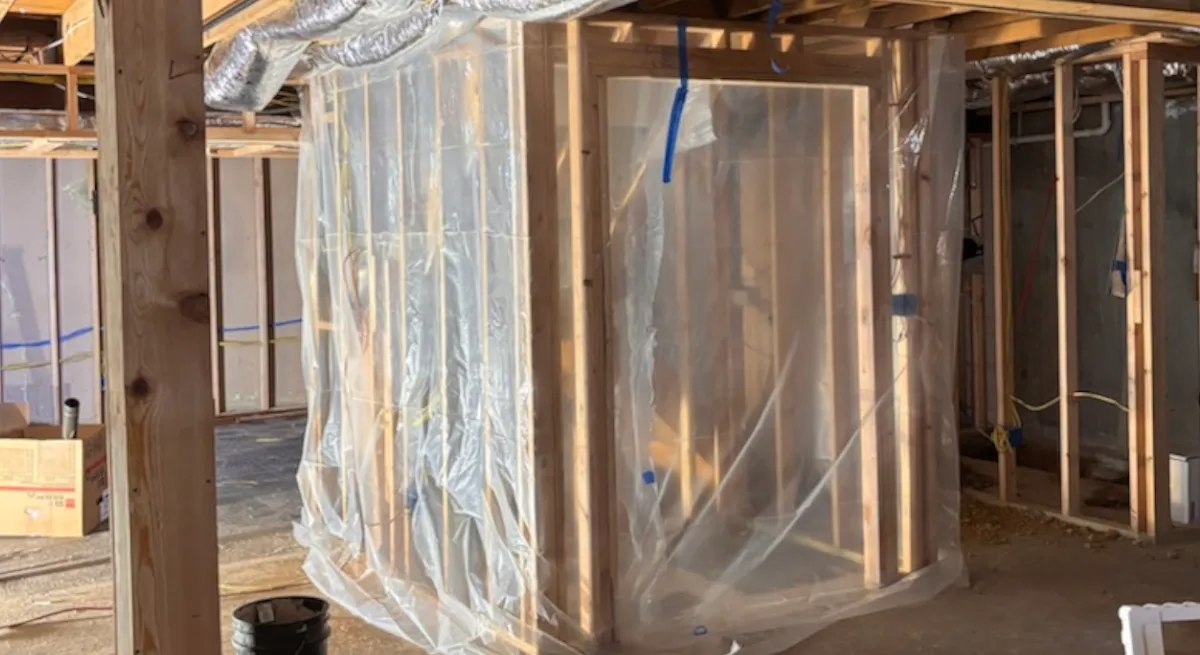
Mold containment is the plastic, the tape, the zippered doorway, and the machine humming in the corner. Homeowners tend to read all of it as theater, an expensive way of looking professional. It is the opposite. Removal without containment does not eliminate a mold problem, it redistributes it, and the house ends up with a clean basement and a contaminated upstairs. Every dollar spent on demolition is wasted if the spores released during that demolition are allowed to travel.
This guide explains what containment is actually doing, the difference between limited and full setups, why negative air pressure matters more than the barrier itself, and the specific things you can look at during your own job to tell whether the crew in your house knows what they are doing.
Breathe Easy Again with Our Expert Crawl Space Mold Removal Services for New York Properties
Undisturbed mold growth releases spores slowly. Disturbed mold growth releases them in enormous bursts. Cutting drywall, pulling insulation, scraping joists, and running a demolition saw take a colony that was sitting quietly on one surface and aerosolize it into the entire air volume of the building.
That is the moment the job either works or fails, and it happens in the first hour, long before anyone talks about clearance.
How Spores Travel Without a Barrier
Spores are small enough and light enough to remain suspended in still air for extended periods, and any air movement carries them. A forced air return in the same room pulls them into the duct system and distributes them to every register in the house. An open stairwell moves them upward with the natural pressure difference between a cool basement and a warmer upper floor. A crawl space hatch left open feeds them straight into the living space through floor penetrations.
Our guide to how far mold spores can travel in the air covers the distances involved, and how mold moves through a building explains the pressure mechanics that make an uncontained basement job a whole house event. The short version: air is the delivery system, so controlling air is the job.
Levels of Containment and When Each One Is Used
Containment is not one thing. Scope drives the setup, and a competent contractor should be able to tell you which level they are using and why.
| Setup | Typical Use | What It Involves |
|---|---|---|
| Source containment | Very small isolated growth, often under ten square feet | Sealed poly directly over the work area, HEPA vacuum at the point of cut, minimal disturbance |
| Limited containment | Moderate areas, a single room, a bathroom wall, a section of ceiling | Single layer barrier, sealed openings, HVAC shut down and registers sealed, negative air |
| Full containment | Large areas, heavy growth, sensitive occupants, category three water | Double layer barrier, decontamination chamber or airlock entry, negative air, controlled disposal path |
What Proper Mold Containment Looks Like on Site
Proper containment is something you can verify with your own eyes, no equipment and no jargon required. Walk to the edge of the work zone and look for these six things, in this order, before the crew gets deep into the job.
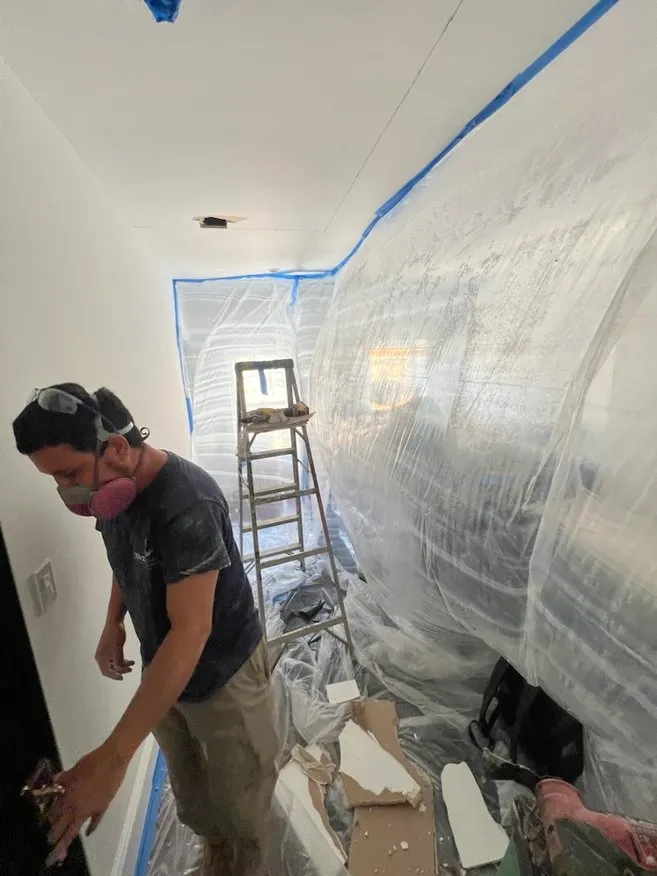
- Barrier Sealed to Structure: the poly is taped tight to walls, ceiling, and floor with no gapping at the perimeter, because plastic hanging loose from a ceiling grid is just decoration.
- Zippered or Airlock Entry: crews go in and out repeatedly, and every uncontrolled flap is a pressure event, so the way in should be a sealed zipper door or an airlock, not an open slit.
- Plastic Pulled Inward: this is the single best visual test on any job, because working negative pressure sucks the barrier in toward the work area and holds it there, while a barrier billowing out into the hallway means air is leaving the zone and entering your home.
- HVAC Off and Registers Sealed: any supply or return vent inside the zone is covered, because a running system defeats a perfect barrier in minutes.
- Exhaust Ducted Outside or HEPA Filtered: air pulled out of containment goes out a window or through a HEPA unit, never dumped into the adjacent room.
- Debris Removed in Sealed Bags: material is bagged inside the containment and wiped down before it crosses the barrier, not carried out on an open shoulder.
Negative Air Pressure: The Part Homeowners Cannot See
A barrier alone does not stop contamination. Barriers leak, doors open, and pressure differences between floors push air through any gap available. Negative air pressure solves the leak problem by deciding which direction the leaks flow.
A negative air machine pulls air out of the contained area and exhausts it, usually outdoors through a window port. That creates slightly lower pressure inside containment than in the surrounding house. Air then moves from the clean side into the dirty side through every gap in the barrier, which is exactly what you want. Contaminated air cannot travel against that gradient.
Machines are sized by the air volume of the work zone and the number of air changes per hour required. A single unit in a large basement is undersized. This is also why a contractor should be able to tell you the cubic footage of the containment and the machine rating without hunting for it.
Air Changes and Why They Matter
Air changes per hour describe how many times the full volume of air inside containment is filtered and replaced. Higher rates clear airborne spore load faster during and after demolition, which shortens the settling period before the area can be tested. Undersized equipment does not just risk leakage, it extends the schedule, a factor covered in our breakdown of how long mold remediation takes.
Common Containment Failures
These are the failures that show up repeatedly on second opinion visits across Long Island, Brooklyn, Queens, and the Bronx:
- The HVAC System Was Never Shut Down: This can turn a contained room problem into a duct contamination problem and significantly increase remediation costs.
- Negative Air Exhausted Into an Adjacent Room: Even filtered air can pressurize the neighboring space and push airflow in the wrong direction.
- Containment Was Removed Too Early: Taking barriers down before airborne particles settle can allow contaminated dust to spread through the property.
- No Sealed Disposal Path Was Used: Carrying unsealed or poorly sealed bags through hallways can release the same contaminants the containment was designed to isolate.
- Containment Was Sized to Visible Growth: The containment area should cover the full demolition and affected area, not just the mold that can be seen on the surface.
- Equipment Was Shut Off Overnight: Negative pressure needs to remain continuous throughout remediation. Turning equipment off after hours can compromise the containment established during the day.
Can I Stay in the House During Mold Remediation?
Most residential jobs do not require the family to leave, and correct containment is the reason why. That said, the calculus changes with the size of the work zone, the location relative to bedrooms and returns, and whether anyone in the household has asthma, a compromised immune system, or a diagnosed mold sensitivity.
Reasonable precautions during an active job: keep children and pets away from the barrier, do not open the containment out of curiosity, avoid running the central system if the contractor has shut it down, and use a different entrance if the disposal path crosses your main one. If the work zone is adjacent to a bedroom used by someone with respiratory issues, relocating that person for the demolition days is cheap insurance.

How Containment Connects to Licensing and Clearance
In New York, containment is not left to contractor discretion. Minimum work standards under the state’s mold program govern how licensed remediation is performed, and the project ends with an independent post remediation assessment rather than the contractor’s own sign off. That is why containment stays up until clearance is complete: the assessor is measuring the air inside the zone, and taking the barrier down early destroys the conditions being tested.
If you are still selecting a contractor, verify credentials first using our guide to the New York mold remediation license and how to check it, and understand the finish line by reading about mold clearance testing. Program requirements are published by the New York State Department of Labor, and containment practice guidance appears in the Environmental Protection Agency remediation guide.
If the plastic is not pulling inward, ask why.
You do not need equipment or training to evaluate a setup. You need to know what correct looks like. If something in your current job does not match what you have read here, a second opinion is worth the call.
Mold Containment: Final Thoughts
Homeowners evaluate remediation companies on price and on how confident the salesperson sounded. Neither predicts the outcome. The barrier does. A crew that seals the perimeter tight, shuts the air handler down, sizes the machines to the space, exhausts outdoors, changes pre filters mid job, and leaves the containment standing until an independent assessor clears it will deliver a result that holds. A crew that skips those steps produces a clean looking room and a contaminated house, and nobody discovers it until symptoms show up in a bedroom two floors away.
The good news is that this is one of the few parts of the process a homeowner can genuinely audit without expertise. Look at the plastic. Listen for the machine. Check whether the thermostat is off. Ask where the exhaust goes. Those four observations tell you more about the quality of your remediation than any brochure will.
Frequently Asked Questions About Mold Containment:
Is containment required on every mold job?
Not on very small isolated growth, where source containment and careful HEPA vacuuming may be enough. Any job involving demolition, cavity access, or an area beyond a few square feet should be contained, and larger or more sensitive projects call for full setups with an airlock entry.
How do I know the negative air machine is working?
Look at the barrier. Plastic that is drawn inward toward the work area indicates negative pressure is holding. Plastic that billows outward or hangs slack means air is escaping the zone, which points to undersized equipment, a loaded filter, or a leaking barrier.
Where should the exhaust air go?
Outside, through a sealed window port, whenever possible. If the machine must exhaust indoors, it has to run through HEPA media, and it should never discharge into an adjacent living space in a way that pressurizes that room.
Do I have to turn off my HVAC system?
Yes, on any job involving demolition. A running forced air system pulls contaminated air into the return and distributes it through the duct network, converting a contained problem into a whole house one. Registers inside the work zone should also be sealed.
Can I stay in my home during the work?
Usually. Correct containment isolates the work zone from the rest of the house. Relocating is worth considering when the zone is large, when it sits next to a bedroom, or when a household member has asthma, a compromised immune system, or a known mold sensitivity.
What is the difference between an air scrubber and a negative air machine?
They are often the same unit used two ways. Ducted outside, it creates negative pressure and removes air from the zone. Left to recirculate inside the space, it functions as an air scrubber, lowering the airborne particle count without moving air out.
How long should the barrier stay up?
Until post remediation verification is complete. Removing it after demolition but before testing releases settled dust into the house and invalidates the conditions the assessor is measuring.
Does containment stop the smell from spreading?
It reduces it substantially, because the odor compounds travel with the same air the barrier and negative pressure are controlling. Some odor may still be noticeable, and it typically resolves after the affected material is removed and the source moisture is corrected.
What should a proposal say about containment?
It should describe the work zone dimensions, the barrier type, whether an airlock or decontamination chamber is used, the number and rating of the air machines, where exhaust is directed, and the disposal path. A proposal that prices mold containment without describing any of that is pricing an assumption rather than a plan.
What Are the Signs That Mold Containment Has Failed?
Common signs include plastic barriers billowing outward, visible dust escaping the work zone, odors spreading into unaffected rooms, or debris appearing outside the containment area. A negative air machine that is not pulling the barrier inward may also indicate inadequate pressure. Any of these signs suggest the containment should be inspected and corrected before work continues.