
If you’re struggling with mold in your crawl space, you’re not alone. Mold destroys more wood than termites and fires combined, and up to 40% of the air you breathe in your home may be coming from your crawl space right now. That means every breath could be carrying mold spores, allergens, and contaminants that impact your health and the integrity of your home.
Ignoring crawl space mold is not an option, it spreads fast, eats away at wooden structures, and can lead to expensive repairs. Whether you’ve noticed musty odors, increased allergy symptoms, or visible signs of mold growth, now is the time to act. Our crawl space mold removal services in New York provide fast, effective solutions to remove mold, restore air quality, and protect your home for the long term.
With professional crawl space mold inspection, mold remediation, and mold encapsulation, we handle everything from detection to full removal, so you won’t have to look anywhere else.
Get Your Crawl Space Mold Problem Solved Today! Contact Us Now for Expert Mold Removal in New York.
7 Signs of Hidden Mold Behind Walls
You rarely see hidden mold behind walls first. You smell it, you feel it in the air, or you notice the wall itself starting to behave strangely. These are the seven signals our inspectors trust most:
- A musty, earthy smell with no visible source, strongest near the floor, a closet, or the HVAC.
- Bubbling, peeling, or cracking paint and wallpaper, caused by moisture pushing out from behind the surface.
- Stains that keep coming back after you wipe or repaint them, often yellow, brown, or shadowy.
- Soft, spongy, or warped drywall that gives slightly when you press it.
- Condensation or a persistent damp feeling on or near a wall, especially an exterior one.
- Allergy-style symptoms indoors (congestion, coughing, itchy eyes, headaches) that improve when you leave.
- A past leak or flood that was “cleaned up” but never fully dried behind the wall.
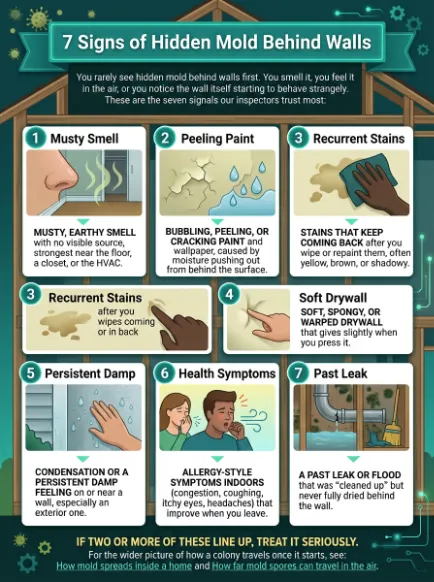
If two or more of these line up, treat it seriously. For the wider picture of how a colony travels once it starts, see how mold spreads inside a home and how far mold spores can travel in the air.
What Hidden Mold Behind Walls Smells and Looks Like
That damp, earthy, locker-room smell is the most reliable clue of hidden mold behind walls, because the colony releases microbial volatile organic compounds (MVOCs) that pass straight through drywall even when nothing is visible. When it does surface, in-wall mold usually appears as shadowy staining that bleeds through paint, sometimes with a fuzzy or slimy texture in black, green, gray, or white. A musty basement smell is the classic example. If the smell is strong but you cannot find the source, the source is almost certainly behind a surface.
Sign, Cause, Severity: What to Do About Each
Not every sign means the same thing. Here is how to read each one at a glance.
| What You Notice | Likely Cause | Severity | DIY-Safe or Call a Pro |
|---|---|---|---|
| Musty smell, nothing visible | Active colony behind the surface | High | Call a pro to locate and test |
| Bubbling or peeling paint | Moisture trapped behind drywall | Medium–High | Investigate; likely a pro |
| Recurring stain after cleaning | Ongoing moisture feeding growth | Medium–High | Investigate the source first |
| Soft or spongy drywall | Long-term saturation, possible rot | High | Call a pro |
| Condensation on a wall | Humidity or a cold-wall dew point | Low–Medium | Often DIY (dehumidify, ventilate) |
| Allergy symptoms indoors only | Airborne spores from a hidden source | Medium–High | Test the air; call a pro |
| Small visible patch (< ~10 sq ft) | Surface growth from a minor leak | Low | DIY with proper safety gear |
Mold or Not? Efflorescence, Water Stains, and Look-Alikes
Before you panic or tear anything out, rule out the two things people mistake for mold every day. Efflorescence is a white, crystalline salt deposit left behind as water evaporates through masonry. It is powdery, it brushes off, and it dissolves in water, whereas mold smears and returns. Old water stains are flat, dry, and odorless with a defined edge; active mold is often raised, damp, and smells. Soot and ordinary dust can also masquerade as mold in corners. The quick field test: mold has a smell and grows back, salt and stains do not. When in doubt, a lab test settles it, which we cover below.
How to Find Mold Behind Walls Without Tearing Them Out
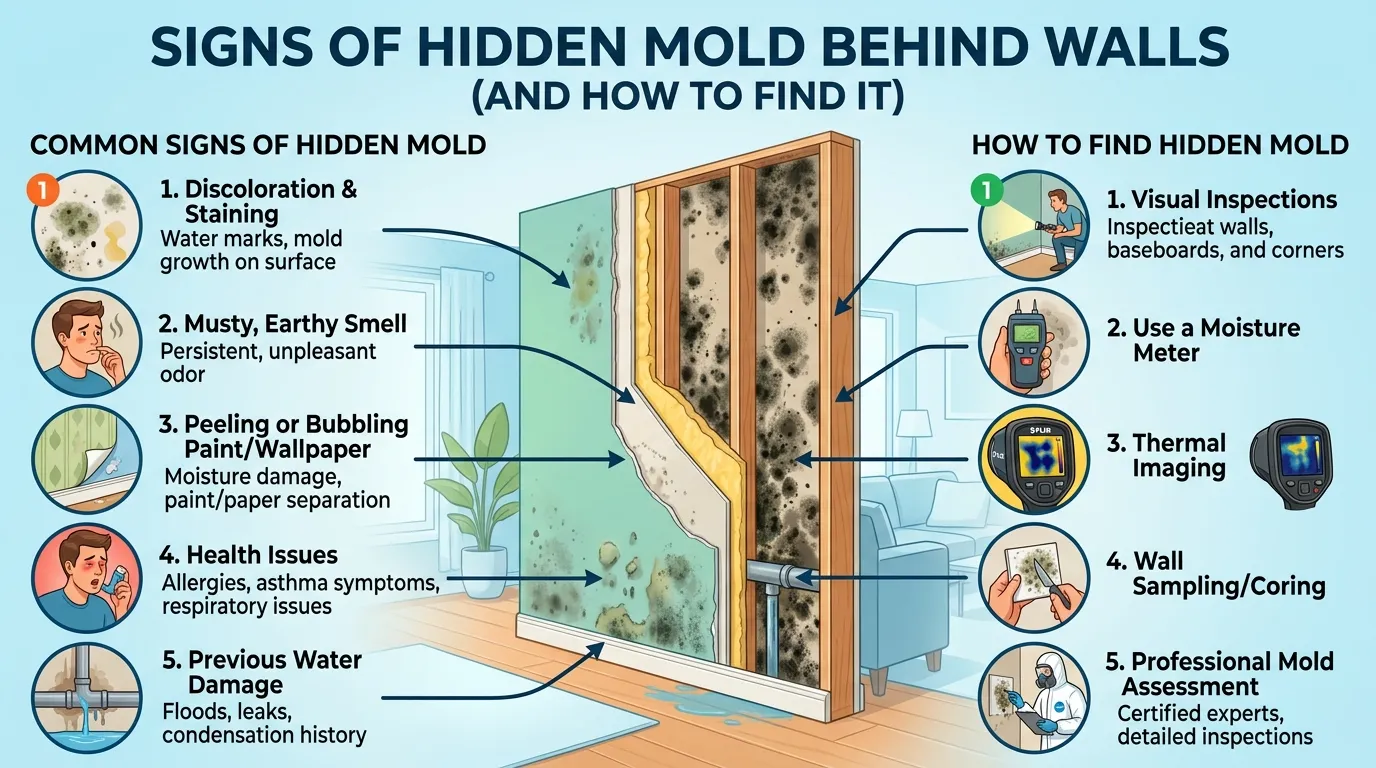
You do not have to demolish a wall to know what is behind it, and you should not, because opening a moldy cavity without containment spreads spores through the whole house. Work through these non-destructive steps in order:
- Follow the smell and the moisture. Map where the odor is strongest and where you have had leaks, condensation, or high humidity.
- Use a moisture meter. Run it across the suspect wall; readings that spike in one zone flag a wet cavity, the number one condition mold needs.
- Scan with a thermal camera. Infrared shows cold, damp areas behind the surface as darker patches, narrowing the search fast.
- Try the outlet test. Turn off the power, remove an outlet cover on the wall, and smell inside the cavity; a musty draft is a strong tell.
- Confirm with a borescope. As a last non-destructive step, drill a pencil-width hole in an inconspicuous spot and slip in a small inspection camera to see the cavity directly.
If the meter, the camera, and your nose all agree, you have found it. For a structured walkthrough of what a professional checks, see our mold inspection checklist.
Field-tested by our inspectors: how to confirm hidden mold behind walls before you open a single wall cavity.
Room by Room: Where Hidden Mold Hides
Hidden mold is not random. It follows moisture, and moisture pools in the same predictable places in every home:
- Bathroom walls: steam and a missing exhaust fan feed growth behind tile and around tubs. See black mold in the bathroom.
- Behind the kitchen backsplash: slow sink and dishwasher leaks wick into the wall unseen.
- Basement and crawl-space walls: below-grade humidity and seepage make these ground zero. See what causes moisture problems in basements.
- Attic knee walls: poor ventilation lets warm, damp air condense on cool sheathing.
- North-facing exterior bedroom walls: cold surfaces hit the dew point and sweat behind furniture, so growth hides where airflow is worst.
- Behind wallpaper: vinyl paper traps moisture against the wall and can hide extensive growth.
The common thread is moisture, which is why the lasting fix always addresses the water, not just the mold. If it is on the drywall itself, see whether mold can grow on drywall and what causes black mold on walls.
DIY Test Kit vs Professional Testing: What Each Really Tells You
Before you spend a dime on a hardware-store kit, here is what each method can and cannot tell you.
| Factor | At-Home Test Kit | Moisture Meter / Thermal (DIY) | Professional Testing |
|---|---|---|---|
| Typical cost | $10–$50 | $25–$200 one-time | Free–$700 |
| What it tells you | That spores exist (they always do) | Where moisture is hiding | Type, amount, and source; clearance |
| Finds hidden in-wall mold? | No | Yes, indirectly | Yes |
| Reliability | Low | Medium–High | High |
| Best for | Curiosity only | Narrowing the search | A real diagnosis and a plan |
The honest verdict:
petri-dish kits mostly confirm that air has spores, which is always true, so they rarely answer the real question. A moisture meter is a better DIY buy. For a definite answer, professional testing wins. We go deeper in do at-home mold test kits work, and you can often start with a free visual mold inspection
.
What It Costs to Test and Remove Mold Behind Walls
Here are the numbers the sign articles never print. These are typical ranges, not a quote; your inspection sets the real figure.
| Item | Typical Range |
|---|---|
| Moisture meter (buy your own) | $25 – $200 |
| At-home mold test kit | $10 – $50 (limited value) |
| Professional visual inspection | Free – $600 |
| Lab air or surface testing | $250 – $700 |
| Open and treat a small wall section | $500 – $1,500 |
| In-wall remediation after a leak | $1,500 – $4,500 |
| Larger or multi-wall hidden mold | $4,000 – $10,000+ |
For the full breakdown, see our mold removal cost guide and national mold inspection cost guide
..
Why Ignoring It Gets Expensive: Health, Structure, Insurance, Resale
A hidden colony is not just an eyesore waiting to happen. It is a bill that grows every month you leave it alone, on four fronts:
- Health: airborne spores drive congestion, coughing, headaches, and asthma flare-ups, worst for kids, older adults, and anyone immune-compromised. See black mold symptoms and health effects and whether black mold is dangerous.
- Structure: the same moisture that feeds mold rots drywall, then framing. Left long enough it becomes a structural repair, not a cleaning.
- Insurance: sudden, accidental water damage (a burst pipe) is often covered; slow, ignored leaks usually are not. Acting early protects the claim.
- Resale: most states require disclosure, and buyers’ inspectors find hidden mold. It is far cheaper to fix now than to renegotiate later. See can you sell a house with mold.
Should You DIY It or Call a Pro?
A patch of surface mold the size of a sticky note is a Saturday chore; a smell with no visible source is a phone call. The practical line, echoing EPA guidance, is about 10 square feet. Below that, on a hard, non-porous surface, a careful homeowner can clean it with proper gear. Above that, or anytime the mold is inside a wall, tied to a recurring leak, or you have health symptoms, bring in a pro who can contain the area, remove it safely, and verify the air with clearance testing. If you do clean it yourself, do not reach for bleach on porous walls; here is how to remove mold from walls the right way. Not sure who to trust? Use our guide to choosing the right mold remediation company.
Signs of Hidden Mold Behind Walls: Final Thoughts
Hidden mold behind walls rewards exactly one thing: acting early, while it is still small. Trust the smell, confirm it without demolition using a meter and a camera, rule out the look-alikes, and match your next step to how far it has spread. Testing is cheap or free; waiting is what gets expensive.
If you can smell it but cannot find it, that is the moment to get a trained set of eyes on the wall. Book your free mold inspection and we will locate any hidden mold behind walls, confirm the source, and give you a clear, honest plan before anything gets opened up.