
Almost nobody finds attic mold on purpose. It gets found when a roofer pops the hatch for a quote, when an insulation crew opens the space to add R-value, or, most expensively, when a buyer’s home inspector shines a light on the underside of the roof deck three days before closing.
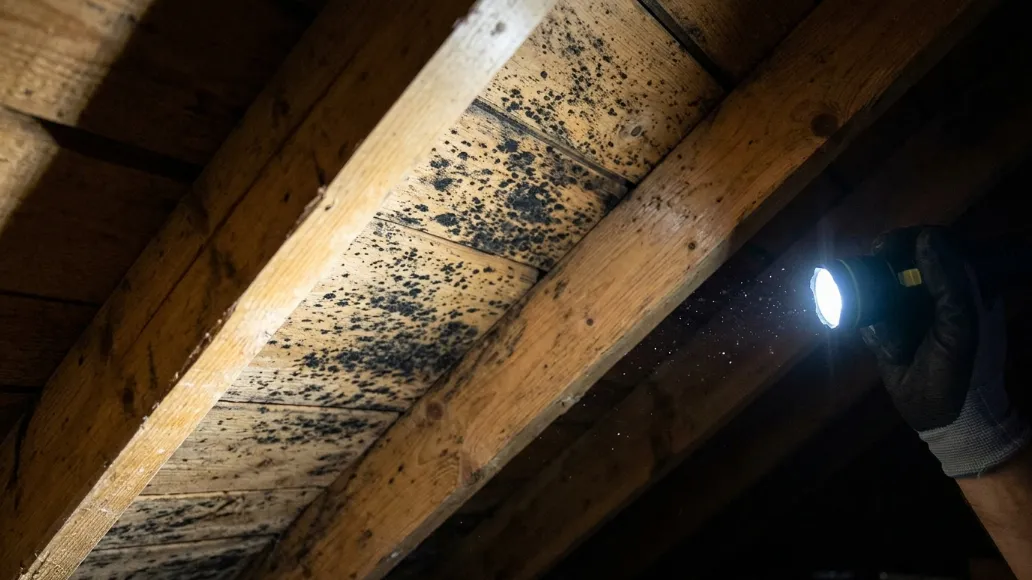
What they see is usually the same thing: dark gray or black staining marching up the sheathing between the rafters, heaviest at the eaves and around the ridge, sometimes with a white fuzz on the framing. And what the homeowner says next is almost always the same too: how long has that been there, and how bad is it?
Attic mold is one of the most common problems we’re called for across Brooklyn, Queens, Long Island, and the Bronx, and it’s also one of the most misunderstood: it is almost never a roof leak, it is almost always a ventilation and air-leakage problem, and it will absolutely come back if you clean it without fixing why it grew.
What Causes Attic Mold?
Mold needs three things: something to eat, a comfortable temperature, and water. Your attic hands over the first two for free. Plywood or OSB sheathing, wood framing, paper-faced insulation, and years of settled dust are all food, and attic temperatures swing through the ideal growth range every spring and fall. So attic mold is really a story about the third ingredient, and the water almost never comes from where homeowners assume it does.
Here is the part that surprises people. In a New York winter, your heated living space is a giant humidity generator. Showers, cooking, laundry, dishwashers, houseplants, and simply breathing. That warm, moist air rises and leaks upward through every gap in your ceiling plane. When it hits the underside of a roof deck that’s sitting at 20°F, the moisture condenses out onto the wood exactly the way it beads on a cold glass in July.
Do that a few hundred times over a winter and you have wet sheathing. Wet sheathing plus wood plus time equals attic mold. A roof leak makes a localized stain around one spot; condensation makes that broad, even, blotchy pattern across whole bays of sheathing, which is why the pattern itself is diagnostic. We break the full mechanism down in our guide to what causes mold in the attic.
Exhaust Fans and Dryer Ducts Venting Into the Attic
This is the single most common cause of attic mold we find in older NY-metro housing stock, and it is usually the cheapest to fix. A bathroom exhaust fan is supposed to carry moist air outside, through the roof or a gable wall, with a solid duct and a working damper. In thousands of homes it does not. The duct terminates a foot above the insulation, it points at a soffit vent instead of through it, or it was connected properly in 1998 and has since fallen off the roof cap and is now emptying into open attic space. Every hot shower becomes a steam injection directly onto your roof deck. Dryer ducts do the same thing with even more moisture. If you find attic mold that is heaviest directly above a bathroom, look up: the answer is usually hanging right there in the joist bay.
Blocked Soffit Vents and Insulation Stuffed Into the Eaves
Attics are designed to breathe. Cool outside air is supposed to enter low at the soffit vents, wash up the underside of the roof deck, and exit high at a ridge vent or gable vents, carrying moisture out with it. That airflow path fails constantly. Blown-in insulation gets pushed into the eaves and plugs the soffits. Baffles were never installed. Someone added insulation to save on heating and unknowingly sealed off the intake. Now the ridge vent has nothing to pull from, air stops moving, humidity stacks up, and attic mold takes hold along the eaves first, which is exactly where we see it most. If your growth is worst at the lower edges of the sheathing, suspect blocked intake before you suspect anything else.
Air Leaks From the Living Space Below
Even with perfect ventilation, you can lose the battle if too much house air is escaping upward. Recessed light housings, the attic hatch, plumbing stacks, bath fan penetrations, wiring holes, and the top plates of interior walls all leak conditioned, humid air into the attic around the clock. This is the cause most contractors skip because sealing it is fussy work you cannot photograph nicely. But it is why some attics develop attic mold even after a new ridge vent gets installed: the ventilation was improved while the moisture supply was left wide open. Our breakdown of attic condensation causes and warning signs covers how to spot this before growth starts. Frost on nail tips in January is the classic early warning sign.
What Does Attic Mold Look Like?
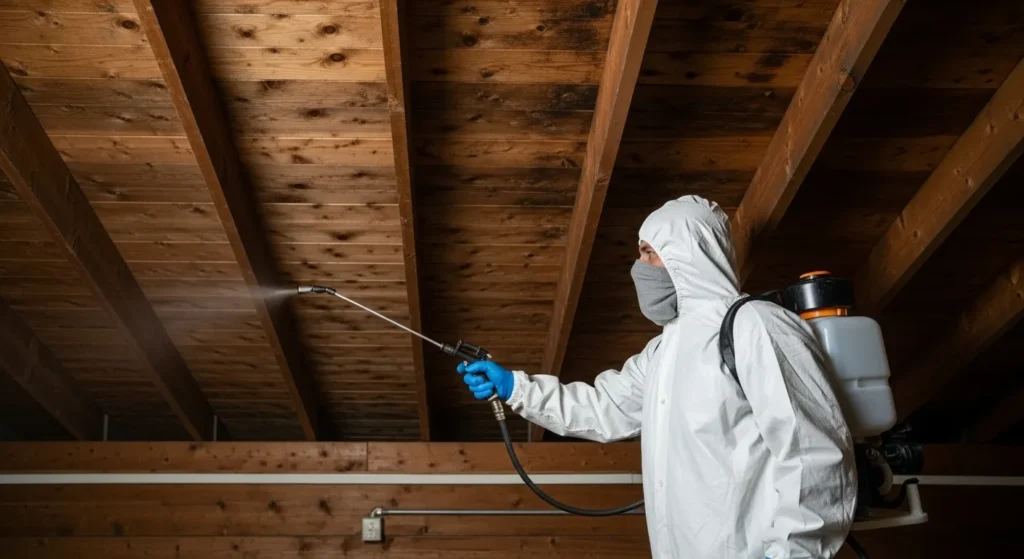
Attic mold usually reads as discoloration rather than the fuzzy stuff people picture. On plywood and OSB sheathing it typically appears as gray, black, or blue-black staining that follows the rafter bays in broad patches, often darkest at the eaves, around the ridge, and above bathrooms. On framing lumber you’ll more often see white or pale gray fuzz standing up off the surface. Insulation may look dirty, matted, or shadowed near the eaves. And there’s a smell. That damp, earthy, wet-cardboard note that gets stronger when the attic warms up on a humid day.
The 8 Warning Signs of Attic Mold You Can Spot from the Hatch
You do not need to crawl the whole attic to know whether you have a problem. Open the hatch, use a real flashlight, and look for these:
- Dark blotchy staining on the underside of the roof sheathing, especially in even patches across multiple rafter bays.
- White or gray fuzzy growth on the rafters, trusses, or ridge board.
- A musty, earthy smell when the hatch opens, or that same smell drifting down into the top-floor hallway.
- Frost or water droplets on nail points and sheathing on a cold morning — condensation caught in the act.
- Damp, compressed, or discolored insulation, particularly along the eaves.
- Rusty nail heads, rusted truss plates, or corroded strapping, which means sustained moisture.
- Warped, cupped, or delaminating sheathing that looks wavy from below.
- Higher heating and cooling bills from wet insulation, which loses most of its R-value when damp.
Any one of these earns a closer look. Three or more, and you’re looking at active attic mold, not a cosmetic stain.
The 8 Warning Signs of Attic Mold You Can Spot from the Hatch
You do not need to crawl the whole attic to know whether you have a problem. Open the hatch, use a real flashlight, and look for these:
- Dark blotchy staining on the underside of the roof sheathing, especially in even patches across multiple rafter bays.
- White or gray fuzzy growth on the rafters, trusses, or ridge board.
- A musty, earthy smell when the hatch opens, or that same smell drifting down into the top-floor hallway.
- Frost or water droplets on nail points and sheathing on a cold morning — condensation caught in the act.
- Damp, compressed, or discolored insulation, particularly along the eaves.
- Rusty nail heads, rusted truss plates, or corroded strapping, which means sustained moisture.
- Warped, cupped, or delaminating sheathing that looks wavy from below.
- Higher heating and cooling bills from wet insulation, which loses most of its R-value when damp.
Any one of these earns a closer look. Three or more, and you’re looking at active attic mold, not a cosmetic stain.
The 8 Warning Signs of Attic Mold You Can Spot from the Hatch
Attic mold is dangerous on two separate fronts that most articles treat as one: what it can do to the people in the house, and what it does to the building itself. The health risk is real but often overstated by scare marketing; the structural and financial risk is real and consistently understated. Both deserve a straight answer, and we go deeper on the medical side in our guide to whether attic mold is dangerous.
The Structural and Resale Side: Where Attic Mold Gets Expensive
This is the risk homeowners underestimate. Sustained moisture doesn’t stop at surface growth. It degrades the sheathing’s ability to hold fasteners, and over years it opens the door to wood decay fungi that eat structure outright. Wet insulation stops insulating, so you pay for the moisture twice. Once on the remediation invoice and monthly on the utility bill. Corroded truss plates and nail heads are a genuine problem in older Long Island trusses.
Then there’s the transaction risk, which in the NY metro is often the biggest number of all. Attic mold noted on a home inspection report reliably stalls deals. Buyers’ agents ask for a licensed remediation with post-remediation verification, lenders occasionally get involved, and the credit demanded at the table is almost always several times what proactive remediation would have cost. Fixing it on your schedule is cheaper than fixing it on a buyer’s.
How Is Attic Mold Removed the Right Way?
Proper attic mold removal is a sequence, not a spray. Skipping the first step is the reason so many homeowners pay twice within three years. Here’s the order of operations a competent remediation follows:
- Diagnose the moisture source first. Fan terminations, soffit blockage, ridge vent function, air-sealing gaps, moisture readings in the sheathing. Nothing gets cleaned until the why is documented.
- Set up containment and negative air. Seal the attic hatch, run HEPA-filtered negative air machines so spores don’t get pushed into the living space during work.
- Remove contaminated porous materials. Moldy, matted, or contaminated insulation gets bagged and removed rather than cleaned, you cannot clean fiberglass or cellulose.
- Physically remove growth from the wood. HEPA vacuuming, then abrasive removal on the sheathing and framing where warranted, soda blasting or dry ice blasting takes the staining off without soaking the deck. Dead mold left in place still triggers allergies, so removal beats “killing.”
- HEPA vacuum the entire cavity including the joist bays and top plates.
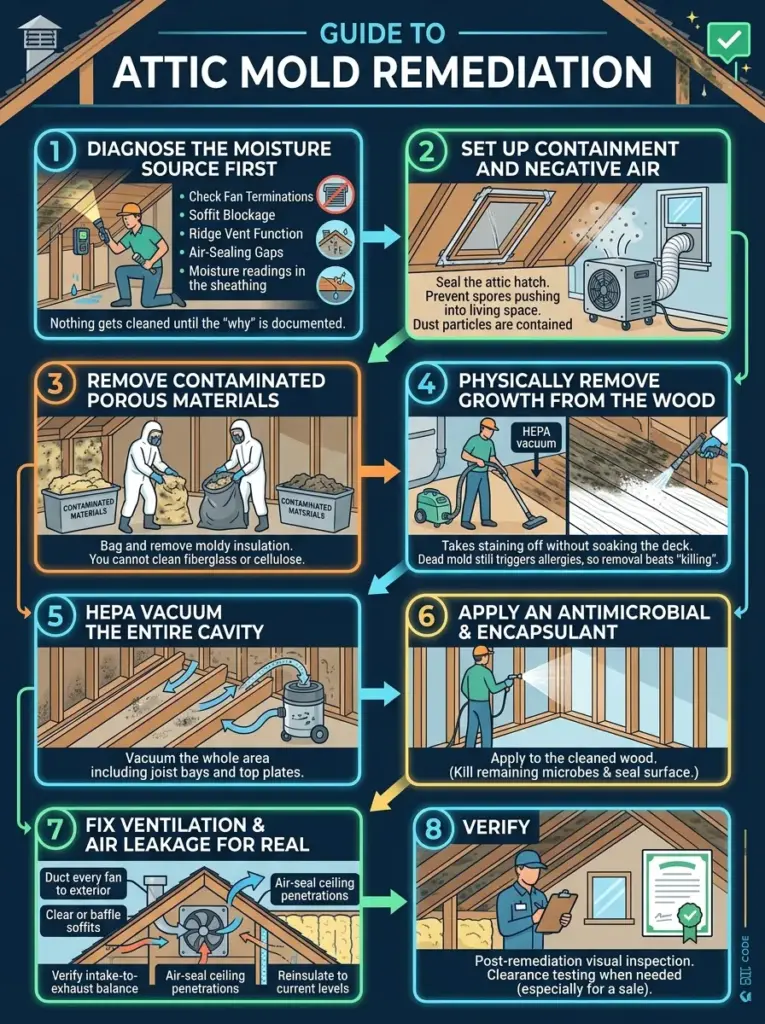
- Apply an antimicrobial and, where appropriate, an encapsulant to the cleaned wood.
- Fix the ventilation and air leakage for real: duct every fan to the exterior, clear or baffle the soffits, verify intake-to-exhaust balance, air-seal ceiling penetrations, and reinsulate to current levels.
- Verify. Post-remediation visual inspection and, when the situation calls for it, clearance testing, especially if this is tied to a sale.
Attic Mold
Three Attic Mold Myths Worth Busting
“Bleach kills it.”
What actually happens
Bleach is mostly water. On porous wood it bleaches the surface, evaporates, and leaves the roots, and adds moisture to the exact material you’re trying to dry out.
“Just add a ridge vent.”
What actually happens
Exhaust without intake does nothing, and can even pull conditioned air up from the house. Ventilation only works as a balanced system.
“Spray an encapsulant over it.”
What actually happens
Painting over live growth on wet sheathing hides the problem until it spreads under the coating. Encapsulant is the last step, never the only step.
Can You Remove Attic Mold Yourself?
Sometimes, with honest limits. The EPA’s general homeowner guidance puts the DIY ceiling at roughly 10 square feet of moldy surface; beyond that, they recommend bringing in professionals. If your growth is a small patch, the wood is dry, the cause is obvious and already fixed, and nobody in the house has asthma or a compromised immune system, a careful cleanup is reasonable. Wear an N95 or better, goggles, and gloves. Work on a cool day, attics hit dangerous temperatures fast. Use a HEPA vacuum and a detergent or vinegar solution rather than bleach, and don’t saturate the wood.
Be realistic about when to stop, though. Most attic mold is larger than it looks from the hatch, because the eaves are where it’s worst and the eaves are where you can’t reach. Walking a floored-out attic is one thing; balancing on ceiling joists over drywall with a respirator fogging your goggles is another, and every year people put a foot through a bedroom ceiling doing it. Anything covering multiple rafter bays, anything tied to a real estate transaction, anything on soft wood, and anything where you can’t identify the moisture source belongs to a crew with containment, negative air, and documentation.
How Much Does Attic Mold Removal Cost?
Here are real NY-metro ranges rather than a vague “it depends.” What drives your number is square footage, how much insulation has to come out, whether ventilation and air-sealing corrections are included, and access.
| Scope of work | What’s included | Typical cost (NY metro) |
|---|---|---|
| Small, localized treatment | Under ~10 sq ft, dry wood, cause already corrected, HEPA clean + antimicrobial | $500 – $1,500 |
| Standard attic remediation | Containment, negative air, HEPA removal, abrasive cleaning of sheathing, antimicrobial + encapsulant | $1,500 – $4,500 |
| Full remediation + insulation + ventilation | Above, plus insulation removal and replacement, fan re-ducting, soffit baffles, air sealing | $4,500 – $12,000+ |
| Add-on: post-remediation clearance testing | Third-party air/surface sampling and written clearance report | $400 – $900 |
Two honest notes on those numbers. First, most complete attic jobs in Brooklyn, Queens, and Long Island land in the $3,000–$6,000 range once insulation and ventilation corrections are in scope, and reputable companies won’t warranty attic mold removal without them, because cleaning wood and leaving the moisture source is knowingly setting up a repeat. Second, the outfits quoting $700 to “fog the attic” are the reason so many homeowners are searching this topic a second time in 2028. Our full attic mold removal cost guide breaks down each line item, including what insulation removal actually adds per square foot.
How Do You Prevent Attic Mold From Coming Back?
Prevention is moisture management, repeated. Once the growth is gone, keeping attic mold from returning comes down to four moves, roughly in order of impact:
- Vent every exhaust fan to the exterior. Bathroom fans, kitchen fans, dryers. Rigid or semi-rigid duct, insulated where it runs through cold space, with a working exterior damper. This one fix solves a large share of the attics we see.
- Restore balanced airflow. Clear the soffits, install baffles so insulation can’t plug them again, and make sure intake area is at least equal to exhaust area. A ridge vent with choked soffits is decoration.
- Air-seal the ceiling plane. Seal around recessed lights, the attic hatch, plumbing stacks, wiring penetrations, and top plates. Then insulate over it. Less house air upstairs means less moisture to condense.
- Keep indoor humidity in check — run bath fans for 20 minutes after showers, use the range hood, and hold winter indoor relative humidity around 30–40%.
- Look twice a year. Ten minutes at the hatch in midwinter (checking for frost) and midsummer (checking for smell) catches almost everything early. Our attic mold prevention checklist walks through both passes.
Ventilation vs. Sealed/Conditioned Attic: Which One Stops Attic Mold?
There are two legitimate strategies, and choosing the wrong one for your house is how attic mold comes back.
| Vented attic (traditional) | Sealed / conditioned attic | |
|---|---|---|
| How it works | Soffit intake + ridge exhaust flush moisture out; attic stays near outdoor temp | Roof deck is insulated and air-sealed; attic is brought inside the thermal envelope |
| Typical cost | Low ($ hundreds to ~$2,500 for vents, baffles, air sealing) | High ($8,000–$25,000+ with spray foam) |
| Best for | Most existing NY homes with accessible soffits and simple roof geometry | Complex roofs, cathedral ceilings, attics containing HVAC equipment or ductwork |
| Main failure mode | Blocked intake, unsealed ceiling leaks | Improper installation trapping moisture in the deck |
| Risk of attic mold returning | Low if intake, exhaust, and air sealing are all corrected | Low if installed correctly; costly to remediate if not |
For the large majority of homes we work in, the vented approach done properly is the right call. Sealed attics earn their cost when the HVAC lives up there.
Attic Mold: Signs, Dangers, Removal, and What It Actually Costs: Final Thoughts
Attic mold is one of the most solvable mold problems in a house, as long as you treat it as the ventilation and moisture problem it actually is. The homeowners who pay once are the ones who fixed the bath fan, opened the soffits, and sealed the ceiling plane at the same time the sheathing got cleaned.
The homeowners who pay twice are the ones who bought the cheapest cleaning and left the steam pipe running. Catch it early using the signs above, resist the bleach-and-hope shortcut, and get an honest diagnosis before a price. Whether you handle a small patch yourself or hand off a full remediation, dealing with attic mold now is always cheaper and simpler than dealing with it three days before closing.
Get Eyes on Your Attic Before You Get a Quote
Frequently Asked Questions About Attic Mold:
Is attic mold dangerous to my health?
It can be, particularly for kids, older adults, and anyone with asthma, allergies, or a weakened immune system. The EPA links damp, moldy environments to respiratory irritation and asthma attacks in sensitive people. Attic mold is generally less likely to reach your living space than basement growth, but attics with HVAC equipment or ductwork are a direct exception.
What causes attic mold in the first place?
Almost always condensation, not a roof leak. Warm humid air from your house rises into a cold attic and condenses on the roof sheathing. The usual culprits are bathroom or dryer fans venting into the attic, soffit vents blocked by insulation, and unsealed ceiling penetrations.
How much does attic mold removal cost?
Small localized jobs run about $500–$1,500. A standard attic remediation typically runs $1,500–$4,500, and a full job including insulation replacement and ventilation corrections runs $4,500–$12,000+. Most complete NY-metro attic jobs land between $3,000 and $6,000.
Can I remove attic mold myself?
For under about 10 square feet of dry, accessible growth where the moisture source is already fixed, yes, with an N95, goggles, gloves, a HEPA vacuum, and a detergent or vinegar solution. Anything larger, anything at the eaves, anything on soft wood, or anything tied to a home sale should go to professionals.
Does bleach kill attic mold?
Not effectively on wood. Bleach is mostly water, so it lightens the surface stain while leaving the roots in the porous sheathing, and it adds moisture to a surface you’re trying to dry. Professional attic mold removal uses HEPA vacuuming, abrasive removal, and antimicrobials instead.
Is black mold in the attic more dangerous than white mold?
Don’t judge risk by color. The CDC states plainly that mold color doesn’t indicate how dangerous it is. White fuzzy growth on rafters and black staining on sheathing are both common in attics; only lab sampling identifies the species.
Will attic mold go away on its own if I fix the ventilation?
Fixing ventilation stops it from growing further, but the existing growth and staining stay put, and dead spores still trigger allergic responses. You need both: correct the moisture and physically remove what’s already there.
How long does attic mold remediation take?
Most residential attics are a one- to two-day job. Add a day if insulation is being removed and replaced, and add scheduling time if post-remediation clearance testing is required for a real estate transaction.
Does homeowners insurance cover attic mold?
Typically only when it stems from a sudden covered event like storm damage or a burst pipe, not from years of condensation or an unvented bath fan. Check your policy’s mold sub-limit, document with dated photos, and report covered water events immediately.
Will attic mold stop me from selling my house?
It won’t stop a sale, but it will complicate one. Inspectors flag it reliably, buyers request licensed remediation with documentation, and the credit demanded at the table is usually far more than the job would have cost. Remediating attic mold before listing, with a written clearance report in hand, is almost always the cheaper path.