
Mold clearance testing is the step that turns a remediation job into a documented, defensible result. Until an accredited laboratory confirms that the airborne spore levels inside your home have returned to normal, all you have is a clean looking wall and a contractor’s word. For homeowners, landlords, buyers, and property managers across Brooklyn, Queens, Long Island, and The Bronx, that gap matters, because New York State treats post-remediation verification as part of the project rather than an optional add-on.
This page walks through exactly what mold clearance testing measures, who is legally allowed to perform it, what a passing report looks like, what a failed test means for your money, and how to schedule testing on a property in the five boroughs or on Long Island.
Request mold clearance testing for your property. Our office coordinates independent, NYSDOL-licensed assessment and returns your written clearance report with full lab documentation.
Mold Clearance Testing Is the Only Proof That Remediation Actually Worked
You cannot see a mold spore. A single spore measures somewhere between 2 and 100 microns, which means several thousand of them can sit invisibly on a square inch of a wall that looks spotless. That is the entire reason mold clearance testing exists: the human eye is not an instrument, and “it looks fine now” is not a finding.
A professional mold remediation crew can pull out contaminated drywall, HEPA vacuum every surface, and still leave a project failing. Spores get pushed into wall cavities when containment is set up badly. Settled dust gets stirred back into the air when the plastic comes down. The original moisture source, a cracked foundation wall or a bathroom fan venting into the attic, never got corrected, so growth restarts inside of a week. None of that is visible on a final walkthrough. All of it shows up in a laboratory analysis.
Clearance testing answers three questions that a walkthrough cannot:
- Are airborne spore counts inside the remediated area now at or below the levels outdoors and in unaffected parts of the building?
- Are water damage indicator species such as Stachybotrys and Chaetomium absent from the indoor samples?
- Is the area dry enough that mold cannot simply grow back?
That written answer is the deliverable. It is what an insurance adjuster wants in the file, what a real estate attorney asks for at closing, and what a tenant’s attorney will subpoena if a dispute goes sideways.
Why New York Law Requires an Independent Clearance Test
New York regulates mold work more tightly than almost any state in the country. Article 32 of the New York State Labor Law took effect in 2016 and created licensing requirements for both mold assessment and mold remediation, along with minimum work standards for how projects are documented and closed out. The New York State Department of Labor publishes the licensing requirements and the license lookup on its Mold Program page.
The provision that matters most to you is the separation rule. Under Article 32, the same company cannot perform both the assessment and the remediation on the same project. An assessor inspects, samples, and writes the remediation work plan. A remediator executes that plan. When the work is finished, the assessor returns to perform the post-remediation assessment and issue clearance.
The logic is straightforward. A contractor who grades their own homework has a direct financial interest in passing. Article 32 removes that incentive by putting the clearance decision in the hands of someone who does not get paid more when the answer is yes. If a company offers to test, remediate, and clear your mold in a single visit for one flat price, that is not a bargain. That is a compliance problem you will inherit.
Who Is Legally Allowed to Perform Your Clearance Test
Your mold clearance testing must be performed by a New York State licensed mold assessor who is independent of the remediation contractor. In practice, that means one of two arrangements:
If we performed your remediation, we schedule an independent licensed assessor to conduct the clearance test. We do not sample our own work, we do not choose the lab, and we do not interpret the results. If the assessor fails us, we come back and re-clean at our cost until the property passes. That is how the law is designed to work and it is the arrangement that protects you.
If another contractor performed your remediation, or if you are a buyer, landlord, or property manager who needs verification on work you did not commission, we coordinate independent clearance testing as a standalone service. You get an unbiased read on somebody else’s job, with lab documentation you can hand to an adjuster, an attorney, or a judge.
Either way, ask any company you speak with for their license type and license number before you write a check. A remediation license and an assessment license are not the same credential, and the distinction is the whole point of the statute.
The Clearance Testing Process, Step by Step
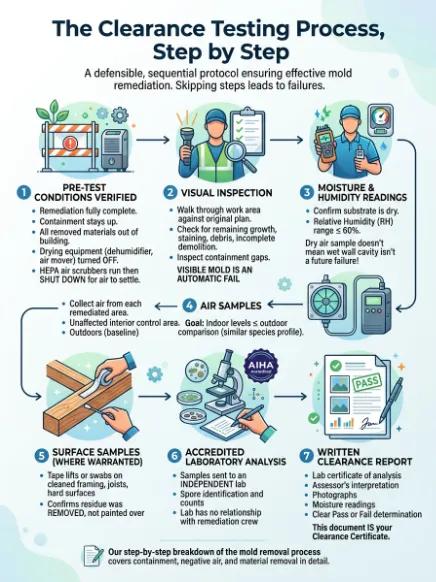
Clearance is not a single air pump in the middle of a room. A defensible mold clearance testing protocol is a sequence, and skipping steps is how projects get passed that should have failed.
What Happens During Mold Clearance Testing
- Pre-test conditions are verified. Remediation must be fully complete before mold clearance testing begins. Containment barriers stay up. All removed materials are out of the building. Drying equipment is off, because a running dehumidifier or air mover skews the sample. HEPA air scrubbers run for a set period and are then shut down so the air can settle to normal occupancy conditions.
- Visual inspection. The assessor walks the work area against the original remediation plan, looking for remaining growth, staining, debris, incomplete demolition, and gaps in the containment. Visible mold is an automatic fail regardless of what the air samples say.
- Moisture and humidity readings. Moisture meters and thermo-hygrometers confirm the substrate is dry and relative humidity is in a range where regrowth is unlikely, generally below 60 percent. A dry sample and a wet wall cavity is a project that fails in six weeks.
- Air samples. Spore trap cassettes collect air from each remediated area, from an unaffected interior control area, and from outdoors. The outdoor sample is the baseline. Mold exists everywhere outside, so the goal is never zero spores, it is indoor levels at or below the outdoor comparison with a similar species profile.
- Surface samples where warranted. Tape lifts or swabs on cleaned framing, joists, and hard surfaces confirm that residue was removed rather than painted over.
- Accredited laboratory analysis. Samples go to an independent AIHA accredited laboratory for spore identification and counts. The lab has no relationship with the remediation crew and no knowledge of what result anyone was hoping for.
- Written clearance report. You receive the lab certificate of analysis, the assessor’s interpretation, photographs, moisture readings, and a clear pass or fail determination. That document is your clearance certificate.
For context on what precedes this stage, our step-by-step breakdown of the mold removal process covers containment, negative air, and material removal in detail.
The Clearance Testing Process, Step by Step
There is no single federal number that defines “safe” for indoor mold. The EPA does not publish a numeric exposure limit, a point it makes clearly in its mold guidance for homeowners. Clearance is therefore comparative rather than absolute, and any company that quotes you a magic spore count as a legal threshold is inventing it.
A passing mold clearance testing report generally shows all of the following:
- Indoor spore counts at or below the outdoor control sample. Total counts inside the remediated area should be lower than the outdoor baseline collected the same day under the same weather conditions.
- A similar species profile to outdoors. Indoor air should look like filtered outdoor air, not like its own ecosystem.
- No water damage indicator species indoors. Stachybotrys chartarum, Chaetomium, and Fusarium do not belong in indoor air at any meaningful concentration. Their presence indicates ongoing or incompletely addressed water intrusion.
- No visible growth and no settled debris in the work area.
- Moisture content within normal range for the building materials tested.
One detail worth understanding: outdoor counts swing enormously by season. A humid August afternoon in Queens produces outdoor spore levels many times higher than a January morning. Because clearance is comparative, testing on a heavy pollen day can produce a technically passing result that would not pass in February. A competent assessor documents the weather conditions and flags that context in the report rather than quietly banking the easy pass.
What Happens When a Clearance Test Fails
A failed test is not a disaster. It is the system working. Roughly speaking, failures fall into four categories, and each has a defined remedy.
- Incomplete Removal: Residual growth was left behind on framing, subfloor, or inside a wall cavity. The remediator returns, extends the scope, and re-cleans.
- Cross-Contamination: Containment leaked and spores migrated into clean areas of the home. This usually means additional rooms now need HEPA cleaning and their own mold clearance testing.
- Inadequate Final Cleaning: Settled spores in dust were never fully HEPA vacuumed and wiped. Detail cleaning and a re-test typically resolves it.
- Uncorrected Moisture: The most serious category, because it means the underlying water problem is still active. No amount of re-cleaning fixes a hydrostatic pressure issue, a failed grade, or a leaking cove joint. The water source gets corrected first, then remediation is repeated, and then the area is re-tested.
Here is the part that protects your wallet: when we perform the remediation and the property fails clearance, the corrective work and the re-test are on us, not on you. A remediation contractor who tries to bill a homeowner for a failed clearance is telling you something important about how they operate.
When You Need a Clearance Test in Brooklyn, Queens, Long Island, and The Bronx
Mold clearance testing is not only for the end of a remediation job. These are the situations where property owners throughout Brooklyn, Queens, Long Island, and The Bronx request it most often:
After Professional Remediation: This is the standard use case and the one Article 32 contemplates.
Before Closing on a Home With a Mold History: Buyers and their attorneys increasingly require a clearance certificate rather than a repair receipt. Our guide on whether you can sell a house with mold explains the disclosure side of the transaction.
To Support an Insurance Claim: Adjusters want documented before-and-after conditions, and clearance provides the final record. See our breakdown of mold testing and insurance claims to learn how carriers evaluate the file.
During Landlord and Tenant Disputes: Mold in a New York City multiple dwelling can generate an HPD violation. Clearance documentation helps close the loop after the correction is completed.
After Water Damage: Basement flooding, sewer backups, and burst pipes can introduce mold growth in concealed areas that were never opened or inspected.
When Symptoms Continue: Additional testing may be appropriate when occupants continue reporting symptoms after remediation was supposedly completed.
For Sensitive or Documented Occupancies: Commercial tenant turnover, schools, daycare facilities, and managed property portfolios may require documented indoor air quality before normal use resumes.
Mold Clearance Testing Service Area
We provide mold clearance testing throughout Brooklyn, including Bay Ridge, Park Slope, Bushwick, Flatbush, Sheepshead Bay, and Williamsburg; Queens, including Astoria, Flushing, Forest Hills, Jamaica, Ridgewood, and the Rockaways; Long Island, including all of Nassau and Suffolk counties, from Great Neck and Hempstead through Huntington, Islip, and the East End; and The Bronx, including Riverdale, Throgs Neck, Pelham Bay, and Morris Park.
Mold Clearance Testing for Brooklyn, Queens, Long Island, and The Bronx: Final Thoughts
Mold clearance testing is the post-remediation verification step that confirms a remediated area is safe to re-occupy. A licensed assessor performs a visual inspection, takes moisture readings, and collects air and surface samples that go to an accredited laboratory. The result is a written pass or fail determination supported by lab data.
Frequently Asked Questions About Mold Clearance Testing:
What is mold clearance testing?
Penicillium mold is common, but indoor growth can contribute to respiratory irritation and allergy-type symptoms, especially when spores remain airborne for extended periods.
Is clearance testing required by law in New York?
New York State Labor Law Article 32 requires a post-remediation assessment on licensed mold projects, and it prohibits the company that performed the remediation from also performing the assessment on that same project. The practical effect is that your clearance test must come from an independent licensed mold assessor.
Can my remediation company do the clearance test?
Not on their own project in New York. If a contractor offers to remediate and clear the same job themselves, that arrangement conflicts with Article 32 and undermines the value of the test. Reputable remediators schedule an independent assessor instead.
How long after remediation can the test be done?
Testing can begin once remediation is fully complete, all debris is removed, drying equipment is shut off, and HEPA scrubbers have run long enough for airborne spores to settle to normal conditions. On most residential jobs that is the same day or the next day after the crew finishes.
How long after remediation can the test be done?
How much does mold clearance testing cost?
In the New York metro, a single area clearance with a small number of air samples and an outdoor control typically runs $400 to $900. Multi-room or whole floor clearance commonly runs $900 to $1,800. Additional lab samples generally cost $75 to $125 each.
What are acceptable mold spore counts for a passing test?
There is no federally established numeric limit for indoor mold. Clearance is comparative: indoor spore counts in the remediated area should be at or below the outdoor control sample taken the same day, with a similar species mix and no water damage indicator species such as Stachybotrys or Chaetomium indoors.
What happens if the clearance test fails?
The remediator returns to address whatever the report identified, whether that is residual growth, cross-contamination, incomplete cleaning, or an uncorrected moisture source. The area is then re-tested. On projects we remediate, corrective work and the re-test are at our cost, not yours.
How long does it take to get results?
Sampling on site usually takes one to three hours depending on the number of locations. Standard laboratory turnaround is two to five business days, and most labs offer 24 hour rush analysis for an additional fee.
Do I need clearance testing to sell my house?
It is not universally required, but if mold has been disclosed or repaired, buyers, buyer’s attorneys, and lenders frequently ask for a clearance certificate before closing. A clearance report is far stronger at the closing table than an invoice showing the work was done.
Can I do mold clearance testing myself with a DIY kit?
No. Consumer settle plate kits do not produce volumetric air data, do not include an outdoor control collected under controlled conditions, and are not accepted by insurers, attorneys, or housing agencies. Clearance requires calibrated sampling equipment, accredited laboratory analysis, and a licensed assessor’s interpretation.