
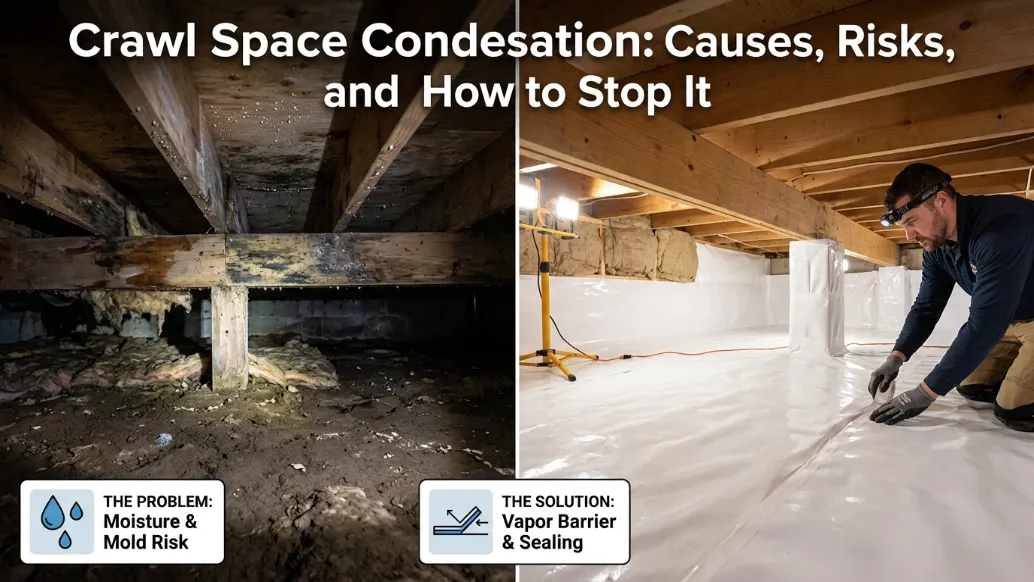
Crawl space condensation is one of those problems homeowners rarely see until it has already done damage, because it happens in a space nobody visits. If you have opened the hatch and found beads of water on the ductwork, damp insulation sagging from the floor above, or a musty smell rolling up into the house, you are looking at condensation.
It forms when humid air meets the cooler surfaces under your home and the moisture turns to water, and it is one of the most common and most misunderstood moisture issues in the region. Crawl space condensation is not just a nuisance under the floor.
It rusts metal, ruins insulation, feeds mold on the joists, and pushes humid air upward into the rooms where your family lives. This guide explains why it happens and, more importantly, the fix that actually stops it.
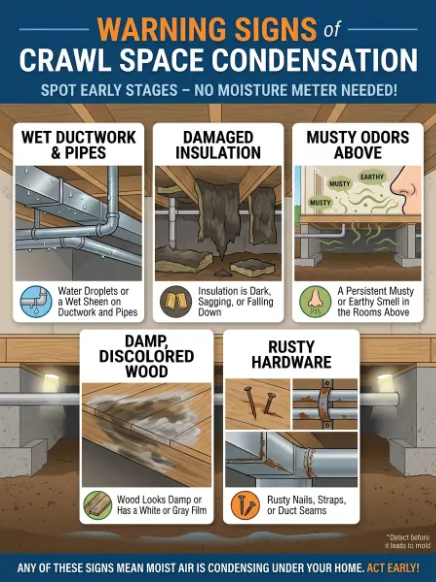
The Warning Signs of Crawl Space Condensation
Crawl space condensation usually shows itself long before most homeowners think to look for it, and you do not need a moisture meter to catch it. On a quick pass with a flashlight, these are the signs that moist air is condensing under your home:
- Water droplets or a wet sheen on ductwork and pipes
- Insulation that is dark, sagging, or falling down
- A persistent musty or earthy smell in the rooms above
- Wood that looks damp or carries a white or gray film
- Rusty nails, straps, or duct seams
Any one of these means moist air is condensing under your home, and the more you spot together, the longer it has been going on. If you are already seeing growth, our guide to mold on floor joists in a crawl space covers what that stage looks like and why it needs professional waterproofing.
What Causes Crawl Space Condensation
The physics is the same as a cold drink sweating on a summer day. Warm air holds a lot of moisture. When that warm, humid air touches a surface that is cooler than its dew point, the air right at that surface can no longer hold the water vapor, and it condenses into liquid. Under your house, the cool surfaces are the earth-cooled floor, the metal ductwork, the water pipes, and the underside of the subfloor.
The counterintuitive part is where the humid air comes from. For decades, crawl spaces were built with open vents on the theory that outside air would keep them dry. In our climate the opposite happens. On a hot, humid day, that warm outdoor air pours in through the vents, meets the cooler surfaces below the house, and dumps its moisture as condensation. The vents that were supposed to solve the problem are often the thing feeding it. Rising moisture from bare soil and the stack effect pulling air upward through the house make it worse.
Contractor note: If your crawl space condensation is worst in summer, open vents are almost always the cause. Homeowners often try to fix a damp crawl space by adding more ventilation, which pulls in even more humid air and increases the sweating. The dampest crawl spaces we see are usually the most heavily vented ones.
Is It Dangerous to Leave Condensation in Your Crawl Space?
Yes, leaving condensation in your crawl space is dangerous, because it quietly attacks the parts of the house that are most expensive to repair. The moisture rots structural wood, rusts metal connectors, ruins insulation, and pushes damp, spore-laden air up into your living space. The EPA guidance on mold and moisture puts the core principle plainly: control the moisture and you control the mold.
Here is what a wet crawl space does when it is left alone:
- Structural Rot: Chronic moisture rots the wooden joists and subfloor that hold your floors up, which is how soft or bouncy floors begin.
- Rusted Connectors: It corrodes the metal fasteners and straps that keep the structure tied together.
- Ruined Insulation: It saturates insulation until it loses all its value and becomes a mold reservoir.
- Worse Indoor Air: Because roughly half the air upstairs originates in the crawl space, that damp air raises humidity throughout the home and carries mold spores with it.
- Rising Repair Costs: The damage moves from cheap materials to expensive ones, so wet insulation is easy to replace, but rot in the joists and subfloor means structural repair that costs many times more.
Catching the moisture early is almost always the difference between a maintenance bill and a repair bill.
How to Stop Crawl Space Condensation for Good
Because the problem is humid air meeting cool surfaces, the durable solution is to keep the humid air out and control the humidity that remains. That combination has a name: encapsulation. It works where band-aid fixes fail.
Seal the Crawl Space From Outside Air
The first move is to stop the flood of humid outdoor air. That means sealing the foundation vents and any gaps where outside air enters. This single step reverses the logic that created the problem and is why sealed crawl spaces stay far drier than vented ones in a humid climate. Our explainer on encapsulation versus a vapor barrier versus a dehumidifier shows how the pieces fit together.
Install a Full Vapor Barrier
Bare soil constantly releases moisture into the air. A heavy vapor barrier across the ground and up the walls cuts off that ground moisture at the source. On its own a liner helps, but as part of a sealed system it is transformative. Our guide on what a crawl space vapor barrier is explains the material and why coverage matters.
Control the Humidity That Remains
Once the space is sealed, a dehumidifier holds the interior humidity in a safe range so condensation cannot form. The benefits of a dehumidifier reach the whole house, and keeping humidity in the target band is the same principle behind the best humidity to prevent mold. Broader crawl space moisture control ties sealing, the barrier, and the dehumidifier into one dry system, and the full crawl space encapsulation process walks through exactly what happens beneath the house.
Water Sweating Under Your Floors?
Why Venting Does Not Fix It
The most common do it yourself response to a damp crawl space is to add more airflow, and in a humid climate that reliably backfires. More vents mean more warm, moisture heavy air entering to condense on the cool surfaces below. The same is true of a fan pushing outdoor air in during summer. This is why sealing, not venting, is the modern standard, and why crawl space mold prevention centers on keeping outside air out rather than moving more of it through. Chasing the symptom with airflow leaves the moisture source untouched.
Crawl Space Condensation: Final Thoughts
The thing to remember about crawl space condensation is that it is a systems problem, not a spot problem. It is not a leak you can patch or a puddle you can mop, it is humid air meeting cool surfaces day after day, and it will keep returning until the air itself is controlled. Adding vents or airflow tends to feed it, which is why so many homeowners fight the same dampness for years.
Sealing the space, laying a full vapor barrier, and managing the remaining humidity with a dehumidifier is the combination that finally keeps the underside of the house dry and protects the joists, insulation, and air quality above it. If your crawl space is sweating, an inspection is the fastest way to learn whether a targeted fix or full encapsulation is right, and it is the surest way to stop crawl space condensation before it reaches the structure.
Free inspection across Long Island, Brooklyn, Queens, and the Bronx. We find the moisture, explain your options, and give you a dry crawl space that stays dry.
Frequently Asked Questions About Crawl Space Condensation:
What causes crawl space condensation?
Crawl space condensation is caused by warm, humid air meeting the cooler surfaces under your home, such as ductwork, pipes, and the underside of the floor, where the moisture turns to water. It is worst in summer, when hot outdoor air enters through open foundation vents and hits those cool surfaces. Moisture rising from bare soil adds to the problem.
Is crawl space condensation a serious problem?
Yes, crawl space condensation is a serious problem, because it attacks the parts of the house that are expensive to repair. Left alone, it rots the wooden joists and subfloor, rusts metal connectors, ruins insulation, and pushes damp, spore-laden air up into your living space. The longer it runs, the more the damage moves from cheap materials to expensive structural ones.
How do I stop condensation in my crawl space?
You stop crawl space condensation by sealing the space from outside air and controlling the humidity inside it. That means sealing the foundation vents, installing a full vapor barrier over the ground and walls, and adding a dehumidifier, a package known as encapsulation. Adding more ventilation usually makes summer condensation worse, not better.
Can crawl space condensation cause mold?
Yes, crawl space condensation can cause mold, because it keeps wood and insulation damp, which is exactly what mold needs to grow on floor joists and subflooring. The same moist air then carries spores and humidity up into the home, so a wet crawl space often explains mold and musty smells on the floors above.
Why is my crawl space wet in the summer?
Your crawl space is wet in summer because hot, humid outdoor air pours in through open vents and condenses on the cooler surfaces below your home. The bigger the gap between that warm air and the earth-cooled floor and ducts, the more water forms. This is why vented crawl spaces are often dampest during the most humid months.
Does closing crawl space vents stop condensation?
Closing crawl space vents helps stop condensation, but only as part of a sealed system rather than on its own. Sealing the vents keeps humid outdoor air out, yet ground moisture and interior humidity still need to be controlled with a vapor barrier and a dehumidifier. Vents alone, opened or closed, do not fully solve the problem.
Is crawl space condensation the same as a leak?
Crawl space condensation is not the same as a leak, though they look similar. Condensation forms when humid air meets cool surfaces and beads up as water, while a leak is bulk water entering from the ground or a plumbing failure. Condensation appears as an even sheen on ducts and joists, whereas a leak shows as puddles or wet tracks on the ground.
Will a dehumidifier fix crawl space condensation?
A dehumidifier will fix crawl space condensation in most cases, but it works best once the space is sealed from outside air. On its own in a vented crawl space, a dehumidifier fights a losing battle against the humid air constantly flowing in. Paired with sealed vents and a vapor barrier, it holds the humidity low enough that condensation cannot form.
How much does it cost to fix crawl space condensation?
The cost to fix crawl space condensation depends on the size of the space and how much moisture control it needs, from a basic vapor barrier to full encapsulation with a dehumidifier. Smaller sealing jobs sit at the lower end, while complete encapsulation of a large crawl space costs more. An inspection is the only way to get an accurate number for your home.
How do I know if my crawl space has a moisture problem?
You can tell your crawl space has a moisture problem by looking for a few clear signs: water droplets or a wet sheen on ducts and pipes, dark or sagging insulation, a musty smell in the rooms above, damp wood with a white or gray film, and rust on nails or straps. Any one of these means moist air is condensing under your home.