
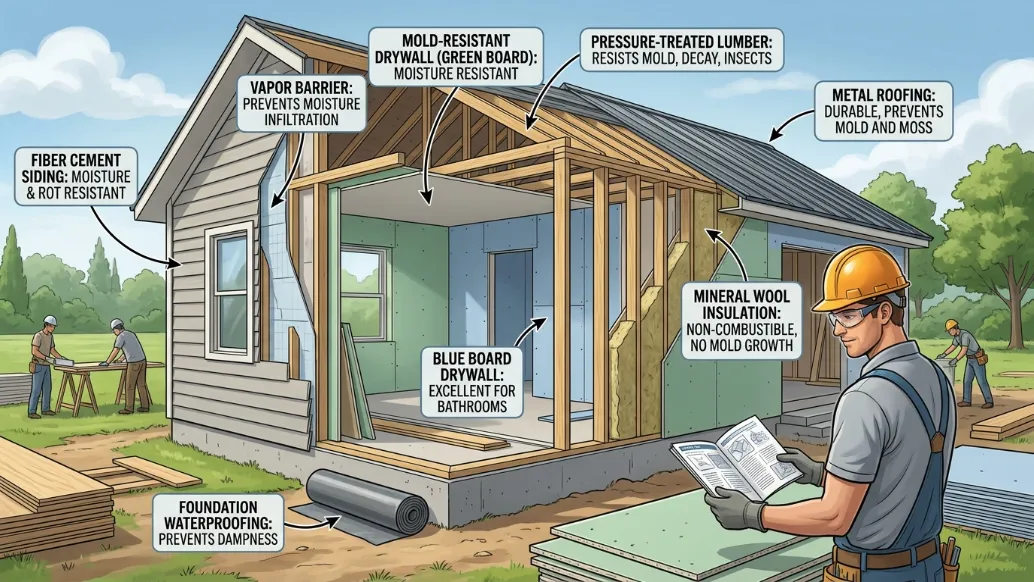
There is a version of this article on every other site on page one, and all of them are shopping lists. Here are eight products, buy them, mold gone. What none of them tells you is the single most important fact about the entire category, and it isn’t hidden in some obscure study. It’s printed in the manufacturers’ own spec sheets. Georgia-Pacific’s submittal document for its Mold-Guard gypsum board says it plainly: “No material can be considered ‘mold-proof’, nor is it certain that any material will resist mold or mildew indefinitely.” That’s not a critic talking. That’s the company selling the product.
So this page is going to do something different. Mold resistant building materials are real, they work, and in most renovations they’re worth the money. But they are a delay tactic, not immunity, and the difference between those two ideas is the difference between a basement that stays dry for twenty years and one you gut twice. We’re a remediation company, we’re the people who open the wall after these materials were already installed. Here’s what actually earns the premium, what each one costs, where it belongs, and the four problems no product on this list can solve.
What Are Mold Resistant Building Materials, Exactly?
Strip away the marketing and “mold resistant” means one specific thing: the material is harder for mold to colonize, not impossible. Manufacturers achieve that in three different ways, and knowing which one you’re buying tells you most of what you need to know about how it will perform.
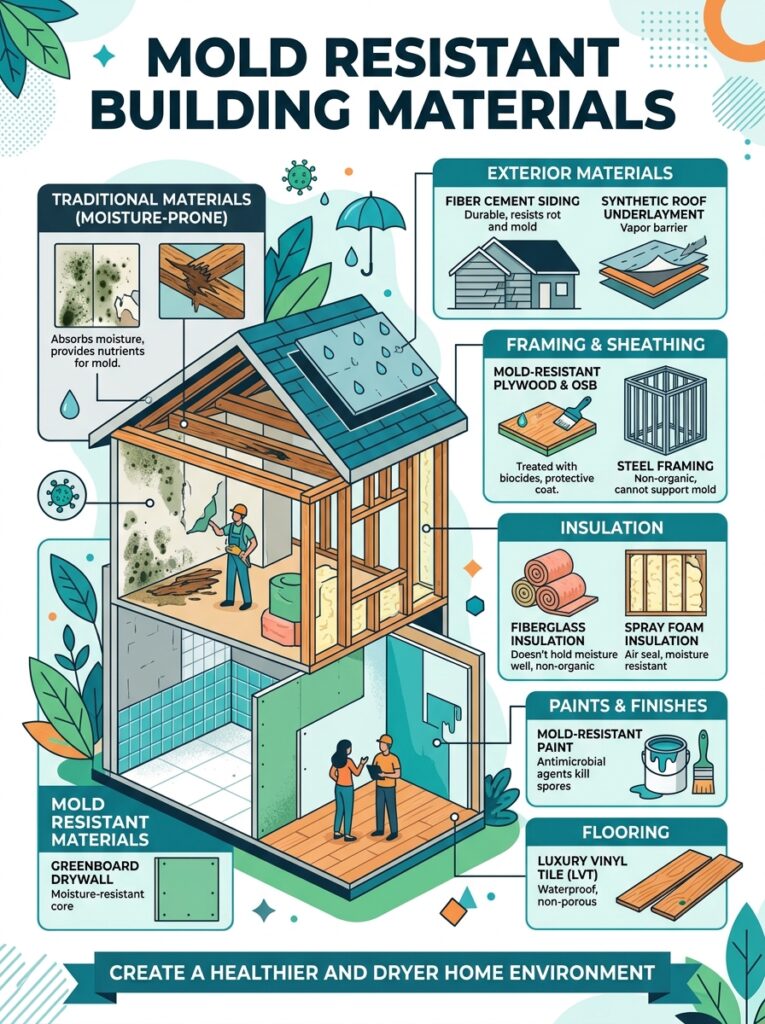
Biocide additives are fungicides mixed into the product (into the paint film, the drywall core, the caulk) that suppress fungal growth on and in that material. Non-organic facings replace the food source: instead of paper on the face of a gypsum panel, you get fiberglass mat, which mold can’t eat. Non-porous surfaces like PVC panels, tile, sheet vinyl, and quartz don’t absorb water and give spores nothing to root into. Most mold resistant building materials use one of these strategies; the best ones combine two.
What none of them do is change the physics. Mold needs a food source, a hospitable temperature, and moisture. These products attack the food source. They leave the moisture completely untouched.
Which Mold Resistant Building Materials Actually Work?
Not all of these products earn the premium, so here’s the honest ranking before the details. Grades reflect real-world performance in a wall assembly, not lab scores.
| Material | Grade | Why | Where It Earns Its Money |
|---|---|---|---|
| Paperless / fiberglass-faced gypsum board | A | Removes the paper food layer entirely rather than treating it | Below-grade walls, bathroom wet walls, laundry |
| Closed-cell spray foam / mineral wool insulation | A− | Non-organic, doesn’t absorb or hold water | Rim joists, crawl space and basement walls |
| Tile, sheet vinyl, LVP flooring | A− | Non-porous, cleanable, survives a wet event | Any floor that could ever get wet |
| Treated paper-faced “mold-resistant” board | B | Scores 10 in the lab, but the facing is still paper | Above-grade bathrooms, kitchens, moderate-risk rooms |
| Mildew-resistant paint | B− | Protects the coating well; does nothing behind it | Bathroom and kitchen ceilings and walls |
| Mildew-resistant silicone sealant | B− | Cheap, effective at the joint, needs replacing eventually | Tub surrounds, sink and counter joints |
| Coated / treated sheathing and framing lumber | C+ | Real protection during construction; modest once enclosed | New builds and additions during the exposed phase |
| Moisture-resistant “green board” | C | Slows water absorption; paper facing still feeds mold | Low-moisture backer; not a wet-area answer |
| PVC wall panels | C+ | Genuinely non-porous, but surface film still hosts growth | Garages, utility rooms, wash-down spaces |
Mold Resistant vs. Mold Proof: The Word That Is Not There
You will see “mold proof” in forums, contractor pitches, and search results. You will almost never see it on a product label, and that is deliberate. Manufacturers are careful with the claim. Georgia-Pacific states that no material can be considered mold proof. American Gypsum takes a similarly cautious approach in its installation guidance, advising installers to replace moisture-exposed gypsum board whenever there is doubt about whether it should remain in place. That is not guidance a manufacturer would give for a product believed to be immune to mold.
The difference between a shopping term and a product specification is where homeowners can lose money. Someone spends extra on premium drywall, assumes the wall is protected, and skips the dehumidifier, drainage correction, or leak repair. Eighteen months later, mold may be growing behind the panel, inside the insulation, or on the framing. Those materials may not have been mold resistant at all.
Mold resistance gives an assembly more margin when moisture gets where it should not. It does not make moisture problems safe to ignore.
What ASTM D3273 Actually Tests, and What a Score of 10 Really Means
Nearly every product in this category points to the same test result: a score of 10 under ASTM D3273. Many articles cite that number as proof of performance without explaining what the test measures.
For the test, a panel is placed in an environmental chamber maintained at roughly 95% to 98% relative humidity for 28 days. Mold spores are introduced into soil within the chamber. At the end of the test period, the panel surface receives a score from 0 to 10. A 10 means no visible mold growth appeared on that tested surface.
Fiberglass-faced gypsum products can score a 10. Treated paper-faced mold-resistant drywall can also score a 10 when tested as manufactured.
The important limitation is what the score does not tell you. The gypsum industry acknowledges that this laboratory test does not predict field performance. USG notes that ASTM lab testing does not accurately represent the mold performance of building materials in real installations. Poor storage, improper installation, leaks, condensation, or ongoing moisture can allow mold to overwhelm any building material. Georgia-Pacific similarly notes that controlled laboratory results may not match actual installation conditions. USG also states that test results do not represent definitive installed performance.
A score of 10 still matters. It shows that the tested surface resisted visible colonization for four weeks in a high-humidity chamber, which standard paper-faced drywall may not do. It is a useful comparison point when choosing mold-resistant building materials.
It is not a warranty against a leaking supply line, basement humidity, floodwater, or a wet wall cavity. Read the score as a starting condition, not a promised outcome.
Materials That Work Against You: Avoid These in Moisture-Prone Areas
Choosing mold-resistant materials helps, but avoiding mold-friendly materials matters just as much. A wall can have fiberglass-faced drywall and still become a mold problem if the rest of the assembly traps water or introduces organic material where it does not belong.
- Carpet Below Grade: Carpet padding holds water for days, and the backing can serve as a food source. Replace it with LVP, sheet vinyl, or tile.
- Vinyl Wallpaper on Exterior or Below-Grade Walls: Vinyl wallpaper can trap moisture behind an impermeable surface, creating a classic hidden-mold assembly. Use paint instead.
- Paper-Faced Insulation Batts in Basements and Crawl Spaces: Kraft paper against a cold surface creates an easy food source in a high-condensation location. Use unfaced fiberglass, mineral wool, or closed-cell spray foam.
- MDF Trim and Cabinetry in Bathrooms and Laundry Rooms: MDF swells when it gets wet and rarely returns to its original condition. Use PVC trim or solid wood in moisture-prone rooms.
- Standard Paper-Faced Drywall Below Grade: The cheapest drywall sheet in the store can become the most expensive wall in the house when basement moisture reaches its paper facing. Use fiberglass-faced board or another material appropriate for the assembly.
Mold-Resistant Paint: What It Protects, and What It Does Not
Mildew-resistant paint contains fungicides that help keep the paint coating free of surface mildew. In a steamy bathroom, that can make a real difference. It may mean occasional cleaning instead of frequent repainting. Semi-gloss and gloss finishes add another layer of practical protection because their tighter surface films shed water and clean more easily.
The limit is simple: the fungicide protects the paint film itself. It does not soak into the drywall, stop moisture from entering the wall, or prevent growth inside the wall cavity.
Painting over existing mold is the most common misuse of this product. The mold can continue growing underneath the coating if moisture and organic material remain available. Eventually, staining can bleed through or the paint can release from the surface. If a stain will not scrub off or moisture is still present, paint is not the solution. No product in the mold-resistant building materials aisle can replace moisture control and proper removal.
Insulation, Flooring, Framing, and Sealants: The Materials That Decide the Assembly
Drywall and paint get most of the attention, but insulation, flooring, framing, and sealants often decide whether a wall or basement stays dry enough to avoid mold. These materials sit within the assembly, where a problem can begin long before anyone sees it.
- Insulation: Paper-faced fiberglass batts are a weak point in many New York metro basements. Kraft paper pressed against a cold below-grade wall creates an organic food source in a condensation-prone space. Unfaced fiberglass and mineral wool do not provide that paper layer, and mineral wool is especially useful because it sheds water rather than holding it. Closed-cell spray foam performs well at rim joists because it provides insulation while also functioning as a vapor retarder. Still, insulation itself can host mold when dust and organic debris build up in it, regardless of the insulation material.
- Flooring: Tile, sheet vinyl, and luxury vinyl plank are the most practical basement flooring choices. They are non-porous, cleanable, and far more likely to survive a wet event. Carpet is usually the worst choice below grade because its padding can hold water for days and its backing can support mold growth. Engineered wood and laminate fall in the middle, but both commonly fail after even one significant water event.
- Framing and Sheathing: Treated lumber and mold-resistant coated OSB provide their strongest value during construction, when framing may sit exposed to rain and humidity for weeks. Once the structure is enclosed and kept dry, their added benefit becomes more limited. They are useful products, but they do not solve a moisture problem inside a completed wall.
- Sealants: Mildew-resistant silicone around tub surrounds, sinks, and countertops is inexpensive and effective. It is one of the better values in this category. The honest limitation is that no sealant lasts forever. Removing a failed caulk and reapplying it every few years usually matters more than buying a premium tube once and forgetting about it.
What Mold Resistant Building Materials Cost vs. Standard
Five articles rank above this one for this topic and not a single one prints a price, so here they are. Ranges are 2026 retail; a supply house will beat them.
- Drywall, 1/2″ 4×8 Sheet: Standard: $14 to $18. Mold-resistant: $20 to $26 for treated paper-faced board or $35 to $50 for paperless board. Premium: +$6 to $10 or +$20 to $35.
- Interior Paint, Per Gallon: Standard: $35 to $50. Mold-resistant: $45 to $70 for mildew-resistant paint. Premium: +$10 to $25.
- Wall Insulation, Per Sq. Ft.: Standard: $0.55 to $0.75 for kraft-faced batts. Mold-resistant: $1.10 to $1.60 for mineral wool or $1.50 to $3.00 for closed-cell foam. Premium: +$0.50 to $2.25.
- Flooring, Per Sq. Ft.: Standard: $1.50 to $3.00 for carpet and pad. Mold-resistant: $2.50 to $5.00 for LVP or tile. Premium: +$1 to $2.
- Sealant, Per Tube: Standard: $5 to $8. Mold-resistant: $8 to $12 for mildew-resistant silicone. Premium: +$3 to $4.
The whole-room math. A 12×15 basement has roughly 500 square feet of wall — about 16 sheets. Moving from standard board to treated paper-faced runs about $130 more. Going all the way to paperless runs about $400–$500 more. Add a premium paint upgrade and you’re at roughly $150 to $550 for the entire mold-resistance upgrade on a basement finish.
Against a finish job that will cost thousands, and against a basement remediation that starts around $2,000 and climbs fast, that’s a rounding error. Which produces the clearest rule in this whole article: when the wall is already open, upgrade. When the wall is closed, don’t tear it apart to do it. And if the budget is tight enough that you have to choose, put the money into the dehumidifier, the grading, or the drainage first — because that’s the problem these products can’t touch.
When These Materials Are Worth It, and When They're a Waste
The right answer changes room by room, and in about half your house the answer is “don’t bother.” Blanket-speccing mold resistant building materials through an entire home is how renovation budgets get eaten by rooms that were never at risk.
| Location | Recommended Spec | Verdict |
|---|---|---|
| Below-Grade Basement Wall | Paperless board, mineral wool or closed-cell foam, LVP or tile | Always. Highest-risk assembly in the house. |
| Bathroom Wet Wall / Tub Surround | Cement board or paperless board, mildew-resistant silicone | Always. |
| Bathroom Ceiling & Non-Wet Walls | Treated paper-faced board, mildew-resistant semi-gloss paint | Usually Worth It. |
| Laundry Room | Treated paper-faced board, LVP, mildew-resistant paint | Usually Worth It. |
| Kitchen | Standard board, mildew-resistant washable paint | Paint Only. A board upgrade rarely pays off. |
| Crawl Space | Not a drywall question. Focus on a vapor barrier and encapsulation. | Wrong Product Category Entirely. |
| Attic | Ventilation and air sealing, not specialty materials | Skip. |
| Above-Grade Bedrooms, Halls, and Living Areas | Standard materials throughout | Waste of Money. |
Three scenarios where spending here is straightforwardly wasted:
- Installing over an unresolved moisture source. You are burying a problem behind a nicer surface. It will find you.
- Upgrading dry, above-grade rooms because it feels safer. A second-floor bedroom doesn’t have a mold risk profile that justifies premium board.
- Buying materials instead of equipment or drainage. A $400 board upgrade in a basement that runs at 70% humidity all summer is money set on fire. A dehumidifier holding the space under 50% is the actual fix, our guide to the best humidity level to prevent mold covers the targets.
And the one scenario that’s a near-automatic yes: rebuilding after remediation or a water loss. You already know the assembly is vulnerable, the wall is already open, and the incremental cost is trivial against what you just spent. If you’re in that position, buy the good board.
The Expensive Mistake: Buying Materials Instead of Fixing the Moisture Source
Every material in this article is a delay tactic, and delay tactics lose to a leak.
The clearest statement of this comes, again, from a manufacturer. USG’s own technical position on mold and moisture: “There are simply too many food sources in a residential project to prevent mold from growing by eliminating just one. Mold will grow on wood studs, insulation, and drywall, just to name a few materials. The most effective way to control mold is to control moisture.”
That is a gypsum manufacturer telling you that upgrading gypsum will not solve your problem. It matches the EPA’s homeowner guidance exactly: the key to mold control is moisture control, and water-damaged materials need to be dried within 24 to 48 hours. Mold resistant building materials change what mold eats first. They change nothing about whether water arrives.
The Four Moisture Sources No Material Can Fix
These are the four conditions that put water into an assembly, and mold resistant building materials are powerless against every one of them.
- Bulk water intrusion. Bad grading, failed drainage, hydrostatic pressure through a foundation wall. The fix is exterior, grading, gutters and extensions, drainage, waterproofing. No panel on the shelf competes with a foundation pushing water.
- Plumbing leaks. A weeping supply line or a failed washer hose delivers more water in a day than any facing can shrug off. The fix is a plumber and fast drying.
- Condensation from air leakage.<span”> Warm humid indoor air meeting a cold surface, a below-grade wall, an uninsulated rim joist, a cold duct. The fix is air sealing and insulation, and in crawl spaces a proper vapor barrier. Nothing in the drywall aisle addresses it.
- Sustained high humidity. A basement sitting at 65–70% RH all summer needs no leak at all to grow mold. The fix is dehumidification and ventilation.
Notice what those four have in common: not one of them is solved at the hardware store. Our complete mold prevention guide covers the actual sequence.
What to Do If Mold Is Already Behind the Wall
Sometimes the reason someone is researching mold resistant building materials is that they already have a problem, and they’re hoping to build over it. That’s the sequence that costs the most.
Signs growth is already established behind finished surfaces: a musty odor with no visible source, staining that keeps bleeding back through fresh paint, a warped or discolored baseboard, buckling at the bottom of a wall, one room that reads noticeably higher on a humidity meter than the rest of the house, or symptoms that improve when the household leaves for a few days.
A professional assessment answers three questions the materials can’t. Where is the water coming from, is this an event or an ongoing source? How far has it gone, moisture mapping and cavity inspection tell you whether you’re replacing two sheets or a wall. And what’s salvageable, framing usually is, insulation and board usually aren’t.
Get that answered before you buy a single sheet of anything. The most expensive version of this project is the one where premium materials get installed over an active source, and the second-most expensive is the one where good materials get thrown away six months later because nobody looked first.
How We Handle It in Brooklyn, Queens, Long Island, and the Bronx
When we’re called into a finished basement, the first thing we do is find the water. We take moisture readings, map how far it’s traveled inside the assembly, and determine whether you’re dealing with a one-time event or a source that’s still running. Then we remediate to standard, containment, HEPA removal, disposal of unsalvageable materials, correct the moisture condition, and tell you honestly what to rebuild with. We don’t sell building materials, which is precisely why our advice about mold resistant building materials is worth having.
Mold Resistant Building Materials: Final Thoughts
Buy the better material. Just know exactly what you bought. Mold resistant building materials give you a slower-burning fuse, more time to catch a leak, a surface that doesn’t feed growth on contact, a wall that survives a spill instead of a spill becoming a demolition. That’s genuinely worth $150 to $500 on a basement finish, and we recommend it without hesitation whenever the wall is already open.
What they don’t give you is permission to skip the boring work. The grading, the gutters, the dehumidifier, the leak you’ve been meaning to look at, that’s where mold is actually won or lost, and every manufacturer in this category will tell you so in their own documentation if you read past the front of the box. Spend on the mold resistant building materials second. Spend on the water first.
Before You Buy the Board, Get the Wall Looked At
Mold Resistant Building Materials: Final Thoughts
Is there such a thing as mold proof drywall?
No. Georgia-Pacific’s own product submittal states that no material can be considered mold-proof, and no reputable manufacturer makes that claim. Products are mold resistant, harder to colonize and slower to fail, which is a real and useful difference, but not immunity.
Does mold resistant drywall actually work?
Yes, within limits. It significantly outperforms standard paper-faced board, particularly the paperless fiberglass-faced type, which removes the organic food layer entirely. It extends the window before growth starts after a wetting event. It does not stop mold when moisture keeps arriving.
Does mold resistant paint really prevent mold?
It prevents mildew on the paint film, which is real value in a steamy bathroom. It does not affect growth in the substrate or the wall cavity behind it, and painting over existing mold reliably fails. Under EPA rules, these products legally cannot claim to protect your health.
What's the difference between green board and purple board?
Green board is moisture-resistant: a wax-treated paper facing that slows water absorption. Purple and blue mold-resistant boards add biocides to the core and facing and perform better. But both still have paper facings. Paperless fiberglass-faced board outperforms both.
Is mold resistant drywall worth the extra cost?
In basements, bathrooms, and laundry rooms, yes. The premium is roughly $130 to $500 on a typical basement finish, trivial against a remediation. In dry above-grade rooms, no. And it’s never worth buying instead of fixing an active moisture problem.
Can mold still grow on mold resistant drywall?
Yes. Biocide treatments deplete over time, and the layer of dust, joint compound, and soap film that accumulates on any finished surface becomes its own food source. Growth also commonly establishes on the back of the panel, in the insulation, and on the studs, none of which are rated.
What is ASTM D3273 and what does a score of 10 mean?
It’s a lab test: 28 days in a chamber at 95–98% relative humidity, scored 0 to 10, with 10 meaning no visible growth. It’s a legitimate benchmark, but the gypsum industry states openly that the test does not represent installed field performance.
Do I need to remove mold resistant drywall after a flood?
Usually yes. American Gypsum’s own installation guidance says that if there’s any doubt about whether to keep or replace gypsum board exposed to moisture, replace it. A mold-resistance rating buys drying time; it doesn’t make saturated board salvageable.
What materials should I avoid in damp areas?
Carpet below grade, vinyl wallpaper on exterior or below-grade walls, paper-faced insulation batts in basements and crawl spaces, MDF trim in bathrooms and laundry rooms, and standard paper-faced drywall anywhere below grade.
What are the best materials for finishing a basement to prevent mold?
Paperless fiberglass-faced gypsum board, mineral wool or closed-cell foam insulation, LVP or tile flooring, and mildew-resistant paint. But the order matters more than the list: install those mold resistant building materials only after the moisture source is resolved, with a dehumidifier holding the space under 50% relative humidity.