
If you’re struggling with mold in your crawl space, you’re not alone. Mold destroys more wood than termites and fires combined, and up to 40% of the air you breathe in your home may be coming from your crawl space right now. That means every breath could be carrying mold spores, allergens, and contaminants that impact your health and the integrity of your home.
Ignoring crawl space mold is not an option—it spreads fast, eats away at wooden structures, and can lead to expensive repairs. Whether you’ve noticed musty odors, increased allergy symptoms, or visible signs of mold growth, now is the time to act. Our crawl space mold removal services in New York provide fast, effective solutions to remove mold, restore air quality, and protect your home for the long term.
With professional crawl space mold inspection, mold remediation, and mold encapsulation, we handle everything from detection to full removal—so you won’t have to look anywhere else.
Get Your Crawl Space Mold Problem Solved Today! Contact Us Now for Expert Mold Removal in New York.

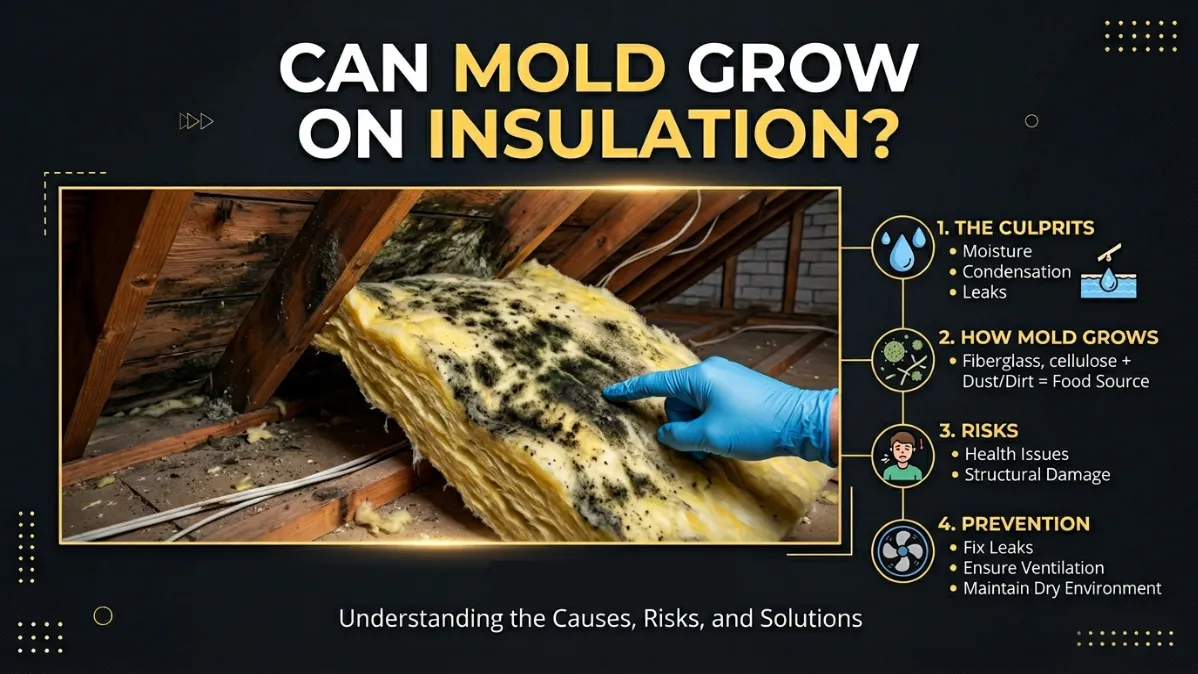
Can Mold Grow on Insulation?
Yes. Mold can grow on insulation when moisture becomes trapped and organic particles like dust, dirt, or paper backing are present. While fiberglass itself is not technically a food source for mold, insulation commonly collects enough debris and humidity to support mold growth in attics, crawl spaces, basements, walls, and around HVAC systems.
Yes. Mold can grow on insulation when moisture becomes trapped and organic particles like dust, dirt, or paper backing are present.
What most homeowners don’t realize is how easily insulation can hold moisture for long periods of time. Even small roof leaks, condensation problems, poor ventilation, or HVAC moisture can create damp conditions where mold quietly spreads behind walls and ceilings without obvious warning signs.
Once insulation becomes wet, it often loses effectiveness while continuing to trap humidity against surrounding materials. Over time, that moisture can spread into wood framing, drywall, subfloors, and other structural components, creating larger indoor air quality and structural concerns throughout your home.
Where to Look for Mold on Insulation:
- Attics: With roof leaks or poor airflow that allows condensation to build up around insulation and decking.
- Crawl Spaces: With humidity, standing water, or missing vapor barriers letting moisture saturate batt insulation.
- Basements: Affected by seepage, flooding, or condensation around cold pipes and ductwork.
- Exterior Walls: Near plumbing leaks where insulation absorbs water inside enclosed cavities.
- HVAC Ductwork: With condensation buildup that dampens insulation wraps and surrounding materials.
- Garage Ceilings: Beneath bathrooms or laundry rooms where slow leaks travel into insulation.
Homeowners often assume hidden mold is harmless because they can’t see it. Unfortunately, insulation mold problems are frequently some of the most expensive to repair because they can spread unnoticed for months before visible damage appears.
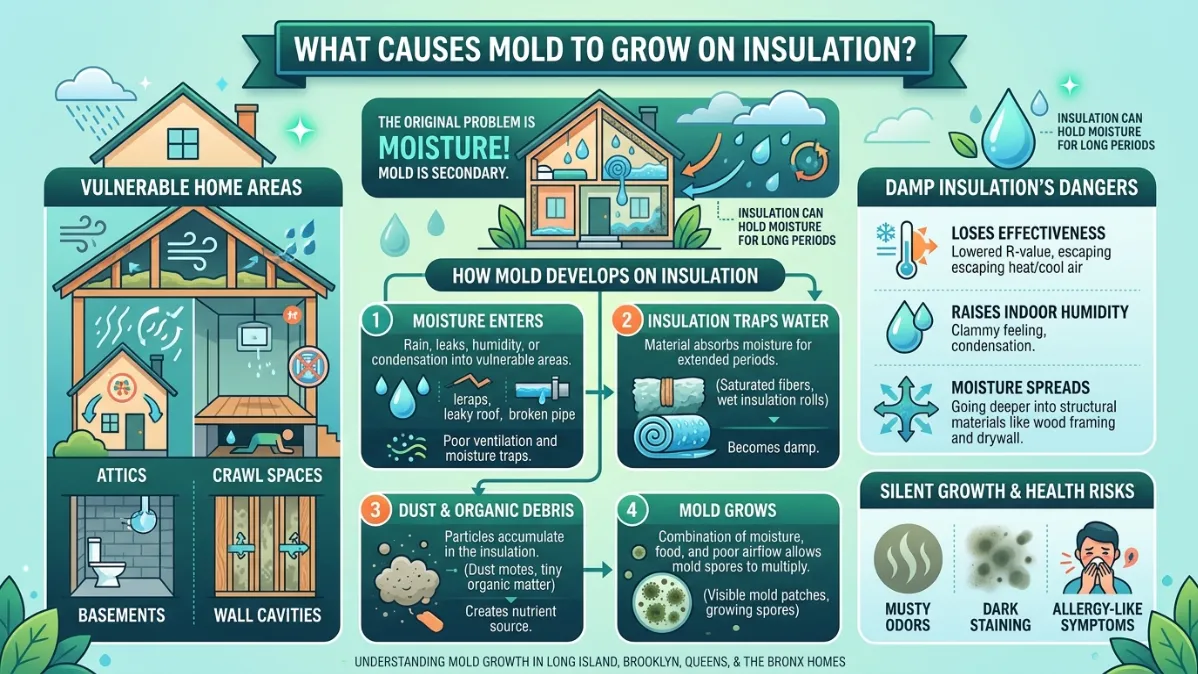
What Causes Mold to Grow on Insulation?
If your insulation has mold on it, the mold itself usually is not the original problem. Moisture is. Insulation becomes vulnerable when water, humidity, or condensation gets trapped inside areas with poor airflow. Once insulation stays damp long enough, dust, dirt, and organic debris caught inside the material create the perfect environment for mold growth. Many homeowners are surprised to learn that insulation can absorb and hold moisture for extended periods of time, especially in attics, crawl spaces, basements, and wall cavities.
Wet insulation not only creates conditions for mold growth, it also loses effectiveness, raises indoor humidity, and lets moisture spread deeper into surrounding structural materials. The dangerous part is that insulation mold problems often develop silently. By the time you notice musty odors, dark staining, or allergy-like symptoms, the contamination may already be spreading behind walls, above ceilings, or underneath flooring. Below are the most common causes of mold growth on insulation that we find in homes throughout Long Island, Brooklyn, Queens, and the Bronx.
Roof Leaks and Attic Moisture
Your attic is one of the most common places for mold to develop on insulation because moisture problems often go unnoticed for months. Even a small roof leak can slowly saturate insulation over time, especially after repeated storms or seasonal weather changes. Homeowners frequently assume a leak would create obvious ceiling stains immediately, but many attic mold problems start quietly above the living space long before visible damage appears inside the home.
Common Warning Signs in the Attic:
- Dark Staining: On insulation batts or surrounding wood framing.
- Musty Odors: Damp or earthy smells noticeable when entering the attic.
- Compressed Insulation: Flattened or sagging batts where moisture has saturated the material.
- Wood Discoloration: Around rafters, trusses, and roof decking.
- Visible Moisture: Around roof vents, exhaust fans, or chimney penetrations.
Crawl Space and Basement Humidity
Crawl spaces and basements naturally collect moisture, which makes insulation in these areas especially vulnerable to mold growth. Fiberglass batt insulation installed beneath floors is particularly vulnerable because it can absorb moisture from humid crawl spaces and stay wet for long periods of time. Once insulation becomes damp, mold can begin growing on trapped dust and debris while moisture spreads into nearby floor joists and framing materials.
We Commonly Find Mold Growth Connected To:
- Sagging Batt Insulation: Fiberglass insulation hanging beneath floor joists, soaked from below.
- Damp Rim Joists: Where the foundation meets the framing along exterior walls.
- Missing Vapor Barriers: Allowing ground moisture to migrate up into insulation and joists.
- Encapsulation Failures: Sealed crawl spaces with drainage problems or dehumidifier issues.
- Ductwork Condensation: Around cold supply lines running through unconditioned space.
- Flood-Prone Corners: Basement walls and cavities that repeatedly take on water.
HVAC Condensation Around Insulated Ductwork
Your HVAC system can quietly create the perfect conditions for mold growth around insulation, especially during hot and humid months. Cold air moving through ductwork naturally creates condensation when warm humid air contacts cooler duct surfaces. If duct insulation becomes damaged, compressed, or improperly sealed, that moisture can get trapped and remain there for long periods of time
Warning Signs Of HVAC-Related Insulation Mold:
- Musty AC Smell: A damp odor when the system kicks on or when you stand near vents.
- Allergy Symptoms Indoors: Sneezing, congestion, or eye irritation that worsens with the AC running.
- Black Spots: Around supply vents, return registers, or ceiling diffusers.
- Damp Duct Wraps: Insulation around ducts that feels wet, compressed, or discolored.
- Visible Condensation: Beading or pooling near HVAC components and duct joints.
- Ceiling Staining: Water marks around vents or near the air handler closet.
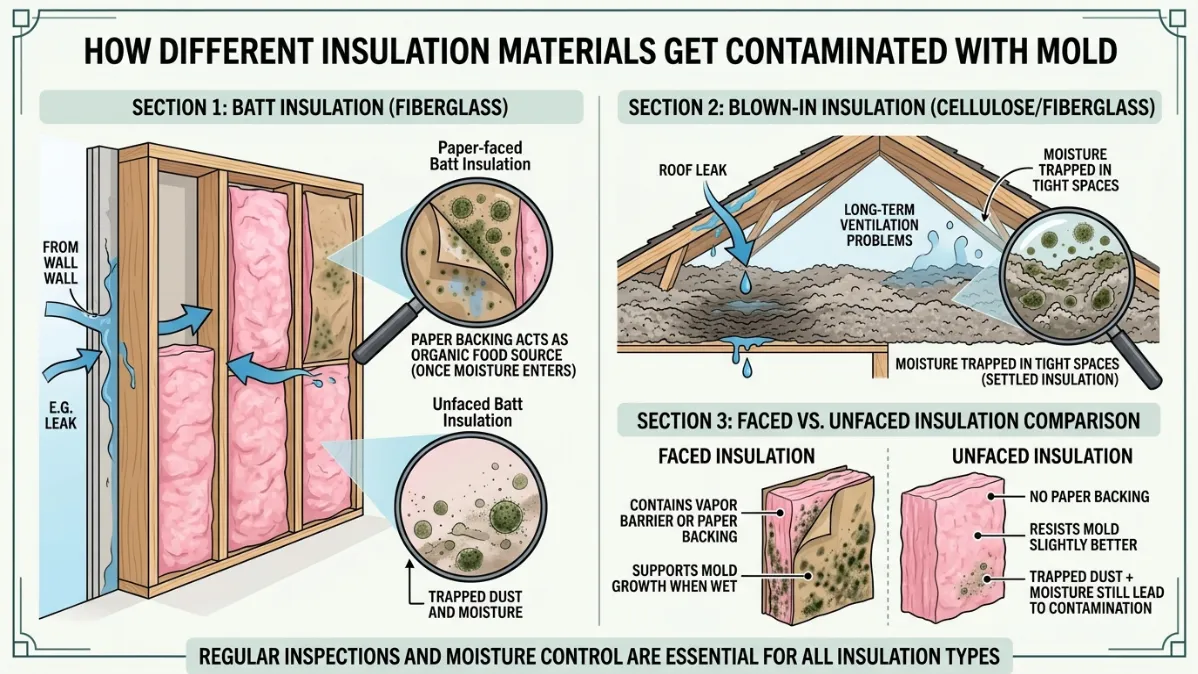
What Does Moldy Insulation Look Like?
Moldy insulation can look very different depending on the moisture source, the type of insulation involved, and how long the contamination has been developing. In some cases, the signs are obvious. In others, mold remains hidden behind walls, ceilings, or flooring systems while moisture continues spreading underneath the surface.
Common Visual Signs of Moldy Insulation:
- Black Spotting: On insulation batts or nearby wood surfaces.
- Green Patches: Fuzzy or velvety growth across damp areas.
- Gray Discoloration: Spread throughout insulation materials.
- Yellow or Brown Staining: Water damage marks indicating past or ongoing moisture.
- Matted or Compressed Texture: Insulation that has lost its loft from saturation.
- Damp or Clumped Material: Soggy sections that hold their shape when disturbed.
- Dark Streaking: Near roof decking, framing, or duct boots.
Thermal imaging, moisture meters, and professional inspections can help identify hidden moisture problems before mold spreads deeper into your home’s structure or begins affecting your indoor air quality more seriously.
Contact Mold Removal Experts Now for a Free Advanced Mold Test and Free Expert Advice!
Is Mold on Insulation Dangerous?
Yes. Moldy insulation can absolutely become a serious problem for both your indoor environment and your home itself. While not every mold exposure affects people the same way, insulation mold should never be ignored because hidden contamination can keep spreading through enclosed areas long before visible damage appears.
One of the biggest concerns is indoor air quality. Mold growing inside insulation can release airborne spores and microbial particles that circulate throughout your property, especially when contamination develops near HVAC systems, attic ventilation, or crawl spaces. What starts as a small hidden moisture issue can eventually affect multiple rooms inside your home.
Reported Health Symptoms Linked to Mold Exposure:
- Allergy-Like Reactions: Generalized congestion, fatigue, or sinus pressure.
- Sneezing and Nasal Irritation: Especially when entering certain rooms.
- Eye Irritation: Itching, redness, or watering eyes indoors.
- Headaches: Recurring headaches with no other clear cause.
- Respiratory Irritation: Coughing, wheezing, or shortness of breath.
- Asthma Flare-Ups: Worsening symptoms in people with existing asthma.
- Heightened Sensitivity: Stronger reactions in musty or humid environments.
Property-level Consequences of Moldy Insulation:
- Reduced Air Quality: Throughout the home, not just the affected area.
- Spore Distribution: Spread through HVAC airflow systems into living spaces.
- Trapped Moisture: Held against framing, drywall, and subfloors.
- Higher Energy Bills: From insulation that has lost its R-value.
- Hidden Spread: Contamination growing behind walls and ceilings unseen.
The dangerous part is that many insulation mold problems remain hidden for months because homeowners cannot easily see inside wall cavities, attics, or crawl spaces. By the time odors or symptoms become noticeable, the contamination may already be far more extensive than expected.
Should Moldy Insulation Be Removed or Cleaned?
In most cases, moldy insulation should be removed rather than cleaned. Once insulation becomes contaminated or saturated with moisture, it is often extremely difficult to fully remediate because insulation materials are porous and can trap hidden spores deep inside the material. What most homeowners don’t realize is that wet insulation also loses its insulating ability.
Even if visible mold appears limited, moisture trapped inside the insulation can keep spreading contamination into nearby structural materials long after the surface appears dry. Surface cleaning alone often does not solve the underlying problem. Hidden spores, moisture pockets, and contaminated debris may remain trapped behind walls, above ceilings, or underneath flooring systems where mold can continue returning.
How Different Mold Situations Are Handled:
Situation | Recommended Action |
|---|---|
Small Isolated Contamination | Professional Inspection And Possible Targeted Removal |
Saturated Insulation | Full Insulation Replacement |
HVAC Contamination | Professional Remediation And Duct Inspection |
Attic-Wide Contamination | Containment, Removal, And Moisture Correction |
Professional remediation teams typically remove contaminated insulation using controlled containment procedures designed to limit airborne spore spread throughout the home.
What Proper Remediation Usually Involves:
- HEPA Air Filtration: Captures airborne spores during the removal process.
Containment Barriers: Plastic sheeting that isolates the work area from living spaces. - Controlled Removal: Insulation bagged and disposed of without disturbing surrounding materials.
- Moisture Correction: Repairing the underlying leak, humidity, or ventilation problem.
- Structural Drying: Bringing wood framing and decking back to safe moisture levels.
- Surface Treatment: Antimicrobial application on nearby framing materials.
Most importantly, the moisture source must always be corrected first. If roof leaks, humidity issues, condensation, crawl space moisture, or ventilation problems are left unresolved, mold will likely return even after insulation replacement. Removing contaminated insulation without fixing the moisture problem usually leads to mold returning.
What Does Moldy Insulation Look Like?
Moldy insulation can look very different depending on the moisture source, the type of insulation involved, and how long the contamination has been developing. In some cases, the signs are obvious. In others, mold remains hidden behind walls, ceilings, or flooring systems while moisture continues spreading underneath the surface. Musty or earthy odors are often the first warning sign homeowners notice before they ever see visible mold growth. If your attic, crawl space, basement, or HVAC system smells damp or stale, hidden moisture inside insulation could already be present.
Common Visual Signs of Moldy Insulation:
- Black Spotting: On insulation batts or nearby wood surfaces.
- Green Patches: Fuzzy or velvety growth across damp areas.
- Gray Discoloration: Spread throughout insulation materials.
- Yellow or Brown Staining: Water damage marks indicating past or ongoing moisture.
- Matted or Compressed Texture: Insulation that has lost its loft from saturation.
- Damp or Clumped Material: Soggy sections that hold their shape when disturbed.
- Dark Streaking: Near roof decking, framing, or duct boots.
Thermal imaging, moisture meters, and professional inspections can help identify hidden moisture problems before mold spreads deeper into your home’s structure or begins affecting your indoor air quality more seriously.
Contact Mold Removal Experts Now for a Free Advanced Mold Test and Free Expert Advice!
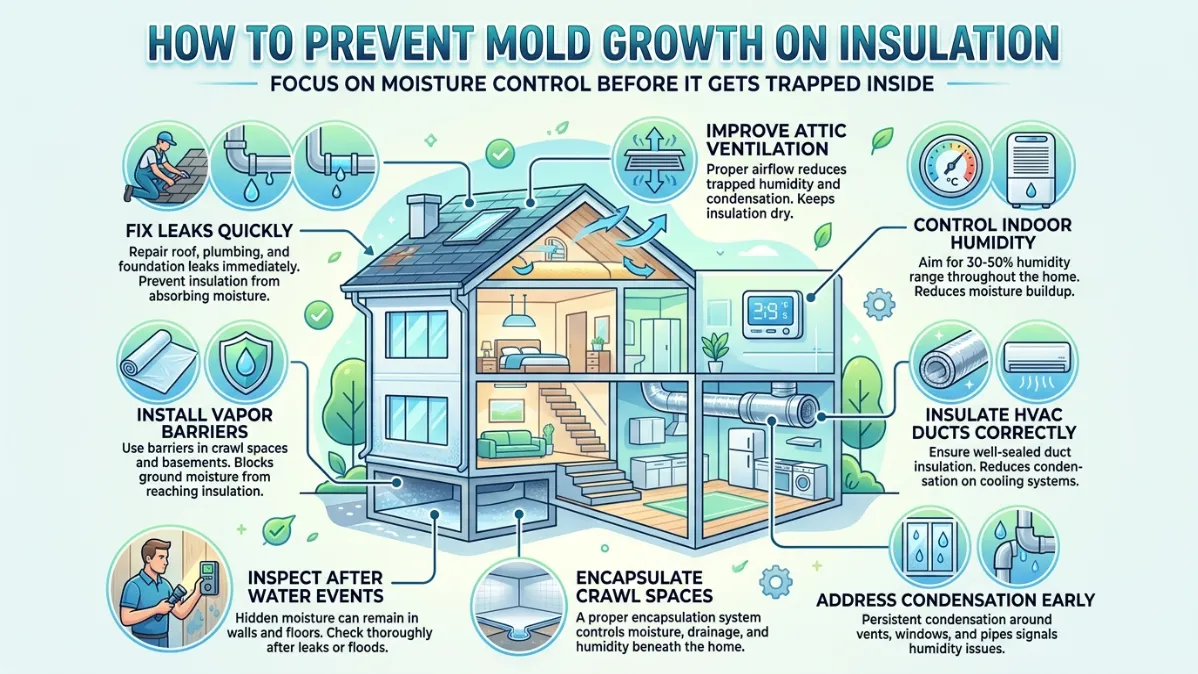
How to Prevent Mold Growth on Insulation
Preventing mold growth on insulation starts with controlling moisture before it becomes trapped inside your home. Most insulation mold problems develop slowly over time due to leaks, humidity, poor airflow, or condensation that homeowners may not notice right away. The good news is that many mold problems can be prevented with proper moisture management and regular inspections.
Steps That Protect Insulation From Mold Growth:
- Fix Leaks Quickly: Roof leaks, plumbing leaks, and foundation seepage should be addressed immediately before insulation absorbs moisture.
- Improve Attic Ventilation: Proper attic airflow helps reduce trapped humidity and condensation buildup around insulation and roof decking.
- Control Indoor Humidity: Keeping indoor humidity between 30 to 50 percent helps reduce moisture buildup throughout the home.
- Install Vapor Barriers: Vapor barriers can help prevent ground moisture and humidity from reaching insulation in crawl spaces and basements.
- Encapsulate Crawl Spaces: Proper encapsulation systems control moisture, drainage, and humidity beneath the home.
- Insulate HVAC Ducts Correctly: Well-sealed duct insulation reduces condensation buildup around cooling systems.
- Inspect After Water Events: Even if insulation looks dry on the surface, hidden moisture may still remain trapped inside walls, ceilings, or flooring systems.
- Address Condensation Early: Persistent condensation around vents, windows, pipes, or ductwork often signals larger humidity issues developing inside the home.
Can Mold Grow on Insulation? Final Thoughts
Yes, mold can grow on insulation, and in many homes, hidden moisture is the real issue driving the problem. Whether the moisture comes from roof leaks, crawl space humidity, condensation, flooding, or HVAC systems, insulation can trap dampness for long periods and create ideal conditions for mold growth behind walls, above ceilings, and beneath floors. What most homeowners don’t realize is that moldy insulation often requires removal because porous materials can hold hidden spores and moisture long after the surface appears dry. Catching the problem early can help protect your indoor air quality, reduce the risk of structural damage, and prevent more expensive repairs later.
If you suspect mold inside your insulation, schedule a professional inspection before hidden moisture spreads deeper into your home.
Book Your Free Mold and Moisture Inspection!
Frequently Asked Questions About Mold and Insulation
Can mold grow on insulation without water damage?
Yes. Mold can grow on insulation from long-term humidity, condensation, and poor ventilation even without major flooding or obvious leaks. Moisture buildup over time is often enough to create conditions for mold growth.
Does wet insulation always need to be replaced?
Not always, but heavily saturated or mold-contaminated insulation usually requires replacement. Wet insulation often loses its insulating effectiveness and may keep trapping hidden moisture even after the surface appears dry.
Can you clean mold off fiberglass insulation?
In some very limited cases, small isolated areas may be treated, but most mold-contaminated fiberglass insulation is typically removed rather than cleaned. Porous insulation materials can trap hidden spores deep inside the material.
How long does it take mold to grow on insulation?
Under the right moisture conditions, mold can begin developing within 24 to 48 hours. High humidity, condensation, or trapped water can accelerate growth inside insulation quickly.
Can attic insulation make you sick?
Mold-contaminated attic insulation may contribute to poor indoor air quality and irritation for some individuals. Homeowners sometimes report musty odors, allergy-like symptoms, sneezing, or respiratory irritation when mold is present.
What does wet insulation smell like?
Wet insulation often produces a musty, damp, or earthy smell. Many homeowners notice the odor before they ever see visible mold growth.
Is black mold common on insulation?
Dark or black-colored mold can appear on insulation, especially after long-term moisture exposure. However, mold color alone does not determine how serious the contamination may be.
Does homeowners insurance cover moldy insulation?
Coverage depends on the source of the moisture damage and the details of your insurance policy. Sudden covered events may qualify, while long-term maintenance-related moisture issues are often excluded.
How do professionals test insulation for mold?
Professionals may use moisture meters, thermal imaging cameras, air sampling, infrared detection, and visual inspections to identify hidden mold and moisture problems inside insulation systems.
Can mold spread through insulation into walls?
Yes. Once insulation becomes damp, mold and moisture can spread into surrounding drywall, framing, flooring systems, and structural materials if the moisture source is not corrected.