
Two dark patches on two walls in the same house can carry two completely different price tags. That is the whole problem with Chaetomium vs black mold. They look alike, they smell alike, they grow in the same wet conditions, and homeowners across Long Island, Brooklyn, Queens, and The Bronx call both of them “black mold” because that is the only name anyone ever taught them. Then the lab report comes back, and one of those walls turns out to be cleanable while the other one has to be cut out and rebuilt.
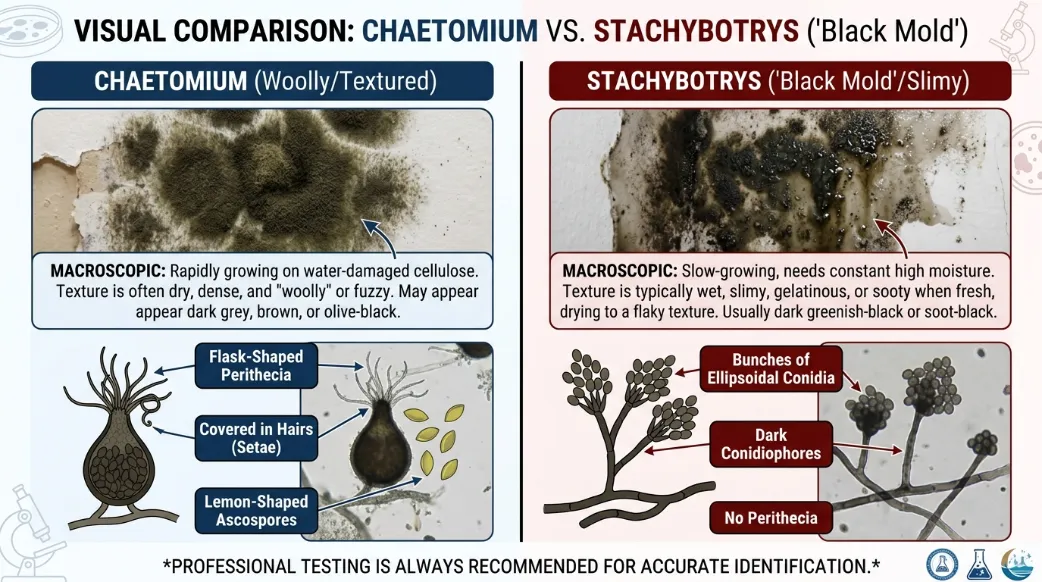
The confusion is understandable. Chaetomium starts white and cottony, then darkens through olive to near black as it matures. At that stage it is genuinely hard to distinguish by eye from Stachybotrys chartarum, the species almost everyone means when they say black mold. Mold remediation contractors mix them up too, which is how people end up paying for a surface cleaning on material that was already structurally spent.
Here is what actually separates them, why the distinction changes your scope of work and your bill, and how to know which one you have before anyone quotes you a number.
Not sure which one is on your wall? Our inspections are free. Schedule your free mold inspection now.
If you only read one section, read this one. The core difference in Chaetomium vs black mold is not toxicity, appearance, or health risk. It is what the organism does to the material it lands on.
Stachybotrys chartarum colonizes a surface. Chaetomium consumes it.
Stachybotrys grows on the paper facing of drywall and on the surface of wet cellulose. It is a serious finding, and it proves you have had water sitting somewhere for a long time, but on many materials the growth is on top of the substrate. Chaetomium secretes cellulase, an enzyme that breaks cellulose down into sugars the fungus can eat. It does not sit on your drywall. It digests it. By the time you can see it, the gypsum board behind it is often soft, delaminated, and structurally finished.
Chaetomium vs Black Mold: The Short Answer
If you only read one section, read this one. The core difference in Chaetomium vs black mold is not toxicity, appearance, or health risk. It is what the organism does to the material it lands on.
Stachybotrys chartarum colonizes a surface. Chaetomium consumes it.
Stachybotrys grows on the paper facing of drywall and on the surface of wet cellulose. It is a serious finding, and it proves you have had water sitting somewhere for a long time, but on many materials the growth is on top of the substrate. Chaetomium secretes cellulase, an enzyme that breaks cellulose down into sugars the fungus can eat. It does not sit on your drywall. It digests it. By the time you can see it, the gypsum board behind it is often soft, delaminated, and structurally finished.
Side by Side: Chaetomium vs Black Mold
| Factor | Chaetomium | Black Mold (Stachybotrys chartarum) |
|---|---|---|
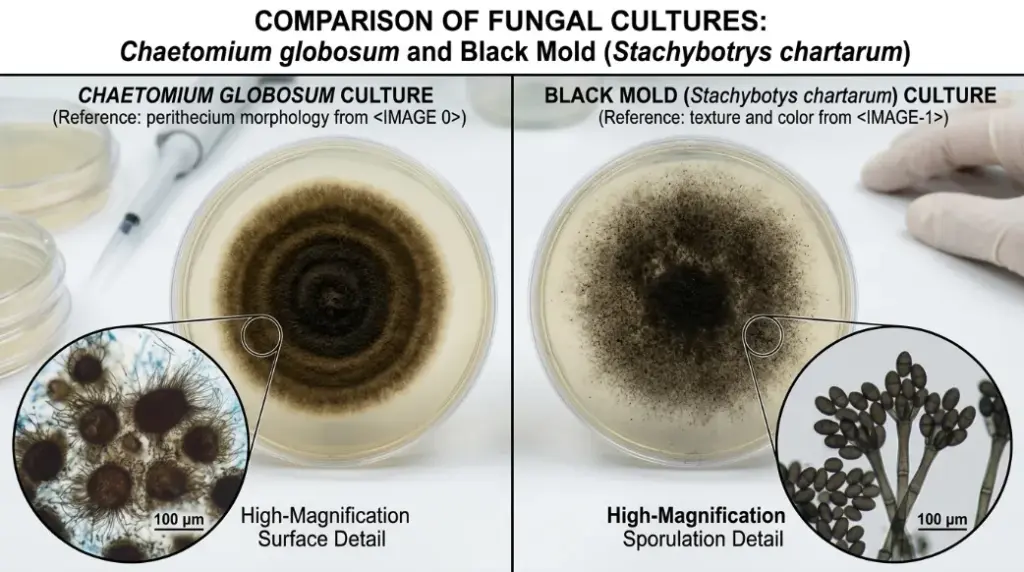
| Early appearance | White, cottony, almost fuzzy | Dark from the start, rarely light |
| Mature appearance | Olive green to gray or black, often with a lighter growing edge | Black to very dark green, uniform |
| Texture | Dry, dusty, powdery when disturbed | Wet, slimy, or sooty. Often glistens |
| Odor | Distinctly musty and dusty, like an old library or damp cardboard | Earthy, heavier, more like wet soil |
| Water required | High. Water activity around 0.90 and above | Very high. Water activity around 0.94 and above |
| Effect on materials | Digests cellulose. Drywall and trim become soft and structurally spent | Colonizes the surface. Substrate damage comes mostly from the water, not the fungus |
| Typical scope | Removal and reconstruction of affected materials | Removal of affected porous material, cleaning of non-porous |
| What it proves about the building | Sustained water intrusion, usually weeks or longer | Chronic, ongoing saturation. Often months |
Which Is More Dangerous in the Chaetomium vs Black Mold Debate?
Both produce mycotoxins. Chaetomium produces chaetoglobosins and, in some species, sterigmatocystin. Stachybotrys produces trichothecenes, including satratoxins. Both are considered toxigenic, and both are strongly associated with respiratory irritation, headaches, and worsened asthma in occupied buildings.
What the research does not support is the popular claim that either one causes catastrophic organ damage from ordinary household exposure. Most of the alarming studies involve laboratory animals dosed with concentrated toxin, not people breathing spores in a bedroom. The EPA’s position on mold and health reflects that same caution, and any contractor who tells you otherwise is selling fear rather than remediation.
The honest ranking: for your health, treat them as equivalent and get both out. For your wallet, Chaetomium is decisively the more expensive finding. We cover the toxin side in depth in our guide to mycotoxins and indoor mold, and the health picture in black mold symptoms and warning signs.
How to Tell Chaetomium vs Black Mold Without a Lab
You cannot identify Chaetomium vs black mold with certainty by looking at it. Nobody can, including us. What you can do is read the four field signals that shift the odds, so you know what to expect before the results come back.
- Check the Growing Edge: Look at the outer boundary of the patch, not the center. Chaetomium expands with a pale, cottony fringe while the interior darkens behind it, so a mature colony often reads as dark in the middle with a lighter halo. Stachybotrys tends toward uniform darkness across the whole colony.
- Touch Test the Surface, Carefully: Do not disturb a colony you plan to have tested, and never do this without an N95 and gloves. That said, Stachybotrys is typically wet, slick, and slightly gelatinous when active. Chaetomium is dry and powdery, and it puffs when brushed. That difference is one of the more reliable field indicators.
- Follow the Odor: Chaetomium has a specific smell that people consistently describe as dusty rather than earthy, the way an old book or a damp cardboard box smells. It frequently announces itself before it becomes visible, which is why a persistent musty smell with no visible growth is worth investigating. Start with the signs of hidden mold behind walls.
- Press the Substrate: This is the tell that matters most financially. Press gently on the drywall near the growth with a gloved finger. If it gives, crumbles, or feels spongy, you are almost certainly looking at cellulose that has been enzymatically degraded, which points strongly to Chaetomium. Firm board under surface growth points toward Stachybotrys.
None of these four replace testing. Retail settle plates will not settle the question either, for reasons we lay out in do at-home mold test kits work. Proper identification requires air or surface sampling analyzed by an accredited laboratory.
Why the Difference Changes Your Scope of Work
Understanding Chaetomium vs black mold matters because it determines whether the material comes out or gets cleaned, and that is nearly the entire cost of a mold job.
With Stachybotrys on a non-porous or semi-porous surface, a remediator can often clean, HEPA vacuum, treat, and dry in place. Porous material still comes out, but the demolition footprint tends to be narrower.
With Chaetomium, cleaning is not an option on affected cellulose material. The gypsum board, the paper facing, the wood trim, and sometimes the sheathing behind it have been partially consumed. You can remove every visible spore from a piece of drywall that Chaetomium has been digesting for two months and still be left with board that has lost its strength. It comes out, the cavity gets dried and verified, and new material goes back in.
Two other consequences follow. First, the demolition footprint has to extend past the visible growth, because enzymatic degradation runs ahead of what your eye can see. Second, the reconstruction is a real trade cost on top of the remediation, which is why our mold removal cost guide shows such a wide range for jobs that look similar in square footage.
What Both Findings Tell You About Your Building
Step back from Chaetomium vs black mold for a moment, because both species agree on one thing: your building has a water problem that has been running for a while.
Neither organism can grow from humidity alone. Both require water activity at or above 0.90, which in practice means liquid water in contact with cellulose for weeks. That rules out a lot of comfortable explanations. It is not condensation on a cold winter morning. It is not one bad shower with the fan off. Somewhere there is a leak, a failed shower pan, a foundation taking on groundwater, or a roof that has been letting water in through a season.
In our service area that usually means one of a short list of causes: a high water table pushing through block foundations, an unencapsulated crawl space with an earthen floor, a bathroom supply line weeping inside a wall cavity, or an attic where a bath fan vents into insulation instead of through the roof. Our guide to mold identification maps species to their moisture sources, and the world’s most dangerous mold types puts both of these in context with the other species you might be dealing with.
Find the water or you will do this again in eighteen months.
How Professionals Handle Chaetomium vs Black Mold Differently
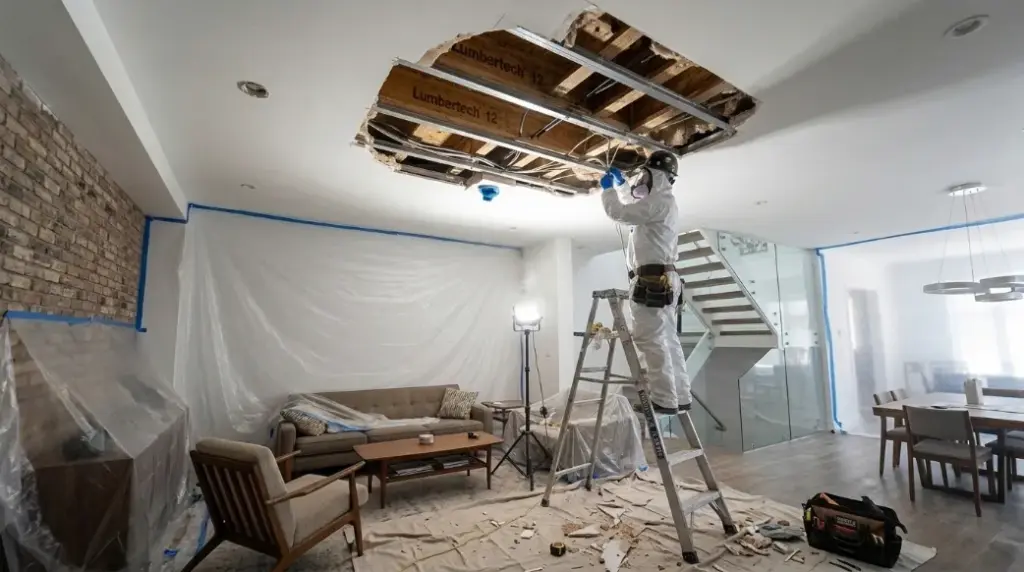
The containment, filtration, and safety protocol for Chaetomium vs black mold is essentially identical. Both are toxigenic, both release spores aggressively when disturbed, and both require full containment with negative air pressure. Where the process diverges is in assessment and in what leaves the building.
- Moisture mapping first. Thermal imaging and pin meters to find the source and the true wet footprint, which is always larger than the visible growth.
- Independent assessment and sampling. In New York, the assessor and the remediator must be separate parties on most jobs. That is state law, enforced by the New York State Department of Labor mold program, not an upsell.
- Containment and negative air. Poly barriers, HEPA air filtration devices, and a decon chamber.
- Scope decision. This is the branch point. Chaetomium findings trigger removal of affected cellulose material with an extended cut line. Stachybotrys findings allow more in-place cleaning of non-porous assemblies.
- Structural evaluation. With Chaetomium on framing or sheathing, someone needs to determine whether the member is still sound.
- Drying to a documented standard, verified by meter, not by feel.
- Independent clearance testing before anything is closed up. See mold clearance testing.
- Source correction, so the moisture condition does not return.
Our full walkthrough is in the mold removal process step by step. Before hiring anyone, check them against New York mold remediation license requirements.
Final Thoughts on Chaetomium vs Black Mold
Black mold gets the headlines. Chaetomium gets the invoice. If you take one thing from this comparison, make it this: the species name on your lab report is not a fear ranking, it is a scope of work. Stachybotrys tells you how long the water has been there. Chaetomium tells you how much of the building you are going to have to replace.
Either way the response is the same in order and different in extent. Find the water, contain the work, remove what cannot be saved, dry to a verified standard, and prove the result with independent clearance testing. Get those five right and the argument over Chaetomium vs black mold stops being an argument at all.
Free Inspections for Chaetomium vs Black Mold Across Long Island, Brooklyn, Queens, and The Bronx!
Frequently Asked Questions About Chaetomium vs Black Mold
Is Chaetomium the same thing as black mold?
No, though it is often called the other black mold. Black mold almost always refers to Stachybotrys chartarum. Chaetomium is a separate genus that happens to darken to a similar color as it matures. They require similar moisture conditions and frequently appear in the same building, sometimes on the same wall.
Which is worse, Chaetomium or black mold?
For health, treat them as roughly equivalent. Both are toxigenic and both warrant professional removal. For cost and building damage, Chaetomium is worse, because it enzymatically digests cellulose and leaves affected drywall and wood structurally unsound rather than merely contaminated.
Can Chaetomium and black mold grow together?
Yes, and they often do. Both need sustained liquid water against cellulose, so the same failed shower pan or foundation leak can support both. A single lab report frequently returns both genera from one sample area.
How do I tell Chaetomium from black mold at home?
Four field signals shift the odds: a pale cottony growing edge suggests Chaetomium, a dry powdery texture suggests Chaetomium, a wet or slimy surface suggests Stachybotrys, and soft or crumbling drywall under the growth strongly suggests Chaetomium. None of these are conclusive. Only lab analysis identifies the genus.
Does Chaetomium have a distinctive smell?
Many people describe it as dusty and musty, closer to an old book or damp cardboard than the heavier earthy odor associated with Stachybotrys. It frequently becomes noticeable before any growth is visible, which makes an unexplained musty smell worth investigating.
Can drywall with Chaetomium be cleaned instead of replaced?
Generally no. Chaetomium secretes cellulase, which breaks down the cellulose in the paper facing and degrades the board. Even with every spore removed, the material has lost integrity. Affected drywall is cut out and replaced, with the cut line extended past the visible growth.
How long does water have to sit before Chaetomium appears?
Typically one to three weeks of sustained saturation, though it varies with temperature and material. It is a later colonizer than fast species such as Penicillium, which can appear within 24 to 48 hours. Finding Chaetomium means the moisture problem is not new.
Is Chaetomium covered by homeowners insurance?
Coverage depends on the water source, not the species. Mold from a sudden accidental event such as a burst pipe is often covered, frequently with a cap. Mold from long-term seepage, deferred maintenance, or groundwater is usually excluded. Documenting the triggering event decides most claims.
Does bleach kill Chaetomium?
Not on porous material. Household bleach is mostly water, and on drywall or wood the water soaks in while the chlorine stays at the surface, leaving the fungal structure inside the material alive and the substrate wetter than before. On sealed non-porous surfaces it has some effect, but it is not a remediation method.
How much does Chaetomium removal cost compared to black mold removal?
Chaetomium jobs generally run higher for the same square footage because the affected material must be removed and rebuilt rather than cleaned in place, and because the demolition footprint extends past the visible growth. The reconstruction is a separate trade cost layered on top of the remediation itself. That single line item is the practical reason Chaetomium vs black mold is worth settling before you accept any quote.