
A New York mold remediation license is not a courtesy credential or a marketing badge. It is a legal requirement enforced by the New York State Department of Labor, and on any mold project covering more than ten square feet, working without one is unlawful. Yet the majority of homeowners across Long Island, Brooklyn, Queens, and the Bronx hire a mold company the same way they hire a landscaper: a phone call, a price, a handshake. That gap is exactly where the bad actors in this trade live.
This guide explains what the license actually covers, why New York separates the person who inspects from the person who removes, how to confirm a contractor is licensed in about five minutes, and what a legally compliant job looks like from the first visit to the final clearance test.
What a New York Mold Remediation License Covers
New York State Labor Law Article 32 created a licensing system with a simple goal: stop a single company from diagnosing a problem, inflating it, and then selling the cure. The Department of Labor’s Mold Program enforces training requirements, licensing requirements, and minimum work standards for anyone performing mold assessment or mold remediation for the public.
Three License Types You Will See on a Job
The law recognizes distinct roles, and each carries its own license. Confusing them is the single most common way homeowners get talked into something noncompliant.
| License Type | What This Person Does | What They Cannot Do |
|---|---|---|
| Mold Assessor | Inspects the property, samples if needed, and writes the remediation protocol that defines the scope of work. | Cannot perform the remediation on that same property. |
| Mold Remediation Contractor | Performs the physical removal, containment, cleaning, and disposal according to the assessor’s protocol. | Cannot write the assessment or the clearance for that same property. |
| Mold Abatement Worker | Works on the crew inside containment under a licensed supervisor. | Cannot run a project independently or contract directly with a homeowner. |
Licenses are issued to individuals and to businesses separately, and they expire on a two year cycle. A company license alone does not mean the supervisor standing in your basement is licensed, which is why the law requires the licenses to be posted on the project.
When the Law Kicks In: The Ten Square Foot Threshold
A “mold project” under Article 32 means mold assessment, remediation, or abatement of an area greater than ten square feet, which is roughly a three foot by three foot patch. Below that threshold, the state does not require licensed professionals, and the Department of Labor acknowledges that a homeowner without mold sensitivity can handle small growth themselves.
The practical read: a patch of surface growth behind a toilet is usually your own project. A basement wall, a crawl space ceiling, an attic sheathing plane, or anything you found after a water event almost always exceeds ten square feet once the material is opened up. If a contractor tells you a visibly large area is “under the threshold” so no licensing paperwork is needed, you are being managed, not served.
Article 32 and Why It Exists
Before 2016, nothing in New York stopped a company from arriving at a house, declaring a five figure mold emergency, and then selling itself as the solution. The incentive structure was broken by design. Article 32 rewired it.
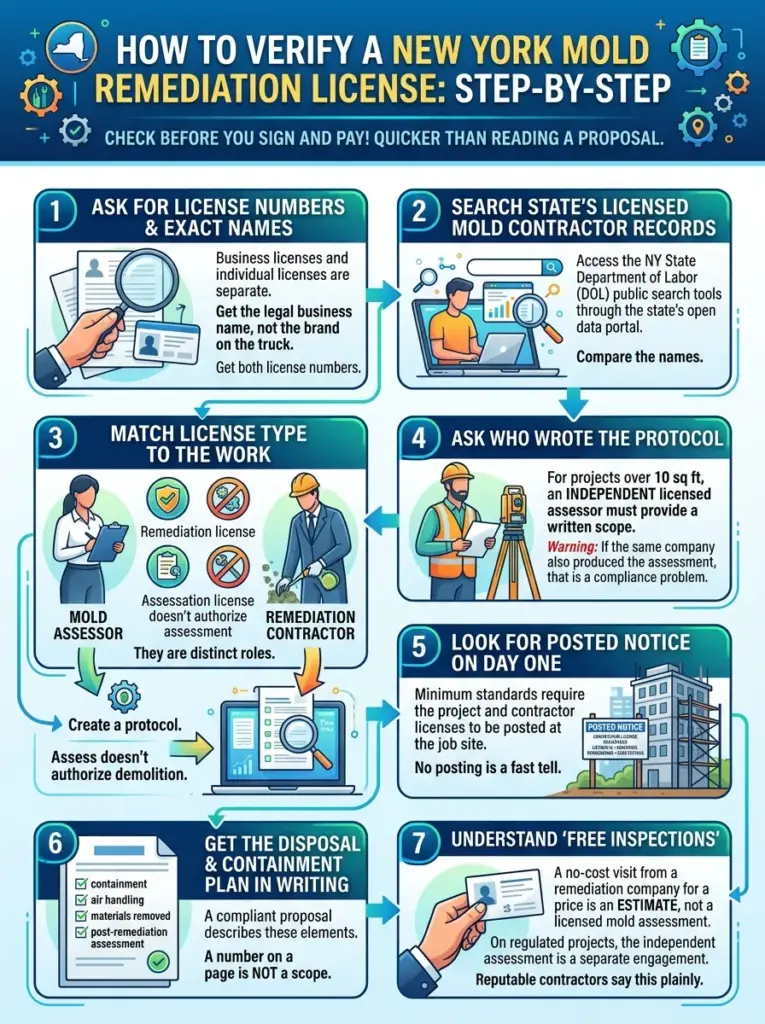
How to Verify a Contractor Before You Sign: Checking a New York Mold Remediation License Step by Step
This takes less time than reading a proposal. Do it before money changes hands, not after.
- Ask for the license number and the exact name it was issued under. Business licenses and individual licenses are separate records. Get both, and get the legal business name, not the brand name on the truck.
- Search the state’s licensed mold contractor records. The Department of Labor maintains public search tools for licensed mold assessors and remediation contractors through the state’s open data portal. Match the name and confirm the license is current, not expired.
- Confirm the license type matches the work. A remediation contractor license does not authorize someone to write your assessment protocol. An assessor license does not authorize demolition.
- Ask who wrote the protocol. On any project over ten square feet, there should be a written scope from an independent licensed assessor. If the company handing you the estimate also produced the assessment, that is a compliance problem.
- Look for the posted notice on day one. Minimum work standards require the project and the contractor’s licenses to be posted at the job site. No posting is a fast tell.
- Get the disposal and containment plan in writing. A compliant proposal describes containment, air handling, materials removed, and the post remediation assessment. A number on a page is not a scope.
What a free inspection is and is not. A no cost visit from a remediation company to look at your situation, measure moisture, and give you a price is an estimate. It is not a licensed mold assessment, and a reputable contractor will say so plainly. On projects above the threshold, the independent assessment is a separate engagement by a separate licensed party. Understanding that distinction protects you. Our breakdown of how to get a free mold inspection explains where the free visit ends and the regulated process begins.
Licensed Mold Removal Experts
You Can Trust
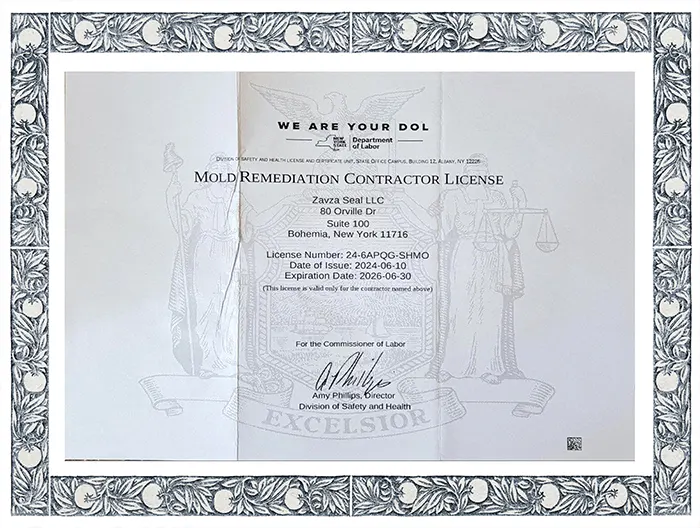
MOLD REMOVAL EXPERTS (ZAVZA SEAL’S MOLD AUTHORITY SITE) LICENSE 26-6APQG-SHMO
Mold Removal Experts is Zavza Seal’s dedicated mold authority, providing property owners with clear, reliable information backed by real remediation experience. As a New York State licensed mold contractor, Zavza Seal operates under Mold License #26-6APQG-SHMO, helping homeowners and property professionals address mold safely, thoroughly, and in accordance with New York requirements.
Red Flags That Signal an Unlicensed Operator
After enough jobs in the New York metro, the patterns become predictable. These are the signals worth acting on:
- The same company offers to test and then remove. On a project over ten square feet, this is not aggressive salesmanship. It is outside the law.
- An out of state certification is offered instead of a New York license. Certifications issued in other states do not authorize mold projects in New York.
- The estimate arrives before anyone opens a wall or reads a moisture meter. Scope without diagnosis is guesswork priced as expertise.
- Pressure to sign same day, with a discount that expires tonight. Mold does not move that fast. Sales quotas do.
- No written protocol, no containment description, no clearance step. If the proposal cannot describe how the job ends, the job does not end.
- Cash only, no license number offered when asked. The refusal is the answer.
These overlap heavily with the general vetting criteria in our guide on how to choose the right mold remediation company, and with the national picture in our overview of legal requirements for mold removal services. New York simply enforces more of it than most states.
What a Compliant Project Looks Like From Start to Finish
Homeowners are rarely shown the shape of the process, so they cannot tell when a step has been skipped. Here is the sequence a licensed job follows:
| Stage | Who Performs It | What You Should Receive |
|---|---|---|
| Initial Contact and Estimate | Remediation contractor | A written estimate and a clear explanation of the moisture source |
| Independent Assessment | Licensed mold assessor | A written remediation protocol defining scope and clearance criteria |
| Setup and Containment | Licensed remediation contractor | Posted licenses, containment barriers, negative air, isolated work zone |
| Removal and Cleaning | Licensed crew under a supervisor | Removal of affected material, HEPA cleaning, controlled disposal |
| Moisture Correction | Contractor or a related trade | Repair of the water source so growth does not return |
| Post Remediation Assessment | Independent licensed assessor | Written clearance documenting that the protocol was met |
The containment stage is where most of the quality difference lives, and it is the stage homeowners see least. Our guide to mold containment, negative air, and HEPA filtration shows what correct setup looks like so you can evaluate it on sight.
Exemptions: When a License Is Not Required
Article 32 carves out narrow exceptions, and understanding them keeps you from demanding paperwork nobody owes you:
- Owners working on their own property. A homeowner remediating their own house does not need a license.
- Certain managing agents and employees performing work on commercial property or a residential building of more than four dwelling units owned by that owner, provided they are not offering mold services to the public.
- Government units and public authorities working on property they own or manage. Their outside consultants and contractors are not covered by that exemption.
- Projects at or under ten square feet, and work such as routine cleaning or construction undertaken for reasons other than mold remediation.
Everyone else who touches a mold project for hire in New York needs the appropriate license.
What Happens If You Hire an Unlicensed Contractor
The immediate risk is not a fine. It is that you pay for a job that has no defensible ending. Without an independent protocol, there is no agreed definition of complete. Without a post remediation assessment, there is no document proving the work passed. That absence follows the property.
It surfaces at resale, when a buyer’s attorney asks for remediation records and you have an invoice instead of a clearance. It surfaces in insurance disputes, where undocumented work is treated as no work. It surfaces when growth returns in eight months because nobody was contractually obligated to correct the moisture source. And it surfaces in the price, because doing it twice costs more than doing it once, as the ranges in our complete mold removal cost guide make clear. If budget is the barrier to doing it correctly the first time, financing options exist across Long Island, Brooklyn, Queens, and the Bronx.
The state also treats unlicensed practice as a civil matter. It is unlawful to engage in, advertise, or hold yourself out as a mold assessor, remediation contractor, or abatement worker without a valid license, and violators face civil penalties. Full program details are published by the New York State Department of Labor Mold Program, and general cleanup guidance is available from the United States Environmental Protection Agency.
Red Flags That Signal an Unlicensed Operator
The immediate risk is not a fine. It is that you pay for a job that has no defensible ending. Without an independent protocol, there is no agreed definition of complete. Without a post remediation assessment, there is no document proving the work passed. That absence follows the property.
It surfaces at resale, when a buyer’s attorney asks for remediation records and you have an invoice instead of a clearance. It surfaces in insurance disputes, where undocumented work is treated as no work. It surfaces when growth returns in eight months because nobody was contractually obligated to correct the moisture source. And it surfaces in the price, because doing it twice costs more than doing it once, as the ranges in our complete mold removal cost guide make clear. If budget is the barrier to doing it correctly the first time, financing options exist across Long Island, Brooklyn, Queens, and the Bronx.
The state also treats unlicensed practice as a civil matter. It is unlawful to engage in, advertise, or hold yourself out as a mold assessor, remediation contractor, or abatement worker without a valid license, and violators face civil penalties. Full program details are published by the New York State Department of Labor Mold Program, and general cleanup guidance is available from the United States Environmental Protection Agency.
Ask for the license. Then ask for the protocol.
Two questions, asked before you sign, filter out most of the risk in this industry. If you are weighing proposals right now and something feels off, a second look costs nothing.
New York Mold Remediation License: Final Thoughts
The licensing framework in this state exists because homeowners could not otherwise tell the difference between a diagnosis and a sales pitch. Article 32 answered that by splitting the two roles apart and putting a public record behind both. Using it takes five minutes and no expertise: get the number, check the type, confirm it is current, and ask who wrote the scope.
Everything downstream of that check gets easier. The scope is defined by someone who does not profit from its size. The work is documented. The ending is verified by a third party rather than declared by the company holding your deposit. That paperwork is what you actually own when the trucks leave, and it is the part that still matters three years from now when a buyer, an adjuster, or a lender asks what happened in that basement.
Frequently Asked Questions About New York Mold Remediation License:
Is a mold license required for every mold job in New York?
No. Licensing applies to mold projects covering more than ten square feet. Smaller areas fall outside the definition, and homeowners working on their own property are exempt regardless of size.
Can the company that tests my home also remove the mold?
Not on the same property, and not on a project above the ten square foot threshold. New York prohibits the same individual from performing both the assessment and the remediation, and requires an independent assessment to define the scope of work.
How do I look up whether a contractor is licensed?
Ask for the license number and the legal business name, then check it against the Department of Labor’s public licensed mold contractor records through the state’s open data portal. Confirm the license type matches the work and that it has not expired.
How long is a New York mold license valid?
Mold licenses are issued for a two year term and must be renewed. Renewal applications cannot be submitted more than ninety days before the current license expires, so an expired license usually signals a lapse rather than a timing issue.
Does a certification from another state count in New York?
No. Certifications or licenses issued in other states do not authorize someone to perform mold projects in New York. This is a frequent gap with national franchise operators sending crews into the metro area.
Do home inspectors need a mold license?
Yes, if their inspection or report includes an assessment of mold conditions. A home inspector who evaluates mold as part of a real estate transaction must hold a mold assessor license.
What should be posted at my house during the job?
Minimum work standards require notice of the project and the contractor’s licenses to be posted at the site. If nothing is posted on day one, ask why before work continues.
What happens if I already hired someone without checking?
Request the license numbers and the written protocol now, and verify them. If the work is finished with no independent assessment on file, arrange a post remediation assessment so you have documentation. Confirming a New York mold remediation license after the fact is less useful than doing it beforehand, but it still tells you what you are holding and what you may need to redo before resale or an insurance claim.