
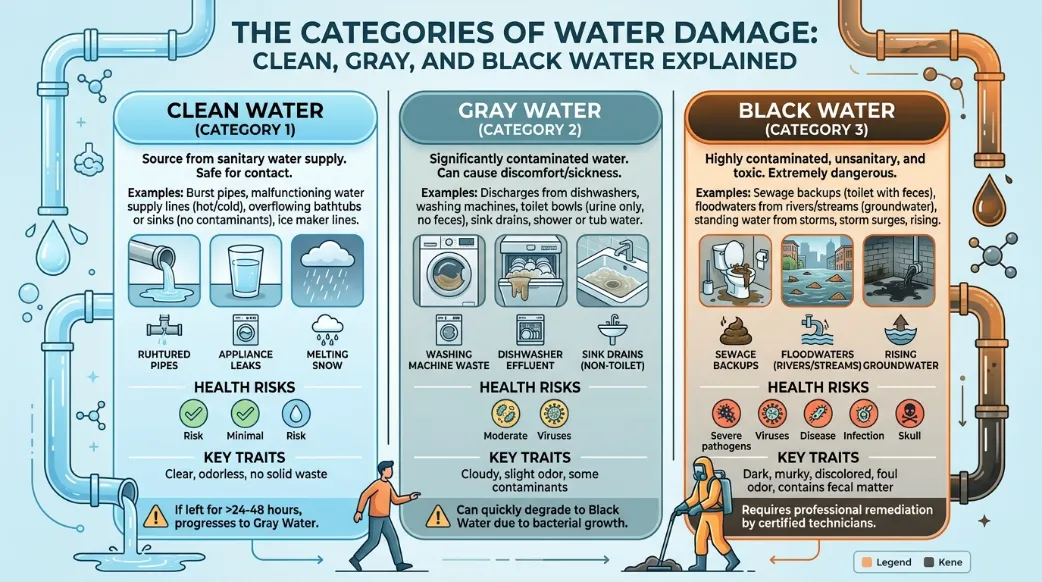
The categories of water damage exist to answer one practical question: how contaminated is the water that got into your building, and therefore what can be dried and what has to go in a bag. Category 1 is clean. Category 2 is gray. Category 3 is black. That much you can find anywhere.
What almost nobody tells you is the part that actually decides your job: the category is not stamped on the water when it leaves the pipe. It is assessed on site, at the time somebody looks at it, and it climbs the longer the water sits.
A clean supply-line leak on Monday is a different category by Wednesday. This page covers all three categories, all four classes, and what each one means for your belongings, your invoice, and your claim.
Call (718) 635-2800 – Get a Free Category Assessment
The Three Categories of Water Damage at a Glance
The categories of water damage are defined by the ANSI/IICRC S500 Standard for Professional Water Damage Restoration, which is the procedural standard restoration contractors work to and the one insurance carriers reference when they evaluate whether a job was done correctly. Here is the entire system in one table, and then we will take each one apart.
| Category | What it is | Typical sources | Dry in place? | Who handles it |
|---|---|---|---|---|
| Category 1 Clean water | Water from a sanitary source that poses no substantial risk to people. | Supply line, water heater, toilet tank, overflowing tub or sink with no contaminants. | Often yes, if caught fast | DIY is reasonable on small, fresh losses |
| Category 2 Gray water | Significantly contaminated water that can cause illness or discomfort on contact or ingestion. | Dishwasher or washing machine discharge, toilet overflow with no solids, HVAC condensate, aquarium. | Non-porous only | Professional recommended |
| Category 3 Black water | Grossly contaminated water carrying pathogens, toxins, or organic soil load. | Sewage backup, rising groundwater, storm surge, flooding, any water that crossed the ground. | No, porous materials come out | Professional only, with containment |
| Field rule The categories of water damage are set by the clock, not just the source. | ||||
Category 1: Clean Water
Category 1 is the only category where the phrase “dry it in place” is on the table. The water came from a sanitary source, it has not picked up an organic load, and the materials it soaked can usually be saved if you get air into them fast enough. Of the three categories of water damage, this is the one with good news attached, and the good news has an expiry date on it.
- Where it Comes From: Broken supply lines, failed water heaters, toilet tank water on the clean side of the bowl, an overflowing tub, a burst pipe, melting ice inside the building envelope.
- What it Does to Materials: Gypsum swells and loses rigidity, wood swells and can cup, laminate delaminates, and insulation loses its R-value. Damage is physical rather than biological, at first.
Here’s The Catch: Category 1 is a starting condition, not a permanent label. Left sitting, it feeds on dust, drywall paper, and soil and climbs to Category 2, then to Category 3. Practically, a Category 1 loss caught inside the first day or two is the cheapest possible version of this problem.
Most drywall survives, most framing survives, and the job is extraction, air movement, dehumidification, and a moisture reading to confirm before anything closes back up. If the wall itself took the hit, our guide to water damage wall repair walks through exactly how that repair should be sequenced.
Category 2: Gray Water
Category 1 is the only category where the phrase “dry it in place” is on the table. The water came from a sanitary source, it has not picked up an organic load, and the materials it soaked can usually be saved if you get air into them fast enough. Of the three categories of water damage, this is the one with good news attached, and the good news has an expiry date on it.
- Where it Comes From: Broken supply lines, failed water heaters, toilet tank water on the clean side of the bowl, an overflowing tub, a burst pipe, melting ice inside the building envelope.
- What it Does to Materials: Gypsum swells and loses rigidity, wood swells and can cup, laminate delaminates, and insulation loses its R-value. Damage is physical rather than biological, at first.
Here’s The Catch: Category 1 is a starting condition, not a permanent label. Left sitting, it feeds on dust, drywall paper, and soil and climbs to Category 2, then to Category 3. Practically, a Category 1 loss caught inside the first day or two is the cheapest possible version of this problem.
Most drywall survives, most framing survives, and the job is extraction, air movement, dehumidification, and a moisture reading to confirm before anything closes back up. If the wall itself took the hit, our guide to water damage wall repair walks through exactly how that repair should be sequenced.
Category 3: Black Water
Category 3 is the category where nothing porous gets a second chance. Of the three categories of water damage this is the one that stops being a cleanup and becomes a controlled removal, with sealed containment, negative air pressure, HEPA filtration, and personal protective equipment, because the goal is no longer only to save the building but to keep what is in that water from being distributed through the rest of it.
Here is the correction that matters most on this topic. Several widely read guides list rainwater and melting snow as Category 1. That is only true while the water is still falling. The moment water contacts the ground and then enters the building, it is carrying soil, fertilizer, pesticide, animal waste, and whatever else is in the earth around your foundation, and the standard treats it as Category 3.
The same applies to rising groundwater pushed in by hydrostatic pressure, to storm surge, and to water coming up through the basement floor. If you have been told a basement flood is Category 1 because “it was only rain,” that classification is wrong and it will cost you.
Where it Comes From: Sewage backup, toilet overflow with solids, rising groundwater, river or storm flooding, and any Category 2 loss that has sat long enough to degrade.
How it is Handled: Sealed containment under negative pressure, controlled removal of all affected porous materials, antimicrobial treatment of what remains, then verification.
How it Ends: With documentation and, where growth was involved, clearance testing before the space goes back into normal use.
What Category 3 Looks Like in Brooklyn, Queens, and Long Island
In this metro, Category 3 is closer to the default than the exception, for two structural reasons. First, large parts of New York City run combined sewer systems, where storm runoff and sanitary sewage share the same pipe.
When a heavy rain overwhelms that pipe, what comes back up through a floor drain is not stormwater, it is sewage, and it is Category 3 the moment it arrives. Second, this is a metro built downward. Finished basements, garden apartments, and below-grade offices put living space exactly where groundwater arrives first.
That combination is why a homeowner here can do everything right upstairs and still be handed the most contaminated category on the list. Our basement water intrusion guide maps every entry point, and what causes basement flooding from rain covers the storm-driven version specifically.
How the Categories of Water Damage Degrade Over Time
The category is not stamped on the water when it leaves the pipe. It is a judgment made on site, at the moment somebody assesses it, and it climbs. This is the single most important thing to understand about the categories of water damage, and it is the thing most guides mention in passing and then never quantify.
| Elapsed time | What is happening | Likely category |
|---|---|---|
| Hour 0 to 24 0 to 24 hours | Physical damage only. Materials are swelling and losing strength. Contamination has not established. | Stays where it started |
| Day 1 to 2 24 to 48 hours | Microbial activity begins on wet gypsum, paper facing, and organic soil. A Category 1 loss starts sliding. | Category 1 becomes Category 2 |
| Day 2 to 3 48 to 72 hours | Colonization is established, odor develops, and the organic load in a gray-water loss keeps building. | Category 2 becomes Category 3 |
| Day 3 onward 72 hours and beyond | Growth is visible or smellable, porous materials are compromised throughout, and the job is a remediation. | Category 3, regardless of source |
| Field rule Because the category is assessed on arrival, not at the moment of the leak, the clock can reclassify a loss before anyone looks at it. | ||
Three things accelerate that clock: heat, contact with porous materials, and an existing organic soil load. A July basement in Queens moves through this faster than a February one. The U.S. EPA puts the same line on it from the mold side, advising that water-damaged materials be dried within 24 to 48 hours to prevent growth, and our guide to how long it takes for mold to grow walks through the biology of that window.
The consequence people miss: because the category is assessed at the time of the visit rather than the time of the leak, waiting can change the classification of your own loss, and the classification is what drives the scope, the price, and in some cases the coverage. Delay is not neutral. Delay is a category change.
How the Categories of Water Damage Degrade Over Time
Most guides stop at three categories and leave the reader with half a system. The categories of water damage tell you how contaminated the water is. The classes tell you how hard it will be to dry. They are two independent axes, and your actual scope of work is the product of both. A Category 1 loss can still be a brutally expensive job if it is a Class 4, and a Category 3 loss in a small tiled bathroom can be relatively contained.
Class 1
The least water and the least absorption. A small area, minimal wet porous material, and the simplest drying setup.
Class 2
An entire room affected, with water wicking up walls to roughly 24 inches. Carpet, pad, and structural materials are involved.
Class 3
Widespread saturation, usually delivered from overhead, with a large share of surfaces being wet porous material. Ceilings, walls, insulation, and subfloor all in play.
Class 4
Specialty drying for dense, low-permeance materials that release moisture very slowly: hardwood, plaster, brick, concrete, and stone. The longest and most expensive drying profile.
Class 4 is where a lot of prewar New York housing stock lands.
Plaster over wood lath, brick party walls, and old-growth hardwood floors all hold water in ways modern gypsum does not, and they need longer drying cycles with different equipment. A homeowner told their job is “just a Class 4” should read that as a schedule warning, not a technicality.
| Elapsed time | What is happening | Likely category |
|---|---|---|
| Hour 0 to 24 0 to 24 hours | Physical damage only. Materials are swelling and losing strength. Contamination has not established. | Stays where it started |
| Day 1 to 2 24 to 48 hours | Microbial activity begins on wet gypsum, paper facing, and organic soil. A Category 1 loss starts sliding. | Category 1 becomes Category 2 |
| Day 2 to 3 48 to 72 hours | Colonization is established, odor develops, and the organic load in a gray-water loss keeps building. | Category 2 becomes Category 3 |
| Day 3 onward 72 hours and beyond | Growth is visible or smellable, porous materials are compromised throughout, and the job is a remediation. | Category 3, regardless of source |
| Field rule Because the category is assessed on arrival, not at the moment of the leak, the clock can reclassify a loss before anyone looks at it. | ||
Three things accelerate that clock: heat, contact with porous materials, and an existing organic soil load. A July basement in Queens moves through this faster than a February one. The U.S. EPA puts the same line on it from the mold side, advising that water-damaged materials be dried within 24 to 48 hours to prevent growth, and our guide to how long it takes for mold to grow walks through the biology of that window.
The consequence people miss: because the category is assessed at the time of the visit rather than the time of the leak, waiting can change the classification of your own loss, and the classification is what drives the scope, the price, and in some cases the coverage. Delay is not neutral. Delay is a category change.
What Each Category Means for What Gets Thrown Away
This is what people actually want to know. Not the definition, but whether the carpet is coming out. Here is how the categories of water damage translate into decisions about real materials. Treat this as the default, not a guarantee, because time and class both move these calls.
| Material | Category 1 | Category 2 | Category 3 |
|---|---|---|---|
| Drywall | Often saved if dried fast | Cut above the wet line | Removed |
| Batt insulation | Usually removed, loses R-value | Removed | Removed |
| Carpet | Often cleanable and reusable | Sometimes, with cleaning | Removed |
| Carpet pad | Usually removed | Removed | Removed |
| Hardwood flooring | Often salvageable with specialty drying | Case by case | Removed |
| Subfloor (OSB or plywood) | Usually dried in place | Dried or replaced by condition | Usually removed |
| Framing lumber | Dried and kept | Cleaned, treated, kept | Cleaned and treated, replaced if soft |
| Cabinetry (particleboard) | Depends on swelling | Usually removed | Removed |
| Upholstered furniture | Often restorable | Case by case, often not worth it | Discarded |
| Non-porous surfacestile, metal, sealed concrete | Cleaned and kept | Cleaned and sanitized | Cleaned, sanitized, verified |
| Kept Judgment call Comes out | |||
The pattern is simple once you see it. Porosity plus contamination equals removal. Anything that water can get inside of, and that you cannot fully clean the inside of, comes out as the category climbs. For the specific cases, see whether mold grows on drywall, how long mold takes to grow on wet carpet, and when wet insulation gets replaced versus remediated.
Straight pricing
What Each Category Costs to Restore
Nobody can quote you a category, because a category is not a scope. What the category actually does is decide which line items appear on your invoice, and that is the honest way to price the difference between the categories of water damage. Here is the map.
| Invoice line item | Typical range | Cat 1 | Cat 2 | Cat 3 |
|---|---|---|---|---|
| Emergency extraction | Job-based | If standing water | Yes | Yes |
| Structural drying and dehumidification | $2 to $8 per sq ft | Yes | Yes | Yes |
| Antimicrobial application | Included or add-on | Rarely | Yes | Yes |
| Containment and negative air | Add-on | No | Sometimes | Always |
| Porous material removal and disposal | Job-based | Limited | Yes | Extensive |
| Mold remediation, if growth is found | $10 to $20 per sq ft | Only if delayed | Common | Expected |
| Clearance testing | Per test | Rarely | Sometimes | Recommended |
| Reconstruction | $20 to $38 per sq ft | Minor | Moderate | Extensive |
| Unlikely to appear Depends on conditions Expect it on the invoice | ||||
Reading that honestly: the whole-project national average for water damage restoration in 2026 lands near $3,900, with most homeowners between roughly $1,400 and $6,400. A Category 3 loss commonly runs two times or more than the same square footage at Category 1, because it adds containment, adds disposal, adds remediation, and adds reconstruction that the Category 1 version never needed.
NY metro labor sits at the upper end of published national ranges. For the full breakdown by loss type, see our water damage restoration cost guide, and if budget is the obstacle, we offer financing across Long Island, Brooklyn, Queens, and the Bronx.
How Insurance Treats Each of the Categories of Water Damage
The word that decides most water damage claims is not damage, it is sudden. A standard homeowners policy is generally built to cover sudden and accidental events originating inside the home, and generally not built to cover gradual seepage, long-neglected leaks, or damage traceable to deferred maintenance. That single test, applied across the three categories of water damage, explains most of what gets paid and most of what gets denied.
Category 1 and 2, inside the home
Most commonly covered. A burst supply line, a failed water heater, a hose that let go. These are the textbook sudden and accidental events.
The appliance itself is separate
On a Category 2 loss, the policy may cover the water damage while the failed dishwasher or washer is not covered at all. That usually falls to a home warranty instead.
Category 3 from outside
Rising groundwater, storm surge, and flooding are almost never covered by a standard policy. That requires separate flood insurance, and this is where most denials happen.
Sewage backup is often its own rider
Many carriers exclude sewer and drain backup from the base policy and sell it as an endorsement. Check whether you carry it before you need it.
Mold is usually sublimited
Many policies cap mold-related payouts well below the dwelling limit, and some exclude mold entirely unless it results from a covered peril. That cap bites hardest on Category 3.
Mitigating promptly is usually required
Letting a known loss sit can itself become grounds for denial, and because category is assessed on the day of the visit, a delayed call can worsen your own classification.
Coverage varies significantly by carrier and by state, so read your own policy language rather than relying on a general rule. Photograph everything with timestamps before anything is removed, because once material is in a contractor bag your evidence is gone. Our guides to whether homeowners insurance covers mold removal and mold testing and insurance claims break down where the line usually falls.
The Categories of Water Damage: Final Thoughts
If you take one thing from this page, make it the reframe. The categories of water damage are not a property of the water. They are a property of the water plus the clock plus everything that water has touched on the way in. Clean water is only clean while it is fresh. Rain stops being clean the moment it crosses the ground. A gray-water loss left over a long weekend is not a gray-water loss anymore.
Which means the one variable you fully control is speed. You cannot change where the pipe broke, you cannot change whether your basement sits below the water table, and you cannot change what your policy says. You can change how many hours pass before somebody with a meter is standing in the room. That is the whole game, and it is why the first call matters more than any decision that comes after it.
Not Sure Which Category You Have? Call (718) 635-2800 or book a free assessment. Brooklyn, Queens, the Bronx, Staten Island, and Long Island.
Frequently Asked Questions About The Categories of Water Damage
What are the three categories of water damage?
Category 1 is clean water from a sanitary source such as a supply line or water heater. Category 2 is gray water, significantly contaminated, from sources like a dishwasher or washing machine. Category 3 is black water, grossly contaminated, from sewage, flooding, or any water that has crossed the ground. The system is defined by the ANSI/IICRC S500 standard.
What is the difference between categories and classes of water damage?
Category measures contamination. Class measures how hard the water will be to dry, based on how much water there is and how absorbent the affected materials are. They are independent axes, and your scope of work is the product of both. A Category 1 loss in plaster and hardwood can cost more than a Category 3 loss in a small tiled bathroom.
Is rainwater Category 1 or Category 3?
Both, depending on where it has been. Rain that enters directly through a roof or window opening without touching the ground starts as Category 1. Rain that hits the soil and then enters the building, including rising groundwater and basement flooding, is treated as Category 3, because it carries soil, fertilizer, pesticide, and animal waste. Several popular guides get this wrong and it leads homeowners to under-treat basement losses.
How fast does clean water become contaminated?
Roughly 24 to 48 hours for a Category 1 loss to slide to Category 2, and roughly another 24 to 48 after that to reach Category 3. Heat, contact with porous materials, and existing soil load all accelerate it. A summer basement moves through that sequence faster than a winter one, which is why response time matters more than the size of the leak.
Is gray water dangerous?
Yes, enough to warrant sanitizing rather than just drying. Gray water carries microorganisms plus the nutrients those microorganisms feed on, so it escalates faster than clean water and can cause illness on contact or ingestion. Non-porous surfaces can be cleaned and kept. Porous materials, especially carpet pad and batt insulation, generally come out.
Does carpet have to be replaced after water damage?
It depends on the category. Category 1 carpet is often cleanable and reusable, though the pad underneath is usually discarded. Category 2 carpet is sometimes salvageable with professional cleaning. Category 3 carpet and pad always come out, no exceptions, because the contamination is inside the fibers and backing where cleaning cannot reach.
Can I clean up Category 2 water damage myself?
Small, fresh Category 2 losses on hard surfaces can be handled by a homeowner with proper disinfectant and protective equipment. Once the water has reached carpet pad, insulation, drywall, or cabinetry, or once it has sat past about 48 hours, bring in a professional. Drying a gray-water loss without sanitizing leaves the contamination in place inside the cavity.
Does homeowners insurance cover all categories of water damage?
No. Standard policies generally cover sudden and accidental losses originating inside the home, which usually means Category 1 and 2 events like a burst pipe or failed appliance hose. Category 3 from rising groundwater, storm surge, or flooding almost always requires a separate flood policy, and sewer backup is frequently sold as its own endorsement. Mold payouts are often sublimited well below the dwelling limit.
What is Class 4 water damage and why does it cost more?
Class 4 describes losses where water has deeply saturated dense, low-permeance materials that release moisture very slowly: hardwood, plaster, brick, concrete, and stone. It costs more because it needs specialty drying equipment and a much longer drying cycle, sometimes weeks rather than days. Prewar New York housing stock lands in Class 4 often, thanks to plaster over lath and masonry party walls.
How do I find out which of the categories of water damage I have?
You cannot reliably determine it by looking, because the categories of water damage depend on the source, the elapsed time, and everything the water contacted on its way in. A professional assessment uses moisture meters and thermal imaging to map the wet area, traces the water to its actual source, and factors in how long it has been sitting. Call (718) 635-2800 and we will assess the category and the class on site, in writing, at no cost.