
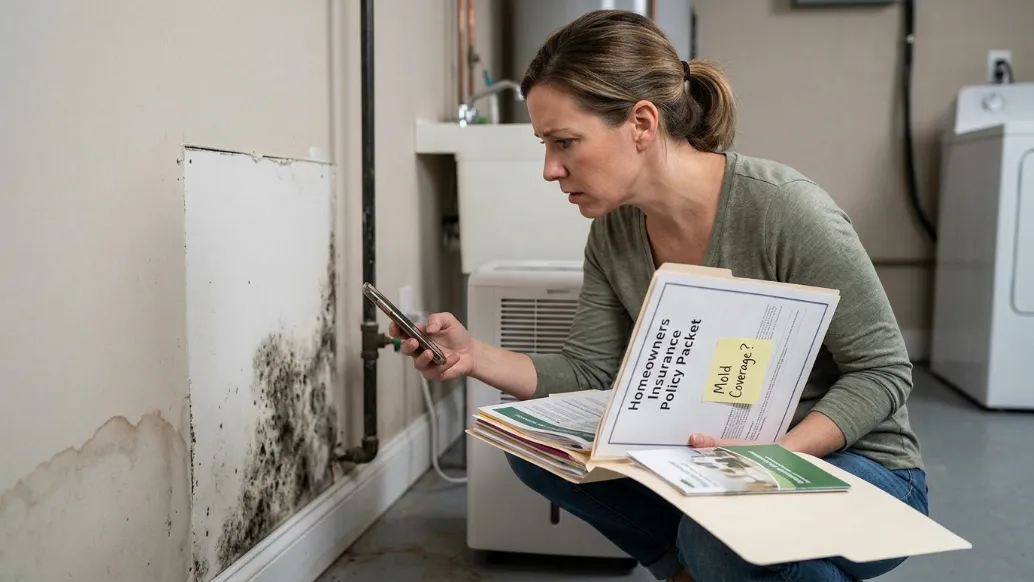
If you have found mold in your home, one of the first questions running through your mind is money. Does homeowners insurance cover mold removal, or are you about to pay for the entire project out of pocket? It is a fair question, because professional remediation is not cheap, and the answer determines how you move forward. The honest reality is that coverage depends almost entirely on how the mold started. Insurance is built around sudden, accidental events, not slow problems that build over months, so the cause of your mold matters far more than the mold itself.
This guide walks you through when a claim is likely to succeed, when it usually will not, and the single most important step homeowners skip before they pick up the phone. Get the sequence right and you protect both your home and your claim. Get it wrong, and you can weaken your case before it starts.
Does Homeowners Insurance Cover Mold Removal? Knowing the Answer Protects Your Budget and Your Home
Most standard homeowners policies treat mold as a consequence of another event rather than a standalone problem. In plain terms, insurers generally ask one question: what caused the water that caused the mold? If the water came from a sudden and accidental covered peril, such as a burst pipe, an overflowing washing machine, or a failed water heater, there is a reasonable chance mold cleanup tied to that event will be considered.
Investopedia notes that mold may be covered when it results from a covered peril like water damage from a burst pipe or an appliance failure, while gradual leaks, floods, and maintenance related mold are commonly excluded or limited.
That distinction is everything. The policy is not really evaluating the mold. It is evaluating the water source behind it. This is why two homes with visually identical mold can get two completely different answers from the same insurer.
When Mold Damage May Be Covered
Coverage becomes far more likely when the mold traces back to a specific, documentable, sudden failure. Common scenarios that carriers are more willing to consider include:
- A pipe that burst suddenly and released water into a wall, ceiling, or floor
- A supply line failure behind a dishwasher, refrigerator, or washing machine
- A water heater that ruptured without warning
- An accidental overflow that was not the result of long term neglect
- Water damage from putting out a fire, which is often tied to the original covered event
In these situations, the mold is framed as secondary damage from a covered incident. Even then, many policies cap mold related payouts at a set dollar amount, so it is worth reading your declarations page closely or asking your agent what your specific mold limit is.
When Mold Damage Is Usually Not Covered
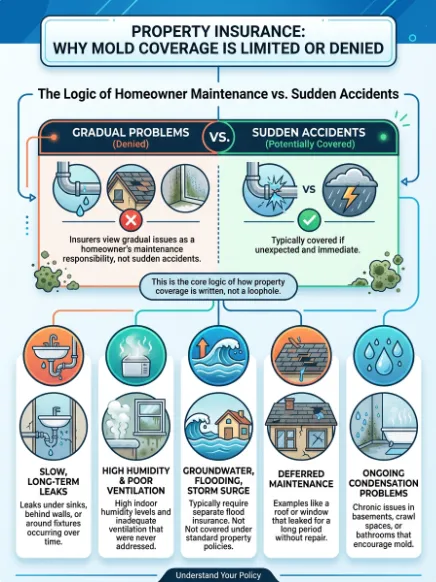
Coverage usually falls apart when the underlying cause looks like something that could have been prevented or maintained. Carriers routinely limit or deny mold tied to:
- Slow, long term leaks under sinks, behind walls, or around fixtures
- High indoor humidity and poor ventilation that were never addressed
- Groundwater, surface flooding, and storm surge, which typically require separate flood insurance
- Deferred maintenance, such as a roof or window that leaked for a long time
- Ongoing condensation problems in a basement, crawl space, or bathroom
The reasoning is consistent: if the problem developed gradually, insurers view it as a homeowner maintenance responsibility rather than a sudden accident. This is not a loophole, it is the core logic of how property coverage is written.
Why The Moisture Source Matters More Than The Mold
By now the pattern is clear. Your claim does not rise or fall on how much mold you can see. It rises or falls on proving where the water came from and how quickly it happened. That is why a rushed homeowner who scrubs away the mold, tosses the wet drywall, and then calls the insurer has often erased the most valuable evidence they had.
A professional inspection exists to answer the exact question your carrier will ask. A trained inspector traces the moisture back to its origin, measures how far it has traveled, and documents whether the growth is consistent with a sudden event or a long term condition. That finding is the foundation of any claim conversation. Understanding the moisture source is also the same logic our team uses when scoping a repair, which is why our mold removal process always begins at the water, not the wall.
Before you call your insurance company, you need documentation. A professional mold inspection can help identify the moisture source, show how far the damage has spread, and give you the evidence needed to understand your next step.
Why You Need Documentation Before Filing A Claim
Insurance is a documentation business. Adjusters make decisions based on what can be shown, dated, and measured, not on a homeowner’s description over the phone. If you file first and gather evidence later, you are asking the carrier to trust a story you cannot fully prove. If you document first and file second, you walk in with the facts already established.
Strong documentation typically includes a clear record of the moisture source, the extent of the affected area, and the condition of materials before anyone starts tearing them out. The goal is a written, professional record that a claims adjuster can actually work with. Homeowners who want to understand how testing fits into this process can review our guide on mold testing and insurance claims, which explains what carriers tend to look for.
Mold Testing, Photos, Moisture Mapping, And Written Findings
Useful documentation is more than a few phone photos. A thorough inspection can produce moisture readings that show where water is still active, photos that establish the scope before demolition, and written findings that connect the growth to a cause. When those pieces line up, they tell a coherent story: this is where the water came from, this is how far it spread, and this is what it will take to correct it. That clarity benefits you whether or not a claim ultimately gets approved, because it also gives you an honest picture of the work ahead.
What To Do Before You Start Removing Materials
The instinct to rip out wet drywall and carpet immediately is understandable, but acting too fast can hurt both your safety and your claim. Before you remove anything, it helps to stop the water source if you safely can, avoid disturbing large areas of visible growth, and get the situation documented.
Removing materials before documentation can eliminate the very proof an adjuster needs. It can also spread spores into clean areas if the work is done without containment, which turns a contained problem into a whole home problem. If you are weighing the total cost of the project either way, our mold removal cost complete pricing guide lays out what drives the numbers.
Should You Call A Mold Inspector Or Your Insurance Company First?
This is the question that trips up most homeowners, and the sequence genuinely matters. Calling the insurance company first feels natural, but it means opening a claim before you know what caused the mold or how far it has spread. You end up answering the adjuster’s questions with guesses.
Calling for an inspection first flips that dynamic. You learn the cause, you get the scope documented, and you find out whether the damage even reaches the level where a claim makes sense. Then, if it does, you file with evidence in hand instead of a story you are still piecing together. For water intrusion events specifically, pairing this with our water damage restoration cost breakdown gives you a realistic sense of scale before you commit to anything.
None of this is a substitute for reading your own policy or speaking with your carrier, since every policy is written differently and coverage varies. Think of the inspection as the step that lets you have that conversation from a position of knowledge rather than panic.
Does Homeowners Insurance Cover Mold Removal? Why Homeowners Trust Our Team
When homeowners ask does homeowners insurance cover mold removal, what they really need is someone who can tell them the truth about their specific situation before they make an expensive or claim damaging mistake. Our team serves Long Island, Brooklyn, Queens, and the Bronx, and we start every project by finding the moisture source and documenting the damage clearly. That gives you an honest answer about scope, a professional record for any claim discussion, and a remediation plan built on the actual problem rather than a guess. If cost is the concern that is holding you back, our mold removal financing options and our mold inspection cost guide can help you plan the next step.
Do Not Guess Your Way Through The Insurance Process
How Mold Removal Experts Can Help
Choosing the right company matters just as much as choosing to act. A qualified remediation team should be able to trace the moisture source, contain the affected area, document everything for your records, and correct the underlying condition so the mold does not simply return. If you are comparing providers, our guide on how to choose the right mold remediation company outlines the questions worth asking before you hire anyone. Reputable public health sources, including the EPA guide on mold, moisture, and your home, recommend professional help once growth extends beyond a small, easily cleaned area, which is often the point at which insurance questions come into play too.
Does Homeowners Insurance Cover Mold Removal: Final Thoughts
So, does homeowners insurance cover mold removal? Sometimes, and the deciding factor is almost always the cause of the water behind it. Sudden accidental failures give you the strongest case, while slow leaks, humidity, and flooding usually do not. The smartest move a homeowner can make is to document before filing, because the moisture source and the scope of damage are the exact facts your carrier will weigh. Whether or not a claim ultimately succeeds, a professional inspection gives you clarity, a usable record, and a plan built on the real problem. If you have mold after a leak or hidden moisture issue, get it inspected before you file and before it spreads.
Frequently Asked Questions About Does Homeowners Insurance Cover Mold Removal:
Does Homeowners Insurance Cover Mold Removal?
Homeowners insurance may cover mold removal when the mold results from a sudden and accidental covered event, such as a burst pipe, appliance leak, or ruptured water heater. Mold caused by gradual leaks, poor maintenance, high humidity, or flooding is usually excluded.
When Does Homeowners Insurance Pay For Mold Damage?
Insurance is more likely to pay for mold damage when the moisture came from a covered peril that happened unexpectedly. The insurer will usually investigate the original water source before deciding whether mold remediation, damaged materials, and related repairs qualify for coverage.
Is Mold From A Leaking Pipe Covered By Insurance?
Mold from a suddenly burst or failed pipe may be covered, depending on the policy and how quickly the homeowner responded. Mold from a pipe that leaked slowly for weeks or months is commonly denied because insurers may classify it as a maintenance issue.
Does Homeowners Insurance Cover Black Mold Removal?
Black mold is not automatically covered or excluded based on its color or species. Coverage depends primarily on what caused the moisture, whether that cause is covered by the policy, and whether the homeowner took reasonable steps to prevent additional damage.
Is Mold Caused By Flooding Covered By Homeowners Insurance?
Standard homeowners insurance generally does not cover mold caused by groundwater, storm surge, or surface flooding. Flood-related mold may be covered under a separate flood insurance policy, subject to its terms, limits, and exclusions.
Should I Call My Insurance Company Or A Mold Inspector First?
A professional mold inspection before filing can help identify the moisture source, document the affected area, and determine whether the situation may support a claim. However, homeowners should also review their policy because some insurers require prompt notification after water damage occurs.
What Documentation Do I Need For A Mold Insurance Claim?
Useful documentation may include dated photographs, moisture readings, inspection findings, plumbing reports, repair invoices, and records showing when the water damage was discovered. Strong documentation helps establish the cause, timeline, and extent of the mold damage.
Should I Remove Mold Before The Insurance Adjuster Arrives?
Avoid removing large areas of mold-damaged material before documenting the conditions and speaking with the appropriate professionals. You should take reasonable emergency steps to stop active water and prevent further damage, but preserve photographs, damaged materials, and records whenever safely possible.
How Much Mold Removal Will Homeowners Insurance Cover?
Mold coverage limits vary significantly between insurance policies. Some policies exclude mold completely, while others provide limited coverage through a mold endorsement or a specific dollar cap for testing, remediation, damaged materials, and additional living expenses.
Can An Insurance Company Deny A Mold Claim?
Yes. An insurer may deny a mold claim when the damage resulted from long-term leakage, deferred maintenance, condensation, humidity, flooding, or another excluded cause. Homeowners can request the denial in writing, review the cited policy language, and provide additional documentation when relevant.