
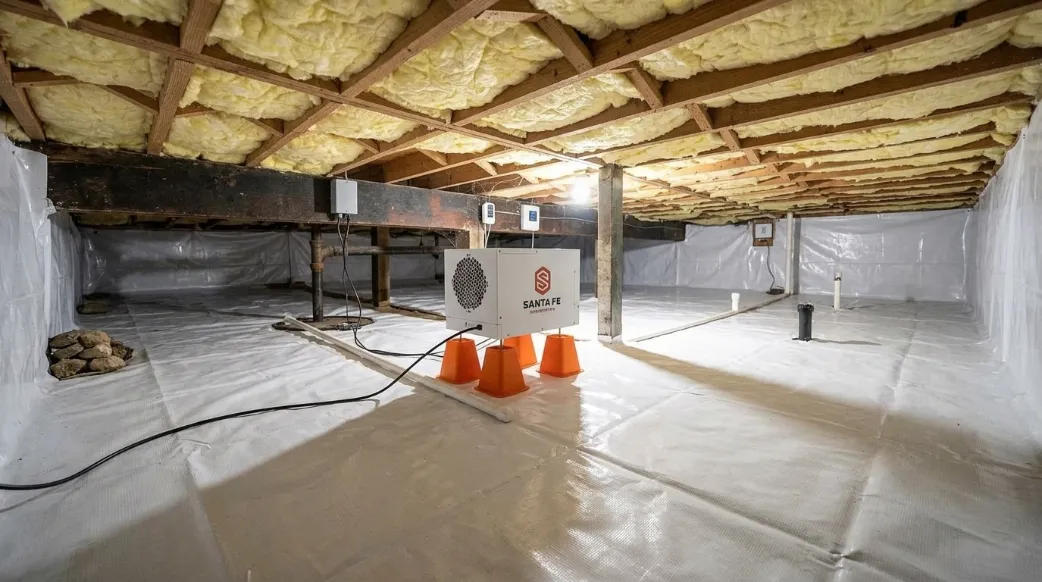
If you are dealing with black mold in a basement or crawl space, buying a larger household dehumidifier and hoping for the best is not a real moisture-control strategy. Mold needs moisture to grow. That makes humidity control one of the most important parts of preventing mold from returning after remediation. The U.S. Environmental Protection Agency recommends keeping indoor relative humidity below 60%, with an ideal target of 30% to 50% when possible.
That is why we recommend the Santa Fe Advance2 for appropriate basement and crawl-space applications. This is not simply a bigger version of the appliance you might pick up at a home improvement store. The Santa Fe Advance2 was specifically designed for basement and crawl-space dehumidification, with the airflow, capacity, controls, filtration, drainage options, and low-temperature operating characteristics needed for challenging below-grade environments. Its manufacturer documentation identifies it as a basement and crawl-space dehumidifier, and its specifications include 90 pints of water removal per day at 80°F and 60% relative humidity.
For moisture control in the right application, that makes a significant difference.
Why A Dehumidifier Matters When You Have Black Mold
There is an important distinction between removing mold and controlling the conditions that allow mold to grow. A dehumidifier does not magically kill black mold. It does not replace professional mold remediation, cleaning, removal of contaminated materials, leak repair, or structural drying.
What it can do is attack one of the conditions mold depends on: excessive moisture. The EPA specifically identifies moisture control as a central component of mold prevention. Its guidance recommends repairing water leaks, drying wet materials promptly, and using air conditioning or dehumidification to maintain low indoor humidity.
That is particularly important in basements and crawl spaces. These areas can stay damp even when the rest of the house feels comfortable. Ground moisture, foundation walls, condensation, plumbing leaks, poor drainage, humid outdoor air, and inadequate ventilation can all contribute to elevated humidity. If the moisture problem remains after mold is cleaned up, the environment can remain favorable for future microbial growth.
That is where a purpose-built dehumidification system earns its place.
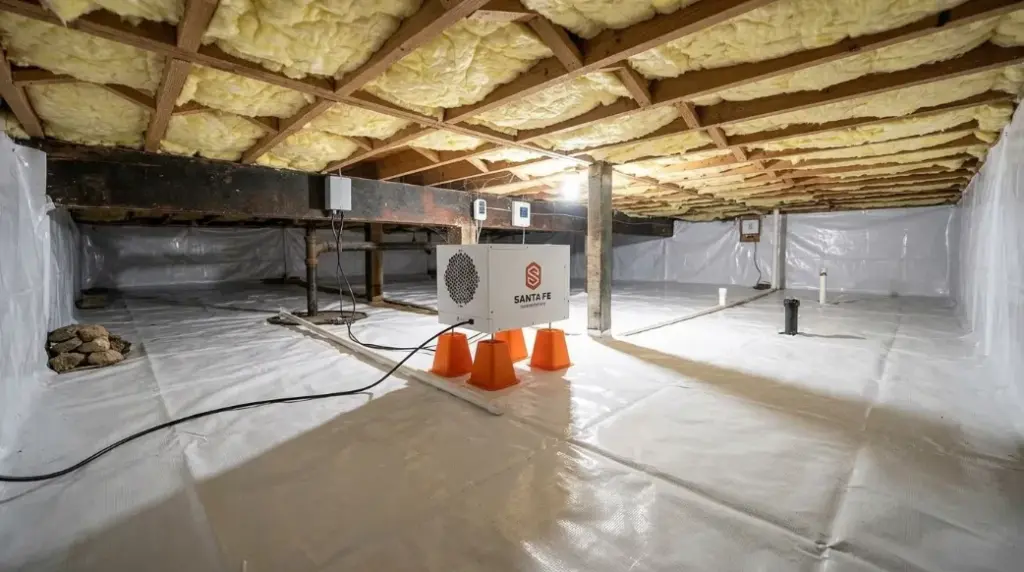
We Recommend The Santa Fe Advance2
We recommend the Santa Fe Advance2 because its design is fundamentally suited to the environments where moisture problems are common. The published specifications list a 90-pint-per-day water-removal capacity at 80°F and 60% RH, approximately 6.4 pints per kilowatt-hour, a 309 CFM blower, and an operating temperature range beginning at approximately 56°F. It is rated for a typical space of approximately 2,200 square feet, depending on the conditions of the space.
Those specifications matter because crawl spaces and basements are not ordinary living rooms. A conventional portable dehumidifier may work adequately in a small finished room under relatively controlled conditions. But below-grade spaces can present a completely different moisture load.
The Santa Fe Advance2 was engineered around that reality!
Purpose-Built For Crawl Spaces And Basements
One of the biggest advantages is specialization. The Advance2 was designed specifically for basement and crawl-space dehumidification rather than being a general-purpose appliance adapted to a basement. Its technical documentation identifies the unit as being designed for these applications and incorporates a dual-air-distribution design. The manufacturer specification sheet also identifies dual outlets designed to optimize airflow in crawl spaces and basements.
That is a major consideration when you’re trying to control humidity across a large, irregular, enclosed area. A crawl space may contain piers, ductwork, plumbing, insulation, wiring, foundation walls, and other obstructions. Air needs to move through the space rather than simply being dried immediately around the machine.
The Advance2’s airflow design gives contractors more options for managing air distribution in these environments.
90 Pints Of Moisture Removal Per Day Capacity is another reason we like the Advance2.
A Better Fit For Basements With Persistent Humidity
Crawl spaces can be particularly difficult environments for moisture control. Temperatures may fluctuate significantly. The space may have limited access. Air movement can be poor. Foundation surfaces can remain cool. Outside air can introduce moisture. And the floor and surrounding soil can contribute moisture if the crawl space has not been properly sealed.
That is why simply putting a dehumidifier in the crawl space isn’t necessarily enough. The space itself has to be evaluated. A properly designed moisture-control strategy may involve drainage improvements, plumbing repairs, vapor-barrier installation, crawl-space encapsulation, insulation, air sealing, and dehumidification.
Santa Fe’s own crawl-space guidance describes a process that includes inspecting drainage and the foundation, sealing vents, installing a reinforced polyethylene vapor barrier, addressing standing-water concerns, and then installing a Santa Fe dehumidifier to reduce humidity.
That is the approach we believe makes sense.
The dehumidifier is part of the moisture-control system, not a substitute for fixing the source of the moisture.
Basements have their own moisture challenges. Even when there is no obvious plumbing leak, basement humidity can remain elevated because warm humid air enters the space and encounters cooler surfaces. Condensation can develop, and foundation walls or floors can remain damp. The EPA specifically identifies condensation and humidity as factors that can contribute to mold problems and recommends reducing moisture in the air through measures such as dehumidification.
That makes a dedicated basement dehumidifier a logical component of long-term moisture management. The Advance2’s footprint is also practical for this type of installation. Published specifications list dimensions of approximately 14.5 inches wide by 19.4 inches high by 26 inches deep, with a listed weight of about 80 pounds.
Its drain connection options also allow for permanent condensate management rather than relying on someone to repeatedly empty a small collection bucket. The specification lists a 3/4-inch threaded NPT connection or a 5/8-inch hose barb.
That is exactly the kind of detail that matters when designing a long-term basement moisture-control system.
The Santa Fe Difference Is In The Details
When you’re trying to protect a basement or crawl space from recurring moisture problems, the details matter.
The Santa Fe Advance2 includes features that make it appropriate for permanent installation and professional moisture-control applications, including:
- High-capacity moisture removal
- Approximately 309 CFM of airflow
- Dual-air-distribution design
- Dedicated basement and crawl-space application
- Permanent drainage connections
- MERV-8 filtration
- Low-temperature operating capability compared with many conventional portable units
- Optional ducting
- Optional condensate pump
- Optional remote humidity monitoring
- Automatic restart capability
- A heavy-duty 80-pound construction
The original specification sheet also lists a two-year parts-and-labor warranty and a five-year warranty on the sealed refrigeration system.
Those are the kinds of specifications we look at when choosing equipment for a building rather than simply choosing an appliance based on price.
Is The Santa Fe Advance2 The "Best" Dehumidifier For Black Mold?
We would make one important distinction. There is no single dehumidifier that is automatically the best choice for every building. The correct unit depends on the square footage, temperature, humidity, construction, air leakage, moisture sources, drainage, encapsulation, and intended application.
But for the right basement or crawl-space application, the Santa Fe Advance2 is a professional-grade choice that we have strong reasons to recommend. It was purpose-built for these environments, has substantial moisture-removal capacity, provides dedicated airflow management, and supports permanent drainage and installation configurations.
Santa Fe also continues to produce specialized dehumidification equipment for crawl spaces and basements. Its current product line includes units specifically sized and engineered for these applications, reinforcing the brand’s specialization in building moisture control rather than general-purpose portable dehumidification.
So when we call the Santa Fe Advance2 one of our top choices, we’re not talking about a random consumer dehumidifier with a big number printed on the box.
We’re talking about equipment designed around the actual moisture problems found in below-grade spaces.
What Humidity Level Should You Target?
The EPA recommends maintaining indoor relative humidity below 60%, with 30% to 50% being the ideal range when possible. For a mold-prone basement or crawl space, we generally don’t want to wait until the space becomes visibly wet before taking action.
A digital hygrometer or remote humidity sensor can help monitor conditions continuously. That is especially useful in crawl spaces because you may not visit the area frequently enough to notice gradual increases in humidity.
The goal is simple:
Keep the environment dry enough that excess moisture does not continually create favorable conditions for mold growth.
Best Dehumidifier for Black Mold: Final Thoughts
Black mold remediation is not simply about cleaning what you can see. If the moisture problem remains, the building can remain vulnerable to another mold problem. That is why we put so much emphasis on moisture control.
For appropriate crawl-space and basement applications, the Santa Fe Advance2 gives us a purpose-built dehumidification platform with the capacity, airflow design, drainage options, filtration, and installation flexibility we want from professional equipment. Its published specifications support the reputation that has made Santa Fe a major name in dedicated crawl-space and basement dehumidification.
And that is ultimately why we recommend it.
Don’t just remove black mold. Control the moisture that helped create the problem in the first place.
Frequently Asked Questions About Dehumidifiers:
Where is the best place to put a dehumidifier?
A dehumidifier removes excess moisture from indoor air by pulling humid air across cold coils, condensing the water vapor, and collecting it in a tank or draining it away. Drier air discourages mold, mildew, dust mites, and musty odors.
When should you use a dehumidifier?
You should use a dehumidifier when indoor relative humidity stays above 50 percent, which shows up as condensation on windows, damp or musty basements, peeling paint, or visible mold. The ideal indoor range is 30 to 50 percent.
What size dehumidifier do I need?
The size dehumidifier you need is measured in pints of water removed per day and depends on room size and dampness. A 20 to 30 pint unit handles a moderately damp room up to about 1,500 square feet, while a 50 pint unit suits wet basements or spaces up to 4,500 square feet.
How much electricity does a dehumidifier use?
A dehumidifier uses roughly 300 to 700 watts per hour while running, or about $20 to $45 per month at average U.S. electricity rates when it runs continuously. ENERGY STAR certified models use about 15 percent less energy than standard units.
Can a dehumidifier get rid of mold?
A dehumidifier cannot get rid of existing mold, but it prevents new mold growth by keeping humidity below the 60 percent level mold needs to thrive. Existing mold must be cleaned or professionally removed first.
Where is the best place to put a dehumidifier?
The best place to put a dehumidifier is in the dampest area of the home, such as a basement, crawl space, laundry room, or bathroom, with at least 6 to 12 inches of clearance on all sides for airflow. Keep doors and windows closed so the unit treats only the intended space.
How long does it take a dehumidifier to work?
Yes. Penicillium frequently grows behind drywall, under flooring, or inside wall cavities after leaks or flooding, even when surfaces appear dry.
Should a dehumidifier run all the time?
Surface cleaning may remove visible staining, but it does not eliminate hidden growth, airborne spores, or the underlying moisture source causing the problem.
What is the difference between a dehumidifier and an air conditioner?
The difference between a dehumidifier and an air conditioner is that a dehumidifier removes moisture and releases slightly warmed dry air back into the room, while an air conditioner removes both heat and moisture and vents the heat outdoors. A dehumidifier lowers humidity without lowering temperature.
How often should you empty a dehumidifier?
You should empty a dehumidifier whenever its tank fills, which is typically every 12 to 24 hours in a damp space and every few days in a mildly humid one. Connecting a drain hose to a floor drain or sump eliminates manual emptying entirely.