
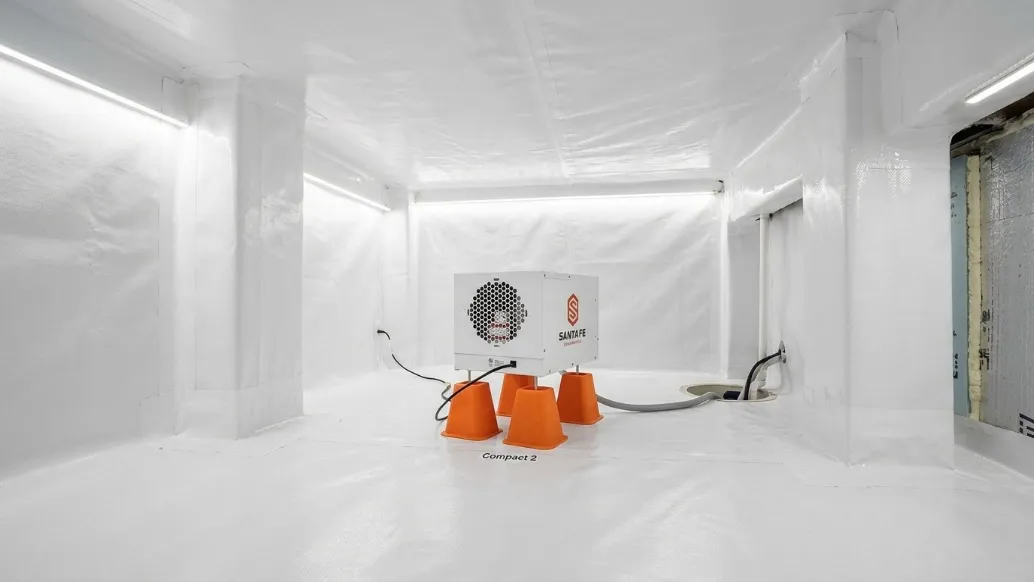
A crawl space dehumidifier is one of the smartest moisture upgrades a Long Island, Brooklyn, Queens, or Bronx homeowner can make, but on its own, it’s rarely the whole answer. In the low-lying, high-water-table neighborhoods where we work, a dehumidifier only handles the air. To keep a crawl space dry for good, it has to be paired with drainage that moves water out and encapsulation that seals ground vapor out.
At Zavza Seal, we install all three as one coordinated system, so instead of chasing humidity year after year, your crawl space stays dry, your air stays cleaner, and your foundation stays protected. That combined approach is exactly why homes in Bay Shore, Islip and similar flood-prone areas call us instead of buying a unit that can’t win the fight alone.
Free Inspections for Nassau County Suffolk County Brooklyn Queens The Bronx
Book a Free Inspection or call (631) 980-1800
Why Low-Lying Long Island Homes Need More Than a Dehumidifier
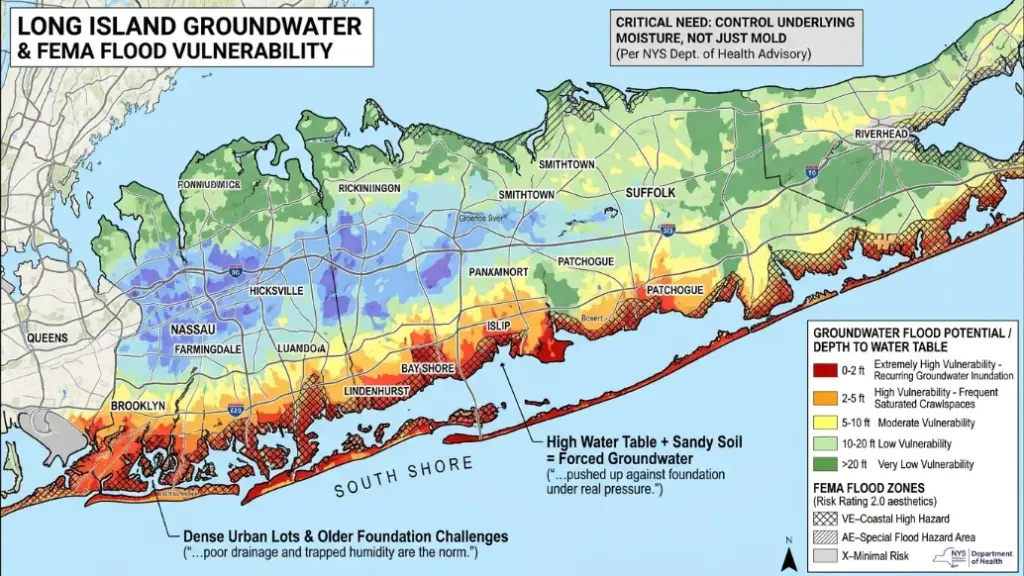
Long Island’s geography works against dry crawl spaces. Much of the South Shore, Bay Shore, Islip, Lindenhurst and the surrounding low-lying areas, sits over a shallow, high water table on sandy, fast-draining soil. When heavy rain or a coastal storm rolls through, the water table rises and pushes groundwater up against the foundation and into the crawl space under real pressure. No amount of air conditioning of the space can stop water that’s being forced in from below.
The boroughs bring a different version of the same fight. In Brooklyn, Queens and the Bronx, older housing stock, tight crawl spaces, and dense urban lots mean poor drainage and trapped humidity are the norm. Whether the water is coming from a high coastal water table or a century-old city foundation, the outcome is identical: chronic dampness that feeds mold, rots wood framing, rusts ductwork, and pushes musty air up into your living space. For those homes, the New York State Department of Health is blunt about the fix, you have to control the underlying moisture, not just the mold it produces.
This is the core reason we lead with a full system in flood-prone areas. Treating the air while ignoring the water is how homeowners end up buying a second dehumidifier two years later, still damp.
The Complete System: Drainage, Encapsulation & Dehumidification
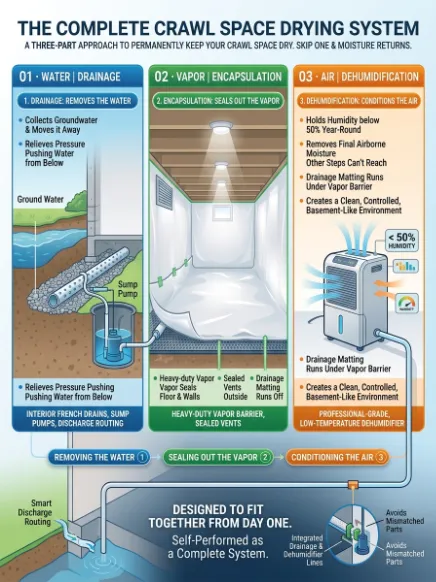
Keeping a crawl space dry in our region is a three-part job, and each part solves a problem the others can’t. Skip one and you leave a door open for moisture to come back. Here’s how the layers work together:
01 · WATER
Drainage
Interior French drains, sump pumps and smart discharge routing collect groundwater and move it away from the foundation, relieving the pressure that pushes water in from below.
02 · VAPOR
Encapsulation
A heavy-duty vapor barrier seals the floor and walls, sealed vents close off outside air, and the crawl space becomes a clean, controlled, basement-like environment.
03 · AIR
Dehumidification
A professional-grade, low-temperature dehumidifier holds humidity below 50% year-round, removing the last of the airborne moisture that drainage and sealing can’t reach.
Think of it as removing the water, sealing out the vapor, and conditioning the air, in that order.
Drainage handles the liquid, encapsulation stops it from rising back in, and the dehumidifier polishes the result. In a dry, well-sealed space, dehumidification alone is plenty. In a wet one, it’s the finishing step of a system that starts with a crawl space drainage system and crawl space encapsulation.
Because we self-perform all three, we design them to fit each other from day one, the drainage matting runs under the vapor barrier, and the dehumidifier is drained to the same discharge line, rather than bolting on mismatched parts from three different contractors.
Choosing the Right Crawl Space Dehumidifier
Not every dehumidifier belongs under a house. Crawl spaces are cold, cramped, and constantly damp. These conditions can quickly overwhelm portable units designed for living rooms. When we specify a crawl space dehumidifier, we look for capabilities that big-box units typically cannot provide:
| Dehumidifier Feature | Why It Matters |
|---|---|
| Capacity Matched to the Space | An undersized unit runs nonstop and never catches up. We size the dehumidifier according to the square footage, ceiling height, and moisture load so it can maintain humidity below 50% without straining. |
| Low-Temperature Performance | Crawl spaces stay cold, causing many consumer dehumidifiers to stall or ice over. We install units engineered to continue removing moisture under the exact conditions in which cheaper models stop working. |
| Automatic Condensate Drainage | Nobody wants to crawl under the house to empty a tank. Our systems drain automatically into a condensate pump, sump basin, or approved drain line, allowing them to operate hands-free. If you are comparing a store-bought unit with a professional installation, our team can explain where an ordinary household dehumidifier falls short. |
The reason we quote encapsulation and dehumidification per project rather than per square foot is that access height, existing water, and how many of the three layers you need all move the number. For a full breakdown of how drainage and moisture-control work is priced, and where the money actually goes, see our drainage cost guide. You’ll get a clear written quote within 24 hours of your free on-site inspection, so there are no surprises. Prefer to see the full menu first? Browse our complete waterproofing and moisture-control services.
Crawl Space Dehumidifiers for Long Island, Brooklyn, Queens & the Bronx: Final Thoughts
A crawl space dehumidifier is worth installing in almost any Long Island, Brooklyn, Queens, or Bronx home — but in the low-lying, flood-prone neighborhoods where groundwater is the real culprit, it only works as part of a complete system. That’s why Zavza Seal pairs professional crawl space dehumidification with the drainage that removes standing water and the encapsulation that seals ground vapor out for good. Homeowners in Bay Shore, Islip, and across the South Shore and the boroughs call us because we diagnose the actual source of the moisture, install all three layers as one coordinated project, and back the work with a clear written quote and long-term warranties. If your crawl space smells musty, feels damp, or floods after storms, let’s fix the cause — not just the symptom. Book your free inspection today and get a dry, healthier crawl space that stays that way.
Call Call (631) 980-1800 See All Services
Frequently Asked Questions About Crawl Space Dehumidifiers for Long Island, Brooklyn, Queens & the Bronx:
What does a crawl space dehumidifier do?
A crawl space dehumidifier removes excess moisture from the air and maintains a consistent relative humidity level. This helps reduce condensation, musty odors, mold-friendly conditions, wood deterioration, pest activity, and corrosion affecting pipes, ductwork, and mechanical equipment.
Is a dehumidifier enough to keep a Long Island crawl space dry?
A dehumidifier may be enough for a crawl space that is already dry, sealed, and protected from groundwater. In low-lying Long Island neighborhoods with shallow water tables, the system may also need drainage to remove liquid water and encapsulation to block ground vapor. A dehumidifier cannot stop groundwater from entering through the soil or foundation.
Why do I need drainage, encapsulation, and dehumidification?
Each component controls a different form of crawl space moisture. Drainage collects and removes groundwater, encapsulation blocks moisture vapor from the soil and foundation walls, and dehumidification controls humidity in the remaining air. Combining all three creates a more reliable crawl space moisture-control system.
What humidity level should a crawl space dehumidifier maintain?
A crawl space dehumidifier should generally maintain relative humidity between 45% and 55%. Zavza Seal typically designs systems to keep humidity below 50% when crawl space conditions allow. Keeping humidity below 60% helps discourage mold growth, condensation, wood decay, and musty odors.
Why does my crawl space stay damp after heavy rain?
A crawl space that becomes damp after rain probably has groundwater intrusion, poor exterior drainage, foundation seepage, or an elevated water table. This is especially common in Bay Shore, Islip, Lindenhurst, and other low-lying South Shore communities. The underlying water problem must be corrected because a dehumidifier only removes moisture from the air.
Can I use a portable household dehumidifier in my crawl space?
A portable household dehumidifier is rarely a dependable long-term solution for a crawl space. Consumer units may struggle in cold temperatures, require frequent tank emptying, and lack the capacity needed for continuous moisture conditions. Professional crawl space dehumidifiers offer low-temperature performance, automatic drainage, and greater durability.
Will a crawl space dehumidifier prevent mold and musty odors?
A properly sized dehumidifier can help prevent mold-friendly conditions and reduce musty odors by controlling excess humidity. However, it will not remove existing mold or correct active water intrusion. Existing contamination may require professional mold remediation before the crawl space moisture-control system is installed.
How is the correct crawl space dehumidifier size determined?
The correct capacity depends on the crawl space’s square footage, ceiling height, temperature, existing moisture, ventilation, drainage, and level of encapsulation. An undersized unit may run continuously without reaching the desired humidity level. Zavza Seal evaluates the entire crawl space before recommending equipment.
How much does crawl space dehumidifier installation cost?
Crawl space dehumidifier installation is priced according to the equipment capacity, drainage connection, electrical requirements, accessibility, and existing moisture problems. Encapsulation and drainage increase the project cost when they are needed to control groundwater and vapor. Zavza Seal provides a clear written quote within 24 hours of a free on-site inspection.
Where does Zavza Seal install crawl space dehumidifiers?
Zavza Seal installs crawl space dehumidifiers throughout Nassau County, Suffolk County, Brooklyn, Queens, and the Bronx. Our service area includes Bay Shore, Islip, Lindenhurst, and surrounding South Shore communities. We can install drainage, encapsulation, and dehumidification as one coordinated crawl space moisture-control system.