
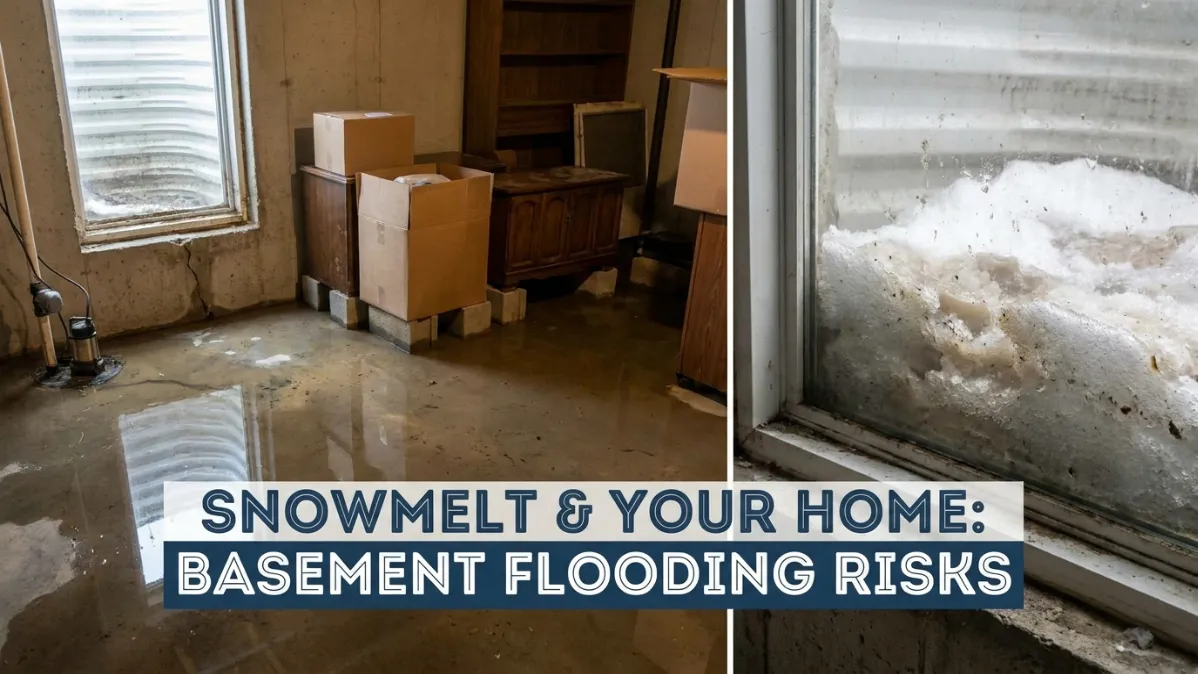
If you are dealing with snowmelt flooding right now, do this first: get water moving away from the house and confirm your sump pump is running. Snowmelt flooding happens when a winter’s worth of snow melts faster than the still-frozen ground can absorb it, and that meltwater rolls downhill straight toward foundations. The reason it catches so many homeowners off guard is that there is no storm to warn you.
It can be a clear, sunny week in March that floods a basement that stayed dry through every summer downpour. Whether the water is already in or you are watching the snowpack shrink and bracing for it, the steps below cover both the emergency response and the prevention that keeps next year’s thaw from doing the same thing.
The volume involved surprises people. Each cubic foot of compacted snow holds gallons of water, so a deep snowpack across your yard is a reservoir waiting to release all at once.
Meltwater already in your basement?
The Best Way to Prevent Snowmelt Flooding in Your Basement
Preventing snowmelt flooding beats response every time, and the most effective moves are things you can stage before the melt even begins. Here is where to focus.
- Clear snow away from the foundation. The snow piled against your walls melts first and closest to where you least want it. Shoveling it back a few feet from the foundation, especially on the sunny side of the house where melt starts early, keeps that meltwater from pooling right at the wall. It is the simplest, cheapest, most overlooked step.
- Make sure meltwater has somewhere to go. Your downspouts matter as much in a thaw as in a storm, maybe more, because the ground cannot absorb the overflow. If your downspouts dump near the foundation, the melt has a direct path inside. Our guide to downspout gutter installation covers how to extend that discharge well away from the house. Pair that with proper exterior drainage solutions and you give the surface water a route that does not run through your basement.
- Check the sump pump and its discharge line before the thaw. This is non-negotiable in snow country. A sump pump is your last line of defense against rising groundwater, and the spring thaw is exactly when it earns its keep. Test it on a cold day so you are not finding out it failed mid-flood. Just as important, check that the discharge line outside is not buried in snow or frozen shut, because a blocked discharge backs water right into the pit. If your pump is old, sluggish, or has no backup, read our guides on sump pump systems and backup options and what to do with a broken sump pump before you need them.
- Address the water table, not just the surface. When meltwater saturates the soil, the water table around your home rises and presses against the foundation from below and the sides. Surface fixes will not stop that. Interior basement drainage systems and a properly placed French drain manage the groundwater that surface measures miss. If you want the full menu of options, our overview of basement flooding solutions compared lays them out side by side.
What to Do During an Active Snowmelt Flood
If the water is coming in now, the priority is limiting damage and protecting yourself. Work in this order.
Stay safe around electricity. If water is near outlets, the panel, or anything electrical, do not wade in. Shut off power to the affected area at the breaker if you can reach it safely and dryly. If you cannot, keep out and call a professional. No belongings are worth the risk.
Get the water moving out. Confirm the sump pump is running. If it is overwhelmed or dead, a wet/dry vacuum, a portable pump, or even towels and a mop buy time. Every gallon you remove early is a gallon that is not soaking into drywall and framing.
Lift what you can. Move furniture, boxes, and anything stored on the floor up onto blocks or to a dry level. Pull up rugs and padding so they do not wick water across the room.
Redirect the source if it is safe to do so. If you can see where meltwater is pooling outside and you can safely clear a path for it to drain away from the house, do it. Sometimes breaking up an ice dam at a downspout outlet or shoveling a channel through snow against the wall slows the inflow noticeably.
Start drying immediately. Once the water stops rising, fans, a dehumidifier, and open windows when the weather allows all matter, because the clock on mold starts the moment things get wet. Standing water and saturated materials can begin growing mold within a day or two, which is why our flood damage cleanup process guide treats fast drying as step one, not an afterthought.
The Hidden Damage Snowmelt Leaves Behind
The flood you can see is not always the worst of it. Snowmelt season is brutal on foundations for a reason that has nothing to do with the water in your basement and everything to do with the freeze-thaw cycle.
Water seeps into small foundation cracks, then freezes overnight as temperatures drop, and freezing water expands with enormous force. That expansion widens the crack a little more each cycle, all winter and through the thaw. By spring, a hairline crack that was cosmetic in the fall can be a genuine entry point. This is one of the most common ways minor cracks turn serious, which we break down in our guide to foundation crack types. If your basement floods during the thaw and you find a crack weeping water, the two are almost certainly connected.
So even after the water is gone and the basement is dry, snowmelt flooding is worth taking seriously as a signal. It is telling you that water is reaching your foundation and that the soil around your home is staying saturated longer than it should. That same pattern, left alone, is what our basement flooding from rain guide describes happening on a smaller scale all year. The thaw just makes it impossible to ignore.
Snowmelt Flooding: Final Thoughts
Snowmelt flooding is one of the few home-water problems you can see coming weeks out, which makes it one of the most preventable. The frozen ground that cannot absorb the melt is the whole story: it turns your yard into a hard surface and routes a winter’s worth of stored water toward your foundation.
If you are in it now, stay safe around electricity, get the water moving out, and start drying fast to stay ahead of mold. If the thaw is still ahead of you, clear snow off the foundation, extend your downspouts, and confirm your sump pump and its discharge line are ready before you need them. Handle the water before it reaches the wall and snowmelt flooding becomes a non-event instead of an annual disaster.
When it keeps happening every spring, that is your foundation asking for a real drainage fix, not another wet-vac.
Frequently Asked Questions About Snowmelt Flooding:
Why does snow melting flood my basement when rain does not?
Snowmelt floods basements because the ground is often still frozen during the thaw. Frozen soil cannot absorb water, so meltwater runs across the surface, pools near the foundation, and finds its way through cracks, window wells, sump pits, or basement walls.
What should I do first if meltwater is coming into my basement?
Stay away from standing water near outlets, appliances, or electrical panels. If it is safe, shut off power to the affected area, confirm your sump pump is working, remove water with a pump or wet/dry vac, and move belongings off the floor before drying the space.
How do I prevent snowmelt from flooding my basement?
Move snow several feet away from the foundation before the thaw, clear downspout outlets, extend gutters away from the house, and test your sump pump. If flooding happens repeatedly, interior drainage, sump pump upgrades, exterior grading, or a French drain may be needed.
Can a frozen sump pump discharge line cause basement flooding?
Yes. A frozen or blocked sump pump discharge line prevents water from leaving the pit, even if the pump motor is running. When the pump cannot discharge water outside, the pit can overflow and send meltwater into the basement.
Why does snowmelt come through basement cracks?
Snowmelt enters basement cracks when water pools against the foundation and creates pressure against the wall. During winter, water can also freeze inside small cracks, expand, and make them wider, which can cause leaking during the spring thaw.
Does snowmelt flooding mean my foundation is damaged?
Not always, but snowmelt flooding can reveal foundation problems. Water entering through cracks, wall joints, floor seams, or recurring seepage points may indicate pressure against the foundation, poor drainage, or cracks that need inspection and repair.
How far should snow be shoveled away from the foundation?
Snow should be moved at least several feet away from the foundation whenever possible. The goal is to keep meltwater from draining directly toward basement walls, window wells, exterior stairwells, and low spots near the house.
Can gutters and downspouts prevent snowmelt flooding?
Yes. Gutters and downspouts help prevent snowmelt flooding by moving roof runoff away from the foundation. Downspout extensions are especially important during thaws because roof snow can melt quickly and dump large amounts of water beside the house.
Why does my basement flood during spring thaw?
Basements flood during spring thaw because melting snow, frozen soil, clogged gutters, blocked discharge lines, and rising groundwater can all happen at the same time. When water cannot drain into the ground, it collects around the foundation and enters through weak points.
When should I call a professional for snowmelt basement flooding?
all a professional if flooding happens more than once, water enters through cracks or wall-floor joints, the sump pump cannot keep up, or you see foundation cracks, bowing walls, musty odors, or recurring dampness. These signs usually point to a drainage or foundation issue that needs a permanent fix.