
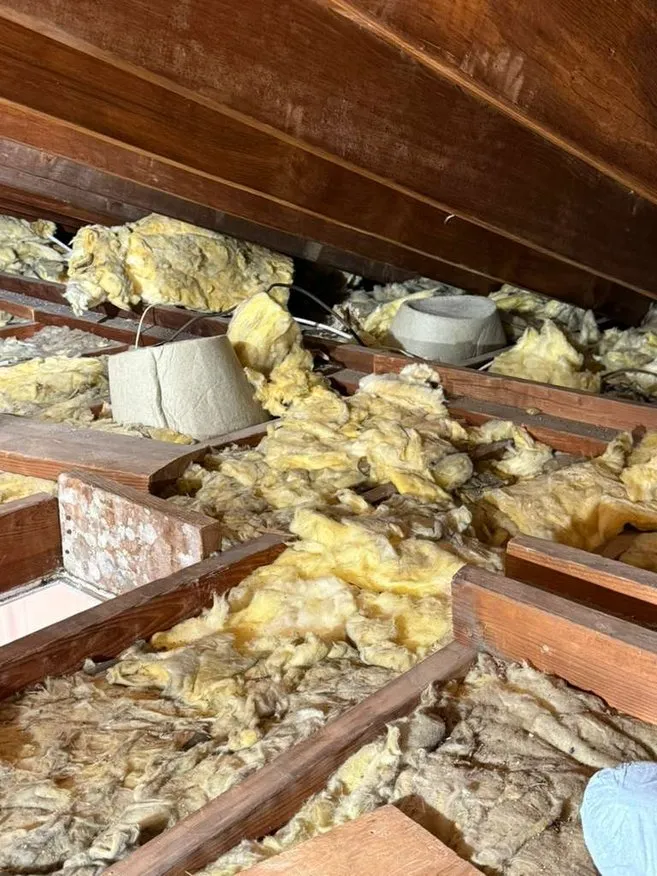
Wet insulation is more than an insulation problem. When water gets into fiberglass, cellulose, mineral wool, spray foam, or another insulation system, the real question is what happens next. Can the insulation dry? Does it need to be removed? Has mold already become a concern? Where did the moisture come from? And is the surrounding framing, sheathing, drywall, or crawl-space structure also wet?
The correct answer depends on the type of insulation, amount and source of water, length of exposure, location, airflow, temperature, humidity, and whether the insulation can actually be accessed for drying. In some situations, insulation can be dried and salvaged. In others, replacement is the more appropriate solution. This guide explains how to evaluate wet insulation in attics, crawl spaces, walls, ceilings, and other parts of a home.
In Nassau or Suffolk County? Call Mold Removal Experts Now for a Free Estimate!

Quick Answer: Can Insulation Get Wet?
Wet insulation is more than an insulation problem. When water gets into fiberglass, cellulose, mineral wool, spray foam, or another insulation system, the real question is what happens next. Can the insulation dry? Does it need to be removed? Has mold already become a concern? Where did the moisture come from? And is the surrounding framing, sheathing, drywall, or crawl-space structure also wet?
The correct answer depends on the type of insulation, amount and source of water, length of exposure, location, airflow, temperature, humidity, and whether the insulation can actually be accessed for drying. In some situations, insulation can be dried and salvaged. In others, replacement is the more appropriate solution. This guide explains how to evaluate wet insulation in attics, crawl spaces, walls, ceilings, and other parts of a home.
In Nassau or Suffolk County? Call Mold Removal Experts Now for a Free Estimate!
- Fiberglass: May be salvageable after limited exposure to clean water if it can be thoroughly dried.
- Mineral wool: Resists water absorption better than many fibrous materials, but surrounding framing can still become wet.
- Cellulose: Absorbs moisture readily, can compact and lose performance, and is often a poor candidate for drying after significant saturation.
- Open-cell spray foam: Can absorb and retain more moisture than closed-cell foam.
- Closed-cell spray foam: Resists bulk water absorption, although water can still collect against adjacent building materials.
- Rigid foam board: Generally has relatively low water absorption, but joints, edges, cuts, and surrounding materials still require evaluation.
The most important question is therefore not simply “Can insulation get wet?”
It is:
What type of insulation got wet, what caused it, and can the entire affected assembly be dried and verified?
That distinction is critical. Simply replacing or drying the insulation without identifying the moisture source can allow the same problem to return.
What Happens When Insulation Gets Wet?
Insulation works by limiting heat transfer through a material structure designed to contain air or gas. When water enters that structure, several things can happen. The insulation may lose some of its intended thermal performance, but the larger concern is often what happens to the materials surrounding it.
In an attic, crawl space, wall, or ceiling, insulation is part of a larger building assembly that can trap moisture and hide damage. That makes it important to evaluate not only the insulation itself, but also the surrounding materials and the source of the water.
1. Thermal Performance Can Decline
Water conducts heat differently from the air trapped within insulation. As moisture enters the insulation assembly, its thermal performance can be reduced. That means wet insulation may no longer provide the performance homeowners expect from the installed R-value.
Depending on the material and degree of saturation, insulation may also become compressed, displaced, or physically damaged, further reducing its effectiveness.
2. Moisture Can Reach the Building Structure
The insulation itself is not always the most serious concern. Water can migrate into other components of the building assembly, including:
- Wood framing
- Roof sheathing
- Floor joists
- Subflooring
- Drywall
- Ceiling materials
- Rim joists
- Ductwork
- Electrical components
- Vapor-retarding materials
A wet insulation problem can therefore become a building-moisture problem. This is especially important when insulation is located inside a wall or ceiling cavity where air circulation is limited.
The visible surface may eventually appear dry while moisture remains trapped deeper inside the assembly. This makes moisture assessment and source identification important before the area is closed back up.
3. Mold Risk Can Increase
Mold requires moisture and a suitable environment to grow. Wet insulation can create conditions that keep adjacent materials damp, particularly when insulation is located inside an enclosed wall, ceiling, attic, or crawl-space assembly.
The longer moisture remains trapped, the greater the concern becomes. Addressing the water source and drying affected materials promptly can help limit the conditions that allow mold to develop.
4. Wet Insulation Can Become Heavy
Water adds significant weight. This matters particularly with overhead insulation and materials that can retain substantial amounts of water. Saturated insulation can contribute to sagging or place additional stress on ceilings and supporting assemblies.
For this reason, heavily saturated insulation should not simply be ignored while it is left to dry. The extent of the water exposure and the condition of the surrounding assembly should be evaluated to determine the appropriate next step.
Bottom line: Wet insulation can affect more than energy efficiency. Moisture can spread into framing and other building materials, increase the potential for mold growth, and create additional problems if it remains trapped inside the assembly.
What Causes Wet Insulation?
Wet insulation is usually a symptom of a larger moisture problem, so identifying where the water is coming from should be the first step. A roof leak, plumbing failure, condensation, flooding, or high humidity can all introduce moisture into an insulation system, and simply replacing the insulation without correcting the source can allow the problem to return.
Common Causes of Wet Insulation
- Roof Leaks: Damaged shingles, flashing, roof penetrations, valleys, and other roofing defects can allow rainwater to enter attic insulation. Even a relatively small leak can cause insulation and surrounding wood framing to remain damp if the area is not properly dried.
- Plumbing Leaks: Burst pipes, leaking supply lines, drain leaks, and plumbing fixtures can introduce water into walls, ceilings, floors, and insulation. Hidden plumbing leaks can be particularly problematic because moisture may remain trapped inside an enclosed wall or ceiling assembly.
- HVAC Condensation: Air-conditioning equipment, ducts, drain pans, and condensate lines can create moisture problems when condensation is excessive or drainage fails. Poorly insulated ducts can also sweat in humid conditions, gradually introducing moisture into nearby insulation.
- Flooding: Floodwater can saturate insulation throughout walls, floors, basements, and crawl spaces. Because floodwater may contain dirt, sewage, chemicals, or other contaminants, heavily saturated insulation may require replacement rather than simply being dried.
- Foundation and Basement Water Intrusion: Water entering through foundation walls, floors, cracks, joints, or inadequate drainage systems can eventually create wet insulation conditions in basements and crawl spaces. Persistent moisture can also increase humidity and contribute to mold growth on nearby materials.
- Crawl-Space Moisture: High humidity, groundwater, plumbing leaks, standing water, poor drainage, and inadequate vapor control can all contribute to wet crawl-space insulation. Because crawl spaces can remain poorly ventilated, moisture may persist long enough to affect both insulation and structural materials.
- Condensation: Warm, humid air contacting cold surfaces can create condensation that gradually wets insulation and adjacent building materials. This can occur in attics, crawl spaces, exterior walls, around HVAC systems, and anywhere temperature differences allow moisture in the air to condense.
- Poor Ventilation: Insufficient attic or crawl-space ventilation can contribute to persistent moisture accumulation under the right conditions. Ventilation problems may not create water by themselves, but they can make it much harder for existing moisture to escape.
Wet Insulation by Material
Not all insulation should be treated the same way when it becomes wet. Some materials resist water relatively well and may be capable of drying in place or after removal, while others absorb significant amounts of moisture and can become difficult to salvage.
| Insulation Type | Water Resistance | Can It Sometimes Be Dried? | Major Concern |
|---|---|---|---|
| Fiberglass | Moderate | Yes, depending on exposure | Trapped moisture and loss of performance |
| Mineral Wool | High relative water resistance | Often, depending on conditions | Water reaching framing |
| Cellulose | Low | Difficult after significant saturation | Absorption, compaction, mold risk |
| Open-Cell Spray Foam | Lower than closed-cell | Depends on severity and access | Moisture retention |
| Closed-Cell Spray Foam | High | Often more resistant | Water trapped against adjacent materials |
| Rigid Foam Board | Generally high | Often | Wet joints, edges, framing, and substrate |
Important: The table is a starting point, not a substitute for evaluating the actual building assembly. The amount of water, duration of exposure, source of the water, accessibility, and condition of the surrounding materials all matter when determining whether wet insulation can be dried or should be replaced.
Wet Fiberglass Insulation
Fiberglass insulation is made from glass fibers that generally do not absorb water in the same way cellulose fibers do. That does not mean wet fiberglass should automatically be left in place. Water can become trapped between the fibers, and the insulation can remain damp when airflow is poor.
When Wet Fiberglass May Be Salvageable
Fiberglass may be a candidate for drying when:
- The water was clean.
- Exposure was limited.
- The insulation is accessible.
- It has not become contaminated.
- It has not been damaged or compressed.
- The surrounding structure can also be dried.
- Moisture can be verified after drying.
When Replacement May Make More Sense
Replacement becomes more appropriate when the insulation is:
- Heavily saturated
- Contaminated
- Mold-affected
- Damaged
- Compressed or displaced
- Trapped inside an inaccessible cavity
- Unable to reach a verified dry condition
Wet Cellulose Insulation
Cellulose deserves special attention because it behaves differently from fiberglass and mineral wool. Cellulose is made primarily from processed plant-based fibers and is capable of absorbing moisture.
When it becomes significantly wet, it can:
- Gain weight
- Compact
- Lose its intended loft
- Lose thermal performance
- Remain damp internally
- Become difficult to dry evenly
- Increase concerns about microbial growth
For heavily saturated cellulose, particularly after prolonged water exposure, removal and replacement may be more practical than attempting to dry it in place.
Wet Spray Foam Insulation
Can Spray Foam Insulation Get Wet?
Yes, but the answer depends heavily on whether the spray foam is open-cell or closed-cell. The way each type interacts with water is different, and the condition of the surrounding building assembly still needs to be considered.
Can Closed-Cell Spray Foam Get Wet?
Closed-cell spray foam is relatively resistant to bulk water penetration because of its cellular structure. However, homeowners should not interpret that as meaning a wet assembly is harmless.
Water can still collect:
- Behind the foam
- At edges
- Around penetrations
- Along framing
- Against roof sheathing
- Against other building materials
The surrounding materials may therefore require inspection even when the foam itself appears relatively unaffected.
Can Open-Cell Spray Foam Get Wet?
Open-cell spray foam is more moisture-permeable and can absorb and retain more water than closed-cell foam. If significant water enters an open-cell foam assembly, determining whether it can be adequately dried may require opening or inspecting the affected area.
Wet Mineral Wool Insulation
Mineral wool is relatively resistant to water absorption compared with cellulose. However, water can still occupy spaces within the insulation assembly and migrate to adjacent building materials.
Water-resistant insulation does not equal a water-resistant building assembly.
If mineral wool becomes wet because of a roof leak, plumbing failure, or crawl-space moisture problem, the framing and sheathing should also be evaluated.
Wet Insulation in a Crawl Space
Crawl spaces deserve special attention because they frequently combine several conditions that can make moisture difficult to control:
- High humidity
- Limited airflow
- Ground moisture
- Plumbing
- Wood framing
- Insulation
- Poor drainage
- Condensation
- Difficult access
Why Wet Crawl-Space Insulation Is a Problem
Wet crawl-space insulation can remain damp long after the visible water is gone. This is particularly concerning when insulation is attached to floor assemblies or located against wood framing.
Persistent moisture can contribute to:
- Mold growth
- Wood decay
- Musty odors
- Reduced insulation performance
- Increased humidity
- Recurring moisture problems
Common Causes of Wet Crawl-Space Insulation
- Groundwater
- Plumbing leaks
- Standing water
- Poor exterior drainage
- Foundation leaks
- Condensation
- High crawl-space humidity
- Missing or damaged vapor control
- Poor ventilation or inadequate moisture management
- HVAC or duct condensation
If the crawl space remains humid, replacing the insulation alone may not solve the underlying problem. The moisture source and overall crawl-space conditions need to be addressed as part of the solution.
Wet Insulation in an Attic
Attic insulation commonly becomes wet because of roof leaks, flashing failures, plumbing penetrations, HVAC equipment, condensation, inadequate ventilation, or air leakage from the conditioned space.
Where Is Water Entering From Outside?
Check for roof leaks, flashing failures, penetrations, damaged roofing materials, and other pathways that allow rainwater to enter the attic.
Where Is Moisture Entering From Inside?
Check for air leakage, condensation, HVAC-related moisture, and other sources that can introduce warm, humid air into the attic.
A roof leak and an attic condensation problem can produce similar visible symptoms while requiring completely different solutions. Investigating the source of moisture is therefore essential before deciding whether attic insulation should be dried, repaired, or replaced.
When Should Wet Insulation Be Removed?
There is no single rule that applies to every insulation material and every water event.
Removal becomes increasingly appropriate when:
- The Water Was Contaminated: Insulation exposed to sewage, floodwater, or other contaminated water presents a different remediation problem than insulation exposed to a small clean-water leak.
- The Insulation Is Heavily Saturated: The more water the material holds, the more difficult complete drying becomes.
- The Insulation Is Mold-Affected: Visible microbial growth changes the remediation strategy.
- The Material Has Lost Its Physical Integrity: Cellulose that has compacted or insulation that has been displaced, crushed, or damaged may no longer perform as intended.
- The Insulation Cannot Be Thoroughly Accessed: If moisture cannot be reached and verified, simply assuming that it will dry inside the assembly is risky.
- The Moisture Source Has Not Been Corrected: Installing replacement insulation before fixing the roof leak, plumbing leak, drainage problem, or condensation source simply resets the clock.
Can Wet Insulation Cause a Musty Smell?
It can. A persistent musty odor following a leak, flood, or other water intrusion is often a reason to investigate for hidden moisture, particularly when the odor continues after visible water has been removed. Wet insulation itself may contribute to an odor, but the smell can also originate from damp framing, sheathing, drywall, flooring, dust, or microbial growth within the affected assembly.
This is one reason odor should be treated as a clue rather than a diagnosis. Simply spraying an odor-control product or replacing the visibly damaged material may not address the underlying moisture problem. If moisture remains inside a wall, ceiling, attic, basement, or crawl space, the odor may persist even after the most obvious water-damaged material has been removed.
A musty odor may indicate persistent moisture or microbial growth, but odor alone cannot identify:
- The type of mold
- The location of the moisture
- Whether insulation must be removed
- Whether the source has been corrected
If an attic, crawl space, basement, wall, or ceiling develops a persistent musty smell after water intrusion, the investigation should look beyond the visible surface.
How to Dry Wet Insulation
There is no single drying method that works for every type of wet insulation or every water-damage situation. The appropriate approach depends on the insulation material, the amount of water involved, the source of the moisture, how long the material has been wet, and whether the insulation is accessible.
One of the biggest mistakes is treating drying as simply a matter of adding a fan and waiting. Effective structural drying requires controlling the conditions that caused the moisture problem, providing an appropriate path for evaporation, managing humidity, and monitoring the affected materials over time.
The process should also account for the materials surrounding the insulation. A wet wall cavity may contain moisture in the insulation, wood framing, sheathing, drywall, or other components. Drying one material does not necessarily mean the entire assembly has reached an acceptable moisture condition.
A general drying process is:
1. Stop the Moisture Source
Fix the roof leak, plumbing failure, drainage problem, HVAC condensation, foundation intrusion, or other source first.
2. Determine the Water Source
Clean water and contaminated water should not automatically be treated the same way. The source and level of contamination can affect whether materials are suitable for restoration.
3. Identify the Affected Area
Determine how far the moisture has traveled through:
- Insulation
- Framing
- Sheathing
- Drywall
- Flooring
- Ceiling assemblies
4. Create Appropriate Access
Enclosed insulation cannot necessarily be dried effectively from the room side. In some assemblies, limited access can prevent adequate air movement and evaporation, requiring a different drying or removal strategy.
5. Remove Unsalvageable Materials
Materials that cannot be effectively cleaned, dried, or restored may need removal.
6. Control Humidity
Dehumidification can help remove water vapor from the environment and support evaporation from affected materials.
7. Provide Air Movement
Air movement across accessible wet materials can accelerate evaporation.
8. Monitor Moisture
Continue measuring affected materials rather than relying on elapsed time. A room that has been running fans for several days is not necessarily a dry room.
9. Verify Dryness
Do not close a wall, ceiling, attic, or crawl-space assembly until the affected materials have been evaluated and determined to be adequately dry.
10. Rebuild Only After the Moisture Problem Is Resolved
New insulation should not be installed over an unresolved moisture problem. Reconstruction should follow drying and, when necessary, cleaning or remediation so that the new materials are not placed into an environment where moisture remains.
Should You Replace Wet Insulation or Dry It?
The answer is not always “replace it” and it is not always “dry it.” Different insulation materials respond very differently to water, and the type of water involved can be just as important as the amount of moisture. A small amount of clean water affecting accessible fiberglass may be handled very differently from insulation that has been saturated by a flood, sewage backup, or long-term plumbing leak.
The condition of the insulation also matters. Material that is slightly damp and can be thoroughly dried may have a different restoration path than material that has collapsed, become contaminated, remained wet for an extended period, or cannot be adequately accessed for drying. In addition, the surrounding framing, sheathing, drywall, and other building materials may require attention even if the insulation itself appears recoverable.
Use this simplified decision framework:
| Situation | General Direction |
|---|---|
| Slightly damp fiberglass from a clean, short-duration event | Drying may be possible |
| Saturated fiberglass | Evaluate carefully; replacement may be appropriate |
| Wet cellulose | Replacement is often the better option after significant saturation |
| Wet mineral wool | May be salvageable if accessible and uncontaminated |
| Wet closed-cell spray foam | Evaluate surrounding materials and moisture source |
| Wet open-cell spray foam | Requires careful evaluation because it can retain moisture |
| Sewage-contaminated insulation | Removal is generally appropriate |
| Flood-contaminated porous insulation | Removal is generally appropriate |
| Visible mold on insulation | Remediation strategy required |
| Insulation trapped in a wet closed cavity | Open and evaluate rather than assuming it will dry |
| Repeatedly wet insulation | Correct the underlying moisture source before replacement |
The key distinction is salvageability versus simply being able to make the material feel dry.
Insulation that has technically dried may still be unsuitable if it has been contaminated, damaged, compressed, or affected by microbial growth. Likewise, replacing insulation without correcting the source of moisture can simply restart the same problem.
Wet Insulation: Final Thought
Fiberglass, mineral wool, cellulose, open-cell spray foam, closed-cell spray foam, and rigid foam can behave very differently after water exposure. Location matters just as much as material. Wet attic insulation may point to a roof leak or condensation problem. Wet crawl-space insulation may point to groundwater, drainage, humidity, or vapor-control problems. Wet basement insulation may indicate foundation water intrusion or a drainage failure.
Replacing the insulation without correcting the moisture source can simply cause the same problem to happen again. When wet insulation is accompanied by visible mold, persistent moisture, contaminated water, hidden cavities, or recurring water intrusion, the right objective is not simply to “dry the insulation.”
It is to identify the moisture source, determine the extent of the affected assembly, remove materials that cannot be restored, dry what can be salvaged, and verify the building is ready to be rebuilt.
Frequently Asked Question Wet Insulation:
Can Wet Insulation Be Dried Instead of Replaced?
Sometimes. The decision depends on the insulation material, how saturated it became, how long it remained wet, the type of water involved, and whether mold or contamination is present. Materials that cannot be thoroughly dried or have been contaminated may need to be removed and replaced.
Does Wet Insulation Always Mean It Needs to Be Replaced?
No. Some insulation can potentially be salvaged after limited exposure to clean water if it can be completely dried and remains structurally sound and uncontaminated. However, saturated, damaged, mold-affected, or contaminated insulation may be better removed.
Why Is the Location of Wet Insulation Important?
The location can help identify the underlying moisture source. Wet attic insulation may be associated with roof leaks or condensation, while wet crawl-space insulation can result from groundwater, drainage problems, humidity, or inadequate vapor control. Wet basement insulation may indicate foundation water intrusion or drainage failure.
Can Wet Insulation Cause Mold?
Yes. Wet insulation can contribute to mold growth when moisture remains trapped in the building assembly. Mold may develop on insulation itself or on nearby materials such as wood framing, drywall, sheathing, and other organic materials.
What Should I Do If Insulation Gets Wet From a Flood?
First, identify the type and source of the water. Floodwater, sewage, or other contaminated water can introduce bacteria, chemicals, and other contaminants, making removal safer and more appropriate than attempting to dry the insulation. The surrounding building materials should also be evaluated for moisture and contamination.
Can I Replace Wet Insulation Without Fixing the Water Problem?
Replacing the insulation alone is usually not enough. If the underlying leak, drainage issue, groundwater intrusion, condensation, or humidity problem remains, the new insulation can become wet as well. The moisture source should be corrected before rebuilding the affected assembly.
How Do I Know If Wet Insulation Is Completely Dry?
Surface dryness does not necessarily mean the entire insulation system is dry. Moisture can remain inside insulation, wall cavities, floors, framing, or other concealed areas. Moisture measurements and an evaluation of the surrounding assembly can help determine whether the area is ready for reconstruction.
Surface dryness does not necessarily mean the entire insulation system is dry. Moisture can remain inside insulation, wall cavities, floors, framing, or other concealed areas. Moisture measurements and an evaluation of the surrounding assembly can help determine whether the area is ready for reconstruction.
Is Wet Cellulose Insulation Salvageable?
Significant water exposure can make cellulose insulation difficult to restore because it can absorb and retain substantial moisture. If cellulose becomes heavily saturated, remains wet for an extended period, becomes compacted, or develops mold or contamination, removal and replacement may be necessary.