
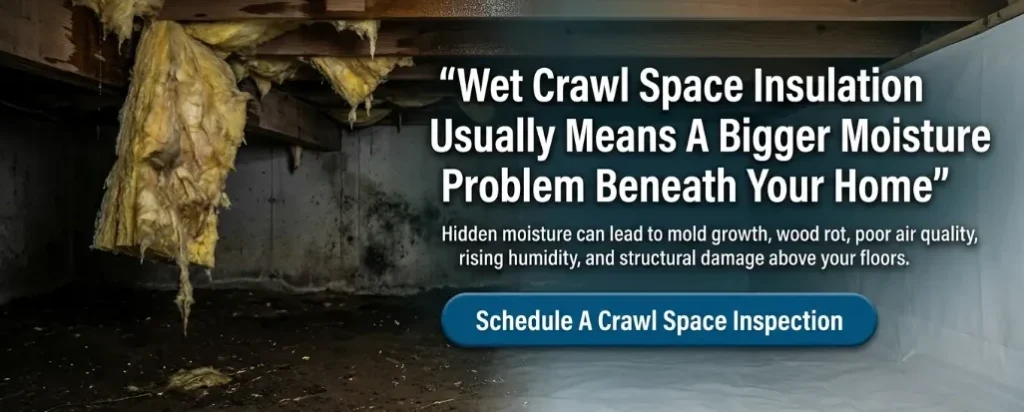
If you’ve opened your crawl space hatch and seen fiberglass batts drooping between joists, dark stains spreading across the paper backing, or insulation lying on the dirt floor in wet clumps, you’re looking at one of the most common, most misdiagnosed, and most consequential moisture failures in residential construction.
Here’s the short answer most contractors won’t give you: wet fiberglass insulation in a crawl space almost never gets replaced with the same material it was before. Not because contractors want to upsell you. Because the insulation getting wet is not the actual problem. It’s the symptom of a problem the original insulation was never designed to survive.
This page walks through the real decision: when wet insulation can be remediated, when it has to come out, what replaces it, and, most importantly, what has to change in the crawl space first so the replacement doesn’t fail the same way in three years.
Quick Decision Guide: If your insulation is fiberglass and shows any of the following, it needs to come out: visible mold, sagging or detachment from joists, persistent dampness, pest contamination, or wood moisture readings above 19% in the joists behind it. Drying it in place is rarely a long-term solution because fiberglass holds moisture against the wood it’s installed against, accelerating wood rot and mold problems it’s hiding.
Long Island, Brooklyn, Queens, and The Bronx Residents Can Call on Zavza Seal for free Advanced Mold Testing and Solutions that Stop Mold for Good! Schedule Yours Now!
Why Crawl Space Insulation Gets Wet in the First Place
Crawl space insulation gets wet because of the slow, mechanical reality of how moisture moves through a vented or semi-vented crawl space across a year.
There are four typical pathways, and most homes have at least two of them happening simultaneously:
- Humid Outside Air Meeting Cool Crawl Space Surfaces. This is the most underdiagnosed cause. When summer air at 80°F and 80% relative humidity enters a vented crawl space and contacts joists or ductwork sitting at 65°F, the air drops below its dew point and deposits liquid water directly onto wood and insulation. The crawl space vents that building codes once required as a “drying” strategy are, in practice, the largest single source of moisture in most crawl spaces during humid months.
- Ground Moisture Rising Through Exposed or Poorly Covered Soil. A bare or partially covered dirt floor releases between 10 and 20 gallons of water per 1,000 square feet per day into the crawl space air. That moisture rises, contacts framing, and saturates everything porous on the way up, including the fiberglass batts pressed against the subfloor.
- Plumbing Leaks and HVAC Condensation. Slow drips from supply lines, drain pipes, or sweating cold-water lines wet the insulation directly. Uninsulated or poorly insulated AC ducts running through the crawl space sweat condensation onto whatever sits beneath them, which is usually fiberglass.
- Bulk Water Intrusion From Foundation Drainage Failure. Grading problems, failed gutters, or hydrostatic pressure can push liquid water into the crawl space during heavy rain. Even a single significant intrusion event can saturate insulation enough to start the failure cascade.
Fiberglass insulation’s failure mode in any of these scenarios is the same: it absorbs and holds moisture, presses that moisture against the wood structure above it, loses its R-value, gains weight, sags away from the joists, and provides an ideal humid substrate for mold colonization on the wood underneath.
The Building Science: Why Wet Fiberglass Becomes a Structural Risk, Not Just an Energy Problem
Fiberglass insulation is sometimes defended with the claim that the glass fibers themselves don’t absorb water. Technically true. Practically irrelevant.
The fluffy structure that gives fiberglass its R-value is also a sponge-like matrix that holds water by capillary action between fibers. Once saturated, fiberglass behaves less like insulation and more like a wet rag pressed against the joists. Three things happen in sequence:
- R-Value Collapses. Water transfers heat roughly 25 times more efficiently than the still air that fiberglass relies on for insulation performance. Wet fiberglass can lose 40% of its rated R-value within the first five years of moisture exposure, and a saturated batt loses nearly all of it. Your heating and cooling bills rise long before you ever see the insulation fail visually.
- Wood Moisture Content Rises Into the Danger Zone. This is the part most homeowners don’t realize. The relevant threshold isn’t visible wetness. It’s wood moisture content (WMC), measured with a pin or pinless meter. The building science consensus is well-established:
| Wood Moisture Content | What’s Happening |
|---|---|
| 7–16% | Healthy range. Normal seasonal variation. |
| 16–19% | Elevated, investigate moisture source. |
| 19–28% | Mold growth supported; surface mold likely; decay organisms can activate. |
| Above 28% | Wood is at fiber saturation. Active rot conditions. Structural risk. |
Wet fiberglass pressed against joists routinely pushes underlying wood into the 20–28% range, especially in summer in humid climates. That’s not a theoretical concern. That’s the active mold and rot zone, sitting hidden behind insulation that looks merely “a little damp” from below.
3. Mold Colonization Begins Within 24–48 Hours: Once wood moisture crosses 19% and stays there, the same colonization timeline that applies to drywall and framing in any water-damaged building applies here. The insulation becomes a sustained-moisture reservoir, the wood behind it becomes a substrate, and the dark, enclosed environment becomes an ideal growth chamber. Common colonizers in this scenario include Penicillium, Aspergillus, Cladosporium, and, with sustained saturation, Stachybotrys chartarum on cellulose-containing materials nearby.
The insulation didn’t just fail. It became the mechanism by which a moisture problem turned into a structural and air-quality problem.
When You Can Remediate Wet Insulation in Place (And Why It's Rare)
There are narrow scenarios where wet or damp insulation can be saved. They share three conditions:
The wetting event was recent and identifiable (a single plumbing leak, a one-time storm intrusion, not chronic humidity) The insulation shows no mold growth, no sagging, no detachment, and no pest contamination Wood moisture content readings on the joists behind it are below 19% and dropping
In that scenario, a contractor may recommend: Removing the affected batts temporarily Drying the wood structure with fans and dehumidification until WMC stabilizes below 16% Reinstalling the insulation only if it’s still structurally intact and clean Correcting the moisture source before reinstallation
This represents perhaps one in ten crawl space insulation cases inspected in the field. Most wet crawl space insulation fails the first criterion alone. The wetting isn’t a single event; it’s been happening seasonally for years.
When Wet Insulation Must Be Removed (The Common Case)
Insulation must come out, not be dried in place, when any of the following are present:
- Visible Mold on the Insulation, Paper Backing, or Adjacent Wood: Mold on paper-faced fiberglass means the cellulose food source is colonized. Drying does not kill mold; it deactivates it. Residual spores, hyphae, and mycotoxins remain and reactivate the next time moisture returns.
- Sagging or Detachment From the Joist Bays: Sagging fiberglass is a confession: it’s been wet long enough and heavy enough to physically deform. The wood behind it has been exposed to sustained elevated moisture, and the insulation itself has lost most of its R-value permanently.
- Wood Moisture Content Above 19% on Joists Behind the Insulation: This is the threshold professional remediators use, and it doesn’t matter whether the insulation “looks” wet. If the wood it’s pressed against reads above 19%, the system has failed.
- Pest Contamination: Rodent nesting, droppings, or urine in insulation introduces bacteria, ammonia, and allergens that aerosolize into the home through the stack effect, the same mechanism by which up to 40% of the air in your living space originates in the crawl space. Pest-contaminated insulation is a health hazard regardless of moisture content.
- Persistent Musty Odors: Microbial volatile organic compounds (mVOCs), chiefly 3-methylfuran and geosmin, are produced by active fungal metabolism. A musty smell from a crawl space is not a cosmetic issue. It’s a chemical signature of active colonization, often hidden behind insulation that looks marginal from below.
- Insulation Older Than 15 to 20 Years in a Vented Crawl Space: Fiberglass batts in dry conditions have a 15 to 20 year service life. In a vented crawl space exposed to seasonal humidity cycles, that lifespan compresses significantly. Older insulation in a humid climate has almost certainly cycled through wet-dry-wet enough times to have permanent performance loss and likely colonization.

Why Replacing Fiberglass With Fiberglass Is Almost Never the Right Answer
Why Replacing Fiberglass With Fiberglass Is Almost Never the Right Answer
This is the part of the conversation that separates contractors who do crawl spaces correctly from contractors who do them quickly.
The modern building science consensus, published by Building Science Corporation, adopted by most current building codes for new construction, and supported by decades of field data, is that vented crawl spaces with subfloor fiberglass insulation are a failed design.
Why Replacing Fiberglass With Fiberglass Is Almost Never the Right Answer
The system was specified before we understood how moisture actually moves through residential foundations, and it has been demonstrated to fail consistently across climate zones whenever ambient humidity rises above roughly 70% for extended periods.
Replacing wet fiberglass with new fiberglass, while leaving the crawl space vented and the floor uncovered, is replacing the insulation without changing any of the conditions that caused it to fail. The new insulation will follow the same failure path on the same timeline.
Two replacement strategies are currently supported by building science and field performance:
Option 1: Encapsulation With Wall Insulation (Preferred for Most Climates)
The crawl space becomes a sealed, conditioned, semi-interior space: Vents are sealed permanently A heavy-mil vapor barrier (typically 12 to 20 mil) covers the entire floor and runs partway up the foundation walls Rigid foam board or closed-cell spray foam is installed against the foundation walls, not between the floor joists A dedicated dehumidifier maintains relative humidity below 60% The subfloor insulation between joists is removed entirely, because the conditioned crawl space air now insulates the floor system above
This approach is what current building science recommends for almost all U.S. climate zones outside of arid regions. The crawl space stops behaving like a small outdoor space under your house and starts behaving like an extension of your interior.
Option 2: Rigid Foam or Closed-Cell Spray Foam at the Subfloor (Specific Cases)
When full encapsulation isn’t feasible, whether for budget reasons, access reasons, or specific construction types, rigid foam board or closed-cell spray foam can replace fiberglass between the joists. Both materials are dramatically more moisture-tolerant than fiberglass. Neither absorbs and holds water. Both maintain R-value when ambient humidity rises.
This is a partial solution. It addresses insulation failure but does not address the broader moisture-source problem in the crawl space itself. Without a vapor barrier on the ground and dehumidification, wood moisture content above the foam can still rise into the mold-supporting range during humid seasons.
The Replacement Sequence That Actually Works
If a contractor proposes simply pulling out the wet insulation and putting new insulation back, ask what changes about the crawl space environment. If the answer is “nothing,” the new insulation is on a timer.
A correct sequence, the one used by remediation contractors working under building science protocols, looks like this:
- Diagnose The Moisture Source: Bulk water intrusion, vapor drive from soil, humid air infiltration, plumbing leaks, and condensation each require different corrections. Replacing insulation without identifying the source of crawl space moisture guarantees recurrence.
- Remove All Compromised Insulation: Full personal protective equipment, sealed disposal, and surface decontamination of the wood above. Treat any visible mold on framing with an appropriate antimicrobial.
- Address Bulk Water And Drainage Issues First: If liquid water enters the crawl space, no encapsulation, no insulation, and no dehumidifier will keep up with it. Drainage correction comes before everything else.
- Cover The Ground: Vapor barrier installation across the entire floor and partway up the walls. This single intervention eliminates the largest source of crawl space moisture in most homes.
- Seal Air Leakage Paths: Vents, rim joists, utility penetrations. The crawl space becomes a controlled environment, not an uncontrolled one.
- Insulate Appropriately: Rigid foam on walls for encapsulated crawl spaces; closed-cell spray foam or rigid foam at the subfloor if encapsulation isn’t pursued.
- Install Dehumidification: A crawl-space-rated dehumidifier set to maintain 55 to 60% RH. Without this, even a properly sealed crawl space can drift into mold-supporting humidity during seasonal extremes.
- Re-Verify Wood Moisture Content: A follow-up reading 30 to 60 days later confirms the wood is drying into the 7 to 16% healthy range and staying there.
This sequence is what separates a repair that lasts 20+ years from a repair that fails in 3.
Wet Insulation In Crawl Space: Final Thoughts
Wet insulation in a crawl space is rarely an isolated problem. It’s usually evidence of a larger moisture-control failure happening beneath the home. Left unresolved, that moisture can quietly damage structural wood, increase indoor humidity, support mold growth, attract pests, reduce energy efficiency, and contaminate the air moving into the living space above.
The longer wet insulation remains in place, the more expensive the consequences typically become.
The good news is that crawl space moisture problems are highly correctable when approached systematically. Proper inspection, moisture-source correction, contaminated insulation removal, vapor control, drainage improvements, encapsulation, and humidity management can restore the crawl space into a dry, controlled environment that protects both the structure and the people living above it. For Long Island, Queens, Brooklyn, and The Bronx residents, we handle insulation removal and replacement, mold remediation, and prevention solutions that stop excess moisture for good!
Protect Your Home Before Hidden Crawl Space Damage Gets Worse!
Can I Just Dry Out Wet Insulation With A Fan?
Almost never successfully. Fans circulate air but don’t remove moisture from the system. In a humid crawl space, a fan often accelerates moisture movement into and out of the insulation without ever reducing the underlying conditions. If the insulation has visible mold, sagging, or pest contamination, drying doesn’t restore it; it just makes the failure less visible.
Is Wet Insulation In The Crawl Space A Health Hazard For The Living Space Above?
Yes, by mechanism. Crawl space air rises into the home through the stack effect. Mold spores, microbial VOCs, and contaminants from wet insulation become part of the indoor air supply. Symptoms can include increased allergic response, respiratory irritation, persistent musty odors in the home, and worsening of asthma, particularly in children, elderly occupants, and immunocompromised individuals.
How Quickly Does Mold Grow On Wet Crawl Space Insulation?
Mold colonization on suitable substrates begins within 24–48 hours of sustained moisture exposure. Wet fiberglass against wood framing typically shows established colonies within a week and significant growth within a month if the moisture isn’t removed.
Does Homeowner's Insurance Cover Wet Crawl Space Insulation Replacement?
It depends on the cause. Sudden, identifiable events such as a burst pipe, an appliance failure, or a covered storm are commonly covered. Gradual moisture damage from humidity, vapor drive, or poor drainage is typically classified as a maintenance issue and excluded. Documentation of the cause matters significantly for claim outcomes.
Should I Remove The Insulation Myself?
Fiberglass insulation removal involves significant exposure to airborne glass fibers, which irritate skin, eyes, and lungs. Mold-contaminated insulation adds spore and mycotoxin exposure. Pest-contaminated insulation adds bacterial and allergen exposure. Professional removal includes containment, PPE, sealed disposal, and decontamination of underlying surfaces, none of which DIY removal typically addresses.
Will Encapsulation Alone Fix The Problem Without Replacing The Insulation?
No. Wet, colonized, or sagging insulation must be removed before encapsulation. Sealing a crawl space with compromised insulation inside it traps contaminants in a now-airtight environment, which makes air quality worse rather than better.
Can Wet Crawl Space Insulation Attract Pests?
Yes. Damp insulation creates ideal nesting conditions for rodents, insects, and other pests. Once contaminated with droppings or urine, the insulation often becomes a biohazard and usually requires full removal and sanitation of the surrounding area.
What Does Wet Crawl Space Insulation Smell Like?
Most homeowners describe it as musty, earthy, damp, or similar to a wet basement smell. The odor often becomes stronger after rain, during humid weather, or when the HVAC system is running because air movement distributes microbial VOCs throughout the home.
Will New Insulation Fix The Problem By Itself?
No. Replacing insulation without correcting the moisture source only resets the timeline until the new insulation becomes wet and contaminated again. Moisture control always comes before insulation replacement.
How Do Professionals Confirm The Insulation Is Wet Or Failing?
Contractors typically use moisture meters, thermal imaging cameras, humidity readings, visual inspection, and sometimes air or surface sampling to determine the extent of moisture intrusion, microbial growth, and material failure within the crawl space system.