
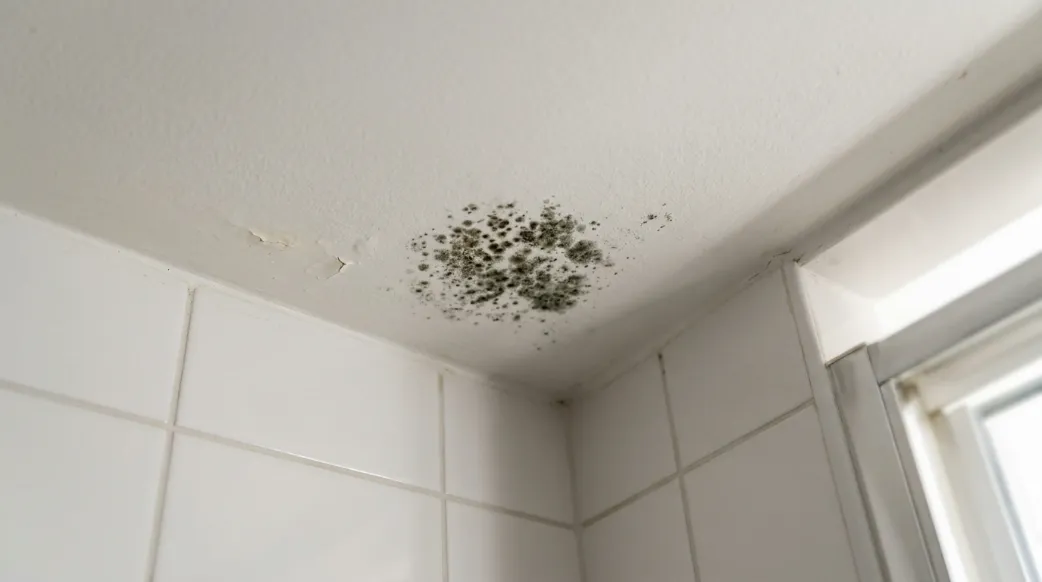
Mold on bathroom ceiling surfaces all look the same no matter what caused the growth, and that is exactly why so many people clean the same spot three times before they fix it. There are three things that put it there: a ventilation system that cannot clear the steam, water leaking in from above, or a ceiling that runs too cold and collects condensation. They produce nearly identical dark spotting, but the repair for each one is completely different, so cleaning without diagnosing is a coin flip.
The good news is that you can usually tell them apart without opening anything, because each cause leaves a different pattern on the ceiling. This guide shows you how to read that pattern, gives you the fix for each of the three causes, and tells you the point at which this stops being a weekend job.
Mold on Bathroom Ceiling: Start by Reading the Pattern
Before you clean anything, turn on the light, stand back, and look at the shape of the growth. Mold on bathroom ceiling surfaces is never randomly distributed. It grows where the moisture is, and the moisture arrives in a different pattern depending on where it comes from. Take a photo, because you will want a before shot for comparison in two weeks, and match what you see against the three patterns below.
| What you see | What it means | Where to go |
|---|---|---|
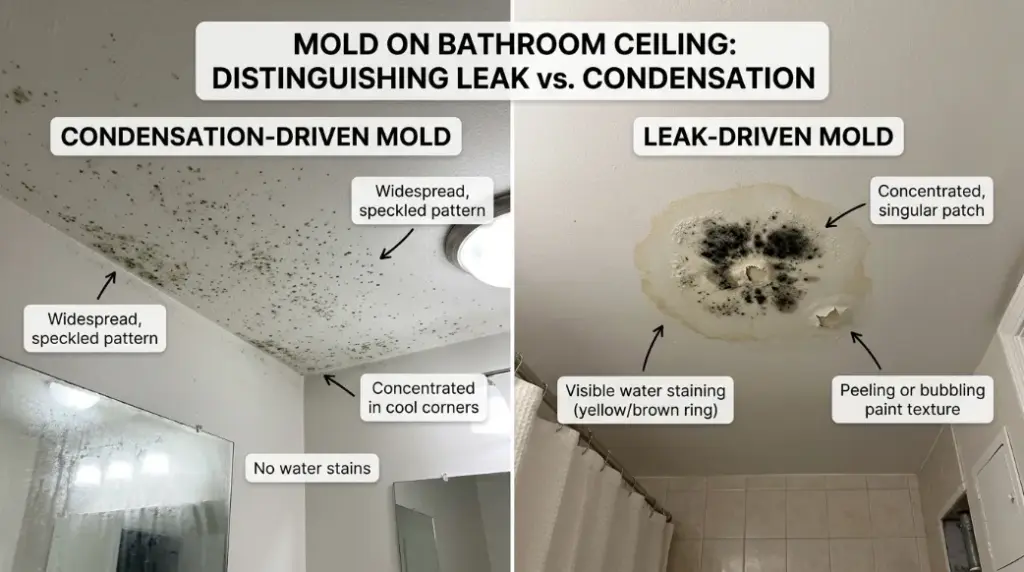
| Fine spotting spread across the whole ceiling plane, or haloed around the fan grille, worst directly above the shower | Steam is sitting on the ceiling long enough to condense. Ventilation cannot keep up. | Cause 1: the exhaust fan |
| A discrete patch with a hard edge and a brown or amber tide ring, often roughly circular, away from the fan and shower | Liquid water is arriving from above and soaking through. | Cause 2: a leak |
| Growth in evenly spaced parallel stripes, or confined to exterior corners and the wall-ceiling junction | The ceiling surface is colder than the room and is condensing moisture out of the air. | Cause 3: a cold ceiling |
Swipe sideways on a phone to see all three columns.
If you see two patterns at once, treat the leak first. Liquid water always outranks humidity.
Cause 1: The Exhaust Fan Is Losing the Fight
Nine times out of ten this is the answer, and nine times out of ten the fan is not broken. It is just outmatched. A hot shower spikes the room to 70 percent humidity or higher in minutes, warm wet air rises, and it condenses on the coolest surface in the room, which is the ceiling. If the fan cannot move that air out before it settles onto paint and paper-faced drywall, spores have everything they need, and mold on bathroom ceiling drywall is the result.
There is an actual number for this. To meet the local exhaust requirements in ASHRAE 62.2 and the International Residential Code, a bathroom fan needs to move at least 50 CFM running intermittently, or at least 20 CFM running continuously. A common sizing rule for a standard bath is roughly 1 CFM per square foot of floor area, with 50 CFM as the floor. Plenty of older homes have a 30 or 40 CFM unit doing a job that needs 80, and plenty have a fan that meets spec on paper but is choked by its ductwork.
Two Tests That Tell You If Mold on Bathroom Ceiling Is a Fan Problem
Two minutes will tell you where you stand.
- The tissue test
Run a hot shower with the door closed. Hold a single square of tissue up to the fan grille. If it holds firmly, airflow is decent. If it barely clings or falls away, the fan is not moving meaningful air.
- The 15 minute mirror test
End the shower, leave the fan running, and check the mirror at 15 minutes. Still fogged means the room is not clearing between uses, and moisture is carrying over from one shower to the next.
Is Mold on Bathroom Ceiling Dangerous?
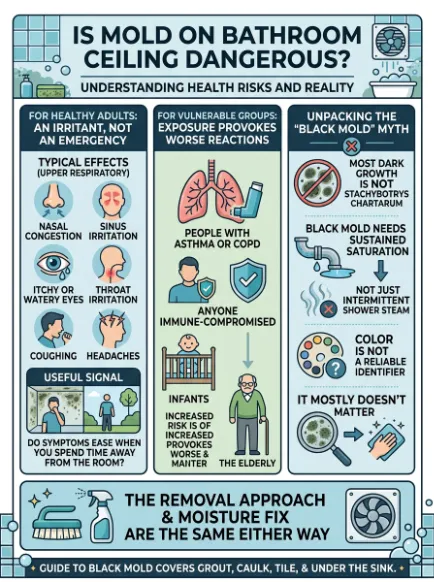
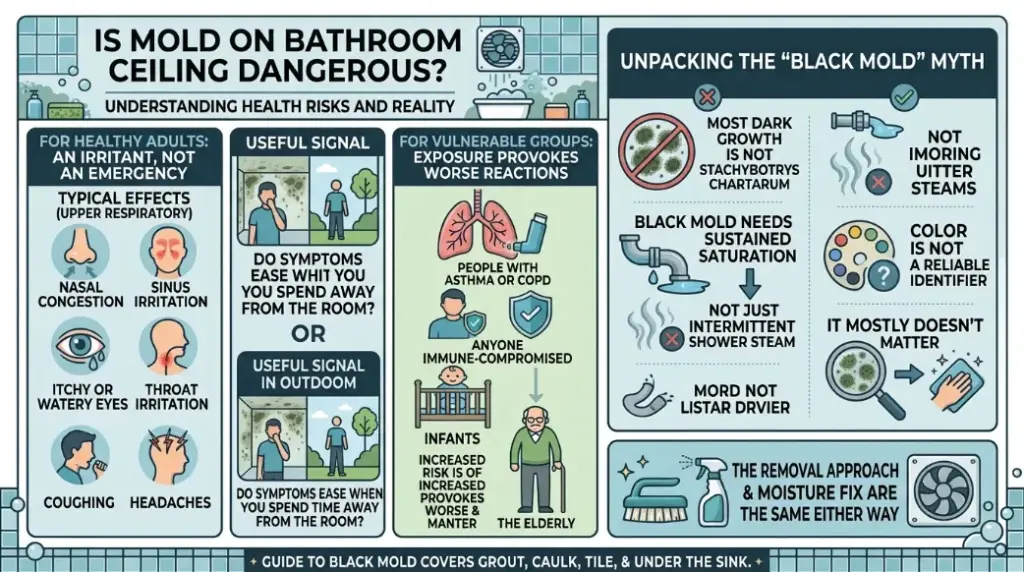
Is mold on bathroom ceiling growth dangerous? For most healthy adults it is an irritant rather than an emergency. The typical effects are upper respiratory: nasal congestion, sinus irritation, itchy or watery eyes, throat irritation, coughing, and sometimes headaches. A useful signal is whether symptoms ease when you spend time away from the room.
The picture changes for people with asthma or COPD, anyone immune-compromised, infants, and the elderly, where exposure can provoke meaningfully worse reactions. As for the black mold question, most dark growth on a bathroom ceiling is not Stachybotrys chartarum, which generally needs sustained saturation rather than intermittent shower steam. Color is not a reliable identifier, and it mostly does not matter, because the removal approach and the moisture fix are the same either way. Our guide to black mold in your bathroom covers the rest of the room: grout, caulk, tile, and under the sink.
Fixes, in the Order That Saves the Most Money
If it fails either test, work the fixes in this order, because the cheap ones usually win.
- Check the duct before you buy anything. Disconnected, crushed, or kinked flex duct is the single most common cause of a fan that spins but does not move air. So is a lint-blocked exterior damper that no longer opens.
- Confirm the duct terminates outdoors, through a wall or roof cap, and not into the attic. This one matters enough that it gets its own warning below.
- Run the fan during the shower and for a full 20 minutes after. Most people shut it off with the light, which is the moment it starts doing the useful part of its job.
- Add a timer switch or a humidity-sensing switch so runtime stops depending on memory. This is the cheapest permanent fix on the list.
- Only then upsize the fan, choosing a unit rated 1 CFM per square foot and 1.0 sone or quieter, because a loud fan is a fan nobody runs.
THE ATTIC WARNING
If your bath fan discharges into the attic instead of outside, do not fix the fan first, fix the duct. A duct dumping warm wet air onto cold roof sheathing creates condensation, and you trade a bathroom problem for a far more expensive one. Our homeowner’s guide to attic mold covers what healthy roof sheathing looks like versus sheathing that has been condensing all winter.
Field rule: mold on bathroom ceiling is a ventilation problem until the pattern proves otherwise.
Cause 2: Water Is Coming From Above
If the spot appeared after a heavy rain rather than after a hot shower, stop reading about fans. You have a leak, and no amount of ventilation will touch it.
Leak-driven mold on bathroom ceiling drywall looks different from condensation-driven growth, and the tells are reliable.
- ▸A hard edge with a brown, amber, or rust-colored tide ring, which is mineral residue left behind as water evaporated at the boundary.
- ▸A discrete patch rather than general spotting, often roughly circular, and usually darker toward the center if it is still active.
- ▸Located away from the fan and away from the shower, which is the opposite of the condensation pattern.
- ▸Drywall that feels soft, spongy, or sagging when you press it gently, or a visible bulge.
- ▸Timing that tracks weather or upstairs water use rather than your own shower schedule.
Ranked by how often they turn out to be the culprit, the usual sources are a bathroom or shower pan on the floor above, a failed wax ring or supply line at an upstairs toilet, a plumbing vent penetration through the roof, failed flashing at a chimney or skylight, and last, the roof field itself. Water travels along framing before it drops, so the stain is often several feet from the actual entry point.
One thing to be clear about: a soft ceiling is not a cleaning job. Once water has saturated paper-faced gypsum, the paper itself is a food source and the colony is inside the material rather than on it. That is why affected board gets cut out and replaced instead of scrubbed.
How to Remove Mold Safely (and What Not to Do)
The EPA’s guidance is that a homeowner can generally handle mold cleanup themselves when the affected area is under about 10 square feet. Above that, or if any of the stop signs in the next section apply, it is a remediation job. For a small patch of mold on bathroom ceiling drywall, work in this order.
Four Things Not to Do
These are the mistakes that bring the spot back
Cause 3: The Ceiling Is Too Cold
This is the cause almost nobody explains, and in the New York metro it is behind far more mold on bathroom ceiling complaints than homeowners realize, especially between November and March.
The physics are simple. Warm, moist air condenses on whatever surface is coldest. If the attic insulation above your bathroom is thin, compressed, wind-washed, or simply missing over part of the ceiling, that ceiling plane becomes the cold surface, and it starts pulling water out of the air every time you shower. The fan may be perfectly adequate and it still will not save you, because the moisture is condensing faster than the fan can clear it.
The giveaway is unmistakable once you know it. If the growth runs in neat, evenly spaced parallel stripes across the ceiling, you are not looking at a mold pattern, you are looking at a map of your ceiling joists. Wood framing conducts cold far better than the insulated bays between it, so the ceiling is coldest directly under each joist and the condensation lines up accordingly.
Installers call the effect ghosting. The same logic explains growth confined to exterior corners and the junction where the ceiling meets an outside wall, which are the hardest spots to insulate well.
The fixes run in this order:
- Air seal first. Recessed lights, the fan housing, and the plumbing and wiring penetrations leak warm indoor air into the attic, which is both a moisture source and an insulation defeat. Sealing costs little and does the most.
- Then insulate to full depth across the whole ceiling, paying attention to the perimeter where insulation is usually thinnest and where baffles may have been crushed.
- Then confirm the attic itself is ventilating, because insulation without airflow relocates the condensation rather than removing it.
Is It Mold or Mildew?
Mold on bathroom ceiling surfaces gets called mildew constantly, and the distinction is worth two minutes because it changes what you do next. Mildew is typically flat, light gray or whitish, sits on the surface, and wipes away cleanly without coming back. Mold tends to be darker, often green-black or occasionally orange, spreads in irregular shapes, has some texture to it, carries a musty smell, and returns quickly after wiping.
The honest test is behavioral rather than visual. Clean the spot properly and mark your calendar. If it is still gone in two weeks, it was surface mildew and your moisture management is adequate. If it is back, it was mold and the moisture that fed it is still there, which sends you straight back to the pattern table at the top of this page.
When to Stop and Call a Professional
There is a line where this stops being a cleaning job, and the clearest sign you have crossed it is that you are cleaning it again. Recurring mold on bathroom ceiling growth means the moisture source is still live and was never found. Bring in a professional if any of these apply.
- The affected area is larger than about 10 square feet.
- The drywall is soft, sagging, spongy, or bulging, which means water got into the material.
- It returns within weeks of a proper cleaning.
- There is a musty smell outside the bathroom, in a hallway, a closet, or a bedroom above or beside it.
- You found growth on the attic side of the ceiling or on the roof sheathing above.
- The bath fan discharges into the attic, which means the moisture load has already been going somewhere you cannot see.
- Anyone in the home has asthma, COPD, a compromised immune system, or is pregnant.
Professional remediation is not just a deeper scrub. A crew seals the work area, runs HEPA filtration under negative pressure so air flows into the containment rather than out of it, removes materials that cannot be salvaged, corrects or documents the moisture source, and verifies the result.
You can see exactly what that process looks like step by step. Mold begins colonizing damp surfaces in roughly 24 to 48 hours, which is why a recurring ceiling spot is worth taking seriously rather than repainting for a third time.
In the NYC metro? Stop repainting it and find the source.
What It Costs to Fix
The cleaning costs almost nothing, which is precisely why so many people keep repeating it instead of paying for the fix. Here is what fixing mold on bathroom ceiling growth actually costs, separated so you can see that the real spend is on the cause and not the stain.
| Line item | Typical range | Notes |
|---|---|---|
| DIY cleaning supplies | $20 to $50 | Respirator, gloves, cloths, cleaning solution. One time. |
| Stain-blocking primer and ceiling paint | $40 to $90 | Do not skip the primer or the stain ghosts back. |
| Timer or humidity-sensing fan switch | $20 to $60 | Cheapest permanent improvement on this list. |
| Fan replacement, existing duct and wiring | $150 to $550 | National average install runs near $400. Unit alone is $30 to $400. |
| New fan install with new duct run to exterior | $250 to $950 | This is the fix when the current duct dumps into the attic. |
| Ceiling drywall patch after removal | $250 to $700 | When the board is soft or sagging and has to come out. |
| Professional mold inspection | $299 to $1,014 | National average near $656. Often waived or credited by remediators. |
| Professional mold remediation | $1,125 to $3,439 | National average near $2,254, driven by area and materials. |
Swipe sideways on a phone to see all three columns.
Read that table as an argument for acting early. A $60 timer switch and a $400 fan upgrade sit on the same page as a $2,254 remediation, and the difference between them is usually a year or two of repainting instead of diagnosing. For anything on a ceiling outside the bathroom, our guide to mold on ceilings generally covers the other rooms.
Mold on Bathroom Ceiling: Final Thoughts
Three causes, three patterns, three different fixes. Spotting spread across the ceiling or ringing the fan means ventilation. A hard-edged stain with a brown tide line means a leak. Neat parallel stripes mean a cold ceiling and thin insulation above it. Match the pattern before you buy anything, because the wrong fix costs the same as the right one and does nothing.
A spot that returns is telling you the moisture source is still live, which narrows the diagnosis rather than resetting it. Recurring mold on bathroom ceiling growth almost always traces back to one of those three causes going unaddressed while the visible growth got treated over and over. When you would rather have someone find the source than guess at it a fourth time, a free inspection is the fastest way to stop the cycle.
Frequently Asked Questions About Mold on Bathroom Ceiling:
Why does mold keep coming back on my bathroom ceiling?
Because cleaning removes the growth but not the moisture that fed it. Recurrence within a few weeks means one of the three causes is still active: ventilation that cannot clear the steam, a leak from above, or a ceiling that runs cold enough to condense. Treat the return as a diagnostic clue rather than a cleaning failure.
Can I just paint over mold on the bathroom ceiling?
No. Paint over live growth traps moisture against the colony and typically prints back through within weeks, often darker than before. Clean it, dry it completely, then use a stain-blocking primer followed by a moisture-resistant ceiling paint. Mold-resistant paint slows absorption but it does not fix a ventilation or leak problem.
How do I tell mold from mildew on a bathroom ceiling?
Mildew is usually flat, light gray or white, and wipes off cleanly without returning. Mold is darker, textured, irregular in shape, musty-smelling, and comes back fast. The reliable test is time: clean it properly and check in two weeks, because anything that returns was mold with an unresolved moisture source behind it.
Does bleach get rid of mold on a bathroom ceiling?
Usually not. True black mold, Stachybotrys chartarum, generally requires sustained saturation rather than intermittent shower steam, and several common molds appear black or dark green. Color is not a reliable way to identify a species, and in practical terms it changes very little, because safe removal and fixing the moisture source are the same either way.
Is black mold on a bathroom ceiling really black mold?
Usually not. True black mold, Stachybotrys chartarum, generally requires sustained saturation rather than intermittent shower steam, and several common molds appear black or dark green. Color is not a reliable way to identify a species, and in practical terms it changes very little, because safe removal and fixing the moisture source are the same either way.
How do I know if my bathroom exhaust fan is big enough?
Code-level guidance calls for at least 50 CFM for a fan running intermittently or 20 CFM running continuously, and a common sizing rule is roughly 1 CFM per square foot of floor area. Test it in practice: hold a tissue to the grille during a shower, and check whether the mirror is still fogged 15 minutes after you finish. Weak hold or a fogged mirror means the fan or its ductwork is not doing the job.
What is the first thing I should do about mold on bathroom ceiling growth?
Diagnose before you clean. Look at the pattern: spotting spread across the ceiling or ringing the fan points to ventilation, a hard-edged stain with a brown tide ring points to a leak from above, and neat parallel stripes point to a cold ceiling with thin insulation. Fixing mold on bathroom ceiling surfaces permanently means correcting whichever of those three is feeding it, because cleaning without the fix just resets the clock. If you are not sure which one you have, a professional moisture reading will tell you in a single visit.
Can a bathroom fan cause mold in the attic?
Yes, and it is common. A duct that terminates in the attic instead of outdoors blows warm, moist air onto cold roof sheathing, where it condenses and can grow mold on the underside of the roof deck. If your fan discharges into the attic, reroute the duct before upgrading the fan, or you will simply move the problem to a more expensive location.
How long does it take for mold to grow on a bathroom ceiling?
Given moisture and a suitable surface, spores can begin colonizing in roughly 24 to 48 hours. A ceiling that stays damp between showers, rather than drying fully each time, gives them a repeating window. That is why fan runtime after the shower matters more than fan power during it.
When should I call a professional instead of cleaning it myself?
Call a professional if the area exceeds about 10 square feet, if the drywall is soft or sagging, if the growth returns within weeks of a proper cleaning, if there is a musty smell outside the bathroom, or if anyone in the home has asthma or a compromised immune system. Growth on the attic side of the ceiling is also past DIY territory.