
A contractor-built breakdown of excavation, membrane, and exterior drainage pricing for NY metro homes, plus how to tell when paying for the exterior method is actually worth it. If you are pricing exterior waterproofing cost, you have likely been told that interior fixes alone will not solve your problem, or you have watched water keep finding its way back no matter how many times you seal a crack. Exterior waterproofing is the most thorough way to keep a basement dry because it stops water before it ever touches the foundation, but it is also the most involved, so exterior waterproofing cost runs higher than interior work. For a full excavation and membrane system, most NY metro homeowners budget somewhere between $8,000 and $20,000, with smaller targeted jobs starting lower and large or complex properties running higher. This guide breaks down each exterior method, what drives the price up or down, and how to know whether the exterior approach is the right spend for your home.
We dig, membrane, and drain foundations across Long Island, Brooklyn, Queens, and The Bronx, so the numbers below reflect real excavation work in this region’s clay soils and older housing stock, not a generic calculator. For the full picture across both interior and exterior methods, pair this with our broader basement waterproofing cost guide.
Breathe Easy Again with Our Expert Crawl Space Mold Removal Services for New York Properties
A contractor-built breakdown of excavation, membrane, and exterior drainage pricing for NY metro homes, plus how to tell when paying for the exterior method is actually worth it. If you are pricing exterior waterproofing cost, you have likely been told that interior fixes alone will not solve your problem, or you have watched water keep finding its way back no matter how many times you seal a crack. Exterior waterproofing is the most thorough way to keep a basement dry because it stops water before it ever touches the foundation, but it is also the most involved, so exterior waterproofing cost runs higher than interior work. For a full excavation and membrane system, most NY metro homeowners budget somewhere between $8,000 and $20,000, with smaller targeted jobs starting lower and large or complex properties running higher. This guide breaks down each exterior method, what drives the price up or down, and how to know whether the exterior approach is the right spend for your home.
We dig, membrane, and drain foundations across Long Island, Brooklyn, Queens, and The Bronx, so the numbers below reflect real excavation work in this region’s clay soils and older housing stock, not a generic calculator. For the full picture across both interior and exterior methods, pair this with our broader basement waterproofing cost guide.
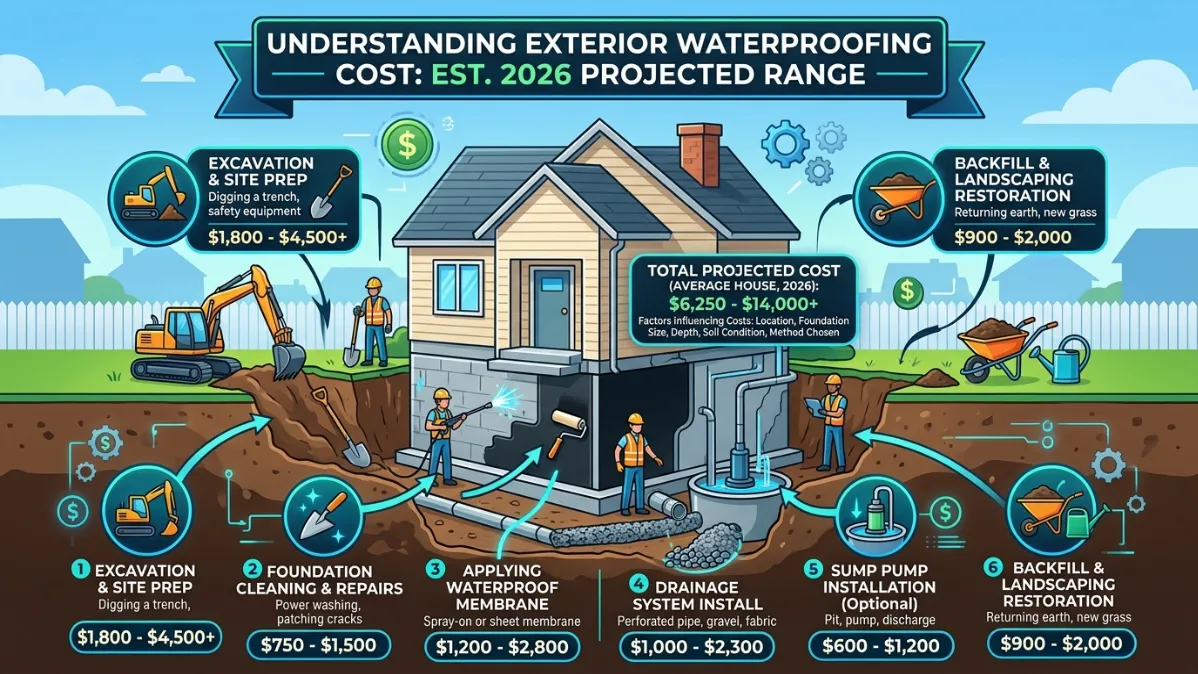
“Exterior waterproofing” is not one service. It is a set of methods applied to the outside of your foundation, and the one you need drives the price. Here is how the main components compare.
| Exterior Method | Typical Unit Price | Typical Project Range |
|---|---|---|
| Full excavation plus waterproof membrane | $120 to $220 per linear foot | $8,000 to $20,000+ |
| Exterior waterproof membrane (material plus install) | $4 to $7 per sq ft of wall | Part of the dig |
| Exterior footing or French drain | $30 to $90 per linear foot | $6,000 to $15,000 |
| Exterior grading and regrading | n/a | $1,000 to $7,000 |
| Dimple or drainage board | Add-on to excavation | Varies by perimeter |
| Excavation permit | n/a | $75 to $500 |
Ranges reflect 2026 national and regional averages. A real number for your home depends on perimeter length, foundation depth, soil, access, and what the crew finds once the walls are exposed. Base your decision on an on-site inspection, not a table.
What Your Exterior Waterproofing Cost Buys: Permanent Protection at the Source
The reason exterior waterproofing cost is higher than interior work is also the reason it is worth it for the right home: it treats the cause rather than the symptom. Interior systems manage water after it has already entered, channeling it to a sump pump. Exterior systems stop the water before it reaches the wall at all. When you pay for the exterior method, you are buying a waterproof membrane bonded to the outside of the foundation, a footing drain that intercepts groundwater, and corrected grading that sends surface water away from the house. Together they relieve the hydrostatic pressure that pushes water through block, cracks, and the cove joint.
That source-level fix is also what protects your indoor air. Once the wall stays dry, the moisture that mold needs to colonize wood, insulation, and drywall is gone. The EPA is direct that controlling moisture is the most effective way to prevent indoor mold, and the exterior method controls it at the one place water actually gets in. Exterior membranes also last a long time, commonly 25 to 50 years, which spreads that higher up-front cost across decades of protection.
Worth knowing before you budget: Homeowners insurance almost never covers waterproofing, because it is classified as preventive maintenance rather than sudden damage. That makes the spend feel optional until a flood proves otherwise. The cost of exterior waterproofing is small next to a gutted basement, mold remediation that New York law requires a licensed contractor to handle above 10 square feet, and the resale hit a documented water history puts on a home.
The Methods Behind Exterior Waterproofing Cost
Understanding what you are paying for makes a quote far easier to read.
Excavation and exterior membrane
This is the core of true exterior waterproofing. A crew digs down to the footing around the affected walls, cleans and preps the foundation, then applies a liquid or sheet waterproof membrane that bonds to the wall and blocks water entirely. The membrane itself runs about $4 to $7 per square foot installed, but the excavation is what drives the bill. Full dig-out work commonly lands at $120 to $220 per linear foot once labor, soil removal, and backfill are included.
Exterior footing or French drain
While the wall is exposed, most crews install or replace a footing drain at the base of the foundation to carry groundwater away before it can build against the wall. Exterior footing drains run roughly $30 to $90 per linear foot installed. This pairs naturally with the membrane and is often the difference between a wall that stays dry and one that leaks again. See our overview of exterior drainage solutions for how these systems route water away from the home.
Dimple board and drainage board
A dimpled membrane installed over the waterproofing creates an air gap and a drainage path that channels any water down to the footing drain instead of letting it sit against the wall. It is an inexpensive add-on relative to the dig and meaningfully improves longevity. Our guide to the benefits of dimple board waterproofing explains why it has become standard on quality exterior jobs.
Grading and surface water management
Even a perfect membrane struggles if the yard slopes toward the house. Regrading the soil to fall away from the foundation, plus extending downspouts, costs $1,000 to $7,000 and reduces the water load the system ever has to handle. The EPA’s guidance on managing rain and runoff reinforces why directing surface water away from the home is the cheapest waterproofing you can do.
“Exterior waterproofing” is not one service. It is a set of methods applied to the outside of your foundation, and the one you need drives the price. Here is how the main components compare.
| Exterior Method | Typical Unit Price | Typical Project Range |
|---|---|---|
| Full excavation plus waterproof membrane | $120 to $220 per linear foot | $8,000 to $20,000+ |
| Exterior waterproof membrane (material plus install) | $4 to $7 per sq ft of wall | Part of the dig |
| Exterior footing or French drain | $30 to $90 per linear foot | $6,000 to $15,000 |
| Exterior grading and regrading | n/a | $1,000 to $7,000 |
| Dimple or drainage board | Add-on to excavation | Varies by perimeter |
| Excavation permit | n/a | $75 to $500 |
Ranges reflect 2026 national and regional averages. A real number for your home depends on perimeter length, foundation depth, soil, access, and what the crew finds once the walls are exposed. Base your decision on an on-site inspection, not a table.
The Smartest Way to Approach Your Exterior Waterproofing Cost
The best way to manage your exterior waterproofing cost is to confirm you actually need the exterior method before you pay for it. Excavation is the most expensive route, and for a large share of homes a well-designed interior system handles the problem at a fraction of the price. The exterior approach earns its premium in specific situations: ongoing groundwater pressure against the wall, a finished interior you do not want disturbed, a stone or hollow block foundation that holds water in the voids, or a wall that is already failing. The smart sequence is to diagnose the water source first, decide interior versus exterior based on that source, then collect itemized quotes that spell out linear footage, membrane type, drain, restoration, and warranty. That turns a vague “around $12,000” into a scope you can compare across bids.
Exterior Waterproofing Cost in the NY Metro: Why It Runs High Here
National averages are a floor for this region, and understanding why keeps a higher quote from catching you off guard. Labor in the NY metro runs well above the national mean, often around $200 per hour for waterproofing crews. Much of the housing stock predates modern drainage codes, with stone and hollow block foundations that trap water in the voids. Clay-heavy soils across Long Island and the outer boroughs are slow and expensive to excavate. Coastal and low-lying neighborhoods sit on high water tables, which is exactly the condition that justifies the exterior method. Excavation permits and soil disposal add cost in dense areas where staging and access are tight. None of that is a markup. It is the real gap between a calculator estimate and what a competent crew can deliver on a New York lot.
Water intrusion here almost always starts outside, which is why we treat the membrane, the drain, and the grading as one system rather than separate line items. To understand the upstream causes feeding the wall, read what causes moisture problems in basements.
The Factors That Move Your Exterior Waterproofing Cost
Two similar homes can get very different exterior quotes. These variables explain why.
| Factor | Effect on Price |
|---|---|
| Foundation depth | Eight foot or deeper walls mean far more excavation, equipment, and backfill |
| Soil type | Heavy clay common in the NY metro is slow and costly to dig versus sandy loam |
| Perimeter length | Most exterior work is priced per linear foot, so a larger footprint costs more |
| Access and obstructions | Decks, patios, AC units, mature landscaping, and tight side yards all add labor |
| Restoration | Backfill, compaction, and replacing landscaping or hardscape is real cost |
| Existing damage | Cracked footing, failed parging, or a leaking cove joint adds repair to the scope |
| Permits and disposal | Excavation permits and soil disposal add cost in dense municipalities |
Financing and Planning Your Exterior Waterproofing Cost
An exterior system is a significant investment, and you should not have to wait for the next flood to act. We offer flexible payment options so you can protect the foundation now and pay over time. Review terms on our waterproofing and mold removal financing page. Because exterior work is rarely the only line in a budget, it helps to plan alongside the cost to install a sump pump in a basement and our guide to waterproofing solutions that prevent mold recurrence, since the goal is a dry basement that stays dry.
Get a Real Number, Not a Guess
The only way to know your true exterior waterproofing cost is a free on-site inspection. We will trace the water to its source, tell you honestly whether you need the exterior method or whether interior work will do, and give you an itemized quote with no pressure.
Exterior Waterproofing Cost: Final Thoughts
Your exterior waterproofing cost is not really the price of a membrane and a trench. It is the price of stopping water at the one place it actually enters, and doing it once rather than fighting the same leak for years. The honest range runs from a few thousand dollars for targeted work to $20,000 or more for a full perimeter excavation, and where your home lands depends on depth, soil, perimeter, access, and condition. The most expensive mistake is not paying for excavation, it is paying for it when an interior system would have solved the problem, or skipping it when groundwater truly demands it. Start with a real diagnosis, insist on an itemized quote, and match the method to the water source. Do that, and your exterior waterproofing cost becomes one of the most durable protective investments a NY metro homeowner can make, paying back in a dry foundation, healthier air, and decades of peace of mind.
Frequently Asked Questions About Exterior Waterproofing Cost:
How much does exterior waterproofing cost on average?
A full exterior excavation and membrane system typically costs $8,000 to $20,000, with large or complex properties running higher. Priced by the perimeter, dig-out work commonly lands at $120 to $220 per linear foot, while exterior footing drains add $30 to $90 per linear foot. NY metro projects tend toward the upper end because of labor rates, clay soils, and older foundations.
Why is exterior waterproofing more expensive than interior?
Exterior waterproofing requires excavating the soil around your foundation down to the footing, which is labor intensive and demands equipment, soil removal, backfill, and landscape restoration. Interior systems avoid all of that by managing water after it enters, so they usually run $3,000 to $8,000. The exterior premium pays for stopping water before it ever touches the wall.
Is exterior waterproofing worth the higher cost?
For homes with groundwater pressure against the wall, failing foundations, stone or hollow block construction, or interior systems that have not worked, yes. The exterior method treats the cause and lasts 25 to 50 years. For many other homes, interior drainage with a sump pump solves the problem far more affordably, which is why a diagnosis should come before you commit to excavation.
Does insurance cover exterior waterproofing?
Almost never. Homeowners insurance treats waterproofing as preventive maintenance, not sudden damage, so the cost falls on the homeowner. Policies may cover sudden events like a burst pipe or a failed sump pump, but not gradual seepage or the waterproofing work itself. That makes proactive waterproofing a pay-now investment that prevents far larger pay-later repairs.
Does insurance cover exterior waterproofing?
Almost never. Homeowners insurance treats waterproofing as preventive maintenance, not sudden damage, so the cost falls on the homeowner. Policies may cover sudden events like a burst pipe or a failed sump pump, but not gradual seepage or the waterproofing work itself. That makes proactive waterproofing a pay-now investment that prevents far larger pay-later repairs.
How long does exterior waterproofing last?
Exterior waterproof membranes commonly last 25 to 50 years, longer than most interior components. The footing drain and grading need occasional attention, and any paired sump pump typically needs replacement every 7 to 10 years. A correctly installed exterior system is one of the longest lasting protections you can add to a home.
Do I need a permit for exterior waterproofing?
Usually yes. Because exterior work involves excavation near the foundation and often changes to drainage discharge, most municipalities require a permit, commonly $75 to $500. If a contractor tells you no permit is needed for an exterior excavation, treat that as a warning sign and confirm local requirements yourself.
How much does exterior waterproofing cost per linear foot?
Full excavation with a waterproof membrane runs $120 to $220 per linear foot, and an exterior footing or French drain adds $30 to $90 per linear foot. Because almost all exterior work is priced this way, your perimeter length is the single biggest driver of the total. A 150 foot perimeter at $150 per foot, for example, lands around $22,500 before drains, restoration, or permits.
Exterior vs interior waterproofing: which is cheaper?
Interior waterproofing is cheaper, typically $3,000 to $8,000 versus $8,000 to $20,000 or more for exterior excavation. Interior drainage and a sump pump manage water after it enters, while the exterior method stops it before it reaches the wall. Cheaper is not always correct, though. If groundwater pressure or a failing wall is the real problem, an interior system can leave the cause untreated.
What makes one exterior waterproofing quote higher than another?
Foundation depth, soil type, perimeter length, and site access drive most of the spread between quotes. Deeper walls and heavy clay soil mean more excavation and equipment, while decks, patios, AC units, and tight side yards add labor. Restoration of landscaping and hardscape, plus any repair to a cracked footing or leaking cove joint found during the dig, can push a quote higher than a competitor that left those items out.
Can I get an accurate exterior waterproofing price without an inspection?
No. Published ranges are useful for budgeting, but a real number depends on your perimeter length, foundation depth, soil, access, and what the crew finds once the walls are exposed. Hidden footing cracks, failed parging, or a leaking cove joint can change the scope entirely. Any firm quote should follow an on-site inspection, not a phone estimate or a table.