
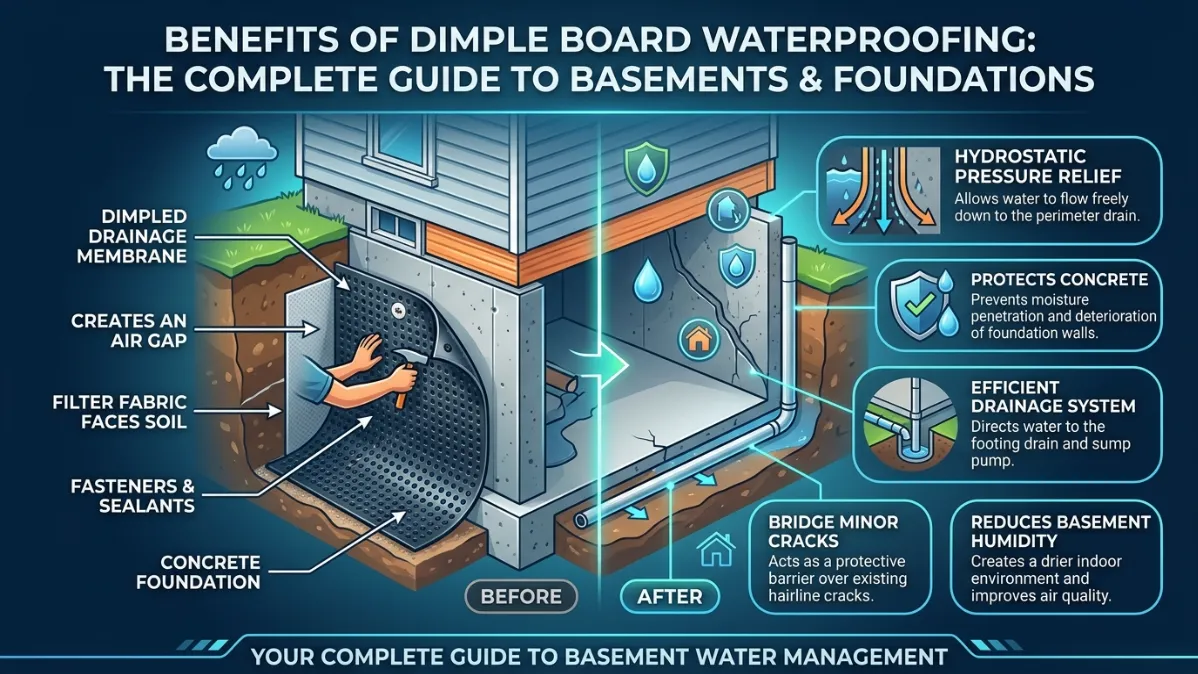
If your basement walls weep, your foundation backfill stays soggy, or you are planning to finish a below-grade space, you have probably come across dimple board waterproofing as a recommended solution and wondered what it actually does. Dimple board waterproofing is one of the most reliable ways to manage water against a foundation, yet it is widely misunderstood, because the product looks deceptively simple and is often confused with a sealing membrane. It is not a coating that blocks water. It is a drainage and protection layer that gives water a controlled path to escape before it can damage your wall or push its way inside. Used correctly, dimple board waterproofing protects both the structure and any waterproofing membrane behind it, on the exterior of a foundation or on the interior of a finished basement. This guide explains how it works, where it belongs, and the real benefits and limits of the system.
Give Foundation Water a Way Out! Get a Free Inspection Now!
What Is Dimple Board?
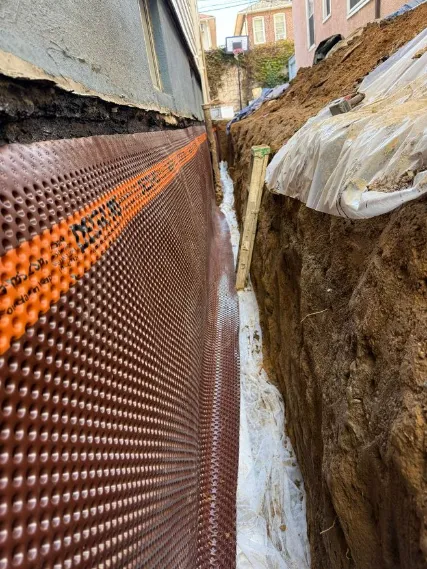
Dimple board is a tough sheet of high-density polyethylene molded with a grid of raised bumps, or dimples, across its surface. You may also hear it called dimpled membrane, drainage board, dimple mat, or foundation wrap. The plastic itself is rotproof, moldproof, and extremely durable, which is why it can sit buried against a foundation for decades without breaking down.
The genius of the product is in those dimples. When the board is installed against a wall with the dimples facing the wall, the raised bumps hold the flat face of the sheet a fraction of an inch off the surface. That gap, usually around three eighths of an inch, becomes a continuous air space and drainage channel running the full height and width of the wall. Water has somewhere to go, and air can circulate so the wall can dry. That single engineered gap is the foundation of everything dimple board does.
How Dimple Board Waterproofing Works
Dimple board waterproofing works on a simple principle: stop fighting water, and instead give it a guided exit. Below grade, soil holds moisture against a foundation constantly, and during heavy rain that moisture turns into real pressure. A flat waterproofing coating alone has to hold back all of it. Add a dimple board, and any water that reaches the wall drops harmlessly into the dimpled channels and runs straight down to the footing drain at the base of the foundation, where a perimeter drain and sump or a daylight outlet carry it away.
Because the water is channeled down and out rather than allowed to sit and build, the wall faces far less hydrostatic pressure. The air gap also acts as a capillary break, stopping moisture from wicking through the wall by contact. And on an exterior installation, the rugged plastic shields the waterproofing membrane underneath from being torn or punctured by sharp backfill, rocks, and roots. The dimple board does the heavy work so the sealing layer can survive and do its job.
The Benefits of Dimple Board Waterproofing
The benefits of dimple board waterproofing stack up across protection, performance, and longevity, which is why contractors reach for it on serious below-grade projects.
- Pressure Relief: By draining water to the footing drain instead of letting it pool, the system reduces the hydrostatic pressure that cracks walls and forces water through seams.
- Capillary Break Protection: The air gap stops moisture from migrating through the wall by direct contact, keeping the inside face drier.
- Waterproofing Membrane Protection: On the exterior, the board takes the abuse of backfill so the sealing layer is not damaged during or after construction.

- Better Wall Drying: Air movement behind the board helps the foundation release moisture rather than trap it.
- Long-Term Durability: The polyethylene will not rot, corrode, or feed mold, so the drainage path stays open for the long haul.
- Interior and Exterior Use: The same core idea protects a foundation from the outside or helps keep a finished basement dry from the inside.
The throughline is that dimple board for waterproofing does not try to be a magic seal. It manages water intelligently, and managed water is water that cannot do damage.
Foundation Dimple Board on the Exterior
Exterior is the classic application. During new construction or a foundation excavation, a foundation dimple board is installed against the outside of the wall, dimples facing in toward the foundation, after the waterproofing membrane is applied. The top edge is sealed with a termination bar or molding so soil and water cannot wash in behind it, and the bottom edge directs water down to the footing drain. From there the perimeter drain carries water away from the house. This is the most effective place to use the product, because it intercepts water before it ever reaches the structure, but it requires excavation, which makes it most practical during construction or a full exterior waterproofing project.
Dimple Board for Interior Basement Systems
When digging up the outside is not feasible, dimple board for interior basement waterproofing offers a powerful alternative. Here the board is installed against the inside face of the foundation wall, again with the dimples toward the wall. Any moisture that comes through the wall runs down behind the board into an interior drainage channel installed at the base of the wall, which feeds a sump pump that discharges the water outside. The finished surface built over the board stays dry, even if the raw foundation behind it occasionally weeps. The same product is also rolled out beneath basement subfloors to create an air gap under the finished floor. This interior approach is the backbone of many basement finishing and moisture-control systems, because it accepts that an old wall may always let in some water and simply gives that water a clean route to the sump.
Dimple Board for Wall Drainage and How It Channels Water
The heart of the system is dimple board for wall drainage. The dimpled channels turn the entire face of a wall into a vertical drainage plane. Instead of water spreading sideways, finding cracks, and seeping through, it is collected across the whole surface and guided straight down by gravity. This dimple board drainage only works, however, if the water has a destination. The channels must terminate into a functioning drain, an exterior footing drain on an outside install or an interior perimeter drain and sump on an inside install. A dimple board that drains into dead soil or a clogged footing drain simply moves water to a different spot and stalls. The board and the drain are a single system, and the drain has to work for the board to deliver.
Why Dimple Board Waterproofing Is the Best Option for Protecting a Below-Grade Wall
For a wall that sits against soil, dimple board waterproofing is the best option in most cases because it solves the real problem rather than masking it. A surface sealer or waterproofing paint tries to hold back water under pressure, and it fails the moment a hairline crack opens or the pressure exceeds what the coating can resist. Dimple board takes the opposite approach: it assumes water will arrive and makes sure that water always has an easier path to the drain than into your basement. That is a more honest and more durable strategy for below-grade conditions. The best results come from combining a sealing membrane with a dimple board on the exterior, or an interior dimple system tied to a sump, rather than relying on any single coating to do everything.
Dimple Board vs Other Waterproofing Methods
A quick comparison clarifies where dimple board fits. Waterproofing paints and sealers are cheap and easy but are surface treatments that crack and peel under real hydrostatic pressure, making them a short-term fix at best. Sheet and liquid membranes seal the wall well but are vulnerable to damage from backfill, which is exactly the weakness a dimple board covers. Interior drainage and sump systems handle water that has already entered but pair best with a dimple board that delivers the water to them cleanly. Dimple board is not a competitor to these methods. It is the component that makes the others last and perform, which is why strong systems use it alongside a membrane or a sump rather than instead of them.
Limitations and When Dimple Board Is Not Enough
A quick comparison clarifies where dimple board fits. Waterproofing paints and sealers are cheap and easy but are surface treatments that crack and peel under real hydrostatic pressure, making them a short-term fix at best. Sheet and liquid membranes seal the wall well but are vulnerable to damage from backfill, which is exactly the weakness a dimple board covers. Interior drainage and sump systems handle water that has already entered but pair best with a dimple board that delivers the water to them cleanly. Dimple board is not a competitor to these methods. It is the component that makes the others last and perform, which is why strong systems use it alongside a membrane or a sump rather than instead of them.
Cost and Installation Realities
Material cost for the board itself is modest, often a few dollars per square foot, but the real cost is in the labor and the surrounding work. An interior dimple board system tied into a new perimeter drain and sump commonly runs from several thousand dollars up, depending on the linear footage of wall and the condition of the basement. An exterior installation costs significantly more because it requires excavation around the foundation, which is why it is most economical during construction or a planned exterior waterproofing project. Treat any figure as a planning range rather than a quote, because depth, wall length, access, and the state of the existing drainage all move the number.
Dimple Board Waterproofing: Final Thoughts
Material cost for the board itself is modest, often a few dollars per square foot, but the real cost is in the labor and the surrounding work. An interior dimple board system tied into a new perimeter drain and sump commonly runs from several thousand dollars up, depending on the linear footage of wall and the condition of the basement. An exterior installation costs significantly more because it requires excavation around the foundation, which is why it is most economical during construction or a planned exterior waterproofing project. Treat any figure as a planning range rather than a quote, because depth, wall length, access, and the state of the existing drainage all move the number.
Frequently Asked Questions About Dimple Board Waterproofing:
Is Dimple Board a Waterproofing Membrane?
Dimple board is not a waterproofing membrane by itself. It is a drainage and protection layer that creates an air gap, channels water toward a drain, and shields the waterproofing membrane behind it. On exterior foundations, it is usually paired with a waterproof coating or sheet membrane, while interior systems connect it to a perimeter drain and sump pump.
What Does Dimple Board Waterproofing Do?
Dimple board waterproofing manages water against a foundation wall. The raised dimples create a drainage space so water can flow down to a footing drain or interior drainage channel instead of sitting against the wall. This helps reduce hydrostatic pressure, protect the foundation, and lower the risk of basement seepage.
Which Way Do the Dimples Face on Dimple Board?
The dimples usually face toward the foundation wall. This orientation creates the drainage gap between the board and the wall, allowing water to travel downward toward the drain. Correct placement matters because reversing the board can reduce drainage performance and limit the air space the system needs.
Can Dimple Board Be Used Inside a Basement?
Yes, dimple board can be used inside a basement as part of an interior drainage system. It is installed against the inside of the foundation wall and connected to a perimeter drain and sump pump. This allows water that seeps through the raw foundation wall to travel behind the finished wall system instead of entering the basement space.
Can Dimple Board Be Used Inside a Basement?
Yes, dimple board can be used inside a basement as part of an interior drainage system. It is installed against the inside of the foundation wall and connected to a perimeter drain and sump pump. This allows water that seeps through the raw foundation wall to travel behind the finished wall system instead of entering the basement space.
Can Dimple Board Be Used on the Exterior Foundation Wall?
Yes, exterior dimple board is commonly installed against the outside of a foundation wall after excavation. It protects the waterproofing layer from backfill damage and gives groundwater a drainage path down to the footing drain. Exterior use is strongest when the wall is cleaned, cracks are repaired, waterproofing is applied, and the footing drain is working properly.
Does Dimple Board Stop Hydrostatic Pressure?
Dimple board helps reduce hydrostatic pressure, but it does not eliminate it by itself. It works by giving water a path to drain instead of allowing it to pool against the foundation wall. For this to work, the footing drain, interior drain, or sump system it feeds must be clear, functional, and properly sized.
How Long Does Dimple Board Last?
Dimple board can last for decades because it is usually made from durable polyethylene that does not rot, rust, corrode, or feed mold. The lifespan of the full waterproofing system depends on the condition of the drains, seams, waterproofing layer, and installation details. If the drainage system clogs, water can still build up even if the dimple board itself remains intact.
Is Dimple Board Better Than Waterproofing Paint?
Dimple board and waterproofing paint do different jobs. Waterproofing paint or coating helps seal the wall surface, while dimple board creates a drainage path and protects the sealing layer. For serious below-grade water problems, dimple board is usually part of a larger system rather than a replacement for proper waterproofing.
Can Dimple Board Fix a Leaking Basement?
Dimple board can help fix a leaking basement when it is installed as part of a complete drainage and waterproofing system. On the exterior, that may include crack repair, waterproofing membrane, dimple board, footing drains, gravel, and proper backfill. On the interior, it may include wall drainage board, a perimeter drain, and a sump pump.