
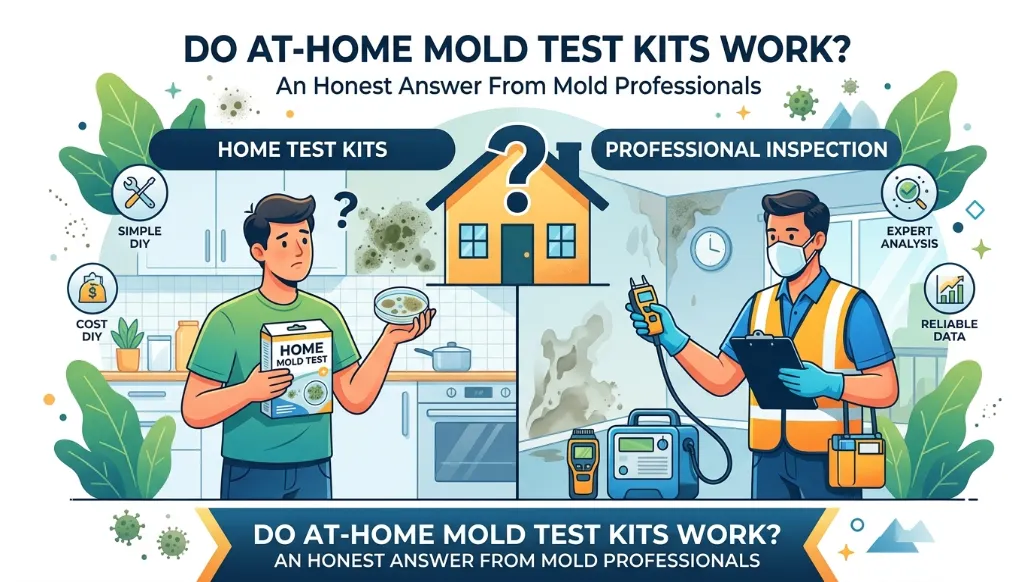
Do at-home mold test kits work? Sometimes. Almost never for the reason you bought one. Here is exactly what a kit measures, what it cannot see, and the three situations where buying one is genuinely the right move. This page is written by people who open walls for a living. We will show you the mechanics of each kit type, explain the one concept that makes mold testing important when needed, and tell you honestly when a kit is worth forty dollars.
In Long Island, Brooklyn, Queens, and The Bronx, Homeowners Trust Mold Removal Experts for Free Advice, Proven Solutions, and Proven Expertise!
Schedule a Free Mold Inspection Now!
Do At-Home Mold Test Kits Work? Here Is What Each Type Actually Measures
Lumping all kits together is how bad advice gets written. There are three fundamentally different products sold under the same shelf label, and they are not equally useful.
| Kit Type | What It Measures | What It Misses | Typical Cost | Verdict |
|---|---|---|---|---|
| Settle Plate (Petri Dish) | Whether any spore lands and cultures on agar | Concentration, species relevance, hidden growth, source, and outdoor baseline | $10 to $25 | Not useful. Will show growth in a clean home. |
| Tape Lift or Swab | Whether visible growth on a specific surface is mold and roughly what genus | Extent, cavity growth, airborne load, and source | $30 to $60 with lab | Marginal. If you can see it, you already know. |
| Mail-In Air Cassette (Spore Trap) | Airborne spore counts per cubic meter of air | Source, cavity access, sampling protocol control, and outdoor control unless purchased separately | $60 to $180 | Best of the three. Still not an inspection. |
Why Almost Every Petri Dish Test Comes Back Positive
Mold spores are in every building, every day, in every climate. They come in through open doors, on clothing, on pets, and through ventilation. A sterile agar plate exposed to indoor air for forty eight hours will culture something in a hospital operating suite.
Three specific mechanical problems make settle plates worse than useless:
- Gravity sorts your sample. Spores vary widely in size and weight. Heavier spores fall out of the air faster and are dramatically over represented in a dish, while the lighter spores that stay suspended and actually reach your lungs are under represented. The dish does not describe the air you breathe.
- There is no volume measurement. A spore trap pulls a known quantity of air across a slide, which produces a count per cubic meter. A dish sits passively and produces a count per “however much air happened to drift by.” You cannot compare that to anything.
- The agar may be compromised before you open it. Many kits carry no expiration date and sit in warehouses and on shelves through temperature swings. A culture medium that was contaminated in storage will grow colonies no matter how clean your house is.
Here’s One Way to Tell: If a kit’s instructions do not require you to also sample outdoor air on the same day, the results cannot be interpreted. That single omission invalidates most of the category.
The Outdoor Control Sample: The Concept That Makes Testing Mean Anything
This is the idea almost every page on this topic skips, and it is the whole ballgame. An indoor spore count is meaningless in isolation. It only means something compared against an outdoor sample taken the same day, in the same weather, within an hour or two of the indoor sample. Outdoor air is the baseline your indoor air is supposed to resemble.
Roughly, here is how a professional reads it:
- Indoor count well below outdoor count, similar genus mix: normal. Your house is doing its job.
- Indoor count similar to outdoor, similar mix: normal, especially with windows open.
- Indoor count meaningfully higher than outdoor, or dominated by a genus barely present outside: you have an indoor source. Now the work begins, which is finding it.
Weather moves outdoor counts by an order of magnitude within a single day. A rainy morning and a dry windy afternoon produce completely different baselines. That is why a control sample taken last Tuesday, or a “national average” printed on a lab report, tells you nothing about the sample you took today.
The Outdoor Control Sample: The Concept That Makes Testing Mean Anything
- Where the water is coming from. Mold is a symptom. Water is the disease. No kit identifies a failed flashing, a cracked foundation, a condensing duct, or a hydrostatic pressure problem.
- How far it has spread. A sample from one room says nothing about the joist bay two rooms over.
- Whether it is inside the wall. Kits sample air and surfaces. Cavities require thermal imaging, moisture meters, and in some cases a borescope.
- Whether the material can be saved. Porous material with rooted growth gets removed. Semi porous material can often be cleaned. That call needs eyes on the substrate.
- What it will cost. A lab report is not a scope of work. See our mold removal pricing guide for what actual numbers look like.
You do not need a species name. You need to know where the water is.
The Outdoor Control Sample: The Concept That Makes Testing Mean Anything
We would be doing exactly what every other contractor page does if we told you kits are always worthless. They are not. There are three real situations where a kit earns its cost.
1. Building a documentation trail as a tenant
If your landlord is ignoring you, a dated lab report is a piece of paper you did not have yesterday. It will not win a case by itself, but it starts the record. See landlord responsibility for mold removal for what else strengthens your position.
2. A first data point when there is nothing visible and no odor
If you are chasing unexplained health symptoms and have no smell, no stain, and no known leak, a mail in spore trap with an outdoor control is a defensible fifty dollar first step before committing to a full assessment.
3. Before making a large purchase decision
A quick screen before an offer expires can inform whether you pay for a proper assessment during the inspection contingency window. Just do not let it replace one. Our mold inspection checklist covers what to look at yourself in the meantime.
What the EPA Actually Says About Mold Sampling
Most pages on this topic assert authority. Here is a citation instead. The EPA’s published guidance holds that sampling for mold is generally not necessary, because in most cases if visible mold growth is present, sampling is unnecessary and the mold should be removed regardless of species. You can read the position directly at EPA guidance on mold testing and sampling.
Read that carefully, because it cuts both ways. It undermines the entire home test kit industry, and it also undermines any inspector who tries to sell you testing you do not need. If you can see mold or smell mold, you do not have a testing question. You have a moisture question and a removal question.
New York State health guidance takes a similar practical line, emphasizing moisture control and prompt removal over species identification. The state’s homeowner mold guidance is available through the New York State Department of Health mold publication.
Your Kit Came Back Positive. Now What?
- You can see growth: stop testing. You have your answer. Move to identifying the moisture source and getting a removal scope.
- You cannot see growth but the house smells musty: you likely have a hidden source. A musty odor is microbial volatile organic compounds, and it is a real signal. See what a musty basement smell actually means.
- Someone in the home is symptomatic: treat it as urgent. Review whether black mold is dangerous and talk to a physician about the household exposure.
- There is an active leak: fix the water first. Nothing else matters until it stops.
- You are selling or buying: get a licensed assessment. A kit result will not survive a negotiation or a disclosure obligation.
- You are a tenant: keep the report, photograph everything, and put your request in writing.
How New York Mold Licensing Law Changes This Conversation
| Capability | Home Test Kit | Professional Inspection |
|---|---|---|
| Identifies That Mold Exists | Yes | Yes |
| Same-Day Outdoor Control Sample | Rarely Included | Standard |
| Moisture Meter Readings on Suspect Materials | No | Yes |
| Thermal Imaging for Hidden Wet Cavities | No | Yes |
| Identifies the Water Source | No | Yes |
| Access to Wall Cavities and Crawl Spaces | No | Yes |
| Controlled Sampling Protocol (HVAC State, Occupancy, Duration) | No | Yes |
| Documented Chain of Custody | No | Yes |
| Accepted for Insurance and Legal Claims | Usually Not | Yes |
| Written Remediation Protocol and Scope | No | Yes |
Do At-Home Mold Test Kits Work: Final Thoughts
They work at exactly one thing: telling you that mold spores exist in a building. That is not a finding. Spores are in every home in New York, every day of the year, and a petri dish left on your counter will confirm it whether your house is dry as a bone or soaked behind the drywall. What a kit cannot do is tell you where the water is coming from, whether the growth is active or dormant, whether it is inside a wall cavity or on the surface, or how much of it there is. Those four answers are the entire basis of a remediation scope, and no kit sold in a hardware store produces any of them.
That does not make kits worthless. Used with an outdoor control sample taken the same day, sent to an accredited lab, they can build a documentation trail for a tenant, flag a hidden source when symptoms have no visible cause, or run a cheap screen before a large purchase. Those are narrow, real uses. Just know what you are buying. If your kit came back positive and you are now asking what to do next, the honest answer is the same one a licensed assessor would give you: stop testing and start looking for the water.
Stop Guessing. Find the Water.
Frequently Asked Questions Abour Do At-Home Mold Test Kits Work
Will insurance accept a home mold test kit result?
Generally no. Carriers typically require documentation from a licensed assessor with a controlled sampling protocol and chain of custody. A self collected sample has no verified provenance, so it is easy for an adjuster to discount.
Why did my mold test show mold when I cannot see any?
Every indoor environment contains mold spores. A culture plate will grow colonies in a clean home. Without a same day outdoor control sample and a volumetric measurement, a positive result cannot distinguish normal background spores from an active indoor colony.
Will insurance accept a home mold test kit result?
Generally no. Carriers typically require documentation from a licensed assessor with a controlled sampling protocol and chain of custody. A self collected sample has no verified provenance, so it is easy for an adjuster to discount.
What is the difference between air sampling and a petri dish test?
Air sampling pulls a measured volume of air across a collection cassette, producing spore counts per cubic meter that can be compared to an outdoor baseline. A petri dish sits passively and captures whatever settles, which over represents heavier spores and yields no volumetric number.
What is the difference between air sampling and a petri dish test?
If you smell a musty odor, have visible staining, know of a past leak, or have unexplained respiratory symptoms, yes. Mold sealed inside a wall cavity or under a subfloor can release very few spores into the living space and produce a clean test result.
How much does professional mold testing cost compared to a kit?
Kits run roughly twenty to one hundred eighty dollars depending on type. A professional assessment costs more but includes moisture mapping, thermal imaging, cavity investigation, outdoor control sampling, and a written remediation protocol. Some inspections are free when tied to a suspected water intrusion.
Do mold test kits expire?
Many carry no printed expiration date, which is a problem. The agar culture medium degrades and can be contaminated during warehouse storage or temperature swings, producing colony growth that has nothing to do with your indoor air.
Can a mold test kit identify black mold?
A lab analyzed sample can identify Stachybotrys if it is present in the sample. It cannot tell you how much is in your home, where it is growing, or whether it is inside a wall. Species identification also does not change the remediation approach, since all indoor mold growth should be removed.
Should I test for mold before buying a house?
A licensed assessment during your inspection contingency is far more useful than a kit. It identifies moisture sources and hidden growth that affect what you should offer and what repairs you should request. A kit result carries little weight in negotiation.
Can I use a mold test kit to confirm remediation worked?
This is the one clearance scenario where the answer to do at-home mold test kits work is a firm no. Post remediation verification should be performed by an independent licensed assessor, not the homeowner and not the remediation contractor. Clearance requires controlled sampling against a same day outdoor control and, in New York, independence between the assessor and the remediator.