
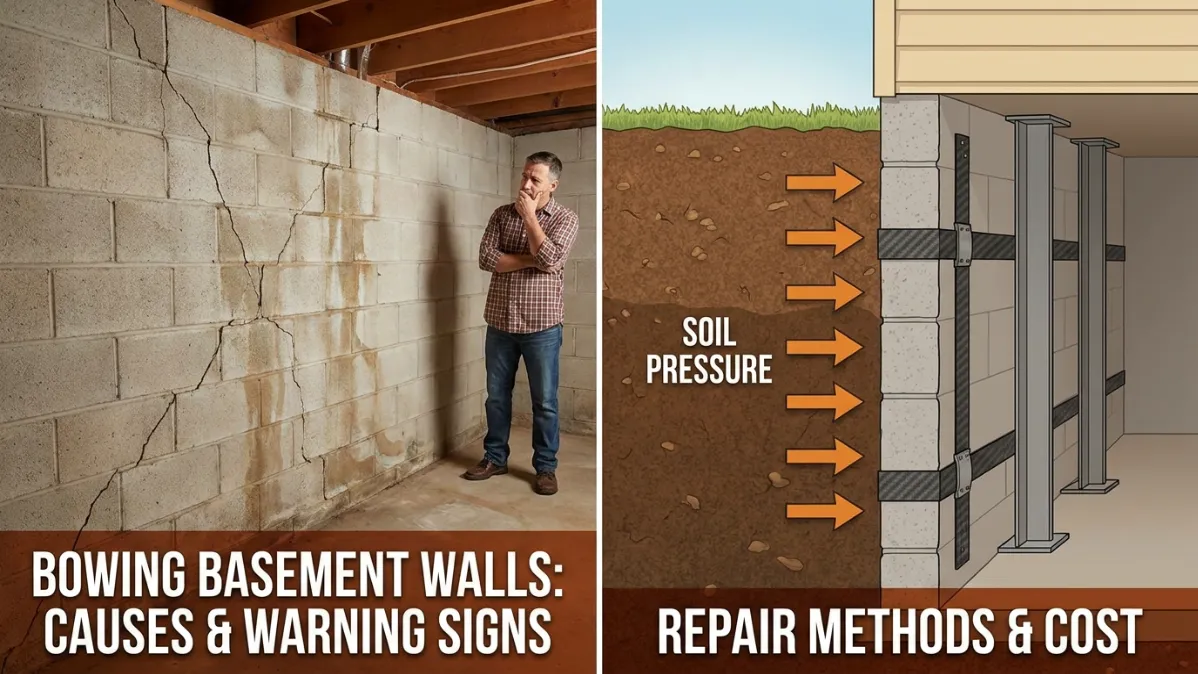
Bowing basement walls are a sign that the soil outside your foundation is pushing inward harder than the wall can resist, and unlike a hairline crack, a bowing wall is already failing structurally. The wall has physically moved out of plumb. That distinction matters: a crack can be cosmetic, but a wall that has started to bend is under active pressure and will keep moving until the cause is addressed.
The good news is that most bowing basement walls are caught early enough to stabilize without tearing the wall out, often for a fraction of what a full rebuild would cost. This guide walks through what causes the movement, how to tell how serious yours is, every bowing basement repair method available, and what each one costs.
In Long Island, Queens, Brooklyn, and The Bronx, Homeowners Can Call on Mold Removal Experts for Proven Solutions, and Free Inspections at Your Convenience! Schedule Yours Now!
What Causes Bowing Basement Walls?
Basement walls bow because the soil outside is exerting more lateral force than the wall was built to hold back. In the New York metro area, where clay-heavy soils and hard freeze-thaw winters are the norm, that pressure builds up faster than most homeowners realize. A few distinct forces are usually behind it.
Hydrostatic Pressure
Expansive Clay Soil
Frost Heave And Freeze-Thaw
Poor Drainage And Grading
Tree Roots And Construction Defects
Breathe Easy Again with Our Expert Crawl Space Mold Removal Services for New York Properties
gA wall doesn’t have to look obviously curved to be bowing, the early signs are usually a crack pattern, not a visible bend. The clearest red flag is a horizontal crack running across the middle of the wall, which is where the bending stress concentrates. In block foundations you’ll often see stair-step cracks tracking along the mortar joints, and diagonal cracks at the corners.
Beyond the wall itself, watch for symptoms upstairs: doors and windows that suddenly stick, floors that slope or feel uneven, and gaps opening up where the wall meets the floor or ceiling. Those mean the movement below is already affecting the structure above. If you run a string line or a level down the wall and see daylight at the middle, that’s measurable inward deflection, and that measurement is exactly what determines how urgent the repair is.
Are Bowing Basement Walls Dangerous?
Yes. Bowing basement walls are a structural problem that gets worse until it’s addressed, and in severe cases the wall can crack apart or collapse. But the level of danger isn’t all-or-nothing; it scales with how far the wall has moved and whether it’s still moving. A wall that bowed slightly years ago and has been stable since is a very different situation from one that moved an inch over the last wet season.
The secondary danger is water. As a bowing wall cracks, it opens a path for water to seep into the basement, and persistent moisture leads to the musty smell, wood rot, and mold growth that turn a structural issue into a health and air-quality issue too. That’s why bowing walls and basement moisture problems almost always need to be solved together rather than one at a time.
How Much Bowing Is Too Much?
How much inward movement a wall can have before it’s serious comes down to a few rough thresholds contractors use:
- Less than 1 inch: monitor it; document the wall with dated photos and a measurement.
- More than 1 inch: have it professionally assessed; this is past normal.
- More than 2 inches: serious; address it promptly before the next wet or freezing season.
- 3 to 4 inches or more: significant risk of accelerating or partial collapse, especially during heavy rain or frost when soil pressure peaks.
- More than roughly half the wall's thickness: the wall has usually moved too far to stabilize and often has to be rebuilt.
Can Bowing Basement Walls Be Fixed?
Yes. The large majority of bowing basement walls can be repaired without rebuilding the wall. What’s important to understand up front is the difference between stabilizing and straightening. Most repair methods stop the wall from moving any further and lock it in its current position. A few methods can also pull the wall back toward plumb over time, but that’s a bonus, not the primary goal. The primary goal is always to halt the movement and relieve the pressure causing it.
How Are Bowing Basement Walls Repaired?
The right bowing wall repair depends on how far the wall has moved, what it is built from, and how much access there is around the foundation. Here are the methods a foundation contractor will consider.
- Carbon Fiber Straps: Carbon fiber straps are the go-to option for minor bowing of about two inches or less. The straps bond to the wall surface with epoxy and run vertically, anchored at the top and bottom, adding tremendous tensile strength to hold the wall in place. They require no excavation, install in a day, and need zero maintenance afterward. They stabilize the wall rather than straighten it.
- Wall Anchors: Wall anchors suit moderate bowing in the two-to-three-inch range and have the advantage of being able to pull the wall back toward straight over time. The system uses a steel plate on the inside of the wall connected by a rod to an anchor plate buried out in the yard. Tightening the rod stabilizes the wall and can gradually recover some of the movement. Wall anchors do require yard space to install the exterior anchor.
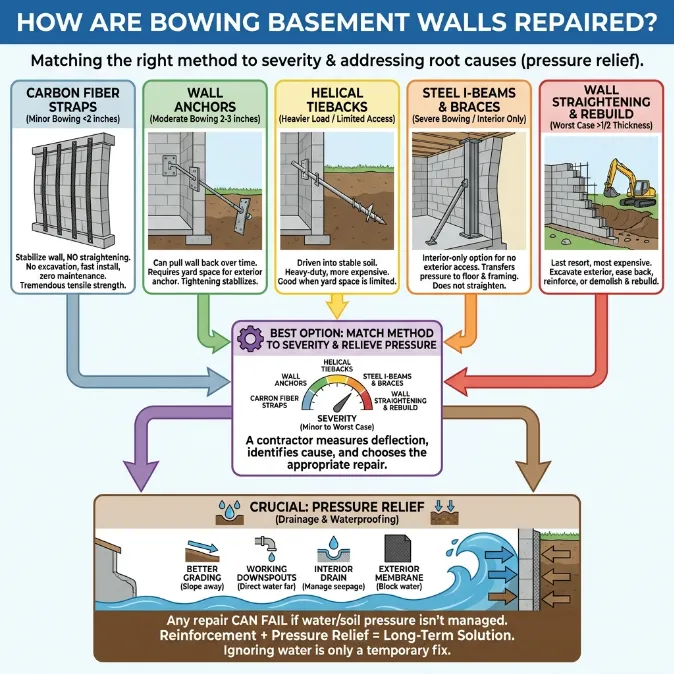
- Helical Tiebacks: Helical tiebacks are used when there is heavier load or when yard access is limited. They are screw-like steel shafts driven at an angle through the wall into stable soil and tightened to a set torque. They are a heavier-duty and more expensive solution than anchors or straps.
- Steel I-Beams And Braces: Steel I-beams and similar bracing systems are an interior-only option, which makes them useful for severe bowing where there is no room to excavate outside. They run vertically against the wall and transfer the soil pressure into the floor and framing.
- Wall Straightening And Rebuild: When a wall has moved past roughly half its thickness, stabilization may not be enough. Straightening involves excavating the exterior, easing the wall back toward plumb, and reinforcing it. In the worst cases, the wall is demolished and rebuilt. This is the last resort and the most expensive path, which is exactly why early action saves so much money.
Best Option For Repairing Bowing Basement Walls: The best option for repairing bowing basement walls is not one product. It is matching the method to the severity and pairing it with pressure relief. A contractor will measure the deflection, identify the cause, and choose carbon fiber, anchors, tiebacks, or beams accordingly.
But here is the part homeowners often miss: any of these repairs can fail again if the water and soil pressure that caused the bow are not dealt with. That means the repair has to be combined with drainage correction and basement waterproofing, such as better grading, working downspouts, an interior drain, or an exterior membrane. Without pressure relief, the same force can keep pushing against the reinforced wall. A reinforcement that ignores the water is only a temporary fix.
How Much Does It Cost to Fix Bowing Basement Walls?
The national average to fix bowing basement walls in 2026 is around $4,500, with most projects landing between $2,000 and $12,000 depending on severity and method. Severe cases that need straightening or a rebuild can run well past $15,000. Cost is driven mostly by how far the wall has moved and how long it is, since most methods are priced per linear foot.
| Repair Method | Best For | Typical Project Cost |
|---|---|---|
| Carbon fiber straps | Minor bowing ≤2″, no excavation | ~$2,000–$5,000 |
| Wall anchors | Moderate bowing 2–3″ | ~$3,000–$8,000 |
| Steel I-beams / braces | Severe, interior-only access | ~$4,000–$8,000+ |
| Helical tiebacks | Heavier loads / limited yard | ~$6,000–$7,200 |
| Wall straightening + rebuild | Severe, past ~50% thickness | $10,000–$25,000+ |
The pattern in those numbers is the whole argument for acting early: a wall caught at one inch of bow is a carbon-fiber job in the low thousands, while the same wall left to reach four inches becomes a straightening or rebuild project several times more expensive. The damage doesn’t get cheaper by waiting.
Breathe Easy Again with Our Expert Crawl Space Mold Removal Services for New York Properties
You can buy a house with bowing basement walls, but not before a foundation specialist inspects it and gives you a repair estimate in writing. Do not rely on the general home inspector for this. Bring in someone who repairs foundations for a living.
Have them measure the bow. If it is under two inches, the fix is usually a standard, affordable carbon-fiber or anchor job, and you can ask for a credit at closing to cover it. Check whether the bowing is paired with cracks elsewhere, which can signal broader movement. Severe bowing is not necessarily a dealbreaker either. It just needs to be priced into your offer so you are not absorbing a five-figure repair the seller should have disclosed.
Can You Fix Bowing Basement Walls Yourself?
No. Bowing basement walls are not a DIY repair. The interior coatings and braces sold for “wall repair” do not address the soil pressure that is actually causing the movement, so the wall keeps bowing behind whatever you apply.
Worse, a wall that has been misdiagnosed and left under load can fail. The responsible first step is a professional inspection to measure the deflection, find the cause, and select a repair engineered to stop the movement for good. Anything short of that is treating the symptom and ignoring the disease.
Bowing Basement Walls: Final Thoughts
Bowing basement walls are a pressure problem, not a cosmetic one. The wall is telling you that water and soil outside the foundation are winning. The encouraging part is that this is one of the most predictable and fixable structural issues a home can have, as long as it is caught before the movement runs away.
A one-inch bow stabilized today is a routine repair. The same wall ignored for a few more wet seasons becomes a far larger and far more expensive one. If you are seeing a horizontal crack, an inward bulge, or doors that have started sticking, the smart move is not to panic or patch it yourself. It is to get the wall measured and the cause diagnosed by a foundation professional.
Addressing bowing basement walls early protects both your home’s structure and its value.
Frequently Asked Questions About Bowing Basement Walls
What Causes Bowing Basement Walls?
Bowing basement walls are caused by lateral pressure from the soil outside exceeding what the wall can resist. The most common cause is hydrostatic pressure from water-saturated soil, followed by expansive clay soil that swells when wet, frost heave in cold climates, poor drainage, and tree-root pressure.
Are Bowing Basement Walls Dangerous?
Yes. A bowing basement wall is a structural problem that worsens over time and can lead to wall collapse if ignored. The level of danger depends on how far the wall has moved. Minor bowing is usually repairable, while movement over two inches needs prompt professional attention.
How Much Bowing In A Basement Wall Is Too Much?
Inward movement under one inch should be monitored, movement over one inch should be professionally assessed, and movement over two inches is considered serious. At three to four inches or more, the risk of partial collapse rises sharply, and a wall that has bowed past roughly half its thickness often has to be rebuilt.
Can Bowing Basement Walls Be Fixed?
Yes. Most bowing basement walls can be repaired without rebuilding. Carbon fiber straps suit minor bowing, wall anchors and helical tiebacks handle moderate movement, and steel braces or wall straightening address severe cases. The right method depends on the severity and the underlying cause.
How Much Does It Cost To Fix Bowing Basement Walls?
Fixing bowing basement walls typically costs $2,000 to $12,000, with a national average around $4,500. Carbon fiber straps for minor bowing run about $2,000 to $5,000, wall anchors about $3,000 to $8,000, and severe cases requiring straightening or rebuilding can exceed $15,000.
What Is The Difference Between A Bowing Wall And A Leaning Wall?
A bowing wall curves inward, usually bulging most at the center, while a leaning wall tilts as a whole, often from the top or bottom shifting. Both are caused by soil pressure and both are structural problems, but the location of the movement helps a contractor choose the right repair method.
Should I Buy A House With Bowing Basement Walls?
You can, but only after a foundation specialist inspects the wall and gives you a repair estimate. Measure the bow, check for accompanying cracks, and negotiate a closing credit to cover the repair cost. Minor bowing is an affordable, standard fix. Severe bowing should be priced into your offer.
Can You Fix Bowing Basement Walls Yourself?
No. DIY patches and interior braces do not relieve the soil pressure causing the movement, so the wall will keep bowing. A professional inspection is the necessary first step to diagnose the cause and choose a repair that actually stops the movement.