
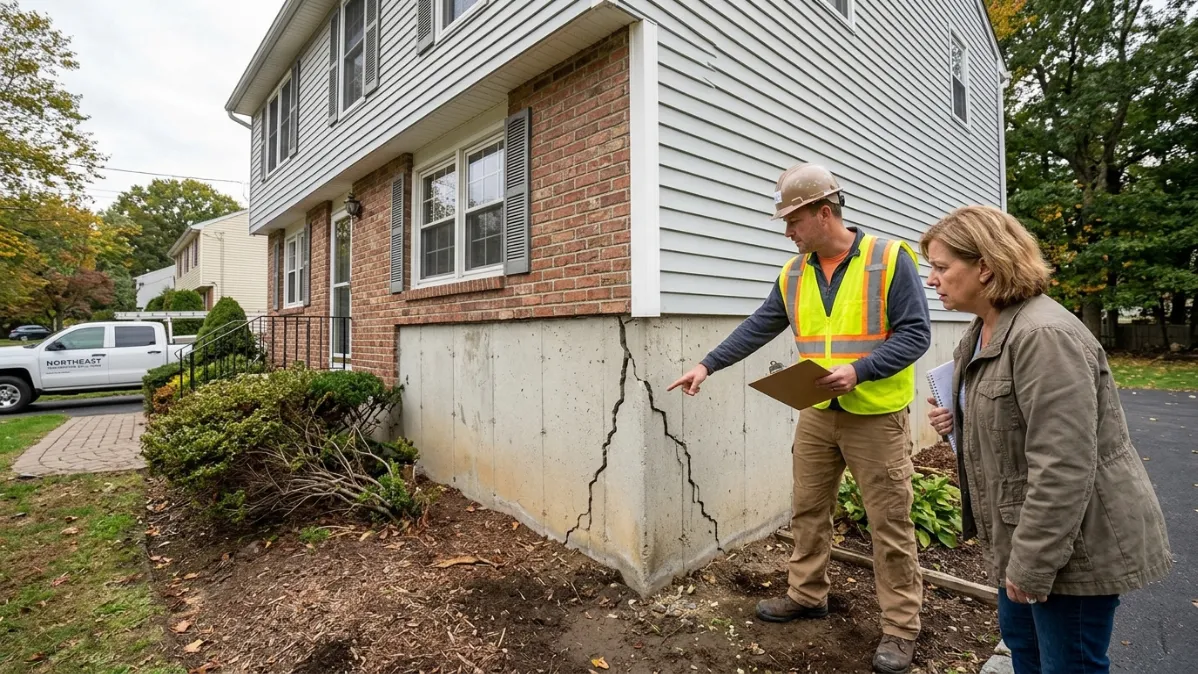
Real price ranges for every repair type, what drives the number up or down, and how to tell whether you’re looking at a $1,500 fix or a $40,000 one before you sign anything.
A foundation problem caught early almost always costs a fraction of one that’s been ignored or misdiagnosed.
Understanding the real price ranges and what separates the low end from the high end is what lets you move from anxious to informed. By the end of this guide, you’ll know how to read what’s in front of you, how to evaluate a quote, and exactly what questions to ask before anyone starts work.
The Moisture Connection You Can’t Ignore: The EPA identifies foundation cracks as a primary entry point for moisture and the mold growth that follows, noting that every structural gap is also a moisture pathway, and that water infiltration through foundation walls is one of the most common causes of indoor air quality problems in residential buildings.
Understanding the Problem
What's Actually Wrong: Reading the Signs Before the Price
A price for foundation repair cost means nothing until you know what it’s solving. Foundation trouble in the NY metro tends to fall into a few recognizable patterns, and learning to identify which one you’re looking at is the first step toward a decision you can actually trust.
Settlement
Settlement is the foundation sinking unevenly into the soil beneath it. You’ll recognize it as stair-step cracks running diagonally through masonry, gaps opening up at the tops of doors and windows, and floors that slope noticeably toward one side of a room. NY-metro soil makes this worse than it sounds. From the sandy fill on Long Island to the clay pockets and disturbed urban fill across the boroughs, the ground expands, shrinks, and compacts at different rates. A foundation that happens to bridge two soil types can sink on one side while the other stays put, creating differential settlement that compounds quickly if left unaddressed.
Bowing and Leaning Walls
Bowing or leaning walls are the reverse situation, soil pushing inward rather than giving way below. Saturated soil creates hydrostatic pressure that leans on a foundation wall until it bows inward, develops horizontal cracks, or shears along the cove joint at the base. If you learn one thing from this guide, let it be this: a horizontal crack running across a basement wall is the one to take most seriously. It’s a sign that the wall is being actively loaded and deformed by soil pressure, and that condition does not improve on its own.
The Crack You Should Never Ignore:
Horizontal cracks across a basement wall indicate active soil pressure bending the wall inward. Unlike vertical hairline cracks, which are often cosmetic, horizontal cracks are structural, and the repair cost climbs significantly the longer the wall continues to move. If you’re seeing this, prompt action saves meaningful money.
Cracks: Cosmetic vs. Structural
Cracks cover a wide range, from completely harmless to genuinely dangerous. Thin vertical hairlines are often just the concrete responding to normal curing and minor seasonal movement, they may never need anything more than monitoring. Horizontal cracks, diagonal stair-step cracks through block or brick, cracks wider than the edge of a coin, and anything actively leaking water belong in a different and more serious category. The problem is that these different crack types can look similar to an untrained eye, which is why two contractors can sometimes diagnose the same wall very differently.
The Moisture Connection
There’s a moisture angle running through all of it. A cracked foundation is also a leaking foundation, every structural gap is a pathway for water, and water in a basement or crawl space is where mold problems begin. A significant number of homeowners arrive at foundation repair the long way around: through a damp basement wall or a persistent musty smell, only to find out during the inspection that the structure itself is contributing to the moisture problem.
Pricing Breakdown
Foundation Repair Cost by Type of Repair: NY Metro Ranges for 2026
The work ranges from a simple crack injection to lifting and re-supporting an entire structure, and the foundation repair cost ranges just as widely. Use these figures as a planning benchmark and a reality check against quotes, not as a substitute for an in-person assessment of your specific foundation.
| Repair Type | Typical NY-Metro Cost | What It Addresses | When It’s the Right Fix |
|---|---|---|---|
| Hairline crack injection | $500 – $1,500 per crack | Non-structural cracks; stopping water entry | Cosmetic or minor cracks with no active wall movement |
| Structural crack repair (carbon fiber) | $1,000 – $3,500 per area | Active cracks that compromise wall integrity | Cracks that are widening or compromising the wall |
| Bowing wall stabilization | $5,000 – $15,000+ | Walls being pushed inward by soil pressure | Any visible inward bowing; horizontal cracks; act promptly |
| Push or helical piers | $1,500 – $3,500 per pier | Foundation that has settled unevenly | Settlement cracks; sloping floors; doors and windows out of square |
| Full underpinning | $25,000 – $100,000+ | Widespread failure; whole-foundation support | Extensive settlement across the full foundation footprint |
Pricing Breakdown
| Repair Type | Typical NY-Metro Cost | What It Addresses | When It’s the Right Fix |
|---|---|---|---|
| Hairline crack injection | $500 – $1,500 per crack | Non-structural cracks; stopping water entry | Cosmetic or minor cracks with no active wall movement |
| Structural crack repair (carbon fiber) | $1,000 – $3,500 per area | Active cracks that compromise wall integrity | Cracks that are widening or compromising the wall |
| Bowing wall stabilization | $5,000 – $15,000+ | Walls being pushed inward by soil pressure | Any visible inward bowing; horizontal cracks; act promptly |
| Push or helical piers | $1,500 – $3,500 per pier | Foundation that has settled unevenly | Settlement cracks; sloping floors; doors and windows out of square |
| Full underpinning | $25,000 – $100,000+ | Widespread failure; whole-foundation support | Extensive settlement across the full foundation footprint |
Each Repair Type Explained
What You're Actually Paying For: The Work Behind Each Number
Foundation repair prices only make sense when you understand what each number actually pays for. A $500 crack injection and a $40,000 pier system are not different versions of the same repair; they solve completely different problems at completely different stages of foundation movement.
The real cost driver is not the crack, gap, bow, or uneven floor you can see, but the hidden condition causing it. That is why proper diagnosis matters more than any price range on a page.
Below is what homeowners are actually paying for when a contractor recommends crack injection, carbon fiber reinforcement, wall stabilization, piers, or full underpinning.
This is the least expensive foundation repair because, when the crack is stable and the wall is otherwise sound, it is often exactly the right repair. The goal is simple: close the opening, stop water intrusion, and keep a minor crack from turning into a larger moisture problem.
The mistake is using injection as a substitute for diagnosis. If the crack is widening, repeating, or tied to settlement, wall movement, or outside moisture pressure, sealing it may hide the symptom while the real problem keeps progressing behind the surface.
Once a crack is active or the wall has lost structural integrity, sealant alone is no longer the answer. Carbon fiber belongs in this category because it is a real structural reinforcement option, not a cosmetic patch.
This is the repair that makes sense when the damage is serious enough that cosmetics are off the table, but early enough that you may still avoid a full stabilization or rebuild system.
Cost rises with the number of reinforced zones, the amount of wall involved, and whether drainage or moisture corrections need to happen at the same time.
This is the point where the repair stops being about the crack and starts being about the force causing it. Bowing and buckling walls are serious warning signs, which is why the repair has to focus on stabilization, not concealment.
Depending on severity, the right fix may involve early reinforcement, steel systems, anchor-based stabilization, or full reconstruction when the wall has moved too far.
It is also where pricing becomes least predictable, because wall height, access, drainage correction, and the degree of movement can rapidly turn a repairable condition into a major project.
Why Is My Upstairs Floor Sagging?
How foundation movement and crawl space deterioration travel upward, and what to do when your floors start telling the story.
Why This Knowledge Pays Off
Benefits of Understanding Foundation Repair Cost Before You Get a Quote
Going into this process with a realistic sense of what foundation repair costs, and why, protects you in ways that go well beyond setting a budget.
It Helps You Catch a Misdiagnosis
If one contractor proposes $1,200 of crack injection and another proposes $40,000 of underpinning for the same wall, that’s not a pricing difference, it’s two people describing two entirely different problems. Knowing the ranges tells you those quotes are incompatible, that someone has the diagnosis wrong, and that you need a third opinion, ideally from an independent structural engineer, before you spend anything. This is one of the most valuable things homeowners can do: bring just enough knowledge to the conversation to recognize when something doesn’t add up.
It Helps You Plan in the Right Order
Foundation work often has prerequisites that need to happen alongside or before the structural repair itself. Drainage corrections, grading improvements, and waterproofing measures frequently need to be in place so that the fix isn’t immediately undermined by the same conditions that caused the damage. Understanding the full scope upfront keeps you from paying for a repair that fails because the water management side was skipped to save money in the short term.
It Gives You Standing in the Conversation
A homeowner who knows that piers are priced per unit, that carbon fiber works for early-stage bowing but not advanced cases, and that injection seals cosmetic cracks but doesn’t address structural movement, that homeowner asks very different questions than one who walked in blind. Those questions reveal whether a contractor is tailoring a real solution to your actual foundation or running a standard estimate template that fits every job the same way.
- Recognize when two wildly different quotes mean a diagnostic disagreement, not just a pricing difference
- Understand which repairs have prerequisites (drainage, waterproofing) that should be done first
- Know that early-stage problems cost a fraction of advanced ones, and act accordingly
- Ask whether a contractor can explain why the price is what it is, tied to your specific problem
- Evaluate whether a warranty transfers to a future buyer, which affects resale value
- Understand why the cheapest quote can become the most expensive outcome
Foundation problems and home value: HUD guidelines establish that structural deficiencies, including foundation instability, are among the most significant factors affecting a home’s appraisable value and its eligibility for federally backed financing. Unrepaired foundation issues must be disclosed and will reduce a home’s appraised value, often by more than the cost of the repair itself. HUD.gov
Price Factors
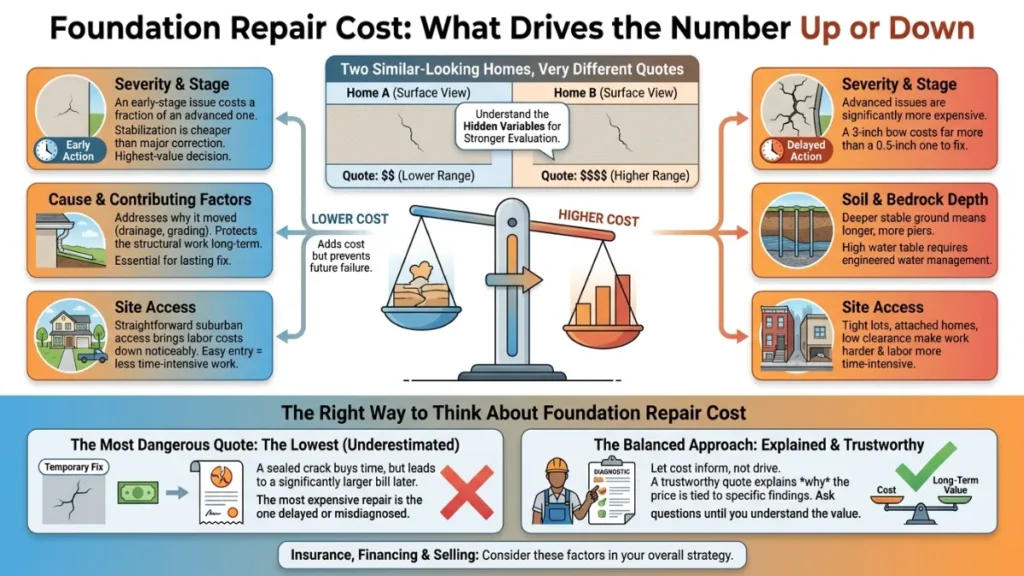
Foundation Repair Cost: What Drives the Number Up or Down
Two homes with foundation problems that look similar on the surface can receive very different quotes, and usually for legitimate reasons. Understanding which variables matter most puts you in a much stronger position when evaluating competing bids.
HUD Single Family Housing Policy Handbook
Foundation Repair Cost: What Drives the Number Up or Down
Two homes with foundation problems that look similar on the surface can receive very different quotes, and usually for legitimate reasons. Understanding which variables matter most puts you in a much stronger position when evaluating competing bids.
Severity & Stage
The most powerful price driver. An early-stage issue costs a fraction of an advanced one. A bowing wall that’s moved half an inch is far less expensive to stabilize than one that’s moved three inches. Early action is almost always the highest-value decision.
Cause & Contributing Factors
A repair that doesn’t address why the foundation moved tends to fail. Drainage corrections, grading adjustments, and water management often need to be part of the scope, adding cost but protecting the structural work long-term.
Soil & Bedrock Depth
Deeper stable ground means longer piers, which means higher cost per pier and sometimes more piers required. A high water table can mean water management has to be engineered into the solution before structural work can even begin.
Site Access
Tight NY-metro lots, attached row houses, narrow side yards, low-clearance crawl spaces, and finished interior spaces all make the work harder and the labor more time-intensive. Straightforward suburban access can bring costs down noticeably.
Foundation Type & Age
Older pre-war foundations built from fieldstone, brick, or rubble require more specialized repair approaches than modern poured concrete. The materials and methods are different, and so is the contractor expertise required to do the work correctly.
Scope of Diagnosis
A contractor who quotes before looking carefully into any of these factors hasn’t priced your foundation — they’ve priced an average. A proper diagnosis before a quote is the difference between a number that means something and one that’s just a placeholder.
The Right Way to Think About Foundation Repair Cost
The most dangerous quote in this category isn’t the highest one, it’s the lowest one from a contractor who underestimated what’s actually wrong. A sealed crack on a settling foundation buys a few quiet months and a significantly larger bill later. The most expensive foundation repair is almost always the one that got delayed or misdiagnosed until the structure forced the issue.
The balanced approach is to let the cost inform your decision without letting it drive the whole show. When a contractor can explain why their price is what it is, tied directly and specifically to what they found in your foundation, that number becomes something you can trust. When they can’t, it’s just a number, and you should keep asking questions until you understand what you’re actually buying.
Price Factors
Insurance, Financing, and What Foundation Problems Mean When You Sell
Does Homeowners Insurance Cover Foundation Repair?
In most cases, no. Standard homeowners policies exclude damage caused by settling, soil movement, and slow water intrusion, treating these as gradual maintenance issues rather than sudden covered events. Coverage may apply if the damage resulted from a specific covered peril, certain sudden plumbing failures, for example. Read your policy carefully and ask your carrier directly rather than assuming coverage either way.
Can Foundation Repair Be Financed?
Yes, and for many homeowners it’s the practical path forward. Home equity lines, personal loans, and contractor-arranged financing plans are all commonly used for foundation work because the expense tends to arrive unplanned. Financing the repair and starting soon is almost always more economical than delaying, because the foundation continues moving while you wait, and the repair cost climbs along with the damage.
Can You Sell a House With Foundation Problems?
You can, but the foundation problem will shape the entire transaction. Issues must be disclosed, a buyer’s inspector will find them regardless, and an unrepaired structural problem typically means a significant price reduction, a financing complication, or a buyer who walks away entirely. Repairing the foundation first, with documentation and a transferable warranty, generally returns more than it costs by protecting the full selling price and keeping the buyer pool as wide as possible.
Can You Sell a House With Foundation Problems?
What disclosure requires, how buyers and lenders respond, and whether to repair before listing or price it into the sale.
Foundation Repair Cost: Final Thoughts
The biggest thing to understand about foundation repair cost is that the number means nothing without the right diagnosis behind it. The exact same crack or wall can require a minor repair or a major structural solution depending on what’s actually causing the movement. That’s why choosing a contractor based on the lowest estimate alone is one of the most expensive mistakes homeowners make.
The good news is that most foundation problems become far more manageable and affordable when they’re caught early, before the damage spreads through the structure. If you’re seeing cracks, sticking doors, sloping floors, or basement wall movement anywhere in the Bronx, Brooklyn, Queens, or Long Island, schedule a professional inspection now and get a clear, honest evaluation before the problem and the cost continue to grow.
Frequently Asked Questions About Foundation Repair Cost
How Much Does Foundation Repair Cost in NY Metro Homes?
Foundation repair costs in the Bronx, Brooklyn, Queens, and Long Island can range from about $500 for a small crack repair to $40,000 or more for major structural stabilization. Minor crack injections usually cost between $500 and $1,500, while pier systems, wall stabilization, drainage correction, or full structural reinforcement can move projects into the five-figure range. The biggest cost factors are the severity of movement, the repair method required, water intrusion, soil conditions, and how long the issue has been developing before repair begins.
Is Foundation Repair Worth the Cost?
Yes. In most cases, foundation repair is far less expensive than allowing structural damage to worsen over time. Foundation issues can reduce property value, complicate home sales, create insurance concerns, and lead to additional damage throughout the house, including cracked drywall, sloping floors, sticking doors, plumbing strain, and framing movement. Catching the problem early is usually what keeps the repair manageable and affordable.
What Are the Signs of a Serious Foundation Problem?
The most concerning warning signs include horizontal basement wall cracks, stair-step cracks in brick or block, bowing walls, leaning foundation walls, widening cracks, uneven or sloping floors, sticking windows and doors, gaps around trim, and recurring water intrusion. Small vertical hairline cracks can sometimes be normal settling, but repeated movement or widening cracks should always be professionally evaluated.
How Much Does It Cost to Fix a Foundation Crack?
Most non-structural crack injections cost between $500 and $1,500. Structural cracks that require reinforcement with carbon fiber straps, steel bracing, or wall stabilization systems often range from $1,000 to $3,500 or more depending on the length, severity, and underlying cause of the movement. The most important factor is determining whether the crack is cosmetic or structural, which requires an in-person inspection.
What Causes Foundation Problems in Long Island, Brooklyn, Queens, and The Bronx?
Most foundation problems in the NY metro are caused by hydrostatic pressure, poor drainage, expanding and contracting soil, groundwater intrusion, aging masonry, settlement, and repeated moisture exposure. Older homes throughout Brooklyn and the Bronx are especially vulnerable because many foundations were built decades before modern waterproofing and drainage standards existed.
Should I Hire a Structural Engineer or a Foundation Contractor First?
For severe, confusing, or conflicting diagnoses, hiring an independent structural engineer first can provide an unbiased assessment and repair plan. Engineers do not profit from selling repairs, which makes their evaluation especially valuable when large structural work is being proposed. For smaller or clearly defined issues, a reputable foundation contractor is often the appropriate first call.
What's the Difference Between Helical Piers and Push Piers?
Both systems stabilize settling foundations by transferring the structure’s weight to deeper, stable soil. Push piers are hydraulically driven into the ground using the home’s weight as resistance. Helical piers are screwed into the soil using large steel helices and are often preferred in softer soils or lighter structures. The correct system depends on soil conditions, structural load, and site accessibility.
How Long Does Foundation Repair Last?
When installed properly and combined with drainage correction, most professional foundation repairs are designed to be permanent. Pier systems, carbon fiber reinforcement, and wall stabilization systems commonly carry long-term or lifetime warranties. However, long-term success depends heavily on addressing the moisture, drainage, or soil conditions that caused the movement in the first place.
Does Homeowners Insurance Cover Foundation Repair?
Usually not. Most homeowners insurance policies exclude foundation damage caused by settlement, hydrostatic pressure, soil movement, drainage problems, or long-term water intrusion. Coverage may apply in limited situations involving sudden covered events, such as burst plumbing lines, but every policy is different. It’s important to review your policy carefully and speak directly with your insurance carrier.
Can Water Problems Cause Foundation Damage?
Absolutely. Water is one of the biggest drivers of foundation movement and structural deterioration. Poor drainage, clogged gutters, leaking plumbing, groundwater pressure, and improper grading can all saturate the soil surrounding the foundation. Over time, that pressure can crack walls, weaken masonry, cause settlement, and create bowing or inward movement in basement walls.