
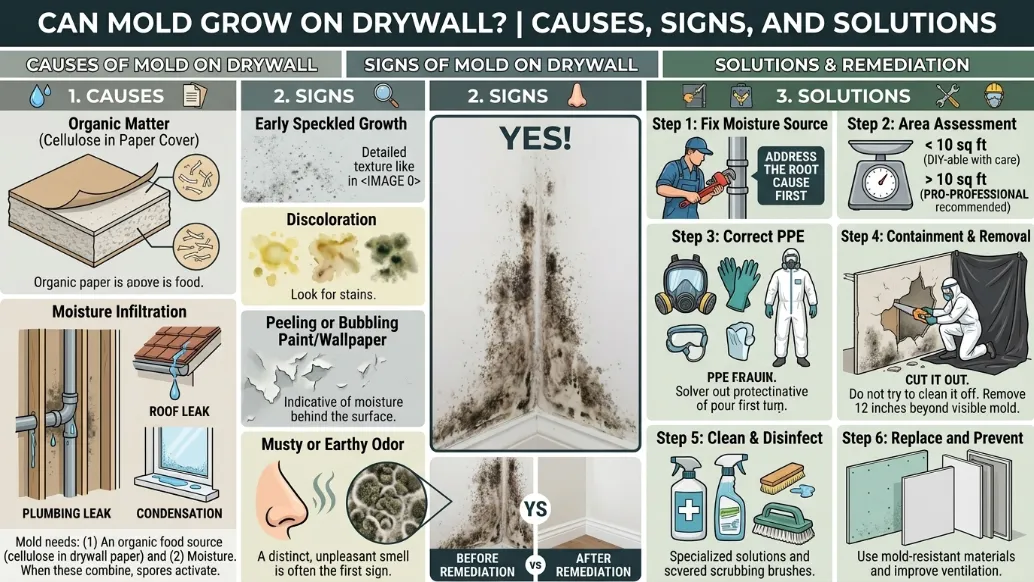
If you’ve spotted a discolored patch on a wall, or you’re simply wondering whether the drywall in your home is at risk, here’s the direct answer. Yes, mold grows on drywall readily, and drywall is one of the most mold-friendly materials in your entire house.
That isn’t an alarmist statement. It’s building science. The paper facing on standard drywall is, from a mold’s perspective, food. Add moisture, and you’ve got everything a mold colony needs.
Understanding why drywall is so vulnerable, and how to recognize the warning signs early, is what separates a small, inexpensive fix from a wall cavity that has to be opened up and rebuilt.
This guide walks through why drywall molds so easily, the causes to watch for, how to recognize the signs (including the hidden ones), and what to actually do about it.
Why Drywall Is So Vulnerable to Mold
Mold needs three things to grow: a food source, moisture, and time. Standard drywall hands it two of the three for free.
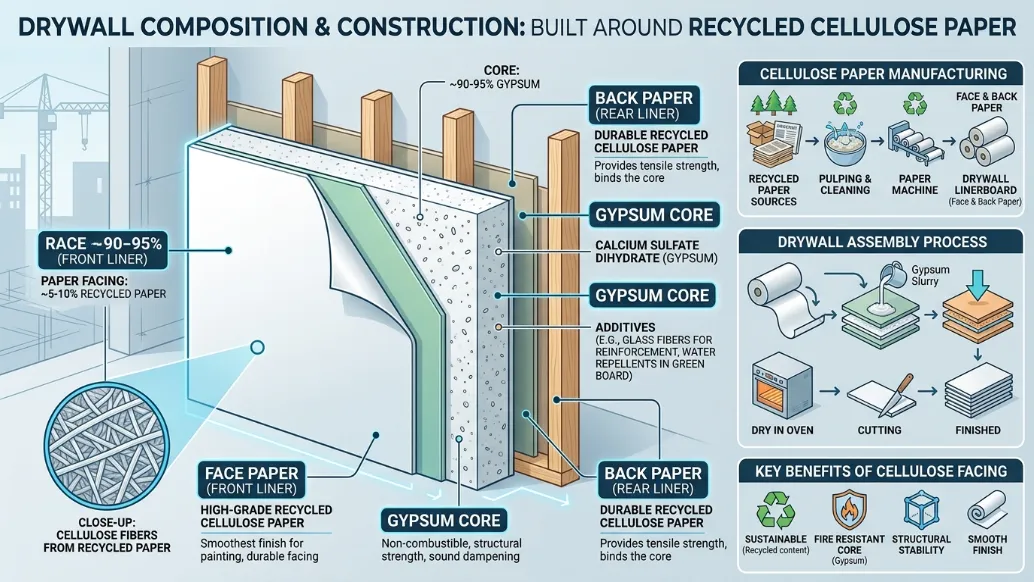
Drywall is built around cellulose
A sheet of standard drywall is a gypsum core sandwiched between two layers of paper. That paper is cellulose, the exact organic material mold feeds on. So unlike, say, glass or metal, drywall isn’t a surface mold merely lands on. It’s a surface mold can actively consume. The gypsum core can also hold moisture, and many walls contain paper-faced or organic components that extend the food supply even further.
This is why drywall ranks so high on the list of what mold grows on and where to look for it in your home. It isn’t an incidental victim. It’s a preferred host.
Drywall is everywhere moisture problems happen
Compounding the material vulnerability is location. Drywall lines bathrooms, kitchens, basements, laundry rooms, and the exterior walls of your home. Those are exactly the places where humidity spikes, leaks occur, and condensation forms. The material’s weakness and the home’s wettest zones overlap almost perfectly.
Moisture is the only missing ingredient
Because drywall already supplies the food, the entire question of “will mold grow on this drywall” comes down to a single variable, and that variable is moisture. Control the moisture and drywall stays clean indefinitely. Allow moisture to persist and mold growth is close to inevitable. Everything else in this guide flows from that one fact. For the bigger picture, see how mold grows and thrives in moisture-rich environments.
Is Mold on Drywall Dangerous?
Mold on drywall carries two categories of concern.
- Health: Mold exposure can trigger allergic and respiratory reactions, including congestion, coughing, and eye or throat irritation, and it can aggravate asthma in those who have it. Sensitive groups, such as infants, older adults, and immune-compromised individuals, warrant extra caution. Reactions vary widely by individual and by exposure. This article is not medical advice, and persistent unexplained symptoms are a conversation for a physician. For balanced context, see is mold dangerous: health risks and when to worry and mold allergy symptoms.
- Your Home. Because drywall mold so often signals moisture inside the wall assembly, the same water can be reaching framing and insulation. Sustained moisture there leads to wood rot and structural risk and ruins insulation. Drywall mold is frequently the visible messenger of a problem with a much larger footprint.
The reasonable response is neither panic nor dismissal. Treat it as a real signal, identify the moisture source, and resolve both the mold and the cause.
How Quickly Can Mold Grow on Drywall?
Faster than most homeowners expect. Given the right conditions, meaning sustained moisture and typical indoor temperatures, mold can begin colonizing damp drywall within about 24 to 72 hours. Our detailed breakdown of how long it takes for mold to grow explains the full timeline, but the headline matters here. Drywall does not give you a long grace period.
This is why the speed of your response to any water event is so important. A leak found and fully dried within a day is usually a non-event. The same leak left for a week is a remediation project. The drywall didn’t change. The exposure time did.
It’s also worth knowing that mold doesn’t need standing water, or even a leak. Sustained high humidity alone is enough to grow mold on drywall, particularly on cooler exterior walls where moisture condenses. So can poor ventilation cause mold? Yes, and drywall is often where it shows up first.
Signs of Mold on Drywall
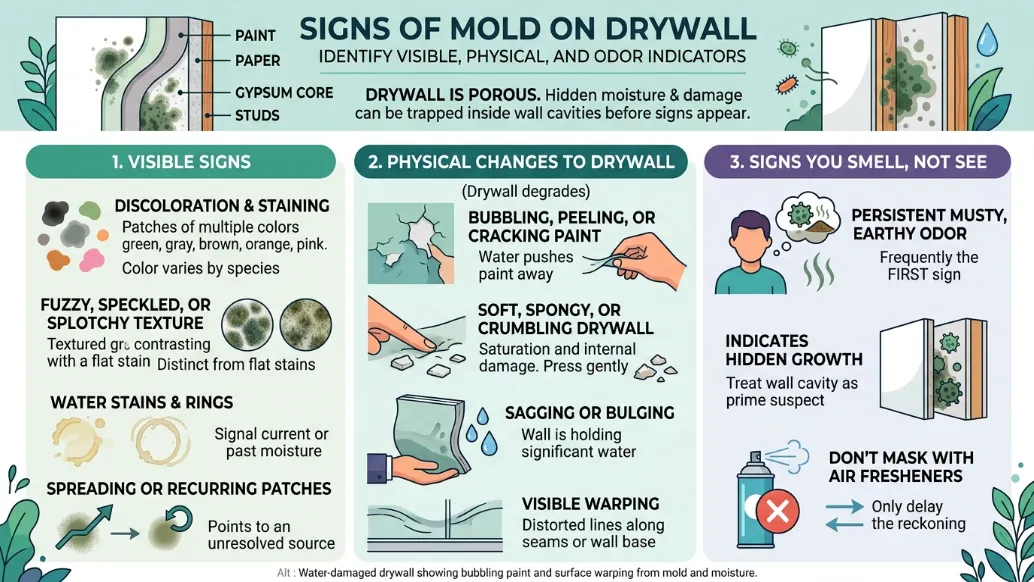
Drywall mold does not always appear as dramatic black patches spreading across a wall. In many cases, the first warning signs are subtle: a musty odor, bubbling paint, discoloration, or drywall that suddenly feels soft or swollen.
Because drywall is porous, mold growth often extends deeper than the visible surface. By the time staining or warping appears, moisture may already be trapped inside the wall cavity, causing hidden damage behind the paint and insulation.
Visible signs
- Discoloration and Staining: Patches of black, green, gray, brown, or even orange or pink. Color varies by species and isn’t a reliable identifier on its own, as what color is mold explains.
- Fuzzy, Speckled, or Splotchy Texture: This is distinct from a flat stain. A textured, slightly raised growth is a strong indicator.
- Water Stains and Discoloration Rings: Yellowish or brownish marks signal current or past moisture, and mold often accompanies them.
- Spreading or Recurring Patches: A spot that returns after cleaning, or grows over time, points to an unresolved moisture source.
Physical changes to the drywall itself
This is where drywall is different from harder surfaces. The material itself degrades:
- Bubbling, peeling, or cracking paint.
- Soft, spongy, or crumbling drywall. Press gently. Healthy drywall is firm. Softness means saturation and likely interior damage.
- Sagging or bulging. The wall is holding significant water.
- Visible warping along seams or at the base of the wall.
Signs you smell, not see
- A persistent musty, earthy odor. This is frequently the first sign of mold inside a wall cavity, well before anything is visible. If you’re chasing a smell with no visible source, treat the wall cavity as a prime suspect. How to get rid of mold smell explains why odor means hidden growth, and why air fresheners only delay the reckoning.
Alt text: “Water-damaged drywall showing bubbling paint and surface warping from mold and moisture.
What Causes Mold to Grow on Drywall?
Drywall is one of the most mold-prone materials in a home because it absorbs and holds moisture easily. Once water intrusion or high humidity reaches the paper facing or gypsum core, mold can begin growing in as little as 24 to 48 hours under the right conditions.
In most homes, drywall mold is not the root problem. It’s the symptom. Plumbing leaks, humidity, condensation, roof failures, and basement moisture issues are the real drivers, and until the moisture source is corrected, the mold almost always returns.
1. Plumbing leaks
Leaks inside walls, whether from supply lines, drain pipes, or fittings, are a leading cause, and a dangerous one. The water often feeds the back of the drywall for weeks before anything shows on the room side.
2. High indoor humidity
When indoor humidity stays elevated, drywall absorbs ambient moisture, and condensation forms, especially on cooler exterior walls. Keeping humidity in the ideal range is one of the most effective forms of prevention. In basements specifically, controlling humidity is critical.
3. Roof leaks
Water entering at the roof travels down through ceilings and into wall assemblies, often surfacing as drywall staining and mold far from the actual entry point. See what causes mold in the attic.
4. Basement and foundation moisture
Below grade, drywall is highly exposed. Water moving through foundation walls, hydrostatic pressure, and basement moisture problems all routinely produce drywall mold. This is the classic mechanism behind black mold on walls.
5. Bathroom and kitchen moisture
Steam, splashing, and inadequate ventilation make these rooms persistent trouble spots. See black mold in the bathroom.
6. Condensation and the building envelope
Where warm, humid indoor air meets cool drywall surfaces, condensation forms. Air-movement effects like the stack effect can concentrate moisture in specific wall areas.
7. Flooding and unfinished water events
After flooding, drywall wicks water upward, well above the visible waterline. If it isn’t dried completely, or removed, mold follows. Our flood damage cleanup process and basement flooding solutions explain how to handle this properly.
What to Do if You Have Mold on Your Drywall
If the affected area is small (a common rule of thumb is under roughly 10 square feet), the drywall is still firm and structurally sound, you’ve confirmed and fixed the moisture source, and no one in the home is highly sensitive, then careful homeowner cleaning of a minor surface spot may be reasonable. General guidance is in how to remove mold from walls.
The honest limitation of cleaning drywall
Be clear-eyed about this. Because drywall is porous and paper-faced, mold roots into the material rather than just resting on top. Surface cleaning can remove what’s visible while leaving the colony embedded, which is exactly why surface “instant” treatments so often fail. Significantly mold-affected drywall usually needs to be removed and replaced, not cleaned. That’s not an upsell. It’s the nature of the material.
When to call a professional
Bring in a professional if any of these apply:
- The affected area is large, or you suspect mold behind the drywall.
- The drywall is soft, sagging, crumbling, or warped.
- There’s a musty smell with no visible source.
- The mold keeps returning after cleaning.
- You haven’t identified the moisture source.
- Anyone in the home has significant respiratory sensitivity.
A professional mold inspection confirms scope and locates the cause, and mold remediation removes affected material under containment. The mold removal process step by step shows what proper work looks like.
The step that actually matters
Whichever route you take, the fix is incomplete until the moisture source is corrected. New drywall in a wall that still gets wet will simply mold again. Depending on the source, the lasting solution is waterproofing, drainage correction, humidity control, or a plumbing or roofing repair.
The Hidden Problem: Mold Behind Drywall
Here’s the single most important thing to understand about drywall mold.
The mold you can see is often the smaller part of the problem.
When moisture enters a wall cavity, whether from a pipe leak, foundation seepage, or condensation inside the wall, it reaches the back of the drywall first. Mold begins growing there, on the hidden interior face, fed by the moisture and the paper backing. It can grow for weeks or months before enough comes through to show on the room-facing surface.
By the time you see a patch on the visible side, the colony inside the cavity is frequently several times larger. That’s why a small spot on the wall should never be assumed to be a small problem.
Warning signs that mold may be active behind your drywall:
- A musty smell with no visible source.
- Recurring patches that return after you clean them.
- Cool or damp-feeling sections of wall.
- Staining, bubbling, or soft spots, which are surface evidence of interior moisture.
- Unexplained allergy-type symptoms that ease when you leave the house.
When the problem is suspected behind the wall, professionals use moisture mapping and meters to find the true footprint before opening anything. And because disturbing hidden mold can release spores, it’s worth understanding how mold spreads and moves before you start cutting into a wall.
How to Prevent Mold on Drywall
You can’t change the fact that drywall is mold-friendly. But you fully control the moisture, and moisture is the whole game.
- Keep indoor humidity in the safe range. See the home humidity guide and best humidity to prevent mold. A dehumidifier helps in damp areas.
- Ventilate moisture-heavy rooms. Bathroom and kitchen exhaust fans matter, because poor ventilation causes mold.
- Fix leaks immediately. Drywall’s 24-to-72-hour window leaves no room for “I’ll get to it later.”
- Manage water around the home. Gutters, grading, and exterior drainage keep moisture away from the walls that contain your drywall.
- Address basement and crawl space moisture at the source. See basement moisture management and crawl space moisture control.
- Dry every water event completely. The difference between an incident and a remediation project is how fast and how thoroughly you dry.
The definitive mold prevention guide brings these habits together.
Can Mold Grow on Drywall: Final Thoughts
Can mold grow on drywall? Yes, easily, quickly, and often invisibly. Drywall’s paper facing is mold food, and your home’s wettest areas are lined with it. The material’s vulnerability is fixed. The moisture is the variable you control.
There are two ideas to carry away. First, a small visible patch can front a far larger hidden one, so drywall mold should never be judged by its surface appearance alone. Second, no drywall repair, whether cleaning or replacement, is truly finished until the moisture source is found and corrected. Solve the water, and the drywall stays clean. Skip that step, and you’re simply scheduling the next patch.
If you have signs of mold on your drywall, whether visible, structural, or just that musty smell, a proper inspection that confirms the scope and traces the moisture is the right next step.
Frequently Asked Questions About Mold on Drywall
Can mold grow on drywall without a leak?
Yes. Sustained high humidity and condensation alone can grow mold on drywall, especially on cool exterior walls. A leak is a common cause, but it isn’t a required one.
How fast does mold grow on wet drywall?
Under sustained damp conditions and typical indoor temperatures, mold can begin establishing within roughly 24 to 72 hours. That’s why fast, complete drying after any water event is so essential.
Can mold on drywall be cleaned, or does the drywall have to be replaced?
A small spot on still-firm drywall, with the moisture source already fixed, can sometimes be cleaned. But because drywall is porous and paper-faced, mold embeds into it, so significantly affected drywall usually has to be removed and replaced rather than cleaned.
Is mold behind drywall common?
Very. Moisture inside a wall reaches the back of the drywall first, so mold often grows on the hidden face, sometimes for weeks or months, before showing on the visible surface. A small visible patch can sit in front of a much larger hidden colony.
Does painting over mold on drywall get rid of it?
No. Paint covers the appearance temporarily but does nothing about the mold or the moisture feeding it. The growth continues underneath, and the paint typically bubbles or peels as evidence.
What does mold on drywall smell like?
A persistent musty, earthy odor. Importantly, this smell is often the first sign of mold inside a wall cavity, appearing before any visible patch shows up.