
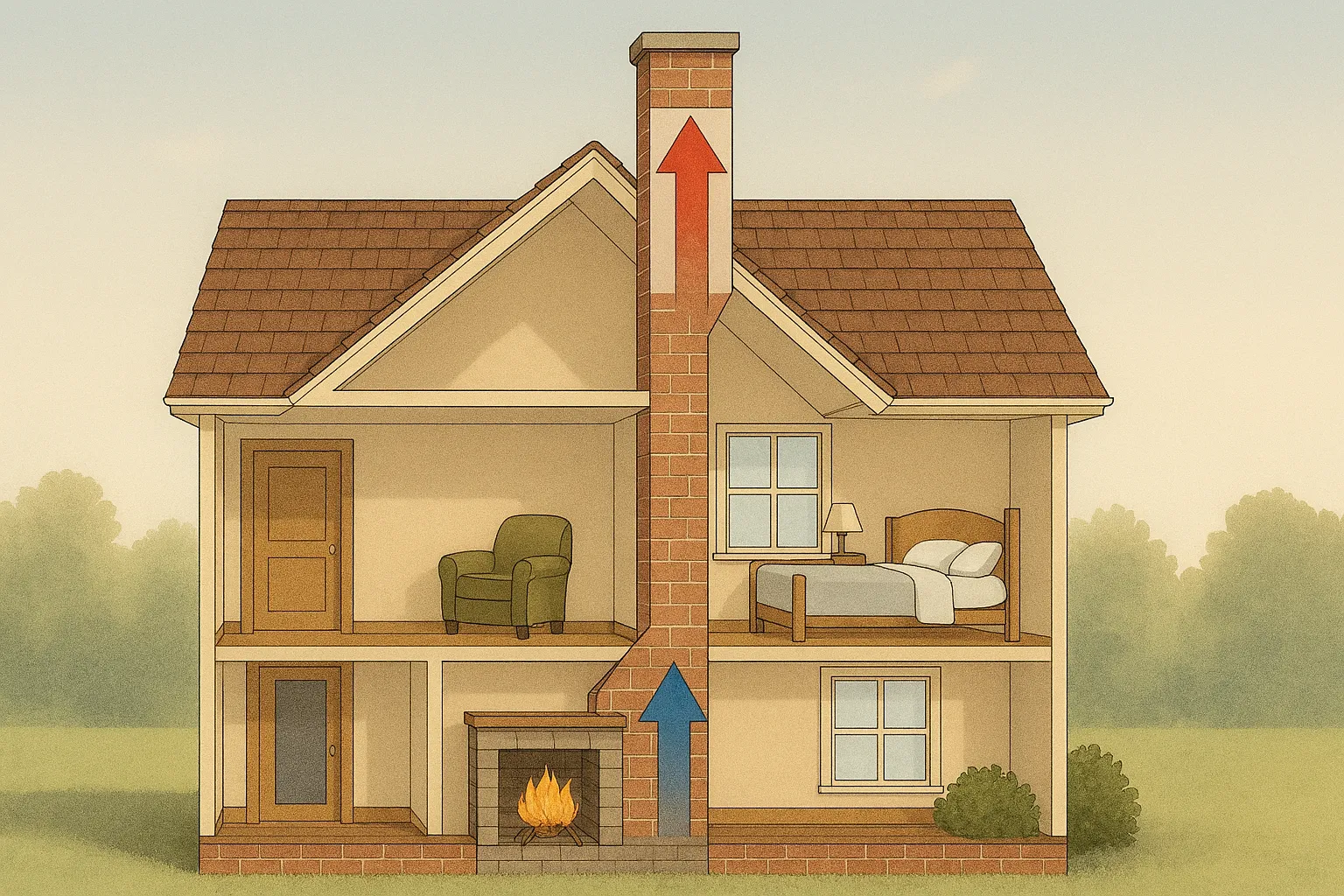
The stack effect is a natural airflow phenomenon that happens in every home, especially noticeable during colder months. It describes how warm air inside your house rises and escapes through upper levels, which causes cooler air from lower levels to get pulled upward to replace it. This invisible air movement can carry moisture, odors, and even mold spores throughout the home. Understanding the stack effect helps homeowners connect the dots between basement dampness and poor indoor air quality upstairs.
How the Stack Effect Works in Homes
In homes, the stack effect creates a constant upward pull of air. Warm air rises and escapes through the attic or upper-level cracks, leaving behind low pressure at the bottom of the house. To make up for the loss, cooler air is pulled in from basements or crawl spaces, often bringing moisture, odors, or mold spores with it. This invisible loop creates a steady, vertical airflow that impacts indoor air quality from the ground up.
Airflow Direction in Homes:
Problems With the Stack Effect and How It Affects Your Home
When the stack effect is not properly controlled, airflow inside a home can become unbalanced. Warm air rising and escaping at upper levels creates negative pressure below, which pulls air upward from basements, crawl spaces, and wall cavities. This pressure imbalance is a normal mechanical process, but when it is left unmanaged, it can amplify existing issues.
Moisture often moves with this airflow. Small damp areas at lower levels can feed moisture into the rest of the home, allowing minor problems to spread over time. As air and moisture move upward, homeowners may notice changes in comfort, indoor air quality, and overall building performance. These issues are not caused by neglect or misuse of the home, but by predictable airflow patterns interacting with moisture and construction details.
How the Stack Effect Affects Moisture and Mold
When airflow moves through a home, it carries more than just heat. Air naturally holds moisture, and as it travels upward through the building, that moisture moves with it. This is why stack effect problems often turn small, localized moisture issues into whole-home concerns.
Homes commonly pull replacement air from basements and crawl spaces, which are the most moisture-prone areas of the structure. Even when moisture levels seem minor at first, continuous upward airflow allows damp air to feed higher levels of the home over time.
- Air Carries Moisture: Warm air can hold significant moisture, which moves vertically as air rises through the house.
- Lower Levels Feeding Upper Levels: Damp basements and crawl spaces become ongoing moisture sources for living spaces above.
- Mold Spores Moving With Airflow: Mold spores are lightweight and easily transported upward through wall cavities and open air paths.
- Small Problems Spreading Gradually: Isolated moisture issues rarely stay isolated when airflow continuously redistributes moisture throughout the home.
Because the stack effect operates constantly, moisture and mold concerns tend to escalate slowly rather than appear all at once, making them harder to trace without understanding airflow patterns.
How the Stack Effect Impacts Indoor Air Quality
The air you breathe inside your home is shaped by where that air comes from. When the stack effect pulls air upward, it often draws from lower, less controlled areas before it reaches main living spaces.
As this air moves vertically, it can carry a mix of humidity, odors, and fine particles that affect comfort and perceived air quality. This is why indoor air issues can feel inconsistent from room to room or floor to floor.
- Air Pulled From Lower Levels: Living spaces frequently receive air originating from basements, crawl spaces, and wall cavities.
- Humidity and Particulates: Moisture, dust, and fine debris move with airflow, even when not visible.
- Odors and Allergens Traveling Upward: Smells, allergens, and airborne contaminants migrate vertically through the home.
- Uneven Air Quality: Changes in airflow and pressure can make some rooms feel stuffy while others feel dry or drafty.
These air quality changes are not random. They reflect predictable airflow behavior driven by temperature differences, pressure imbalance, and the home’s construction details working together over time.
Controlling Stack Effect in Construction
The stack effect is not an accidental or poorly understood phenomenon. It is a well-documented aspect of building science that architects, engineers, and builders account for when structures are properly designed and constructed. Modern construction methods aim to manage airflow intentionally rather than allow it to move unchecked through a building.
One of the primary strategies is controlling where air is allowed to enter and exit the structure. By sealing critical points at both the top and bottom of the building, airflow paths become more predictable and easier to manage. This helps reduce pressure imbalances that drive unwanted air movement.
Pressure balancing also plays a key role. When air leakage is minimized and ventilation is properly planned, the pressure differences that intensify stack effect are reduced. This does not eliminate airflow, but it prevents it from becoming disruptive.
Moisture management is inseparable from airflow control. Construction approaches that address drainage, vapor movement, and home humidity help ensure that air moving through the structure does not carry excess moisture. For this reason, modern building standards increasingly treat air sealing, moisture control, and ventilation as connected systems rather than isolated features.
What You Can Do as a Homeowner to Control the Stack Effect
Homeowners do not need specialized training to reduce stack effect–related issues, but they do benefit from understanding how their home behaves as a system. Air and moisture move together, and small conditions in one area often influence comfort and air quality elsewhere. Paying attention to patterns rather than isolated symptoms helps clarify what is actually happening. Awareness and observation are often enough to identify when airflow is contributing to larger moisture or comfort concerns.
- Awareness of Moisture Sources: Notice where moisture tends to appear, such as condensation, damp surfaces, or musty odors, especially at lower levels of the home.
- Importance of Keeping Lower Levels Dry: Basements and crawl spaces commonly supply the air pulled upward, making their condition critical to the rest of the house.
- Understanding Ventilation Basics: Knowing where air enters and exits helps explain why some rooms feel uneven in temperature or humidity.
- Recognizing Systemic Patterns: Repeated issues across multiple floors usually indicate an airflow-driven problem rather than a single surface defect.
Solutions That Help Reduce Stack Effect Issues
Stack effect concerns are best addressed by looking at airflow and moisture together, not as separate problems. Homes respond most predictably when air movement is controlled and moisture is managed at the same time. Rather than relying on a single fix, solutions are more effective when they support each other. A coordinated approach reduces unintended consequences and improves overall building performance.
- Air Sealing Concepts: Limiting uncontrolled air entry and escape helps stabilize pressure differences that drive vertical airflow.
- Moisture Control Strategies: Managing humidity, drainage, and vapor movement reduces the amount of moisture available to travel with air.
- Proper Ventilation Alignment: Balanced ventilation ensures air moves intentionally instead of being pulled unpredictably through the structure.
- Why Solutions Work Best Together: Addressing airflow without moisture control, or vice versa, can leave underlying issues unresolved or create new imbalances.
Taken together, these strategies support steadier airflow, more consistent indoor conditions, and better long-term building health when applied thoughtfully and evaluated as a system.
Final Thoughts: Why Understanding Stack Effect Matters
The stack effect itself is normal. Every building experiences it to some degree. Problems arise when airflow and moisture move unchecked through the structure, quietly amplifying small issues over time. Moisture and airflow are always connected. When one is overlooked, the other is rarely far behind. Understanding how they interact helps homeowners make sense of symptoms that might otherwise seem unrelated.
Early awareness creates options. Recognizing airflow-driven issues before they escalate allows for informed decisions rather than reactive repairs. When needed, professional evaluation is best viewed as an information-gathering step. A clear assessment of airflow, pressure, and moisture conditions provides understanding first, allowing homeowners to move forward with confidence.
Long Island and Brooklyn Homeowners Trust Mold Removal Experts for a Free Mold Inspection and Detailed Quote!