
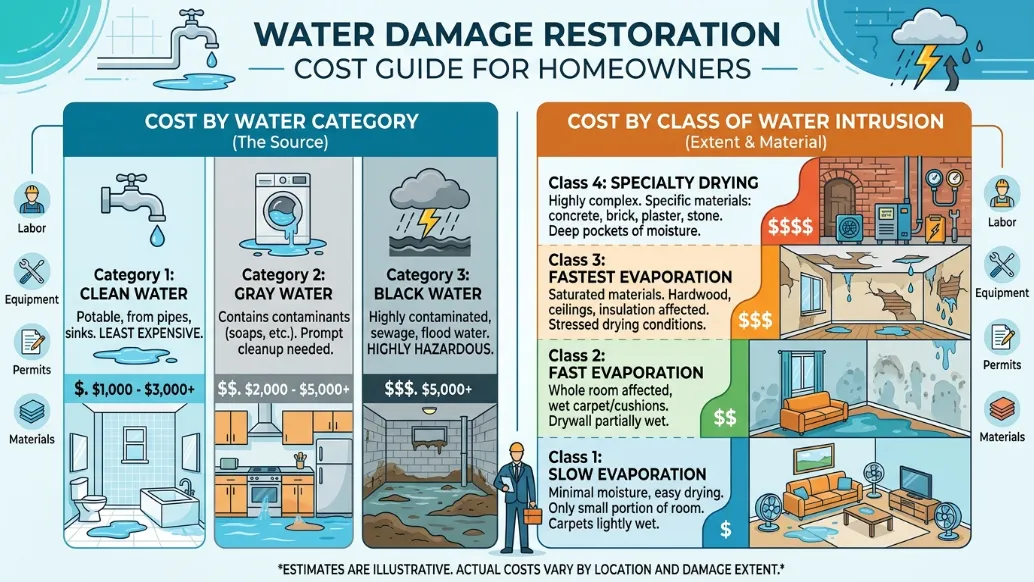
When water gets into your home, the clock starts immediately, and so does the question every homeowner asks: what will this cost? Water damage restoration cost depends less on a single flat rate and more on three things professionals assess in the first hour: how clean or contaminated the water is, how much of your home it soaked, and how long it sat before drying began.
A small clean-water leak caught early might run a few hundred dollars. A contaminated flood left for days, with mold already taking hold, can climb into the five figures. This guide breaks down water damage restoration cost the way a restoration crew actually prices it, so you can read an estimate with confidence and understand exactly where your money goes.
For homeowners across Long Island, Brooklyn, Queens, and the Bronx, where aging plumbing, heavy storms, and high water tables all play a role, understanding these numbers early is what keeps a manageable problem from becoming a gut renovation. The single biggest lever on the final price is how quickly the drying process starts.
Speak with a Long Island Mold Specialist Today!
Average Water Damage Restoration Cost by Severity
National averages give you a starting frame, though your actual number depends on the specifics below. Most homeowners land somewhere in the $1,300 to $5,600 range, with the national average often cited around $3,000 to $3,800. Here is how that spreads across severity levels.
| Severity | Typical Cost Range | Example Scenario |
|---|---|---|
| Minor (clean water, small area) | $150 to $1,500 | Supply line leak dried within hours |
| Moderate (one to two rooms) | $1,500 to $4,500 | Overflowing appliance, some drywall affected |
| Major (multiple rooms or a level) | $4,500 to $8,000 | Burst pipe flooding a finished basement |
| Severe (contaminated water or delay) | $8,000 to $15,000+ | Sewage backup or standing water with mold |
| Per square foot (general guide) | $3 to $8 per sq ft | Varies by water category and materials |
Those per-square-foot figures are the most reliable way to sanity-check a quote. Clean water in a contained area sits near the bottom of the range. Contaminated water spreading across a finished level sits at the top. The difference between the two is not arbitrary, and understanding it is the key to reading your water damage restoration cost correctly.
Why speed matters most: Mold can begin growing on wet materials within 24 to 48 hours. Every hour water sits, it wicks deeper into drywall, subfloor, and framing, converting a drying job into a demolition-and-rebuild job. You can see how quickly this happens in our guide on how long mold takes to grow on wet carpet.
Water Categories: The Biggest Driver of Water Damage Restoration Cost
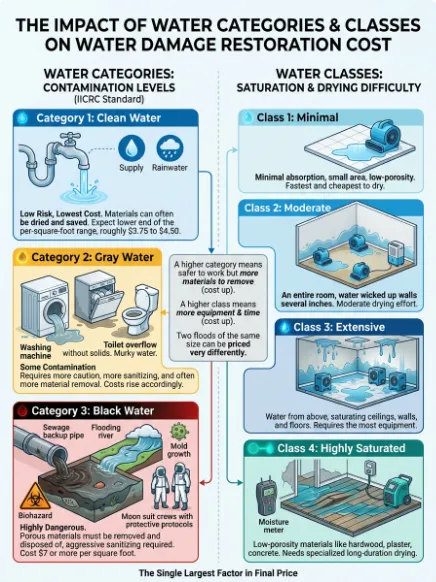
Restoration professionals classify every water event into one of three categories defined by the industry standard from the IICRC. The category tells the crew how dangerous the water is, what protective steps are required, and how much material must be discarded rather than dried. This is the single largest factor in your final price.
Category 1: Clean Water
This is water from a clean source such as a supply line, faucet, or rainwater with no contaminants. It carries the lowest risk and the lowest cost because much of the affected material can often be dried and saved. Expect the lower end of the per-square-foot range, roughly $3.75 to $4.50.
Category 2: Gray Water
Gray water contains some contamination, such as discharge from a washing machine, dishwasher, or a toilet overflow without solids. It requires more caution, more sanitizing, and often more material removal. Costs rise accordingly.
Category 3: Black Water
Black water is grossly contaminated, including sewage backups, flooding from rivers or storm surge, and any water sitting long enough to grow harmful microbes. This is the most expensive category because porous materials must be removed and disposed of, aggressive sanitizing is required, and crews need full protective protocols. Our detailed resource on sewage backup and contaminated water risks explains why these jobs demand a different level of care and cost $7 or more per square foot.
Water Classes: How Much of Your Home Got Wet
While category measures contamination, class measures how much water your materials absorbed and how hard the space will be to dry. Class ranges from 1 to 4, and it directly affects how much drying equipment and time your job requires.
- Class 1: Minimal absorption, a small area with low-porosity materials. Fastest and cheapest to dry.
- Class 2: An entire room with water wicked up walls several inches, including carpet and cushion. Moderate drying effort.
- Class 3: Water reaching from above, saturating ceilings, walls, and floors. Requires the most equipment.
- Class 4: Deeply saturated low-porosity materials like hardwood, plaster, and concrete that need specialized long-duration drying.
A higher class means more air movers, more dehumidifiers, and more days on site, each of which adds to your water damage restoration cost. This is why two floods of the same size can be priced very differently.
The Line-Item Breakdown Behind Your Estimate
A professional estimate is built from individual services, not one lump sum. Knowing these line items helps you judge whether a quote is complete and fair.
| Service | Typical Cost | Purpose |
|---|---|---|
| Emergency water extraction | $100 to $400+ | Pumping and vacuuming standing water |
| Drying equipment (per day) | $50 to $200 per day | Air movers and dehumidifiers, often 3 to 5 days |
| Antimicrobial treatment | $150 to $500 | Sanitizing to prevent mold and bacteria |
| Demolition and material removal | $500 to $2,500 | Removing unsalvageable drywall, flooring, insulation |
| Structural drying and repair | $1,000 to $5,000+ | Rebuilding what had to be removed |
| Mold remediation (if present) | $500 to $6,000 | Added when growth has already started |
The mold line item is the one homeowners most often trigger by waiting. If drying starts within the first day or two, mold remediation may never appear on your bill. If water sits, it becomes one of the largest line items. For a full walkthrough of what a proper response looks like from the first hour, see our flood damage cleanup process step by step.
What a Professional Water Damage Restoration Cost Protects You From
It is tempting to grab a shop vac and a box fan and handle a flood yourself, and for a truly minor clean-water spill that can be reasonable. The problem is that surface dryness is deceptive. Water hides inside wall cavities, under flooring, and in framing, where household fans cannot reach it. That trapped moisture is exactly what feeds mold and quietly rots structural wood over the following weeks.
What a professional water damage restoration cost buys you is verified dryness. Crews use moisture meters to confirm that materials have returned to a safe baseline, not just that surfaces feel dry to the touch. They also identify which materials can be saved and which must go, preventing the far more expensive scenario where hidden moisture surfaces months later as a mold problem or a sagging floor. Our guide to the types of mold from water damage shows what tends to appear when drying is incomplete. The federal guidance on cleaning up mold in your home echoes this: the fix is thorough moisture removal, not surface cleaning.
The Best Way to Control Water Damage Restoration Cost: Act Within 24 to 48 Hours
The single most effective way to keep your water damage restoration cost low is speed. Acting within the first 24 to 48 hours is the best option available to any homeowner, and it costs nothing but a phone call. In that window, materials can usually be dried and saved, mold has not yet colonized, and the job stays in the extraction-and-drying phase rather than the demolition-and-rebuild phase. Every day of delay pushes the work up the cost ladder: from drying, to material removal, to mold remediation, to structural repair. The homeowners who pay the least are almost always the ones who called first and asked questions later.
Water where it should not be? The first 48 hours decide the cost.
Water Damage Restoration Cost and Homeowners Insurance
Insurance is where many homeowners recover a large share of their water damage restoration cost, but coverage hinges on the cause. Standard homeowners policies typically cover sudden and accidental events, such as a pipe that bursts without warning. They generally exclude gradual damage from an unaddressed leak, and they usually exclude external flooding unless you carry separate flood insurance. Federal preparedness resources like Ready.gov on floods and the CDC flood guidance underscore how quickly flood situations become health hazards, which is another reason documentation matters.
To protect a claim, photograph everything before cleanup begins, keep damaged materials until an adjuster has seen them, and get a professional to document the cause and scope. If your basement is a recurring problem, addressing the source is what stops the claims from repeating. Our guides on basement flooding from groundwater and what causes basement flooding from rain cover the permanent fixes, and basement waterproofing cost explains what prevention runs.
Water Damage Restoration Cost: Final Thoughts
The way to make sense of water damage restoration cost is to remember that price follows three variables: contamination, saturation, and time. Clean water in a small, quickly dried area sits near $3 to $4 per square foot, while contaminated water or a delayed response can push a job past $8,000 to $15,000 once demolition, mold remediation, and structural repair enter the picture. The homeowners who spend the least are the ones who treat water intrusion as the emergency it is and start drying within the first 24 to 48 hours. For families across Long Island, Brooklyn, Queens, and the Bronx, that early phone call is the difference between a drying bill and a rebuild bill. Understand the categories, read the line items, document everything for your insurer, and above all move fast, because in water damage the cost is written by the clock.
Frequently Asked Questions About Water Damage Restoration Cost:
How much does water damage restoration cost on average?
Most homeowners pay between $1,300 and $5,600, with a national average often cited around $3,000 to $3,800. Minor clean-water jobs can be a few hundred dollars, while contaminated water or delayed drying can exceed $8,000 to $15,000.
Why does contaminated water cost so much more?
Category 3 black water, such as sewage or storm flooding, requires removing and disposing of porous materials, aggressive sanitizing, and full protective protocols. Little can be dried and saved, so labor, disposal, and rebuild costs all rise, often to $7 or more per square foot.
Does waiting really increase the price?
Significantly. Mold can begin within 24 to 48 hours, and water keeps wicking into framing and subfloor. Fast drying keeps a job in the extraction phase. Delay pushes it into demolition, mold remediation, and structural repair, which are far more expensive.
Will homeowners insurance cover water damage restoration?
Usually yes for sudden and accidental events like a burst pipe, but generally not for gradual leaks or external flooding without separate flood coverage. Photograph the damage, keep affected materials, and get professional documentation to support the claim.
Can I handle water damage myself to save money?
A truly minor clean-water spill dried within hours can be a DIY job. Anything larger risks hidden moisture in walls and framing that household fans cannot reach, which leads to mold and rot later. Professional drying verifies materials are actually dry, not just dry to the touch.
What has the biggest impact on the final cost?
The water category matters most. Clean water from a supply line is cheapest to dry, while gray water from appliances and black water from sewage or flooding cost far more because of sanitizing and disposal. After that, the size of the affected area, the materials involved, how quickly drying begins, and whether mold has already formed drive the price up or down.
How much does it cost to fix water damage in a basement?
Basement water damage typically runs $2,000 to $10,000, higher than most rooms because water pools at the lowest point and sits longer. An unfinished basement with a quick cleanup may stay near the low end, while a finished basement with soaked drywall, flooring, and possible mold can exceed $10,000 once demolition and rebuild are included.
How much does mold remediation add to the total?
Mold remediation usually adds $500 to $6,000 depending on how far it has spread. A small surface patch caught early sits at the low end, while mold inside walls, HVAC, or across a large area drives cost up because it requires containment, removal, and air scrubbing. This is why fast drying is the cheapest form of mold prevention.
How long does water damage restoration take?
Most jobs take 3 to 5 days for drying, though the full timeline depends on severity. Extraction and equipment setup happen on day one, drying and daily monitoring run several days, and rebuilding any removed materials can add one to three weeks. Contaminated water or structural damage extends every stage.
How can homeowners keep restoration costs down?
Act fast. Shutting off the water source and starting professional drying within the first day keeps a job in the cheaper extraction phase instead of demolition and mold repair. Document everything for insurance with photos before cleanup, keep damaged materials until the adjuster reviews them, and get more than one detailed estimate so you can compare scope, not just price.