
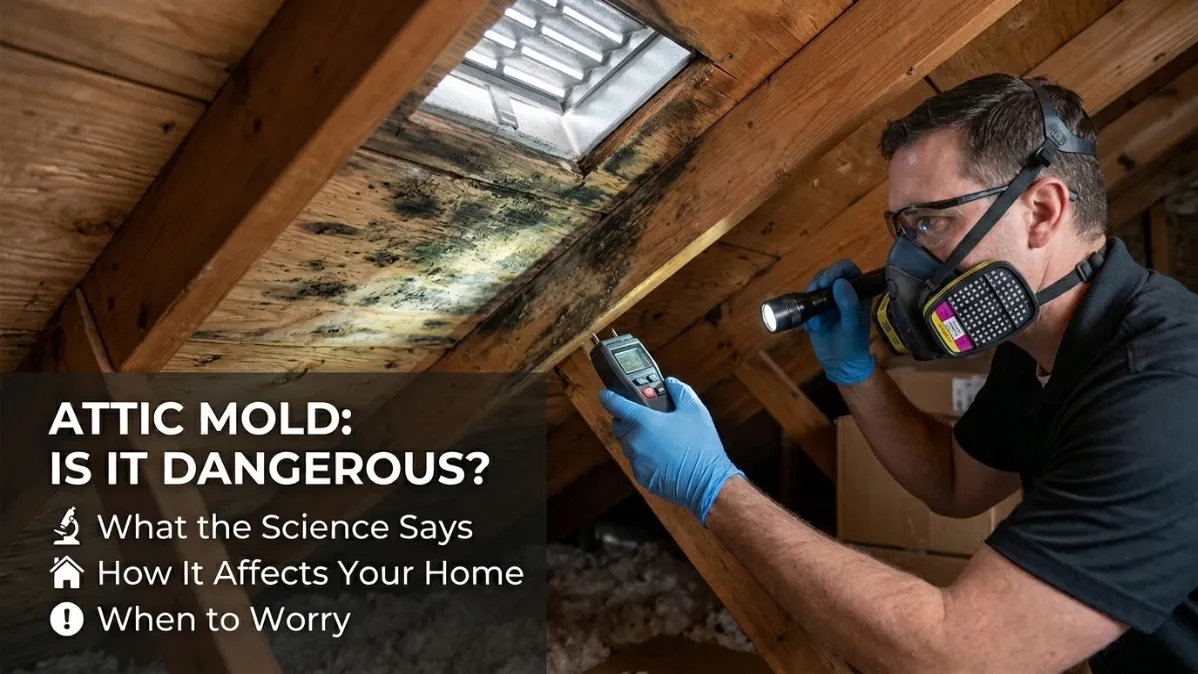
If you climbed into your attic and found dark staining or fuzzy growth on the underside of the roof sheathing, your first question was probably whether attic mold is dangerous to your family. It is a fair question, and most of what is written online answers it with either panic or a sales pitch. This article does neither. We will walk through exactly what the science says about mold and health, why attic mold is a different situation than mold in your living space, who is genuinely at risk, when it crosses into urgent territory, and the right way to handle it for good.
Get a Free Attic Inspection!
Quick Answer: Is Attic Mold Dangerous?
This should answer the main query immediately. Something like:
Attic mold can be dangerous for people with asthma, allergies, chronic lung disease, weakened immune systems, infants, and older adults. For healthy people, attic mold is usually more of a moisture, building, and resale issue than an immediate medical crisis. However, because attic air can move into living areas through the stack effect, attic mold should still be inspected, removed, and corrected at the moisture source.

Why Taking Attic Mold Seriously Protects Both Your Health and Your Home
Here is the framing that keeps homeowners from either overreacting or underreacting. Attic mold is rarely a five-alarm health crisis, but it is never just cosmetic either. Treating it early, before it spreads across the sheathing and before the moisture that feeds it rots your roof deck, protects you on several fronts at once.
- Protects Indoor Air: Sealing the attic and removing the mold stops spores from riding the stack effect down into the rooms you actually breathe in.
- Saves the Roof Deck: The same moisture that grows mold rots plywood sheathing and rafters. Acting early can mean a cleaning instead of a costly structural replacement.
- Protects Resale: Attic mold flagged on a home inspection can stall or sink a sale. Documented remediation is a clean bill of health for buyers.
- Fixes the Real Cause: Mold forces you to find the ventilation, insulation, or leak failure behind it, which protects the whole home, not just the attic.
What the Science Actually Says About Mold and Health
Let us start with the established facts rather than the internet myths. According to the EPA, molds produce allergens and irritants, and inhaling or touching mold can trigger allergic reactions in sensitive people, including sneezing, runny nose, red eyes, and skin rash. Mold can also set off asthma attacks in people who are allergic to it, and it can irritate the eyes, skin, nose, throat, and lungs of allergic and non-allergic people alike.
The CDC is equally measured: exposure to damp and moldy environments may cause a variety of health effects, or none at all. People with asthma or mold allergies may have stronger reactions, and immune-compromised people or those with chronic lung disease can develop more serious lung infections. A landmark Institute of Medicine review found sufficient evidence linking indoor mold exposure to upper respiratory symptoms, cough, and wheeze in otherwise healthy people, to worsened asthma in asthmatics, and to hypersensitivity pneumonitis in susceptible individuals.
What you will not find from credible health agencies is support for the scarier claims, that ordinary household mold causes memory loss, brain damage, or sudden severe illness in healthy adults. That distinction matters. The documented risks are real and worth acting on; the exaggerated ones are not. For more depth, see our guides on respiratory illness from mold, mold allergy symptoms, and how mold affects asthma.
The key point: Mold does not affect everyone equally. The same attic mold that one person walks past without a symptom can trigger a real reaction in a child with asthma or a relative with a compromised immune system. Risk is about who is exposed as much as what they are exposed to.
The Real Reason Attic Mold Reaches You: the Stack Effect
This is the part most homeowners miss, and it is the difference between “the mold is up there, so it cannot affect us” and the truth. Your house behaves like a chimney. Warm air rises and escapes through the upper levels and attic, and that rising air pulls replacement air, along with whatever it carries, upward from below. This is called the stack effect, and it runs continuously, strongest in the heating season.
The practical consequence is that air does not stay neatly trapped in the attic. Through gaps around recessed lights, attic hatches, plumbing and wiring penetrations, and the top plates of your walls, attic air mixes with the air in your living space far more than people assume. When that attic air carries mold spores, a portion of them ends up in the rooms below. Mold spores are light and travel easily, which is exactly why they spread through the air and why mold moves through a house the way it does.
So the reassuring idea that attic mold is sealed away from you is only partly true. A well-sealed attic limits the exchange; a leaky one lets it happen freely. For a family with no sensitivities and a tight attic, the day-to-day exposure may be minor. For a sensitive household with an air-leaky attic, it can be a meaningful and ongoing source of indoor spores.
Is It Attic Mold or Just Wood Staining?
Not every dark mark on attic sheathing is active mold, but any staining on roof decking deserves a closer look. Old water stains, dust, soot, tannins in the wood, and leftover discoloration from a past leak can all look similar to mold at first glance. The difference is that mold is usually tied to active or recent moisture, and it may appear fuzzy, powdery, spotty, or spread across the wood grain.
Wood staining often looks flat and dry, especially if the moisture problem was corrected years ago. Mold is more concerning when the area feels damp, smells musty, keeps spreading, or appears near roof leaks, bathroom fan exhaust, blocked vents, or cold condensation points. If the staining is widespread, dark, or paired with attic humidity, it should be inspected rather than dismissed as cosmetic.
This is especially important because cleaning the wrong problem does not solve anything. If it is only old staining, the attic may simply need documentation and moisture verification. If it is active attic mold, the source of the moisture must be corrected before the growth can be removed for good.
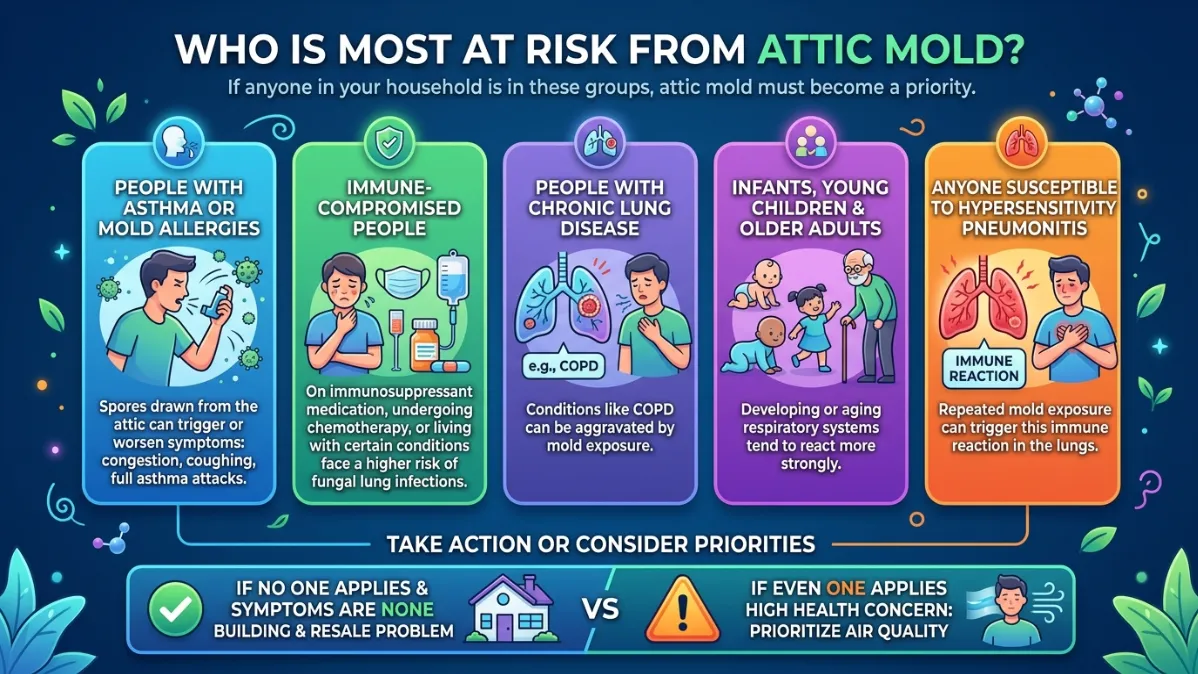
Who Is Most at Risk From Attic Mold
If anyone in your home falls into these groups, attic mold deserves to move up your priority list. The health agencies are consistent on who is more vulnerable.
- People with asthma or mold allergies. Spores drawn down from the attic can trigger or worsen symptoms, from congestion and coughing to full asthma attacks.
- Immune-compromised people. Those on immunosuppressant medication, undergoing chemotherapy, or living with certain conditions face a higher risk of fungal lung infections.
- People with chronic lung disease. Conditions like COPD can be aggravated by mold exposure, which is covered in our guide on mold and COPD.
- Infants, young children, and older adults. Developing or aging respiratory systems tend to react more strongly.
- Anyone susceptible to hypersensitivity pneumonitis, an immune reaction in the lungs that repeated mold exposure can trigger. See hypersensitivity pneumonitis and mold.
If your household includes none of these and your symptoms are nonexistent, attic mold is more of a building and resale problem than a health one. If it includes even one, treat the air-quality angle as real.
Not sure how bad your attic mold really is?
When Attic Mold Crosses Into Urgent Territory
Most attic mold can be planned around rather than rushed, but some situations warrant fast action. Treat it as urgent when you see any of the following.
- Widespread black growth across the sheathing, rather than a few isolated patches, which usually signals a long-running moisture problem.
- Visibly wet, soft, or delaminating roof decking, because at that point the moisture is destroying structure, not just feeding mold.
- A musty smell reaching the living space, which tells you the stack effect is actively moving attic air down to you.
- Household members developing unexplained respiratory or allergy symptoms that ease when they leave the house.
- Active water intrusion, a roof leak or a bathroom fan dumping warm wet air into the attic, which will keep regrowing mold no matter how many times you clean it.
Wondering whether what you are looking at is even mold or just wood discoloration, or how aggressive the species might be, is normal. If you are unsure of what you are looking at still after reading this blog and you live in Long Island, Queens, Brooklyn, or The Bronx, reach out to us for a free inspection and let’s find out together!
| Situation | Risk Level | What It Means |
|---|---|---|
| Small isolated stain on sheathing | Low to moderate | May be early growth or old staining |
| Widespread black growth | High | Long-term moisture problem likely |
| Musty smell in living space | High | Attic air may be entering the home |
| Wet or soft roof decking | Urgent | Structural damage may be starting |
| Symptoms in sensitive household members | Urgent | Indoor air exposure may be affecting health |
| Bathroom fan venting into attic | High | Mold will likely return unless corrected |
Beyond Health: the Damage Attic Mold Does to Your Home
Even when the health risk is modest, attic mold is rarely harmless to the building, because the mold and the structural threat share the same cause: trapped moisture. Mold grows on your roof sheathing because that wood is staying damp, and wood that stays damp eventually rots. Left alone, you move from a cleanable surface problem to soft, weakened decking and rafters that need replacement, which is dramatically more expensive.
There is also the financial reality at sale time. Attic mold is one of the first things a home inspector checks, and a moldy attic on an inspection report scares buyers and invites price reductions or failed deals. Documented professional remediation, by contrast, turns a liability into a non-issue.
How Much Does Attic Mold Removal Cost?
The cost of attic mold removal depends on how much of the attic is affected, how accessible the space is, and whether the mold is only on the surface or tied to deeper moisture damage. A small, isolated area on dry sheathing is usually far less expensive to treat than widespread growth across roof decking, rafters, insulation, and framing.
The final price can also change if the attic needs ventilation corrections, bathroom fan rerouting, insulation replacement, roof leak repair, air sealing, or structural wood repair. That is why two homes with the same amount of visible mold can have very different remediation costs. One may need cleaning and minor ventilation improvements, while another may need mold removal, wet insulation removal, roof repairs, and moisture control upgrades.
The best way to keep attic mold removal costs down is to act early. Once roof decking becomes soft, delaminated, or rotted, the project moves beyond mold remediation and into structural repair. Early inspection helps confirm whether you are dealing with a manageable surface problem or a moisture issue that is already damaging the roof system. If you are weighing the numbers, our attic mold removal cost guide lays out what to expect, and financing is available for larger jobs.
The Best Way to Handle Attic Mold and Make Sure It Stays Gone
The single most important thing to understand is that you cannot solve attic mold by cleaning alone. Both the EPA and the CDC make the same point about all indoor mold: if you remove the mold but do not fix the moisture, the mold comes back. Attic mold is moisture made visible, so lasting removal is always a two-part job.
Part one is the moisture cause. In our region, attic mold almost always traces to one of a few failures: blocked or missing attic ventilation, insufficient or compressed insulation that lets warm moist air condense on cold sheathing, bathroom or dryer exhaust fans venting into the attic instead of outside, or a roof leak. Identifying which one you have is the heart of the fix. Our breakdown of what causes mold in the attic covers each in detail, and correcting ventilation and insulation is what keeps the attic dry going forward.
Part two is safe, complete removal. Small, isolated growth on a hard surface can sometimes be cleaned by a careful homeowner, but widespread attic mold, porous materials, or any case involving a sensitive household is professional territory. Pros contain the area, use proper protection, treat the affected wood, and verify the job is finished, all of which our team handles through our attic mold remediation service for New York properties. Then they confirm the moisture fix so you are not repeating this next winter. For prevention going forward, see how to prevent attic mold.
What Not to Do If You Find Attic Mold
Finding attic mold can be stressful, but the wrong response can make the problem worse or allow it to come back. The goal is not just to make the wood look cleaner. The goal is to remove the mold safely, find the moisture source, and correct the attic condition that caused it.
Avoid these common mistakes:
- Spraying Bleach and Calling It Fixed: Bleach may lighten surface staining, but it does not solve the roof leak, condensation, poor ventilation, or bathroom fan issue that caused the mold. If the moisture source remains, the mold can return even after the attic looks cleaner.
- Painting Over the Mold: Paint can hide the growth, but it does not remove it. Covering mold on roof sheathing or rafters can trap moisture and make it harder to see whether the problem is spreading.
- Covering Moldy Areas With Insulation: Adding insulation over moldy sheathing or framing can trap moisture against the wood. Wet or contaminated insulation may also need to be removed before the attic can be properly treated.
- Disturbing Large Areas Without Protection: Scrubbing, sanding, or tearing out moldy materials without containment can release spores into the air and spread contamination beyond the original area.
- Ignoring the Stack Effect: Attic mold is not always isolated from your living space. Air leaks can allow attic air, odors, and spores to move into the rooms below, especially through recessed lights, attic hatches, wall cavities, and ceiling penetrations.
- Waiting Because the Mold Is Not in a Living Area: Attic mold can still affect indoor air and damage roof sheathing, rafters, and insulation over time. The longer the moisture remains active, the more expensive the repair can become.
- Skipping the Moisture Fix: Mold removal without moisture correction is temporary. The right response is to inspect the source, remove the growth safely, and fix the ventilation, insulation, leak, or exhaust problem that allowed the mold to grow.
Bottom line: The best option for almost every homeowner is a single professional visit that diagnoses the moisture cause, removes the attic mold safely, and corrects the ventilation or insulation failure behind it. Cleaning without the cause fix is the most common reason attic mold comes back.
Is Attic Mold: Dangerous? Final Thoughts
We hope this answered your question, “Is attic mold dangerous?” Remember, for most healthy households in a reasonably sealed home, attic mold is a slow-burning building and resale issue more than an acute health threat. But that still means it’s not something you want to leave on the back burner. For anyone with asthma, allergies, a weakened immune system, or young children, the stack effect makes it a genuine indoor-air concern that deserves prompt attention. Either way, the mold is telling you the same thing: moisture is collecting in your attic, your roof structure is at risk, and the ventilation or insulation that should keep the space dry has failed. Clean it without fixing that, and attic mold will be back by next winter. Fix the cause and remove it properly, and it stays gone for good.
If you have found attic mold, get a clear, no-pressure read on how serious it is. We will inspect it free and tell you exactly what we find.
Request Your Free Attic Inspection
Frequently Asked Questions About Attic Mold
Can Attic Mold Make You Sick?
Attic mold can affect your health, especially if you have asthma, mold allergies, chronic lung disease, or a weakened immune system. Spores from the attic can enter living areas through air leaks, attic hatches, recessed lights, wall cavities, and the stack effect. Healthy people in a well-sealed home may notice fewer symptoms, but the mold still points to a moisture problem that should be corrected.
Is Attic Mold Dangerous?
Attic mold is not always an immediate health crisis, but it should never be ignored. The bigger risk is that the same moisture feeding the mold can damage roof sheathing, rafters, insulation, and indoor air quality over time. If the growth is widespread, dark, musty, or tied to active moisture, it needs prompt attention.
Is Attic Mold an Emergency?
Attic mold is usually urgent rather than an emergency. Small isolated patches can often be scheduled for inspection and remediation, but wet roof decking, soft plywood, active roof leaks, heavy black growth, or musty odors reaching living areas should be handled quickly. The longer moisture sits, the more likely the problem becomes structural.
Will Attic Mold Spread to the Rest of My House?
Attic mold spores can spread through air movement. Warm air rises through the house and escapes into the attic, while pressure changes can pull contaminated attic air back down through gaps around lights, vents, framing, and attic access points. Air sealing, ventilation correction, and mold removal help stop that movement.
What Causes Mold in the Attic?
Attic mold is usually caused by trapped moisture. Common sources include poor attic ventilation, blocked soffit vents, bathroom fans venting into the attic, dryer vents leaking warm air, roof leaks, missing insulation, and condensation on cold roof sheathing. Mold is the symptom, but moisture control is the real fix.
Can I Remove Attic Mold Myself?
Small surface mold on a hard, nonporous area may be cleaned carefully, but DIY cleaning often misses the cause. If the mold covers roof sheathing, insulation, rafters, or large attic areas, professional remediation is safer and more reliable. Cleaning without fixing ventilation, insulation, air leaks, or roof leaks allows the mold to return.
What Does Black Mold in the Attic Mean?
Black mold in the attic usually means moisture has been present long enough for visible growth to develop on wood, sheathing, or insulation. The color alone does not confirm the mold species, but dark staining should still be inspected. The key question is not just what type of mold it is, but why the attic is staying damp.
Does Attic Mold Lower Home Value?
Attic mold can lower home value because it often appears during a home inspection. Buyers may ask for remediation, request a price reduction, delay closing, or walk away if the cause is unclear. Documented mold removal and moisture correction can protect resale value and make the home easier to sell.
Does Homeowners Insurance Cover Attic Mold?
Homeowners insurance may cover attic mold if it comes from a sudden covered event, such as storm damage or an accidental leak. It usually does not cover mold caused by long-term humidity, poor ventilation, neglected maintenance, or gradual roof leaks. The best step is to document the damage, identify the moisture source, and review your policy before filing a claim.
How Do You Prevent Attic Mold From Coming Back?
To prevent attic mold from returning, you need to fix the moisture source. That may include improving soffit and ridge ventilation, air sealing ceiling penetrations, adding proper insulation, venting bathroom fans outdoors, repairing roof leaks, and removing wet insulation. Mold remediation works best when removal and moisture correction are handled together.