
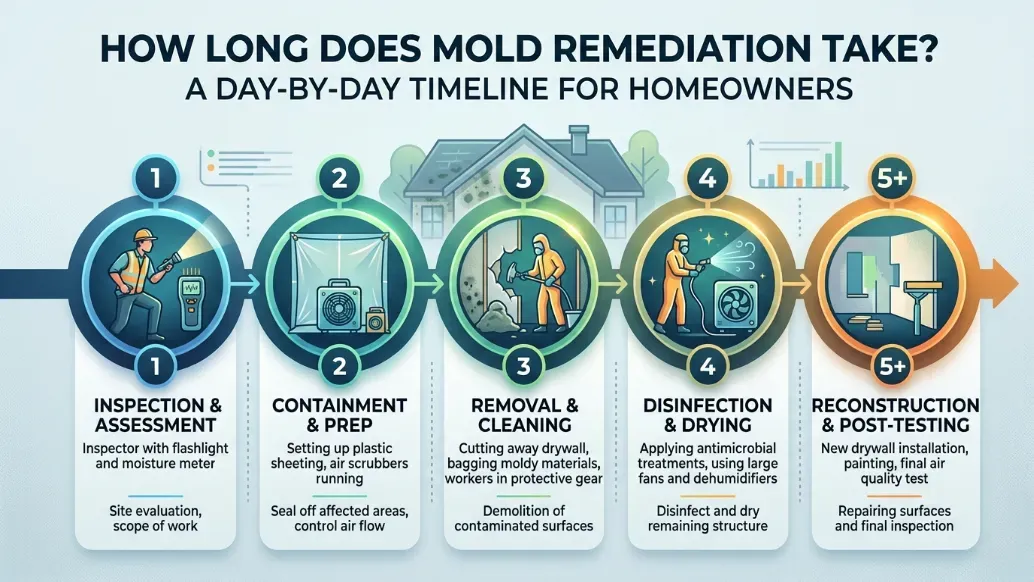
Short answer: How long does mold remediation take? For most homes, active remediation takes two to five days. A small contained area can finish in one day. A whole basement, a contaminated crawl space, or an HVAC system carrying spores through the house can run seven to fourteen days. Reconstruction is separate and often takes longer than the remediation itself.
That last sentence is the part homeowners are never warned about, and it is the reason so many people feel misled halfway through a project. There are two clocks running on your house. The first clock is remediation: containment, removal, cleaning, drying, and clearance testing. The second clock is putting your home back together. Every contractor quotes you the first one. Very few explain the second one until the drywall is already in a dumpster.
This guide on how long mold remediation takes covers both. You will get real day ranges by job type, a day by day account of what physically happens in your home, a straight answer on whether you have to move out, the nine things that stretch a timeline, and the New York licensing rule that adds days to every project over ten square feet in this state.
How Long Does Mold Remediation Take, and Why the Answer Protects Your Budget
Time and money are the same variable in this trade. Every extra day is labor, equipment rental, containment materials, and in many cases hotel nights. When you ask how long does mold remediation take, you are really asking what this is going to cost you in dollars, disruption, and lost sleep. Here is the master timeline.
| Job type | Active remediation | Move out needed? | Total including rebuild |
|---|---|---|---|
| Bathroom or closet patch under 10 sq ft | 1 day | No | 1 to 3 days |
| Single room, 10 to 100 sq ft | 2 to 3 days | Usually no | 4 to 10 days |
| Finished basement, partial | 3 to 5 days | Sometimes | 2 to 4 weeks |
| Full basement gut and remediate | 5 to 8 days | Often yes | 4 to 8 weeks |
| Crawl space with encapsulation | 3 to 6 days | No | 1 to 2 weeks |
| Attic remediation | 2 to 4 days | No | 1 to 3 weeks |
| HVAC contaminated whole home | 7 to 14 days | Yes | 4 to 10 weeks |
| Post flood, multiple levels | 10 to 21 days | Yes | 2 to 6 months |
What Actually Happens on Each Day
Understanding how long does mold remediation take gets much easier when you know what a crew is physically doing with those hours. Here is a standard three to five day residential project.
Day one: inspection, moisture mapping, and containment
A technician walks the space with a moisture meter and, on larger jobs, a thermal camera. They are not looking for mold. They are looking for water, because water is the reason the mold exists. This is the same discipline covered in our moisture mapping guide. Then containment goes up: six mil poly sheeting, zippered entry, and a negative air machine that pulls the work area to lower pressure than the rest of the house so spores cannot migrate. You will hear a constant fan hum from this point until the last day.
Day two: removal and demolition
Porous materials that grew mold do not get cleaned. They get cut out. Drywall, carpet pad, insulation, and compromised subfloor go into sealed bags and out through the containment. Semi porous framing gets HEPA vacuumed, wire brushed or sanded, and treated. This is the loudest, dustiest, most alarming looking day of the project, and it is the day most homeowners take a photo and panic.
Day three: cleaning, treatment, and air scrubbing
Every surface inside containment gets HEPA vacuumed and wiped. Antimicrobial goes on framing. Air scrubbers run continuously, cycling the air in the containment several times per hour. If your job is small, day two and day three often collapse into one.
Day four: structural drying
Dehumidifiers and air movers run until the wood and masonry reach a documented dry standard. Not “looks dry.” A number on a meter, compared to an unaffected reference area in the same building.
Day five: clearance testing and demobilization
An independent assessor samples the air and surfaces and compares indoor spore counts against a same day outdoor control. If it passes, containment comes down. If it fails, the crew re cleans and retests, which adds one to three days.
Want your actual number instead of a range?
An inspection produces a written scope, a day count, an occupancy plan, and a fixed protocol before anyone touches your house.
Do You Have to Move Out During Mold Remediation?
Usually no. Sometimes absolutely yes. Here is how to tell which one you are.
- Single contained room, no HVAC involvement: stay. Containment and negative pressure isolate the work. Avoid the room, keep pets away from the barrier.
- Basement or crawl space only: stay. These spaces are already below the living area and are easy to isolate. Note that if your furnace or air handler sits in that space, the answer can flip.
- Work on the same floor as bedrooms: plan to relocate sleeping arrangements even if you stay in the house.
- HVAC system contaminated: leave. The system is shut down, which means no heat or air conditioning, and duct cleaning circulates disturbed material. See mold in air ducts for what that scope involves.
- Anyone in the household is pregnant, immunocompromised, or has moderate to severe asthma or COPD: leave for the demolition and cleaning days regardless of containment quality. Our guides on mold during pregnancy and mold and asthma explain why this is not an overreaction.
If your policy covers the loss, additional living expenses often cover hotel and meals during forced relocation. Read what homeowners insurance covers on mold before you book anything, and keep every receipt.
The Second Clock: Remediation Ends, Your House Is Not Finished
Remediation is a health and safety operation. It ends when the contamination is gone and the space passes clearance. At that moment your basement is studs, concrete, and daylight through a hole where the bathroom used to be.
Reconstruction is a separate contract, usually a separate crew, sometimes a separate company, and it runs on its own calendar. Drywall, tape, prime, paint, flooring, trim, cabinetry, and fixtures. Add permit time on structural work. Add material lead times. This is why a five day remediation becomes a six week project.
Ask two questions before signing anything: does this quote include reconstruction, and if not, who is doing it and when do they start. Getting that in writing on day zero eliminates the most common dispute in this industry.
Ten Things That Make Mold Remediation Take Longer
Hidden Mold Behind Walls
Once a cavity opens and the growth is larger than the surface suggested, the scope expands. Add one to four days.
Wet Insulation
Saturated batt insulation is a removal item, not a drying item. See when to replace versus remediate wet insulation. Add one to two days.
HVAC Contamination
This can turn a single-room project into a whole-house job. Add three to seven days.
Structural Rot
Rotted joists, sills, or columns mean a structural contractor must enter the schedule. Add one to three weeks.
An Active Water Source
Nothing dries while water is still coming in. Drainage repairs or waterproofing must happen first. Add days to weeks.
Occupied Home Restrictions
Working around a family, pets, and a home office can cost the crew hours each day. Add roughly 20% to the timeline.
Access Constraints
A Brooklyn row house without a driveway, a walk-up without an elevator, or a co-op with restricted service-entrance hours can slow the work. Add about one day.
Insurance Approval
The adjuster’s clock often runs before the remediation crew’s clock can begin. Add three days to three weeks, depending on the carrier.
A Failed Clearance Test
The affected area must be cleaned again and retested. Add one to three days.
The Bleach Trap
Bleach can discolor porous material without eliminating mold rooted beneath the surface. DIY bleach treatments frequently fail, allowing the problem to return months later. The fastest project is the one completed correctly the first time.
Why the Drying Phase Cannot Be Rushed
This is where inexperienced crews cheat, and it is the number one reason for repeat contamination. Framing lumber, sheathing, and masonry hold moisture deep inside. A surface can feel dry while the core sits well above the dry standard. Put drywall over that and you have built a sealed incubator.
Proper drying is verified with a penetrating moisture meter against a reference reading from an unaffected area of the same structure. It takes as long as it takes, typically one to three days with the right equipment sizing. The EPA remediation guidance on water damaged materials sets the widely used twenty four to forty eight hour response window for wet materials and specifies which materials can be dried versus which must be discarded.
A contractor who offers to skip drying to save you two days is offering to sell you the same job again next year. Our page on whether mold remediation actually works covers what separates a permanent result from a temporary one.
How New York Licensing Law Changes the Timeline
This is the part no national restoration blog will tell you, because it does not apply where they operate. New York State Labor Law Article 32 requires that on any mold project larger than ten square feet, the person who assesses the mold and the person who remediates it must be separate licensed entities. One company cannot legally diagnose the problem and then sell you the cure.
Practically, that means a licensed mold assessor inspects, tests, and writes a remediation plan. A licensed mold remediation contractor executes that written plan. Then an independent clearance assessment confirms the work. You can verify licensing through the New York State Department of Labor mold program.
That handoff adds real time, often two to five business days on the front end. It is also the strongest consumer protection in this trade. It structurally prevents a contractor from inventing a problem he then bills you to fix. If someone offers to inspect and remediate your New York home under one contract on a job over ten square feet, that is a licensing violation and a reason to keep shopping. Our guide on choosing a mold remediation company covers what else to verify.
When Is It Safe to Go Back In?
Safety is determined by clearance testing, not by a stopwatch. Once the project passes clearance and containment is removed, the following waiting periods provide practical guidance.
| Household Member | Wait After Clearance Passes | Extra Precaution |
|---|---|---|
| Healthy Adults | Immediately | None |
| Children and Infants | 24 hours | Run normal ventilation first |
| Pregnant Residents | 24 to 48 hours | Stay out entirely on demolition days |
| Asthma or COPD | 48 hours | Use HEPA filtration in adjacent rooms for one week |
| Immunocompromised Residents | 48 to 72 hours | Confirm with a physician, not a contractor |
If your project did not include independent clearance testing, you do not actually know it is finished. Ask for the report.
How Long Does Mold Remediation Take With a Licensed New York Contractor?
Faster, and the reason is preparation rather than shortcuts. A licensed crew working from a written assessment plan knows the scope before the truck is loaded. Containment materials, equipment sizing, disposal, and manpower are staged in advance. There is no mid project stop while someone drives back for another negative air machine.
The projects that run long are almost always the ones that started without a real inspection. Somebody guessed, opened a wall, found four times the growth they expected, and the schedule collapsed. When we quote a day count, it comes from a moisture map and a documented scope, which is why the number holds. If cost is the barrier to starting, our financing options for Long Island, Brooklyn, Queens, and the Bronx exist for exactly that reason.
How to Get an Accurate Timeline for Your Home
A range on a website is not a schedule. Here is what a real inspection hands you before any work begins:
- A moisture map showing where water is entering and how far it has traveled
- Square footage of affected material by room and by material type
- A written remediation protocol with a day by day sequence
- An occupancy plan telling you which nights you sleep somewhere else
- A clear line between remediation cost and reconstruction cost
- The moisture correction required so it does not come back, which often means waterproofing that prevents recurrence
If you want the numbers side first, our complete mold removal pricing guide and step by step remediation process pair directly with this timeline.
Stop guessing at your schedule
We inspect, map the moisture, and give you a written day count and occupancy plan before anything gets torn out.
How Long Does Mold Remediation Take: Final Thoughts
How long does mold remediation take? Two to five days of active work for most homes, one day for a small contained patch, and seven to fourteen days when a crawl space, a full basement, or an HVAC system is involved. Then the second clock starts, and reconstruction routinely runs longer than the remediation that preceded it. In New York, licensing law adds a few days on the front end and gives you a legally independent set of eyes in exchange.
The projects that finish on schedule are the ones that started with a real inspection instead of a guess. Get the moisture mapped, get the scope written, get the occupancy plan in your hand, and the calendar stops being a mystery. If you are in Long Island, Brooklyn, Queens, or the Bronx and you want that written timeline, we will come look at it.
How Long Does Mold Remediation Take: Final Thoughts
How long does mold remediation take? Two to five days of active work for most homes, one day for a small contained patch, and seven to fourteen days when a crawl space, a full basement, or an HVAC system is involved. Then the second clock starts, and reconstruction routinely runs longer than the remediation that preceded it. In New York, licensing law adds a few days on the front end and gives you a legally independent set of eyes in exchange.
The projects that finish on schedule are the ones that started with a real inspection instead of a guess. Get the moisture mapped, get the scope written, get the occupancy plan in your hand, and the calendar stops being a mystery. If you are in Long Island, Brooklyn, Queens, or the Bronx and you want that written timeline, we will come look at it.
Frequently Asked Questions About How Long Does Mold Remediation Take
How long does mold remediation take for a small bathroom?
A contained patch under ten square feet is typically a single day, including containment setup, removal, cleaning, and breakdown. Add a day if the drywall behind the tile is saturated and needs drying before it is closed up.
Do I have to leave my house during mold remediation?
For most single room projects, no. Containment and negative air pressure isolate the work area. You should relocate if the HVAC system is involved, if the work is on the same floor as bedrooms, or if anyone in the home is pregnant, immunocompromised, or has moderate to severe respiratory disease.
How long after mold remediation is it safe to be in the house?
Once the project passes independent clearance testing and containment is removed, healthy adults can return immediately. Allow twenty four hours for children, twenty four to forty eight hours during pregnancy, and forty eight to seventy two hours for immunocompromised residents.
Why is my mold remediation taking so long?
The most common reasons are hidden growth discovered after a wall was opened, saturated materials that will not reach dry standard, an unrepaired water source still feeding the space, a pending insurance approval, or a failed clearance test requiring a re clean.
How long before mold grows back after remediation?
If the moisture source was corrected, it should not return. If it was not corrected, visible growth can reappear within weeks. Homeowners who ask how long does mold remediation take rarely ask how long the result lasts, and that second answer depends entirely on whether the water was fixed. Mold needs sustained moisture, so recurrence is always a water problem rather than a cleaning problem.
Does mold remediation include putting my walls back?
Usually not. Remediation removes contamination and returns the space to a clean, dry, structurally sound shell. Reconstruction is normally a separate scope and separate cost. Confirm in writing which one your quote covers before signing.
Can mold remediation be done in one day?
Yes, for small contained areas with no hidden growth and no saturated structural material. Any project requiring structural drying will run at least two to three days, because drying to a verified standard cannot be compressed.
How long does insurance take to approve a mold claim?
Adjuster response typically runs three days to three weeks depending on carrier and season. Emergency mitigation to stop ongoing water damage should not wait for approval, since most policies require you to prevent further loss. Document everything with photos before anything is removed.
What is clearance testing and how long does it add?
Clearance testing is an independent post remediation assessment comparing indoor air and surface samples against a same day outdoor control. Sampling takes about an hour, lab results take one to three business days. A failed clearance adds one to three days of re cleaning and retesting.
Does crawl space mold remediation take longer than basement work?
Crawl spaces are usually faster for the remediation itself, three to six days, because they are smaller and unfinished. They frequently extend, however, when encapsulation, vapor barrier installation, or dehumidification is added to prevent recurrence.