
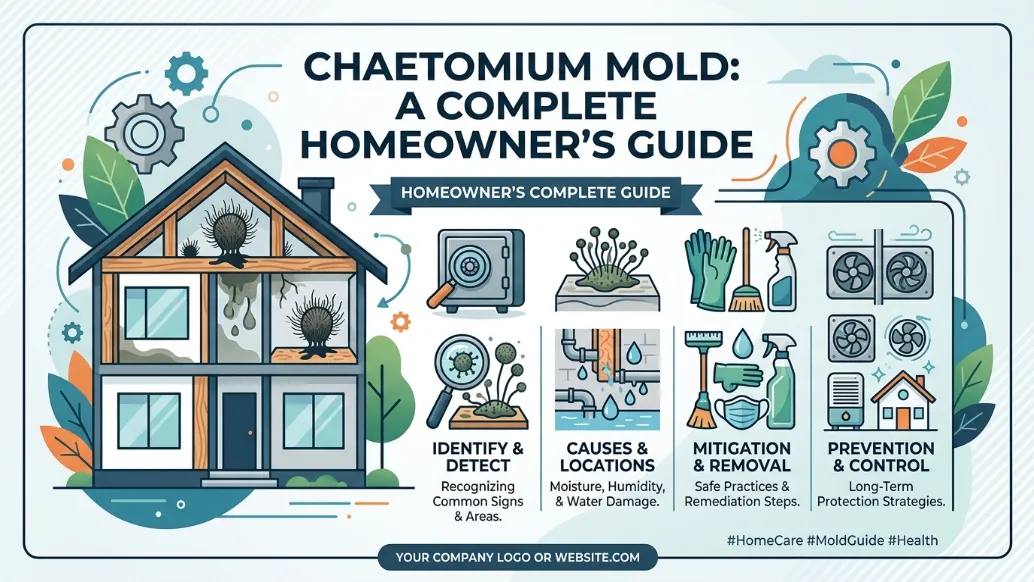
If a mold inspection report came back with the word Chaetomium on it, you’ve probably spent the last hour searching for what that actually means. Here’s the short version, and it’s worth understanding clearly. Chaetomium is not a “surface mold.” It’s a water-damage indicator species. Its presence tells a trained eye that your home has had prolonged, ongoing moisture, not a one-time spill that dried out on its own.
That distinction changes everything about how you should respond.
This guide explains what Chaetomium is, how to recognize it, why building scientists treat it as a warning flag, the health concerns associated with it, and most importantly, what its presence usually means about the actual condition of your house. Because with Chaetomium, the mold itself is rarely the real problem. The real problem is the water that has been feeding it, often for months.
Quick Answer (For Readers in a Hurry)
- What it is: A fast-growing mold (genus Chaetomium) that needs sustained, high moisture to grow.
- What it indicates: Chronic water intrusion or long-term dampness. Think leaks, flooding, foundation seepage, or crawl space moisture that was never properly resolved.
- Where it’s found: Drywall, wallpaper, baseboards, subfloor, carpet backing, ceiling tiles, crawl space wood, and other cellulose-rich materials that have stayed wet.
- Why it matters: Finding Chaetomium means you almost certainly have an active or recent moisture source that needs to be located and fixed, not just cleaned.
- What to do: Treat it as a diagnostic signal. The mold can be remediated. But if the underlying water problem isn’t corrected, it will come back.
Free Advanced Mold inspections for Long Island, Brooklyn, Queens, and The Bronx, Residents!
What Is Chaetomium Mold?
Chaetomium is a genus of mold containing dozens of species, and Chaetomium globosum is the one most commonly identified in water-damaged homes. It’s one of the most widely distributed molds in the world. In nature it lives in soil, decaying plant matter, and compost, where it works as a champion cellulose decomposer. Outdoors, that’s useful. It helps break down dead organic material.
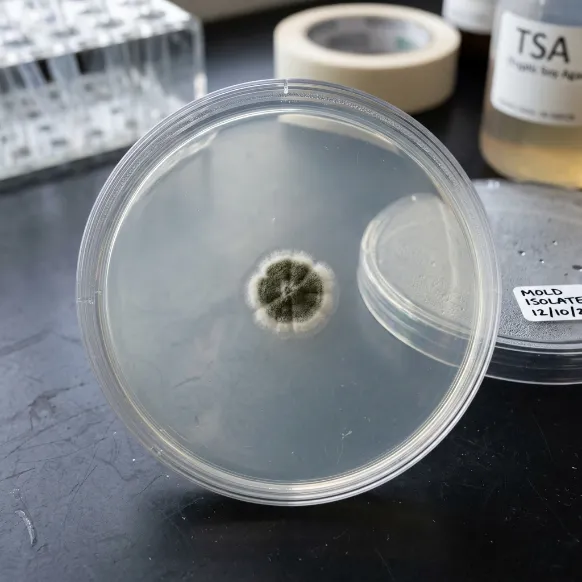
Inside a house, that same trait becomes the problem. The cellulose Chaetomium “eats” in your home is the paper facing on drywall, the wood in your subfloor and joists, wallpaper, cardboard, and natural-fiber materials. It is, in effect, a microscopic decomposer that has mistaken your building materials for a forest floor.
Here’s the single most important fact in this entire guide:
Chaetomium does not grow on materials that get briefly damp. It needs materials that have stayed genuinely wet for an extended period. That’s exactly why inspectors and remediation professionals classify it as a water-damage indicator species, in the same category as molds like Stachybotrys.
To understand why mold appears at all when moisture is present, it helps to know how mold grows and thrives in moisture-rich environments. Chaetomium simply sits at the demanding end of that moisture spectrum.
Is Chaetomium Mold Dangerous? Health Considerations
Homeowners are understandably anxious about health, so let’s be clear and measured here.
Chaetomium is not classified as harmless. But it’s just as important not to slide into panic. Health responses to any mold vary significantly from person to person, and they depend on how much exposure there’s been, how long it lasted, and individual sensitivity.
Reported and studied health concerns associated with Chaetomium exposure include:
- Allergic and respiratory reactions, such as nasal congestion, sneezing, coughing, and eye or throat irritation. These overlap with general mold allergy symptoms.
- Aggravation of asthma in people who already have it. See can mold affect asthma.
- Greater concern for sensitive groups, including infants, older adults, people with compromised immune systems, and those with existing respiratory conditions.
- Mycotoxin potential. Certain Chaetomium species are known to be capable of producing mycotoxins under some conditions. That doesn’t mean every Chaetomium colony is producing toxins at harmful levels, but it’s part of why the genus is taken seriously. Our overview of mycotoxins and indoor mold puts this in context.
Here’s an important and honest caveat. This article is not medical advice, and a contractor cannot diagnose a health condition. If anyone in your household has unexplained respiratory symptoms, fatigue, or irritation that improves when they leave the house, that’s a conversation for a physician. What a remediation professional can do is identify and remove the mold and, critically, fix the moisture source so the exposure doesn’t continue.
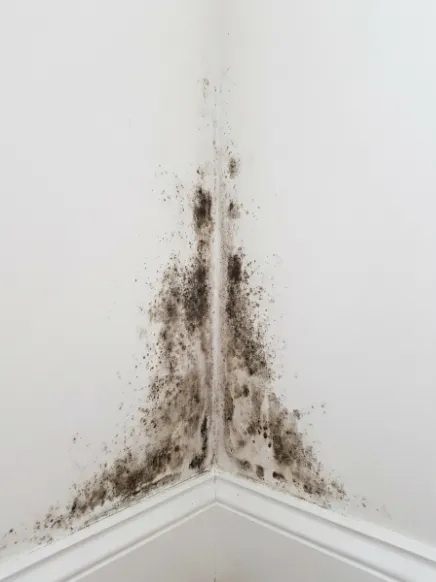
How to Identify Chaetomium (Visual Identification)
Let’s set expectations honestly. Homeowners cannot definitively identify a mold species by sight. Only laboratory analysis of a sample (tape lift, swab, or air sample under a microscope) can confirm Chaetomium. This section is for recognition, not diagnosis. If what you see matches the description below, the right next step is testing, not assumption.
That said, Chaetomium does have a recognizable visual and physical signature.
Color and texture progression
Chaetomium changes appearance as a colony matures, which is a big part of why it gets misidentified so often:
- Early Growth: Starts as a white or grayish, cottony or fuzzy patch. At this stage homeowners frequently mistake it for harmless dust, lint, or “just a bit of mildew.”
- Maturing Growth: Darkens to gray, olive-green, or brown.
- Mature Growth: Turns dark, often charcoal gray to black, and the surface develops a slightly fuzzy-to-woolly texture. At this stage it can look superficially similar to other dark molds, which is one more reason testing matters.
One characteristic worth knowing: as Chaetomium ages, colonies can take on a cotton-like aerial texture with darker centers, and up close they sometimes look powdery or granular because of their fruiting structures.
The “musty earthy” smell
Chaetomium is associated with a distinctive musty, earthy odor, often described as “old” or like “damp soil.” Many homeowners report smelling the problem before they ever see it, particularly in basements, behind walls, or in closets set against exterior walls. If you’re chasing a smell, our guide on how to get rid of mold smell explains why odor so often signals hidden growth, and why masking it never actually works.
Where it tends to hide
Because Chaetomium needs sustained moisture and loves cellulose, it concentrates in fairly predictable places:
- Behind and inside drywall, especially the back of the paper facing, where it can grow extensively before showing on the visible surface.
- Under flooring and in subfloor, including carpet backing, padding, and the wood underneath.
- Baseboards and window trim, wherever condensation or seepage tends to collect low.
- Basement walls and ceilings, particularly below grade.
- Crawl space wood, including joists, subfloor, and beams in damp crawl spaces.
- Around plumbing, under sinks, behind toilets, and near water heaters.
- Ceiling tiles and the area around roof leaks.
A critical visual warning
The most dangerous trait of Chaetomium is that the visible patch is often the smallest part of the problem. Because it grows on the hidden side of materials first, like the back of drywall or the underside of subfloor, what you see on the room-facing surface may be only a fraction of the actual colony. This is a recurring theme in what every homeowner should look for during a mold inspection. The surface tells you very little about the true scope.
Why Chaetomium Is Treated as a Water-Damage Indicator
This is the section that matters most for your home, so it’s worth slowing down here.
Mold inspectors and remediation professionals group indoor molds, informally, by how much moisture they need to grow. Some molds, like many Cladosporium and Penicillium species, can establish themselves with relatively modest, even intermittent dampness or elevated humidity. They’re common, and they tell you comparatively little about how severe a moisture problem really is.
Chaetomium sits at the opposite, demanding end of that spectrum. It needs water activity high enough that the material is, functionally, wet. And it needs that condition to persist. A surface that gets damp and dries within a day or two will not support a Chaetomium colony. A wall cavity that’s been fed by a slow foundation leak for three months absolutely will.
So when a lab report shows Chaetomium, an experienced inspector doesn’t think “this is a cleaning problem.” They think:
“Where is the water coming from, and how long has it been there?”
In that sense, Chaetomium is a biological timestamp. Its presence is evidence of a moisture event that was significant in volume, in duration, or in both. Frequently it’s both. Common underlying sources include:
- Foundation and basement seepage, where water has been moving through walls or the floor over time. If this sounds like your situation, what causes moisture problems in basements is essential reading.
- Chronic crawl space moisture, including damp earth, missing or failed vapor barriers, and standing water feeding the framing above. See crawl space moisture control.
- Slow, long-running plumbing leaks, the kind that stay hidden inside a wall or under a floor for months.
- Roof leaks that have saturated ceiling and attic materials over multiple rain events.
- Past flooding that was cleaned superficially, where hidden materials never fully dried. Our flood damage cleanup process explains how easily this happens.
- Hydrostatic pressure forcing groundwater through foundation joints and cracks, explained in hydrostatic pressure 101.
The takeaway is simple. Chaetomium is rarely the disease. It’s the symptom. Treating the visible mold without finding and correcting the water source is like taking a fever reducer and declaring the infection cured.
Chaetomium and Structural Damage: The Risk Homeowners Underestimate
Health concerns get the headlines, but Chaetomium carries a second risk that, over time, is just as costly. It damages your house.
Remember what Chaetomium actually does in nature. It decomposes cellulose and wood. The conditions that let Chaetomium thrive are the same conditions that drive wood rot and structural decay. Where you find established Chaetomium on framing, subfloor, or joists, you’re very often looking at materials that are also losing structural integrity.
This is especially true in crawl spaces and basements, where the mold finding and the structural finding tend to show up together:
- Damp crawl space framing can develop wood rot with serious structural risks.
- Sustained moisture under a home is a leading cause of sagging upstairs floors, because the joists below have weakened.
- Moisture also ruins insulation. Saturated material loses its R-value and becomes its own mold reservoir, which is why wet insulation sometimes has to be replaced rather than remediated.
The point is this. A Chaetomium finding should prompt you to ask not only “is my air safe?” but also “is the wood in my house being quietly degraded?” Both questions trace back to the same answer. The moisture has to stop.
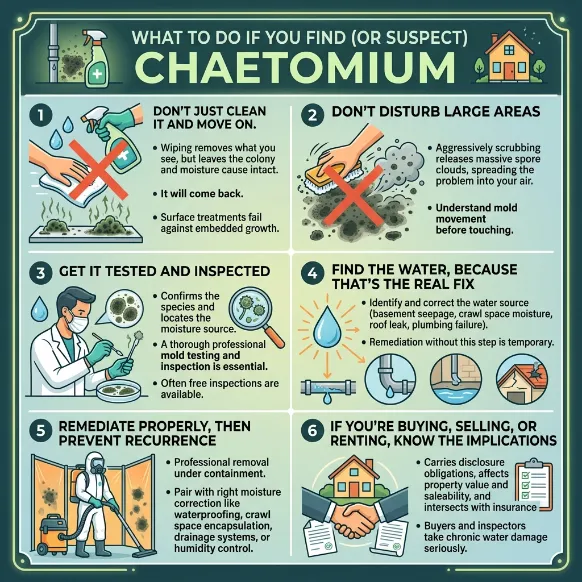
What to Do If You Find (or Suspect) Chaetomium
Here’s a clear, ordered response. Notice that “scrub the mold” is deliberately not step one.
1. Don’t just clean it and move on
Wiping Chaetomium off a surface with a household cleaner removes what you can see and leaves the colony, and the cause, fully intact. It will come back. What kills black mold “instantly” explains why surface treatments fail against moisture-driven, embedded growth.
2. Don’t disturb large areas
Aggressively scrubbing or tearing into a sizeable colony can release a large volume of spores into your air and spread the problem. Understanding how mold moves is worth two minutes before you touch anything substantial.
3. Get it tested and inspected
Because Chaetomium is a diagnostic mold, professional mold testing and a thorough mold inspection do two jobs at once. They confirm the species and locate the moisture source. In many cases homeowners can even arrange a free mold inspection to get professional eyes on the problem.
4. Find the water, because that’s the real fix
This is the heart of it. Whether the source is basement seepage, a crawl space moisture problem, hydrostatic pressure, a roof leak, or a hidden plumbing failure, the water source has to be identified and corrected. Remediation without this step is temporary.
5. Remediate properly, then prevent recurrence
Professional mold remediation removes affected materials and treats the area under containment. The lasting fix pairs that with the right moisture correction, whether that’s waterproofing solutions that prevent mold recurrence, proper crawl space encapsulation, drainage systems, or humidity control, depending on the source.
6. If you’re buying, selling, or renting, know the implications
A Chaetomium finding can carry disclosure obligations, affect your ability to sell, and intersect with insurance claims. Because it indicates chronic water damage, it’s a finding that buyers and inspectors take seriously.
How to Prevent Chaetomium From Ever Establishing
Chaetomium cannot grow without sustained moisture, which means moisture control is prevention. The same measures that protect your home from water protect it from this mold:
- Keep indoor humidity in the safe range. Aim for the levels described in our home humidity guide and best humidity to prevent mold.
- Control crawl space moisture with a proper vapor barrier and, where appropriate, encapsulation.
- Manage water around the foundation with functioning gutters, correct grading, and exterior drainage solutions. Worth noting: overflowing gutters can damage your home precisely by creating the chronic dampness Chaetomium needs.
- Address basement water proactively with interior French drains and sump pump systems where conditions call for them.
- Dry water events fast and completely. Most Chaetomium cases trace back to moisture that was never fully dried. Our definitive mold prevention guide ties these habits together.
Chaetomium Mold: Final Thoughts
Chaetomium is best understood not as a mold problem but as a message about your house. Its presence is reliable evidence that water has been somewhere it shouldn’t be, for longer than it should have been. The mold can be removed. Whether the problem is actually solved depends entirely on whether the moisture source is found and corrected.
If Chaetomium has shown up on a report, or you have the musty smell, the recurring dark patch, and the suspicion, the right next move is a proper inspection that confirms the species and traces the water. Fix the water, and you fix the mold. Skip that step, and you’ll be reading an article like this one again next year.
This guide is educational and does not constitute medical advice. Health concerns related to mold exposure should be discussed with a qualified physician.
Frequently Asked Questions About Chaetomium Mold:
Is Chaetomium as dangerous as black mold (Stachybotrys)?
Both are treated as water-damage indicator molds, and both warrant a serious response. Stachybotrys tends to get more public attention, but the correct posture toward Chaetomium is the same. Confirm it, remediate it properly, and above all, fix the moisture source. Our homeowner’s guide to Stachybotrys chartarum is a useful companion read.
Can I remove Chaetomium myself?
Small, very limited surface growth on a non-porous, easily cleaned material can sometimes be handled by a homeowner. But Chaetomium’s defining trait, large hidden colonies sitting behind a small visible patch, means DIY frequently misses most of the problem. And cleaning never addresses the water source. For anything beyond a minor spot, testing and professional assessment are the safer path.
Does Chaetomium always mean I have major water damage?
It strongly indicates prolonged moisture, yes. The water source can range from a slow hidden leak to active foundation seepage to a damp crawl space. Whether it’s “major” depends on the source, but “chronic” is almost always accurate. That’s the whole reason the species is on your report at all.
Will Chaetomium come back after remediation?
Only if the moisture source isn’t corrected. Remediation removes the colony. Moisture correction prevents the next one. This is the single most important thing to understand about Chaetomium: the mold is recurring evidence of an unsolved water problem.
How is Chaetomium identified? Can my inspector tell just by looking?
No. Visual signs can prompt suspicion, but definitive identification requires lab analysis of a sample. A reputable inspector will recommend testing rather than declaring a species from across the room.
Does homeowners insurance cover Chaetomium remediation?
It depends entirely on the cause and on your policy. Sudden, accidental water damage is treated very differently from long-term seepage or maintenance issues, and because Chaetomium indicates chronic moisture, coverage can get complicated. See mold testing and insurance claims and review your specific policy.