
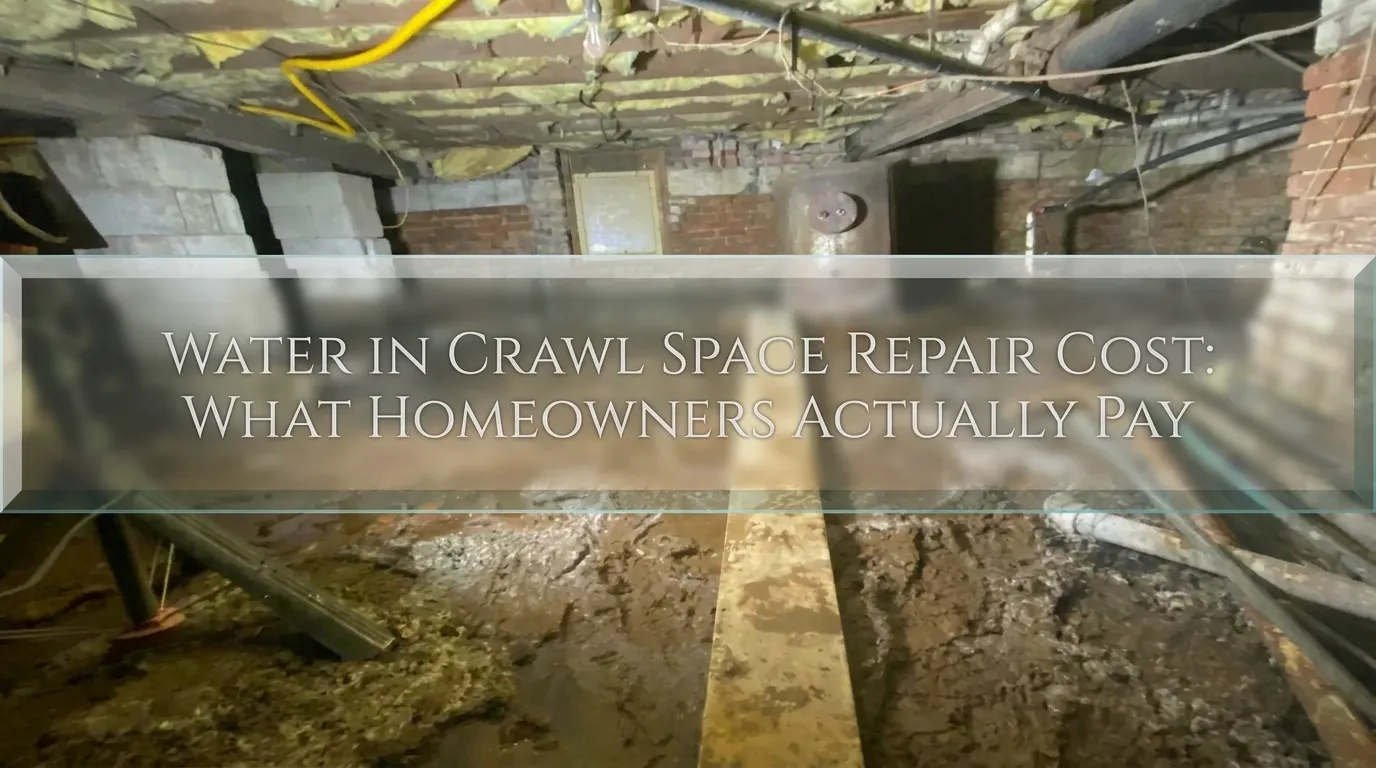
By Mold Removal Experts · Licensed & Insured · Serving Manhattan, Brooklyn, Queens, The Bronx, Long Island & the Hamptons
If you’re here for wet crawl space repair cost, you want one thing: a real number. Not “it depends.” Not a vague range from a contractor who hasn’t seen your house. A defensible estimate you can use to plan, to compare bids, and to tell a salesperson exactly where their quote stands.
Here it is. Below is the master pricing table for crawl space water repair in the New York metro area in 2026. Every project tier, the typical price per square foot, and what scope you’re actually buying at each level.
If You’re in Long Island, Brooklyn, Queens, or The Bronx, Our Advice is Always Free. Reach out Now to Schedule Your Free Assessment!
Before You Read Anything Else
If you just found water under your house, do these four things first:
1. Do not enter the crawl space if water is touching anything electrical. Cut power at the breaker first.
2. If a plumbing source is obvious (burst pipe, water heater leak), shut off the water main.
3. Photograph and video everything before you touch it — insurance documentation starts now.
4. Note the date, the weather, and what you saw. Memory fades fast; claims adjusters ask hard questions.
Step One
How Do I Get the Water Out of My Crawl Space?
Removing the water is the easy part. Doing it without leaving behind the damage that becomes a $20,000 problem next year is the part nobody talks about. Structural damage is NOT fun to deal with as a homeowner.
There are three real ways to get water out of a crawl space, and which one you need depends entirely on how much water is down there.
For a damp floor or small puddles — under an inch or two of water — a wet/dry shop vac is usually enough for the visible water, but the real work is drying. The vapor barrier, the soil underneath, the bottom of the joists, the insulation — all of that holds moisture you can’t see. You need commercial-grade dehumidifiers and air movers running for three to five days minimum. A box fan from the garage is not drying; it’s just redistributing humid air.
For standing water above two inches, you need a pump. A submersible utility pump (the kind you can rent at any hardware store for $40 a day) will move the bulk water. After the bulk is out, the same commercial drying setup as above takes over. The mistake people make here is pumping the water out, seeing dry concrete, and assuming they’re done. They’re not. Anything organic that got wet — wood framing, fiberglass insulation, paper-faced products — is now a mold incubator on a 48-hour countdown.
For deep flooding or contaminated water — sewer backup, anything from a sanitary line, water that’s been sitting for weeks — this is a professional call, full stop. Contaminated water requires biohazard protocols, proper PPE, and disposal procedures that homeowners aren’t equipped for. Trying to DIY a sewer backup is how people end up in the ER.
| Water Situation | Removal Cost | Timeline |
|---|---|---|
| Damp / minor puddles | $500 – $1,200 | 2–4 days |
| Standing water (2″–12″) | $1,200 – $2,500 | 3–5 days |
| Deep flooding (12″+) | $2,500 – $5,000 | 5–7 days |
| Sewer / contaminated water | $3,500 – $8,000+ | 5–10 days |
Removal-only pricing. Does not include underlying cause repair, damaged material replacement, or mold remediation — all of which usually come next.
Step Two
How Do I Make Sure Water Doesn’t Come Back?
Pumping out the water without fixing what let it in is like mopping the floor while the faucet’s still running. Here’s the hierarchy of permanent fixes — cheapest to most comprehensive.
There’s no universal answer to this question because water gets in through different paths. The good news is the fixes follow a clear hierarchy: start with the cheapest exterior corrections, escalate inward only as needed. A good contractor doesn’t sell you encapsulation if the real problem is a downspout dumping water against your foundation.
Below are the permanent solutions ranked by where the water is coming from and what stops it for good.
Step Three
Why Does My Crawl Space Flood Every Time It Rains?
If water shows up every time it rains, the cause is upstream of your foundation. Here are the five usual suspects, in the order we find them.
01 · GUTTERS & DOWNSPOUTS DUMPING AT THE FOUNDATION
By far the most common cause. A clogged gutter or a downspout that ends six inches from the foundation can dump 1,500+ gallons of water against your house during a heavy storm. The fix is usually a few hundred dollars in extensions and cleanup. Check this first, always.
02 · NEGATIVE GRADING AROUND THE HOUSE
Over years, soil settles. The grade that originally sloped away from your foundation can flatten or even reverse — sending surface water straight toward your crawl space. Regrading six to ten feet out from the foundation usually solves it.
03 · HIGH WATER TABLE / HYDROSTATIC PRESSURE
Common across Long Island, the South Shore, and low-lying parts of Queens and Brooklyn. When heavy rain saturates the soil, the water table rises and pushes water through any weakness in the foundation — the cove joint, hairline cracks, porous block. This is the cause that needs interior drainage and a sump pump.
04 · CRACKS IN THE FOUNDATION WALLS OR FLOOR
Older brick and block foundations — common in Brooklyn, Queens, and the Bronx — develop hairline cracks over decades. Under hydrostatic pressure, those cracks become highways for water. Fix depends on severity: some get sealed, some get reinforced with carbon fiber, some signal foundation issues that need a different conversation.
05 · OPEN VENTS LETTING HUMID AIR IN
Not flooding, but worth naming. Open foundation vents were standard in older NY metro construction. In humid summers they pull in warm wet air that condenses on cool surfaces inside the crawl space — looking exactly like a leak. The fix is sealing the vents as part of encapsulation.
Quick health note
If water has been in your crawl space for more than 48 hours and you’re noticing musty smells, increased allergies, or unexplained respiratory symptoms upstairs, that’s not coincidence. Up to half the air you breathe on the main floor originated in the crawl space. It’s not an emergency, but it’s not something to sit on for months either.
Now Let’s Talk Numbers
You know what removal looks like, you know what permanent fixes exist, and you know what’s causing the water in the first place. Now the question is what the full job actually costs when you stack all of that together.
Below is the master pricing table for crawl space water repair in the New York metro area in 2026 — every project tier, the typical price per square foot, and what scope you’re actually buying at each level.
| Solution | What It Stops | Cost |
|---|---|---|
| Gutter & downspout fixes | Roof runoff pooling at the foundation. The #1 cause and the cheapest fix. | $500 – $4,000 |
| Foundation regrading | Yard slope pushing surface water toward the house instead of away. | $500 – $3,000 |
| Exterior French drain | Subsurface water moving through saturated soil toward the foundation. | $30 – $100/ft |
| Sump pump (with backup) | Groundwater that’s already inside the crawl space. Buys you insurance against the next storm. (cost guide) | $1,200 – $5,000 |
| Interior drainage system | Hydrostatic pressure forcing water through the cove joint and wall cracks. The standard fix for chronic groundwater. | $50 – $100/ft |
| Vapor barrier | Ground moisture evaporating up into the crawl space. Doesn’t stop liquid water, stops the humidity feeding mold. | $1,500 – $4,500 |
| Full encapsulation | Everything. Sealed floor and walls, sealed vents, dehumidifier, controlled environment. The permanent answer for chronic problems. (cost guide) | $5,000 – $18,000 |
Most permanent fixes stack two or three of these together. A diagnosis tells you which.
The ROI nobody mentions
Exterior fixes are the highest-ROI work in this entire category. A $1,500 gutter and grading correction prevents what would otherwise become a $15,000 interior drainage system. Start outside. Always.
Table 01
Crawl Space Water Repair: Project & Per Square Foot Pricing
| Project Tier | Total Project Cost | Per Sq Ft | Scope at This Level |
|---|---|---|---|
| Minor Caught early | $1,500 – $5,000 | $2 – $5 | Gutter and downspout corrections, regrading, basic sump pump. One identified water source, no damage yet. |
| Moderate Some damage | $5,000 – $15,000 | $5 – $12 | Interior drainage, sump pump with backup, vapor barrier, partial insulation replacement, short-term mold cleanup. |
| Major Chronic exposure | $15,000 – $40,000 | $12 – $25 | Full encapsulation, extensive mold remediation, complete insulation replacement, drainage, some structural repair. (cost guide) |
| Severe Years of damage | $40,000+ | $25 – $60+ | Foundation repair, joist and subfloor replacement, full structural stabilization, comprehensive remediation. |
Per-square-foot figures assume a 600–1,500 sq ft crawl space, the typical NY metro range. Tight access (under 24″ clearance) or oversized footprints can push per-square-foot pricing up 30–50%.
Budgeting rule of thumb
If you’ve seen visible water but no visible damage, plan for the moderate tier ($5,000–$15,000). Reputable contractors who quote you under $5,000 without ruling out drainage failure are usually selling a Band-Aid. Contractors over $40,000 without showing you structural or mold damage are usually overselling. The middle is where most honest jobs land.
Three Real Scenarios: What These Numbers Look Like in an Actual House
Tier labels don’t pay contractors. Scope does. Here are three real-shape projects: what was wrong, what got done, and what it cost.
Scenario 01 · Minor
The Long Island Ranch After a Heavy Rain
Total Paid
$3,400
4 days · 1,100 sq ft
The problem: Homeowner found a damp vapor barrier and a small puddle after a nor’easter. No standing water, no visible mold, insulation appeared dry.
What we did: Identified two clogged downspouts dumping water against the foundation. Cleaned and extended downspouts, regraded a section of the foundation perimeter, installed a basic sump pump as insurance against the next storm.
Why it stayed cheap: They called within a week of noticing. No damage had compounded yet. The fix was upstream — gutters, not drainage.
Scenario 02 · Moderate
The Queens Colonial With a Musty Smell
Total Paid
$11,800
9 days · 850 sq ft
The problem: A musty smell in the living room for “a few months.” Inspection found two inches of standing water in part of the crawl space, soaked fiberglass insulation, and surface mold on three joist bays.
What we did: Pumped and dried the space over four days. Removed and replaced all wet insulation. Surface mold remediation with HEPA filtration. Installed a sump pump with battery backup, new 20-mil vapor barrier, and corrected the exterior grading that was funneling roof runoff toward the foundation.
Why it cost more: Time. The water had been there long enough to ruin insulation and seed mold. Every month of delay added a line item.
Scenario 03 · Major
The Hamptons Buyer’s Inspection Bombshell
Total Paid
$28,500
19 days · 1,400 sq ft
The problem: Pre-purchase inspection flagged years of intermittent water, established mold on framing, two joists showing early rot, saturated insulation throughout, and a crawl space humidity reading north of 85%.
What we did: Full interior drainage system (140 linear feet), dual sump pumps with battery backup, complete mold remediation with clearance testing, sistered two compromised joists, removed all old insulation, full encapsulation with 20-mil barrier and a dedicated dehumidifier.
The kicker: Buyer negotiated $35,000 off the sale price citing the inspection. Net effect: they paid us $28,500 and came out $6,500 ahead — with a permanently fixed crawl space.
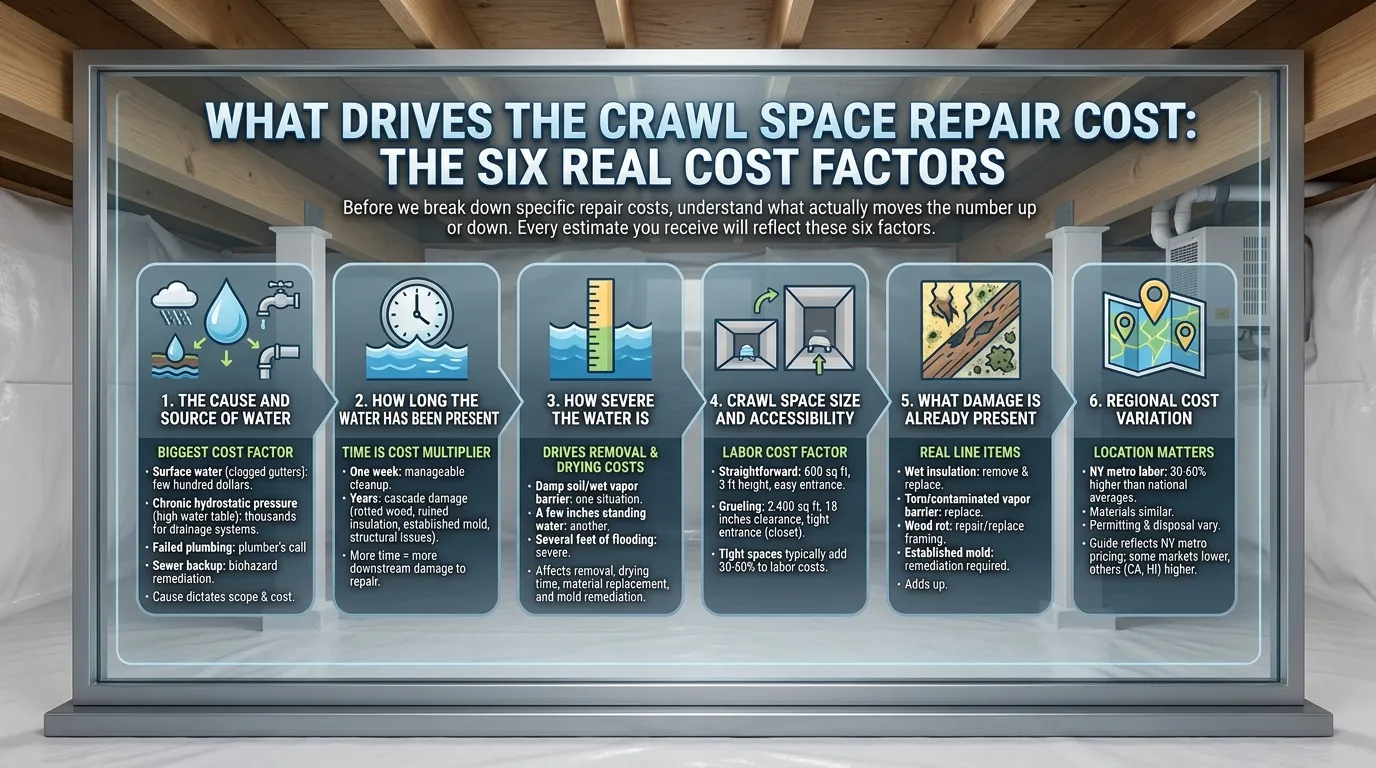
The Six Things That Move the Cost of Repairing a Wet Crawl Space Up or Down
01 · CAUSE OF WATER
A clogged gutter is a $400 fix. Hydrostatic pressure from a high water table is a $10,000 drainage system. Same wet floor, completely different scope.
02 · HOW LONG IT’S BEEN WET
A week of water is a cleanup. Years of water is cascade damage — ruined insulation, mold colonies, wood rot, possible structural issues. Time is the single biggest cost multiplier in this work.
03 · WATER SEVERITY
Dampness, two inches of standing water, and three feet of flooding are three different jobs. Severity drives removal cost, drying time, and how much material has to come out.
04 · CRAWL SPACE ACCESS
A 3-foot working height and a normal entrance is straightforward. 18 inches of clearance with one tight entrance through a closet adds 30–50% to labor. Workers can’t move fast on their backs.
05 · EXISTING DAMAGE
Wet insulation gets replaced. Torn vapor barrier gets replaced. Rotted framing gets sistered or replaced. Established mold gets remediated. Each one is a real line item and they stack fast.
06 · REGION
NY metro labor runs 30–60% above national averages. Pricing on this page reflects that. If you’re outside our region, expect lower numbers in the South and Midwest, comparable or higher in coastal California.
Before You Pay Out of Pocket
What Your Homeowners Insurance Will (and Won’t) Cover
Document everything from the moment you find the water — photos, video, dates, weather. Call your agent before authorizing major work. Below is the honest breakdown.
USUALLY COVERED
Sudden internal water damage — burst pipe, water heater failure, washing machine line rupture. Mold remediation tied to a covered event, often capped at $5,000–$10,000.
MAYBE COVERED
Sewer backup (needs a specific endorsement). Sudden hydrostatic events from extreme weather. Anything tied to one identifiable covered event rather than slow progression.
USUALLY NOT COVERED
Chronic moisture from drainage failure. Gradual or long-term water exposure. Maintenance-related damage like clogged gutters. Foundation issues from soil movement. Mold from non-covered sources.
How to Read a Quote
Real Estimate vs. Sales Pitch
This industry has world-class specialists and notorious bad actors operating side by side. Use this as your filter. If a quote has more right column than left, walk.
| ✓ Real Estimate | ✗ Red Flag |
|---|---|
| Written diagnosis of the specific problem | Verbal summary and a default “package” |
| Itemized scope with each line priced | Lump-sum quote, no breakdown |
| Materials specified: barrier mil, insulation R-value, pump HP | “Heavy-duty” and “premium” with no numbers |
| Specific warranty: duration, conditions, transferability | Vague “lifetime” guarantee from a company with no track record |
| Permits, disposal, and timeline addressed in writing | “Sign today and I’ll knock off 20%” |
| Reasonable deposit (10–30%), milestone progress payments | Demands for 50%+ upfront |
| Proof of license and insurance on request | Quote 40%+ below others (missing scope) or 50%+ above (oversold) |
The Math Nobody Tells You
The Real Cost of Waiting
We’ve watched a $2,500 repair become a $40,000 repair seven years later because the homeowner thought waiting would save money. There is no version of crawl space water where waiting is cheaper. The damage compounds. The scope grows. The numbers move in one direction.
And the direct repair cost isn’t even the full bill.
15–25%
Energy Loss
Higher heating & cooling bills from a wet, uninsulated crawl. Often $3,000–$8,000 over a decade.
3–10%
Resale Hit
Price reductions when a buyer’s inspector finds it. On a $750k home, that’s $22,500–$75,000.
50%
Air You Breathe
Up to half the air upstairs originated in your crawl space via the stack effect. Mold travels.
Who’s Behind These Numbers
Mold Removal Experts · NY Metro
We’re a licensed and insured crawl space and waterproofing specialist working across Manhattan, Brooklyn, Queens, the Bronx, Nassau, Suffolk, and the Hamptons. Every job starts with a written diagnosis. Every quote is itemized. Every warranty is in writing, transferable, and backed by a company that’s still going to be here when you need it.
Free inspection includes: physical entry into the crawl space, moisture and humidity readings, water entry point identification, evaluation of insulation, vapor barrier, framing and visible damage, and a written diagnosis with specific repair recommendations and pricing. If a “free inspection” doesn’t produce a written diagnosis, it wasn’t really an inspection.
Free · No Pressure · Same Week
Get the Real Number for Your House
A written diagnosis. An itemized estimate. Specific materials, specific timeline, specific warranty. No 2-hour living room sales pitch. No “today only” pricing.
Manhattan · Brooklyn · Queens · The Bronx · Long Island · The Hamptons
Request your free crawl space inspection →
Pricing reflects 2026 NY metro market conditions and is provided for educational purposes. Specific estimates require an on-site inspection of your property. This guide is not a substitute for a written quote from a qualified contractor. Scenario figures represent composite real-project examples.
Frequently Asked Questions About Crawl Space Water Problems
Is water in a crawl space after heavy rain normal?
No. While minor dampness can happen during severe storms, standing water in a crawl space is not considered normal. Persistent moisture usually points to drainage problems, groundwater intrusion, grading issues, plumbing leaks, or poor moisture control beneath the home.
Can you sell a house with water in the crawl space?
Yes, but crawl space water problems can affect inspections, appraisals, financing, and buyer negotiations. Many buyers request waterproofing repairs, drainage corrections, mold remediation, or crawl space encapsulation before closing.
What should I do if my crawl space floods?
Start by safely shutting off power to the affected area if needed. Remove standing water quickly, dry the crawl space thoroughly, inspect for mold or damaged insulation, and identify the source of the flooding before making permanent repairs.
Do crawl space dehumidifiers actually work?
Yes. Crawl space dehumidifiers help control humidity, reduce mold risk, protect wood framing, and improve indoor air quality. They work best when combined with encapsulation and proper moisture control systems.
What should I do if my crawl space insulation is wet?
Wet crawl space insulation should usually be removed and replaced. Damp insulation loses effectiveness, traps moisture against wood framing, and can contribute to mold growth, wood rot, odors, and pest activity.
Do I need to leave my home during the work?
Usually not. Most crawl space waterproofing, drainage, and encapsulation projects can be completed while the home remains occupied. Temporary relocation is generally only necessary during severe mold remediation or major air-quality containment work.
Is financing available for crawl space waterproofing or repairs?
Yes. Many homeowners qualify for financing options that include promotional 0% interest periods, flexible monthly payments, and longer-term financing plans. Insurance coordination may also be available for qualifying claims.
Will a fan dry out a crawl space?
Water is typically removed using pumps, wet vacuums, drainage systems, sump pumps, dehumidifiers, and professional drying equipment. Long-term solutions may also include encapsulation, vapor barriers, or exterior drainage improvements.
How do you remove water from a crawl space?
Water is typically removed using pumps, wet vacuums, drainage systems, sump pumps, dehumidifiers, and professional drying equipment. Long-term solutions may also include encapsulation, vapor barriers, or exterior drainage improvements.
Why does my crawl space flood when it rains?
Rainwater commonly enters crawl spaces because of poor grading, clogged gutters, hydrostatic pressure, foundation drainage failure, or high groundwater levels around the home. Older homes and homes with improper drainage are especially vulnerable.
Who should I call for water in my crawl space?
A crawl space waterproofing contractor or drainage specialist is usually the best first call. Depending on the cause, you may also need a plumber, mold remediation company, or foundation repair professional.
How much water in a crawl space is acceptable?
Ideally, none. Even small amounts of standing water or ongoing dampness can lead to mold growth, pest problems, wood rot, insulation damage, and poor indoor air quality over time.
How long do crawl space waterproofing systems last?
Most professional systems are designed for long-term performance. Interior drainage systems often last 20–30 years, encapsulation systems can last 15–25+ years with maintenance, sump pumps typically last 7–10 years, and structural repairs are often considered permanent when properly engineered.
What if my home is outside the NY metro area?
You can still reach out. We can help you evaluate contractor estimates, explain waterproofing options, and show you what to look for when choosing a qualified crawl space or foundation repair specialist in your area.