
Quick answer: Yes. Mold on air vents is dangerous because your HVAC system actively circulates spores through every room in the home. Unlike a single moldy patch on a basement wall, vent mold turns your air conditioning and heating system into a delivery mechanism, exposing your entire household with every cycle. Even small visible growth on a register or supply vent usually signals a larger moisture problem inside the ductwork that you can’t see.
If you’re seeing dark spotting around your vents or smelling something musty whenever the system kicks on, this is the kind of situation where waiting makes it worse, and significantly more expensive.
Schedule a Professional Mold Inspection Before It Spreads Through Your System!
Is Mold on Air Vents Dangerous? Why Mold on Air Vents Is a Bigger Problem Than Surface Mold
A patch of mold on a bathroom ceiling is a containment problem. A patch of mold on an air vent is a distribution problem. The difference matters more than most homeowners realize, and it is recommended to take action if you see mold on or in your HVAC system.
When mold grows on or inside your HVAC system, three things happen that don’t happen with isolated mold:
Every Air Cycle Becomes a Spore Distribution Event
A central HVAC system moves the entire air volume of your home roughly five to seven times per hour during normal operation. If mold exists anywhere near the airflow path — on the vent register, inside the boot, along the supply duct, or around the cooling coil — every cycle may be pulling spores into circulation and redistributing them throughout the home.
That means the bedroom three rooms away can experience the same airborne mold exposure as the room where visible growth first appeared. Once contamination enters the HVAC pathway, the system itself can become a delivery mechanism for spores, allergens, and microbial particles.
Airflow Keeps Mold Spores Active and Airborne
Mold spores sitting on a static surface often remain relatively localized. But once airflow enters the equation, those spores become aerosolized — suspended in moving air where they are far more likely to be inhaled.
This is one reason HVAC-related mold problems often trigger stronger respiratory symptoms than isolated surface contamination. The same mold colony that might remain a minor issue behind drywall can become a major indoor air quality concern once it’s positioned inside a constant airflow stream.
Visible Vent Mold Is Usually Only the Surface Problem
When mold becomes visible on the louvers of an air vent or register, the contamination behind the system has often been developing for much longer than homeowners realize. What you can see is typically only the portion that expanded far enough outward to become noticeable.
The larger concern is what may already exist deeper inside the ductwork, around insulation, near the air handler, or along hidden HVAC surfaces where moisture and condensation accumulate. In many cases, spores have already been circulating throughout the home long before visible mold appears at the vent opening itself.
This is why HVAC mold is treated as a more urgent situation than equivalent square footage of mold anywhere else in a home.
Health Risks of Mold in Air Vents
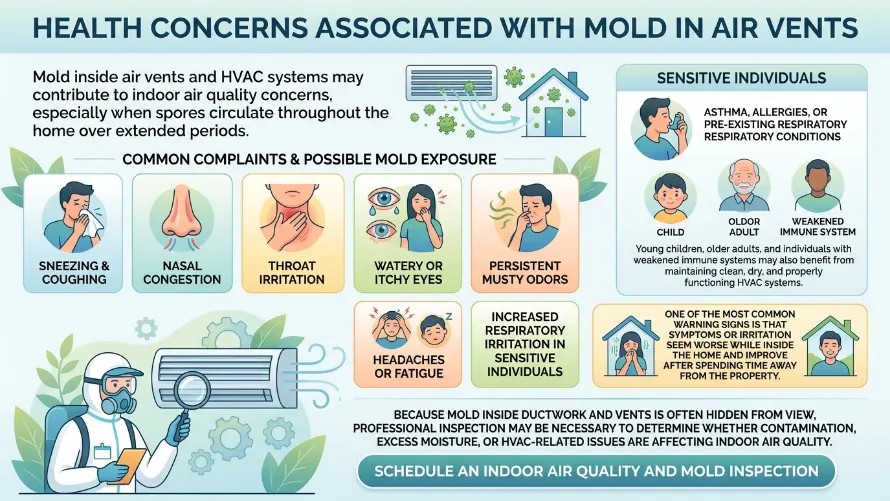
Mold in air vents can cause respiratory irritation, allergic reactions, sinus problems, headaches, fatigue, and asthma flare-ups. Severity depends on the amount of mold, the species involved, the length of exposure, and the individual’s sensitivity. Vulnerable people like children, elderly adults, those with asthma or compromised immune systems can develop more serious complications.
Symptoms generally fall into three tiers depending on exposure level and individual sensitivity:
- Mild Symptoms
Mild symptoms show up first and are the easiest to dismiss as something else (a cold, seasonal allergies, dry air). They include sneezing, coughing, throat irritation, itchy or watery eyes, and a runny or congested nose. Even if you normally have allergies, a lot of times these are mold-related rather than seasonal: they tend to be worse when you're home and better when you're away for several hours.
- Moderate Symptoms
Moderate symptoms appear with longer exposure or in more sensitive individuals. These include persistent headaches, unexplained fatigue, brain fog, sinus pressure and infections, skin rashes, and a chronic feeling of being "run down." Many people live with these for months before connecting them to indoor air quality.
- Severe Symptoms
Severe symptoms are the ones that bring people to a doctor. Asthma attacks triggered or worsened by being home, shortness of breath, wheezing, and chest tightness. For people with weakened immune systems, fungal infections like aspergillosis can develop, which is a genuinely serious medical situation.
The populations most at risk:
- Children
Children, whose smaller airways and developing immune systems make them more reactive to airborne irritants
- Older Adults
Older adults, particularly those with existing respiratory conditions
- People with Asthma or COPD
People with asthma or COPD, where mold exposure can trigger severe flare-ups
- Immunocompromised Individuals
Immunocompromised individuals — chemotherapy patients, organ transplant recipients, people with autoimmune conditions on suppressive medication
- Pregnant Women
Pregnant women, where the precautionary principle applies even when symptom severity is mild
If multiple people in your household have developed similar unexplained symptoms over the same timeframe, and those symptoms improve when you’re away from home, your HVAC system is worth investigating. With over 20+ years of experience in waterproofing and mold remediation services across Long Island, Brooklyn, Queens, and The Bronx, Mold Removal Experts is New York’s leading source for free inspections and proven solutions.
Experiencing Symptoms? Don’t Ignore Possible Airborne Mold Exposure! Schedule a Free Advanced Mold Testing Today!
How Mold Forms on Air Vents in the First Place
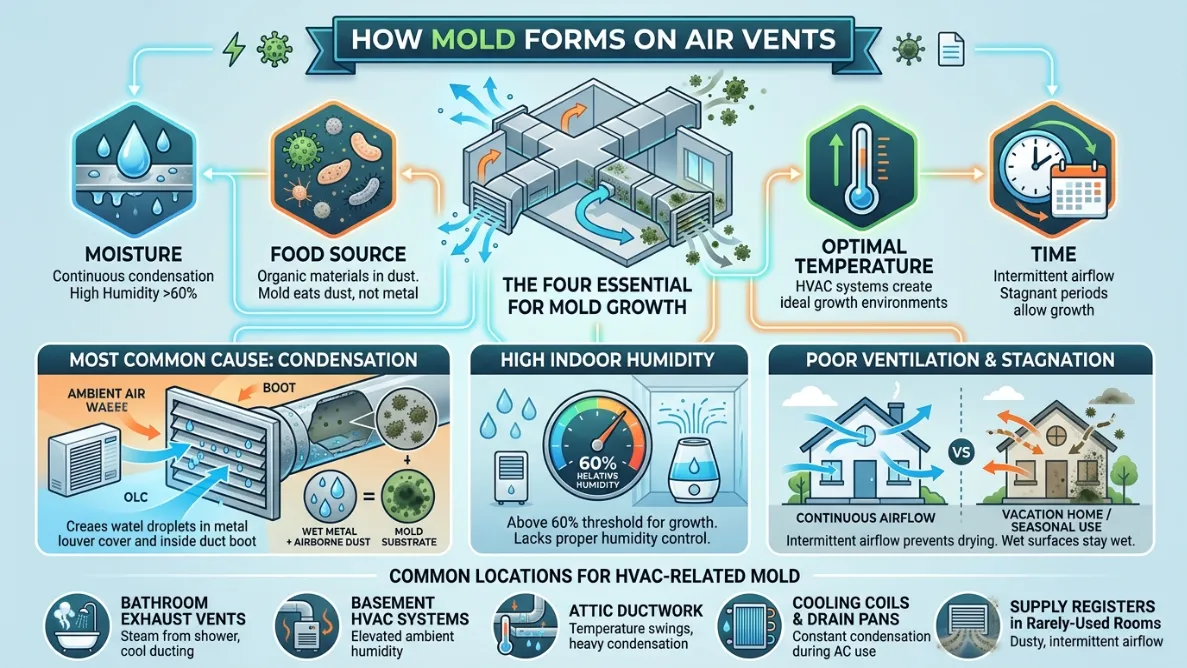
Mold on air vents, once present, requires four conditions to be present at the same time: moisture, an organic food source, the right temperature, and time. HVAC systems happen to be efficient at providing all four.
- Condensation From Temperature Differences Is the Most Common Cause: When cold air from an air conditioning system meets warmer ambient air at the vent face, the temperature differential causes moisture to condense on the metal louvers and inside the duct boot. In humid climates or during humid summer weeks, this condensation can be continuous. Wet metal plus airborne dust equals an ideal mold substrate.
- High Indoor Humidity Amplifies Everything: Indoor relative humidity above 60% is the threshold above which mold can grow on most common materials. HVAC systems in homes that lack proper humidity control essentially recycle moist air through metal channels, which is exactly the environment mold needs.
- Dust Buildup Provides the Food Source Mold Actually Consumes: Mold doesn’t eat metal, it eats the organic material on top of it. Dust is largely organic (skin cells, fabric fibers, pet dander, pollen), and HVAC systems collect dust at every surface where air slows down; particularly inside ducts, around filters, and at the back of vent covers.
- Poor Ventilation and Stagnation Complete the Picture: Mold grows poorly in well-ventilated areas with strong airflow. It grows aggressively in spaces with intermittent airflow, where wet surfaces have time to stay wet between cycles. This is why HVAC systems that run sporadically (vacation homes, basement systems used only seasonally) develop mold faster than systems that run continuously.
The Most Common Locations to Find HVAC-Related Mold:
- Bathroom exhaust vents, where high humidity meets cool ducting
- Basement HVAC systems, where ambient humidity is already elevated
- Attic ductwork, where temperature swings cause heavy condensation
- Cooling coils and drain pans, where condensation is constant during AC operation
- Supply registers in rarely-used rooms, where intermittent airflow allows moisture to settle
Signs There's Mold in Your Air Vents or HVAC System
The earlier you catch HVAC mold, the cheaper it is to address. Here’s what to watch for:
- Musty Odors When The System Runs:
This is the single most reliable indicator. If a damp, earthy, or "old basement" smell appears within seconds of the AC or heat kicking on and fades when the system shuts off, there's mold somewhere in the airflow path. The nose is more sensitive to mold than most home test kits.
- Dark Spotting Around Vent Covers:
Black, green, brown, or grayish spots on the louvers of supply registers, return vents, or the wall area immediately around them may indicate mold growth. The spotting often looks like dirt or staining at first glance. Wipe a vent louver with a damp cloth. If it doesn't come clean or comes back within a week, you're likely looking at mold rather than dust.
- Allergy Symptoms That Worsen Indoors:
The classic pattern is feeling fine outdoors, becoming sniffly within an hour of getting home, congested overnight, and unexpectedly clear-headed after a weekend away. This pattern reverses the normal seasonal allergy trend and points toward indoor air contamination.
- Dust Or Particles Blowing From Vents:
Some dust is normal during system start-up. Persistent, visible particles blowing from vents during regular operation are not. This often indicates heavy duct contamination or an air filter that is failing to capture airborne material properly.
- High Indoor Humidity Despite Running AC:
A properly functioning air conditioner should help reduce indoor humidity levels. If humidity remains above 55% to 60% while the AC is running, the system may have moisture or airflow issues that also create conditions favorable for mold growth.
- Multiple Household Members Developing Symptoms:
When several people in the home begin experiencing similar respiratory irritation, congestion, coughing, or allergy symptoms within the same timeframe, the HVAC system may be the shared environmental factor contributing to the problem.
Is Mold on Air Vents Always Dangerous?
The honest answer needs some nuance.
A small patch of mold on the outside of one vent, with no musty smell when the system runs and no symptoms in the household, is usually manageable. Often it’s just surface condensation mold feeding on dust. Clean the vent face, fix the humidity issue, and you’re done.
But two things make HVAC mold riskier than other mold situations:
It’s systemic. Even tiny mold on a vent has access to your entire duct system. There’s no such thing as “isolated” HVAC mold.
Hidden growth almost always beats visible growth. What you see on the louvers is the part that grew into open air. The duct interior is dark, often damp, and coated in dust. That’s where the bigger colonies live.
Mold that keeps coming back, spreads to multiple vents, or comes with a musty smell needs professional assessment. Skip the DIY route.
Can Mold in Air Vents Spread to the Rest of Your Home?
Yes, and HVAC is one of the fastest ways mold spreads in a house.
Mold reproduces through microscopic spores built to travel through air. One square inch of established growth can release millions of them. Drop that into active airflow and those spores get pulled into the duct network and pushed into every room the system serves.
Over weeks or months, you start finding mold in places that have no obvious moisture source:
- Walls and ceilings near supply registers
- Furniture and upholstery (fibers trap spores)
- Carpets and padding, especially in basements
- Closets where air sits still
- HVAC components themselves, including the cooling coil, blower, and drain pan
Once mold has been circulating through your ducts for a while, remediation has to cover the original source plus all the secondary spots. That’s the cost curve that surprises homeowners: a $400 vent issue becomes a $4,000 multi-area job after six months of neglect.
The earlier you catch it, the smaller the bill.
The Real Cause: Moisture And Humidity
This is the part most articles skip.
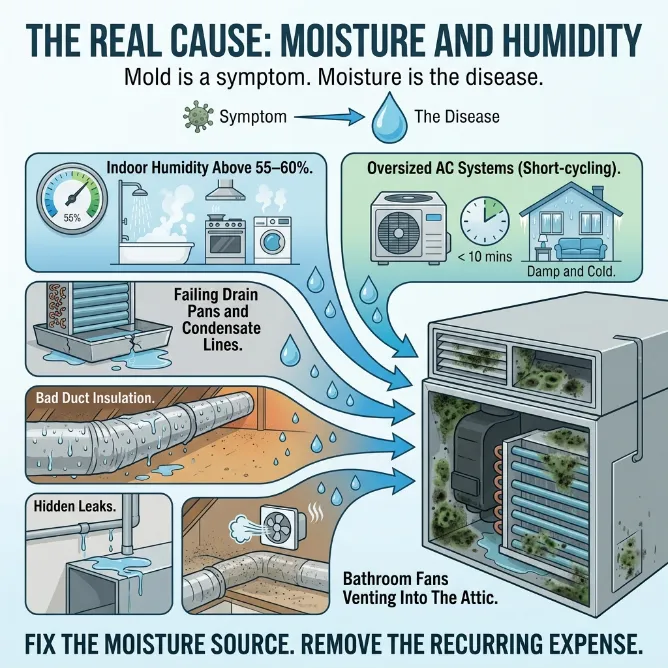
Mold is a symptom. Moisture is the disease.
You can remediate every patch of mold in a home and it will return within months if the underlying moisture is not fixed. That is why professional remediation includes a “why did this happen” assessment, and it is why some homeowners pay for remediation twice.
The Moisture Sources That Feed HVAC Mold:
- Indoor Humidity Above 55–60%: The biggest factor by far. If your home humidity runs above 55-60%, mold has favorable conditions everywhere, not just inside the HVAC system. Fix it with a whole-home dehumidifier, portable units, or better ventilation in bathrooms, kitchens, and laundry rooms.
- Oversized AC Systems: Counterintuitive but common. An AC system that is too large cools the home quickly but does not run long enough to remove humidity from the air. The result is cold, damp air, which is exactly what HVAC mold needs to thrive. If your AC consistently reaches the set temperature in under 10 minutes, it may be oversized.
- Failing Drain Pans And Condensate Lines: The pan beneath your evaporator coil collects water. If the pan cracks or the drain line clogs, standing water remains there continuously. This is one of the most common causes of mold growth around cooling coils.
- Bad Duct Insulation: Uninsulated ducts in hot attics or cold crawl spaces often develop heavy condensation. Over time, that moisture damages insulation materials and creates ideal conditions for mold growth.
- Hidden Leaks: Plumbing leaks, roof leaks, and slow drips near ductwork all contribute excess moisture that can feed hidden mold colonies.
- Bathroom Fans Venting Into The Attic: Instead of venting outdoors through the roof, some fans dump moist air directly into attic spaces where ductwork is located. This is one of the most common construction defects found in older Long Island and Northeast homes built before 2000.
Fix the moisture source and you fix the recurring expense.
Cost to Remove Mold from Air Vents
The cost to remove mold from air vents varies, contingent on a number of different factors. Here are some honest ranges for common scenarios:
| Scenario | Typical Scope | Cost Range |
|---|---|---|
| Single Vent Surface Cleaning | One register, no duct work | $150 – $400 |
| Multi-Vent + Inspection | Several vents, basic duct check, light antimicrobial | $400 – $1,200 |
| Localized Duct Remediation | Containment, HEPA, single-zone duct cleaning, antimicrobial | $1,500 – $3,500 |
| Full HVAC Remediation | Whole system including coil, blower, all accessible ducts | $3,500 – $7,500 |
| Remediation + Component Replacement | Above plus replacing damaged ducts or HVAC parts | $5,000 – $12,000+ |
| Post-Flood Whole-System Remediation | Total contamination, often with water damage repair | $8,000 – $20,000+ |
What drives cost up or down:
- Severity (surface vs. heavy internal growth)
- System complexity (single vs. multi-zone, duct accessibility
- Duct material (flex duct usually gets replaced; metal can be cleaned)
- Component damage (coil, blower, or duct sections needing replacement)
- Testing (pre and post adds $300-$800 but documents the work)
- Underlying moisture fixes (dehumidifiers, ventilation, insulation)
Step one is always inspection, not cleaning. A real inspection tells you what scope you need and what it should cost. Companies quoting prices over the phone are guessing.
How Professionals Handle Mold in Air Vents
HVAC mold remediation isn’t the same as duct cleaning. Duct cleaning is maintenance. Remediation is contamination control. Homeowners often pay for expensive duct cleanings that don’t touch their actual mold problem.
Here’s what real remediation looks like:
- Comprehensive Inspection: Visual checks of the coil, drain pan, blower, and accessible ducts. Moisture readings throughout the home. Thermal imaging where useful. Lab testing when it is warranted.
- Containment: Plastic sheeting and negative air pressure isolate the work area before any cleaning starts. This is the step that separates remediation from “$199 duct cleaning specials.”
HEPA Filtration: HEPA air scrubbers run during the work to capture released spores. Shop vacs and household purifiers do not count. - Source Removal: HEPA vacuuming, brush agitation, and antimicrobial treatment on accessible surfaces. Badly contaminated ducts get replaced. The coil and drain pan get cleaned separately, often requiring partial disassembly.
- Antimicrobial Application: EPA-registered products go on after physical removal. The right product depends on species and surface.
Root Cause - Assessment: Why did the mold grow? A leaking drain pan, an oversized AC, bad insulation? If that does not get fixed, the mold comes back.
- Post-Remediation Verification: For bigger jobs, a third-party industrial hygienist should test for clearance. The remediation company should not test its own work.
Real HVAC remediation takes one to three days for moderate cases and runs $1,500 to $7,500 depending on complexity. Anything dramatically cheaper probably isn’t the same service.
How to Prevent Mold on Air Vents
Most HVAC mold is preventable. Three categories of attention: humidity control, system maintenance, and inspection.
- Keep Humidity Between 30 And 50 Percent Year-Round: A hygrometer costs under $20. If you are consistently above 50%, you have a humidity problem before you have a mold problem. Fix it before mold has a reason to grow.
- Change Filters On A Real Schedule: Most homes need new filters every 60–90 days. Homes with pets, pollen, or nearby construction may need monthly changes. Dirty filters restrict airflow, which lowers coil temperature and creates more condensation. Filter changes are one of the cheapest forms of mold prevention.
- Clean Vent Covers Periodically: Once or twice a year, remove vent covers and wash them with soap and water. This helps stop dust buildup from becoming food for mold growth.
- Get The HVAC Serviced Annually: Professional service clears the drain pan and condensate line, inspects the coil, cleans the blower, and checks refrigerant levels. Preventive maintenance costs far less than remediating mold caused by neglected HVAC systems.
- Address Condensation Immediately: Water droplets on vents, around registers, or on ducts in unconditioned spaces are warning signs. Do not wait for visible mold growth to confirm there is a problem.
- Ventilate Moisture-Heavy Rooms: Run bathroom fans for at least 20 minutes after showers, use the range hood while cooking, and ventilate laundry rooms properly. Removing moisture at the source helps reduce indoor humidity levels.
- Get Duct Inspections Every 2–3 Years: Not cleanings. Inspections. Regular inspections help catch developing moisture or contamination issues before they require full remediation.
These steps cost almost nothing. The remediation they prevent costs many times more.
Don't Forget, You Can Always Get a Free Mold Inspection from Us in Long Island, Brooklyn, Queens, or The Bronx!
Most HVAC mold is preventable. Three categories of attention: humidity control, system maintenance, and inspection.
- Keep Humidity Between 30 And 50 Percent Year-Round: A hygrometer costs under $20. If you are consistently above 50%, you have a humidity problem before you have a mold problem. Fix it before mold has a reason to grow.
- Change Filters On A Real Schedule: Most homes need new filters every 60–90 days. Homes with pets, pollen, or nearby construction may need monthly changes. Dirty filters restrict airflow, which lowers coil temperature and creates more condensation. Filter changes are one of the cheapest forms of mold prevention.
- Clean Vent Covers Periodically: Once or twice a year, remove vent covers and wash them with soap and water. This helps stop dust buildup from becoming food for mold growth.
- Get The HVAC Serviced Annually: Professional service clears the drain pan and condensate line, inspects the coil, cleans the blower, and checks refrigerant levels. Preventive maintenance costs far less than remediating mold caused by neglected HVAC systems.
- Address Condensation Immediately: Water droplets on vents, around registers, or on ducts in unconditioned spaces are warning signs. Do not wait for visible mold growth to confirm there is a problem.
- Ventilate Moisture-Heavy Rooms: Run bathroom fans for at least 20 minutes after showers, use the range hood while cooking, and ventilate laundry rooms properly. Removing moisture at the source helps reduce indoor humidity levels.
- Get Duct Inspections Every 2–3 Years: Not cleanings. Inspections. Regular inspections help catch developing moisture or contamination issues before they require full remediation.
These steps cost almost nothing. The remediation they prevent costs many times more.
Is Mold on Air Vents Dangerous: Final Thoughts
Yes, and the reason is structural. Mold on air vents is dangerous because it has access to your home’s air distribution system, which makes exposure whole-home rather than local. Small visible growth usually means bigger hidden contamination, and HVAC mold tends to multiply rather than stay put.
The right move when you suspect HVAC mold is a professional inspection. Not because every case needs full remediation, but because only inspection tells you what your situation actually needs. The difference between a $400 fix and a $4,000 remediation is usually whether you caught it at the vent or after it spread through the system.
Visible mold, musty smell when the system runs, or respiratory symptoms that improve when you leave the house are the signals worth acting on. Inspection is cheap. Waiting isn’t.
Protect Your Air and Health. Book a Mold Inspection Now!
Frequently Asked Questions About Mold in Air Vents:
Is mold in vents toxic?
Some HVAC molds can produce mycotoxins, including Aspergillus, Penicillium, and Stachybotrys. Whether yours is producing them depends on species and conditions, which only lab testing can confirm. Practically speaking, treat any persistent vent mold as a health issue worth professional assessment.
Can HVAC spread mold?
Yes. HVAC systems are one of the most efficient spore distribution mechanisms in a home. Air handlers move the home’s full air volume five to seven times per hour, so any spore in the airflow reaches every room the system serves. That’s why HVAC mold gets prioritized over similar amounts of mold elsewhere.
How fast does mold spread through air?
Spores released into active airflow can reach every connected room within minutes. New visible growth in those rooms takes weeks to months and needs favorable moisture. The exposure happens fast. The visible spread takes longer, which is why HVAC mold often goes undetected until symptoms show up.
Can I run my AC if there's mold?
You can, but you probably shouldn’t. Running the system keeps circulating spores. If you suspect HVAC mold, limit runtime until inspection and consider running HEPA purifiers in occupied rooms in the meantime.
Does cleaning vents remove mold completely?
Cleaning the visible part of a vent removes the visible part. If mold has established inside the ducts, on the coil, in the drain pan, or in the blower, vent cleaning leaves most of the contamination behind. Full removal needs whole-system inspection and treatment.
How do I know if my musty smell is from the HVAC system?
Notice when it shows up. If it starts within seconds of the system kicking on and fades when it shuts off, it’s HVAC. If the smell is constant, the source is elsewhere. If it shows up after a long period of inactivity (vacation home, seasonal use), it’s almost certainly HVAC-related.
Will an air purifier solve HVAC mold?
No. A purifier filters air that passes through it but doesn’t touch the source. If mold is growing in the HVAC system, the purifier is downstream of the problem. Purifiers help as a supplement during remediation or for air quality after the source is fixed, but they don’t replace removing the growth.
Does homeowner's insurance cover HVAC mold remediation?
Sometimes. Usually when the cause is sudden and accidental like a burst pipe, appliance leak, or storm damage. Mold from long-term humidity, deferred maintenance, or slow leaks is typically excluded. Coverage depends on your policy language, the documented cause, and how the carrier reads it. Professional documentation of cause is often what decides the claim.
How long does HVAC mold remediation take?
Depends on how far it’s spread. A contained problem caught early, like mold on the evaporator coil or in the drain pan, can often be handled in one to three days. Once it’s into the ductwork, blower housing, and insulation, you’re looking at five to ten days because porous components like duct liner usually need replacement, not cleaning. Whole-system contamination with multiple zones can run two weeks or longer. The timeline isn’t just removal. It’’s containment setup, source repair (fixing the moisture cause), remediation, post-remediation verification testing, and reassembly. Anyone quoting a same-day fix for system-wide HVAC mold is cleaning, not remediating.
What causes mold to grow in HVAC systems in the first place?
Moisture meeting organic material at the right temperature. In HVAC specifically, the usual culprits are an oversized AC unit that short-cycles and never dehumidifies properly, a clogged condensate drain backing water into the pan, undersized or leaky return ducts pulling humid crawl space or attic air into the system, low airflow across the coil causing condensation in the wrong places, and dirty filters letting dust (the organic food source) accumulate on wet surfaces. Climate matters too homes in humid regions running AC against 70%+ outdoor humidity put constant condensation load on the system. Mold doesn’t appear randomly. It appears where moisture has somewhere to sit and something to feed on, and HVAC systems unfortunately offer both.