
Moisture in a basement is never random, and it’s almost never caused by just one thing. Whether you’re seeing damp spots on the floor, musty odors, peeling paint, or active water seepage, the real problem is usually a combination of exterior drainage issues, structural vulnerabilities, indoor humidity, and environmental pressures working together.
In this guide, we break down every known cause of basement moisture from hydrostatic pressure and negative grading to plumbing leaks, condensation, foundation cracks, and over 100 additional sources that homeowners often miss. By the end, you’ll know exactly how to identify the root cause, why it’s happening, and what to do next to protect your home before the problem becomes structural or leads to mold growth.
Get A Free Basement Moisture Evaluation Today!
What Basement Moisture Is (and Why It Matters)
Before you can fix basement moisture, you need to understand what kind of moisture you’re dealing with. Not all moisture behaves the same way, and each type enters a basement through completely different pathways. Misdiagnosing the source is the #1 reason homeowners waste money on the wrong repair.
Below is a simple, scannable breakdown of moisture intrusion, humidity, and liquid water, followed by core terms every homeowner should know.
The Three Types of Basement Moisture
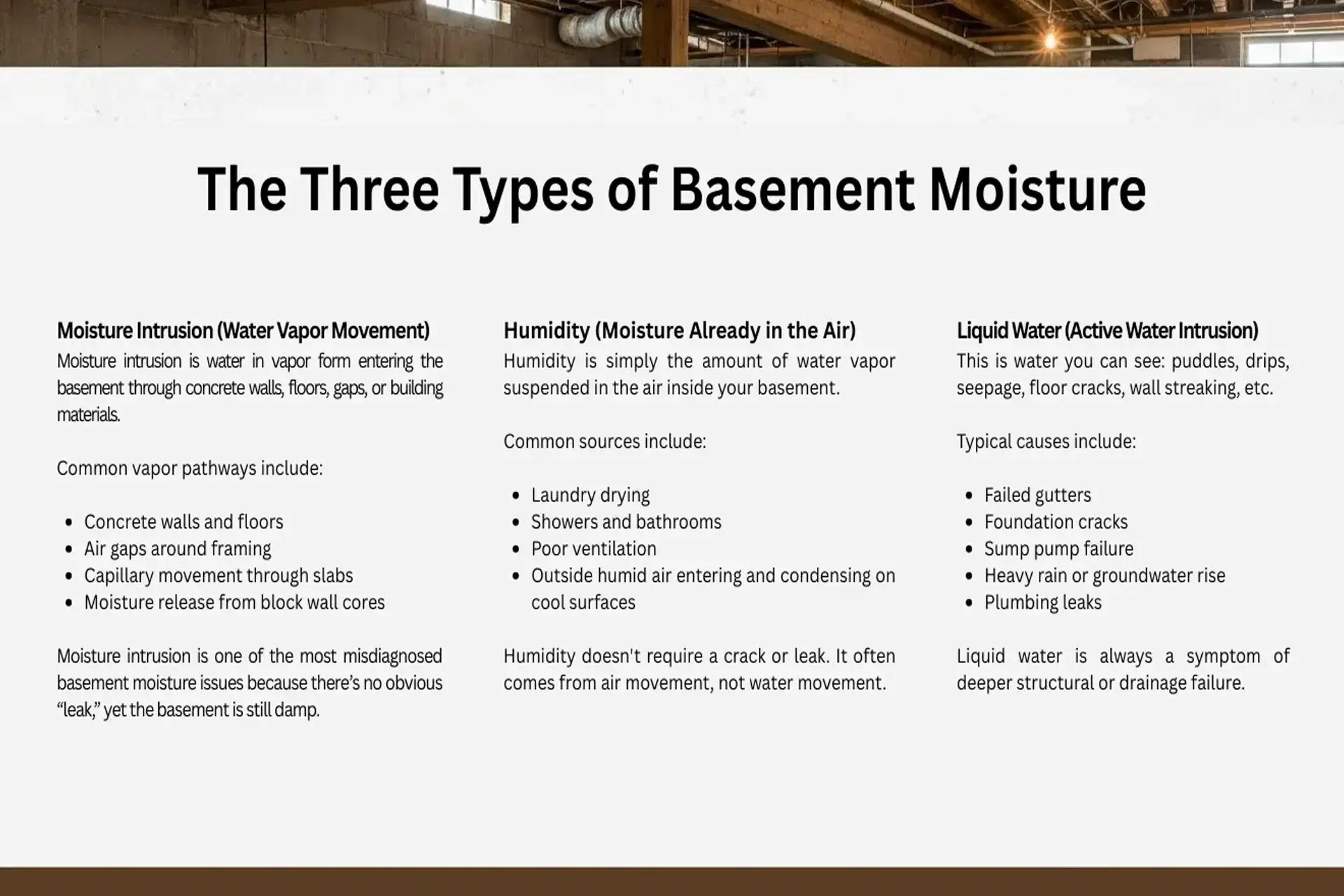
- Moisture Intrusion (Water Vapor Movement)
Moisture intrusion is water in vapor form entering the basement through concrete walls, floors, air gaps, or building assemblies.
- It’s invisible.
- It travels through concrete because concrete is porous.
- It raises indoor humidity and causes musty odors, efflorescence, and mold risk.
This is the silent form of basement moisture problems that most homeowners never see coming.
- Humidity (Moisture Already in the Air)
Humidity is simply the amount of water vapor suspended in the air inside your basement.
Common sources include:
- Laundry drying
- Showers and bathrooms
- Poor ventilation
- Outside humid air entering and condensing on cool surfaces
Humidity doesn’t require a crack or leak. It often comes from air movement, not water movement.
- Liquid Water (Active Water Intrusion)
This is water you can see: puddles, drips, seepage, floor cracks, wall streaking, etc.
Typical causes include:
- Failed gutters
- Foundation cracks
- Sump pump failure
- Heavy rain or groundwater rise
- Plumbing leaks
Liquid water is always a symptom of deeper structural or drainage failure.
Why Understanding This Matters
Fixing the wrong type of moisture leads to wasted money, failed repairs, and long-term mold growth or structural damage. When you can identify whether you’re dealing with humidity, vapor, or liquid water, you can choose the correct solution, whether it be grading, drainage, dehumidification, crack repair, sump systems, or full waterproofing.
What Causes Moisture Problems in Basements?
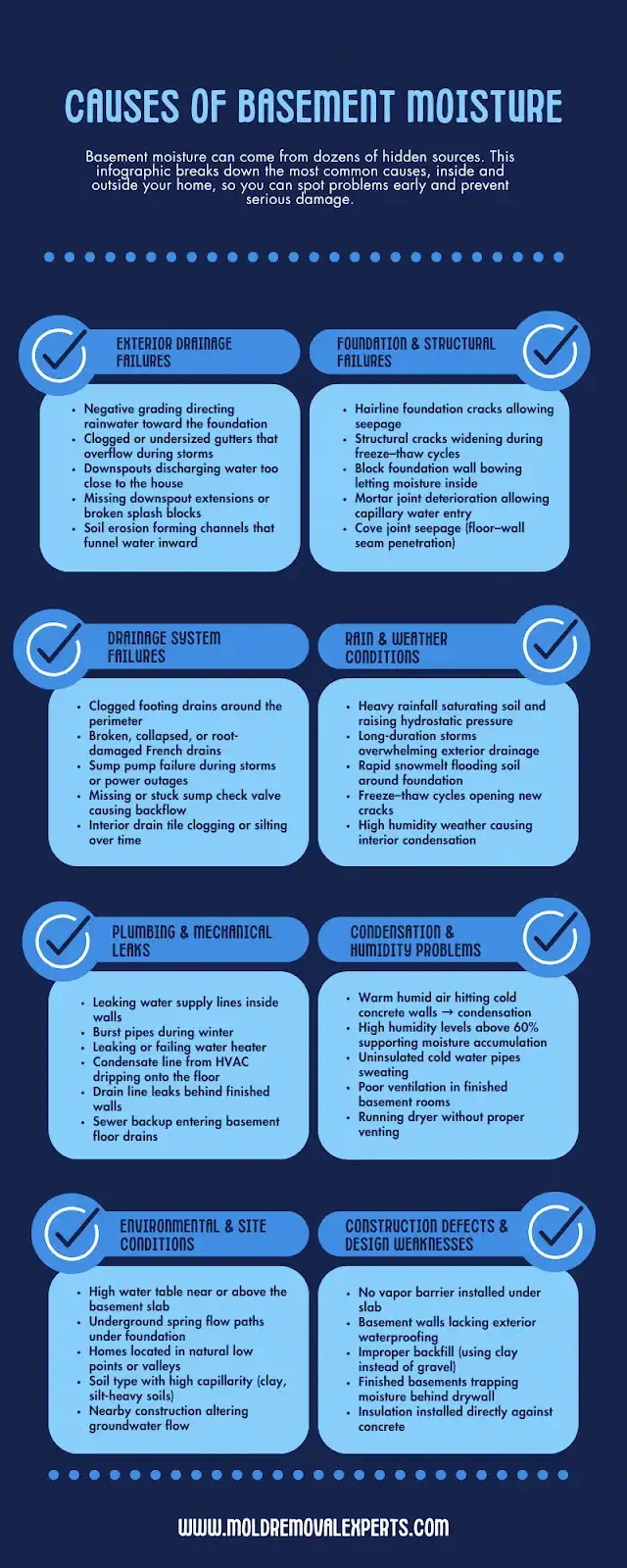
There are over 110 verified sources that can lead to leaks, dampness, odors, or full flooding. But instead of burying you in an endless list, we’ve organized the most common and most impactful causes into clear categories so you can quickly understand where moisture really comes from and how it enters a home.
Each category highlights the top problems homeowners encounter, giving you a simple, structured way to identify what might be affecting your basement.
Exterior Drainage Failures (Surface Water Issues)
When it comes to basement moisture, exterior drainage failures are one of the most common and most overlooked sources. Even small issues outside the home can send gallons of water toward your foundation during storms or snowmelt.
While there are dozens of potential problems in this category, here are the top 10 most impactful exterior drainage-related causes you should watch for:
- Negative grading directing rainwater toward the foundation
- Clogged or undersized gutters that overflow during storms
- Downspouts discharging water too close to the house
- Missing downspout extensions or broken splash blocks
- Soil erosion forming channels that funnel water inward
- Landscaping mounds trapping water against foundation walls
- Driveway or sidewalk slope directing runoff toward the home
- Improper drainage from neighboring properties flowing onto yours
- Mulch beds holding water against foundation siding
- Patio or porch slabs tilted toward the basement wall
Foundation & Structural Failures
Structural weaknesses act like invitation points for water. Even the smallest cracks, gaps, or deteriorated materials allow moisture to migrate into the basement—especially under pressure from saturated soil.
Here are the top 10 most common and high-impact foundation-related causes homeowners should look for:
- Hairline foundation cracks allowing seepage
- Structural cracks widening during freeze–thaw cycles
- Block foundation wall bowing causing moisture to migrate inward
- Mortar joint deterioration allowing capillary water entry
- Cove joint seepage (floor–wall seam penetration)
- Window well leakage due to no drains or clogged drains
- Porous concrete allowing moisture diffusion
- Honeycombing in poured concrete walls
- Cracked or deteriorated parging on exterior walls
- Failed or missing exterior waterproofing membrane
Drainage System Failures (Footing Drains, Sump Pumps, Tiles)
Basements rely on hidden drainage systems to keep groundwater under control. When any part of that system clogs, fails, or becomes overwhelmed, moisture has only one direction to go: into the basement. Below are the top 10 drainage-related failures that commonly lead to water intrusion:
- Clogged footing drains around the perimeter
- Broken, collapsed, or root-damaged French drains
- Sump pump failure during storms or power outages
- Undersized sump pump that can’t handle flow volume
- Missing or stuck sump check valve causing backflow
- Interior drain tile clogging or silting over time
- Sump pit overflowing due to heavy groundwater rise
- Discharge lines frozen or clogged in winter
- Discharge lines too short or pointed toward foundation
- Improperly installed sump pit allowing soil wash-in
Rain & Weather Conditions (Environmental Water Events)
Some moisture problems appear only during certain weather patterns — and when they do, they follow a predictable seasonal rhythm. From intense storms to freeze–thaw cycles, the environment itself can push water directly into your home.
Here are the top 10 weather-driven causes every homeowner should be aware of:
- Heavy rainfall saturating soil and raising hydrostatic pressure
- Long-duration storms overwhelming exterior drainage
- Rapid snowmelt flooding soil around foundation
- Freeze–thaw cycles opening new cracks
- High humidity weather causing interior condensation
- Wind-driven rain forcing water against foundation walls
- Seasonal groundwater rise in spring
- Hurricanes or tropical storms pushing water tables higher
- Storm drain overflow soaking soil near basements
- Excessive rain pooling in clay-rich soils (NYC, Toronto, Midwest)
Plumbing & Mechanical Leaks (Inside the Home)
Not all basement moisture comes from the outside. Indoor plumbing issues often masquerade as “mystery leaks” until they worsen and cause major damage. These internal failures can produce both sudden flooding and slow, persistent moisture buildup.
Here are the top 10 indoor plumbing and mechanical sources most responsible for basement moisture:
- Leaking water supply lines inside walls
- Burst pipes during winter
- Leaking or failing water heater
- Condensate line from HVAC dripping onto the floor
- Drain line leaks behind finished walls
- Washing machine hose failure
- Sewer backup entering basement floor drains
- Leaking basement bathroom fixtures
- Refrigerator or freezer leak (in finished basements)
- Radiator or boiler system leaks causing floor moisture
Condensation & Humidity Problems (Interior-Air Driven Moisture)
Some of the most persistent moisture problems come from inside the basement itself. When warm, humid air meets cold concrete surfaces, condensation forms—often in areas homeowners rarely inspect. These issues can mimic leaks even when no liquid water is entering from outside.
Below are the top 10 internal humidity and condensation sources that commonly lead to damp basements:
- Warm humid air hitting cold concrete walls → condensation
- High humidity levels above 60% supporting moisture accumulation
- Uninsulated cold water pipes sweating
- Poor ventilation in finished basement rooms
- Running dryer without proper venting
- Crawl space humidity transferring into basement air
- Dehumidifier not sized properly for basement volume
- Poorly sealed basement windows allowing humid air entry
- HVAC short cycling creating temperature swings
- Dryer vent leaks saturating basement air
Environmental & Site Conditions (Location-Driven Causes)
Your home’s surroundings play a massive role in how moisture behaves. Soil type, water table depth, neighborhood drainage, and even nearby infrastructure can create moisture problems you cannot see from the surface.
Here are the top 10 site-related environmental conditions that frequently contribute to basement moisture:
- High water table near or above the basement slab
- Underground spring flow paths under foundation
- Homes located in natural low points or valleys
- Soil type with high capillarity (clay, silt-heavy soils)
- Nearby construction altering groundwater flow
- Municipal storm drain backup saturating ground
- Houses built near slopes directing runoff toward foundation
- Floodplain or historical wetland areas
- Coastal-zone groundwater rise during seasonal tides
- Irrigation system overspray saturating perimeter soil
Construction Defects & Design Weaknesses
Sometimes the basement was built with vulnerabilities from day one. Older homes may lack modern waterproofing, while newer builds can suffer from shortcuts or missing components. Even small design flaws can allow constant moisture migration over time.
Here are the top 10 construction and design defects most likely to cause moisture issues:
- No vapor barrier installed under slab
- Basement walls lacking exterior waterproofing
- Improper backfill (using clay instead of gravel)
- Finished basements trapping moisture behind drywall
- Insulation installed directly against concrete
- Poor workmanship on foundation pours
- Inadequate flashing around basement windows
- No drainage mat or damp-proofing on exterior walls
- Incorrect sump pump placement
- Foundation built below the water table without proper engineering
What to Do If You Already Have Moisture (Step-by-Step Action Plan)
Basement moisture escalates quickly. The faster you act, the more damage you can prevent. If you live in the Long Island, Brooklyn, Queens, or The Bronx areas, you can reach out to us any time for a free assessment. As leading mold remediation and waterproofing contractors in Long Island, we deal with basement moisture every day, and our opinion and expert advice is always free.
If you aren’t in our service area, here’s the exact sequence professionals follow when responding to active moisture problems in a home.
- Identify the Source (Quick Diagnostics)
Before you spend a dollar on repairs, you need to know what type of moisture you’re dealing with.
Do this first:
- Check walls and flooring for visible seepage or wet spots
- Inspect corners, cove joints, and window wells
- Look for condensation on pipes or concrete surfaces
- Smell for musty odors (strong indicator of humidity or hidden leaks)
- Note whether the problem happens only during rain, only in summer, or all the time
Fast rule of thumb:
- Wet after rain? Exterior drainage or hydrostatic pressure
- Wet in summer? Condensation or humidity
- Random wet spots? Plumbing or internal leak
- White powder (efflorescence)? Vapor intrusion or capillary rise
A correct diagnosis saves thousands.
- Stop Water Entry Immediately
If water is entering your basement in real time, prioritize stopping the flow.
Immediate actions:
- Place towels, sandbags, or temporary barriers at active entry points
- Tighten plumbing fittings
- Shut off the main water valve if a pipe is suspected
- Clear clogged drains or window wells
- Move belongings to higher ground to prevent damage
If water continues entering:
Call an emergency restoration company or waterproofing specialist. Time matters especially with electrical hazards.
- Lower Humidity Within 24 Hours
Moisture becomes mold within 24-48 hours, especially in humid climates or finished basements.
Lower humidity fast by:
- Running a dehumidifier at 45-50%
- Opening windows only if outdoor air is dryer than indoor
- Using fans to circulate air (but avoid pointing at mold)
- Running HVAC to remove moisture from the air
Target humidity:
Below 50% is safe
Below 45% is ideal
- Prevent Mold Growth
Once condensation or moisture forms, mold begins colonizing almost immediately.
Before mold appears:
- Remove wet materials (carpet, cardboard, insulation)
- Wipe surfaces with an antimicrobial solution
- Keep airflow moving
- Maintain temperature above 68°F (warmer air holds less moisture on surfaces)
If mold is already visible: Do not spray bleach. This drives mold deeper into porous materials. Call a remediation professional.
- Repair Structural Issues
Once the area is dry and safe, address the cause.
Common repairs include:
- Crack injections
- Sump pump replacement
- Regrading or downspout extensions
- Window well drainage corrections
- Drain tile repair or replacement
- Vapor barrier or membrane installation
This step prevents recurrence and protects the foundation from deterioration.
- Install Long-Term Protections
After the emergency is handled, put permanent moisture control systems in place.
Recommended long-term solutions:
- French drains or interior drain tiles
- Exterior waterproofing membrane
- Sump pump with battery backup
- Dehumidification system
- Hydrostatic pressure control channels
- Foundation crack sealing
- Crawl space or sill plate air sealing (if applicable)
These systems dramatically reduce the chances of basement moisture returning.
Need fast basement moisture help? Book a free basement moisture inspection.
Long-Term Basement Moisture Prevention (Homeowner Checklist)
This is your long-term maintenance system, simple steps that prevent 80-90% of future basement moisture issues. Add it to your seasonal home routine.
Grading Maintenance
- Ensure soil slopes 6-10 feet away from the foundation
- Add topsoil annually if erosion or settling occurs
Sump Pump Testing
- Test pump monthly
- Lift float to ensure activation
- Confirm battery backup is working
- Replace pumps about every 7-10 years
Gutter Cleaning Schedule
- Clean gutters 2-4 times a year depending on tree coverage
- Extend downspouts 6-10 feet from home
- Repair crushed or disconnected elbows
Seasonal Storm Prep
- Inspect window wells
- Clear outdoor drains
- Move water-sensitive items away from basement walls
- Check sump pump discharge outlets
NY-Specific Winter Prep
New York has unique challenges due to freeze–thaw cycles and snow load.
Checklist includes:
- Clear snow away from foundation walls
- Ensure discharge lines don’t freeze
- Remove ice dams from gutters
- Inspect for frost-related cracks
Foundation Crack Monitoring
- Inspect interior and exterior cracks twice a year
- Track width changes
- Seal hairline cracks early to prevent seepage
Dehumidifier Maintenance
- Replace filters per manufacturer specs
- Empty reservoirs or use continuous drain
- Set humidity to 45–50% year-round
What Causes Moisture Problems in Basements: Final Thoughts
Basement moisture is more than an inconvenience. It’s a warning sign. Small damp spots today become structural cracks tomorrow. Regular sources of moisture become mold growth. A little groundwater seepage turns into a flooded basement during the next storm. The earlier you understand the cause, the easier (and more affordable) it is to fix it.
This guide walked you through what causes moisture problems in basements, from exterior drainage failures and hydrostatic pressure to plumbing leaks, condensation, poor construction design, and environmental conditions. If you’re already seeing moisture, don’t wait until walls begin bowing, floor tiles lift, or mold becomes a health hazard. You can stop the problem now, before it becomes structural.
Schedule a Free Moisture Inspection. Stop the Problem Before It Becomes Structural.
Frequently Asked Questions About Basement Moisture Problems:
What is the most common cause of basement moisture?
The most common cause is poor exterior drainage, including clogged gutters, short downspouts, and grading that directs water toward the foundation, especially during rain or snowmelt.
Is basement moisture dangerous?
Yes. Moisture can lead to mold growth, wood rot, electrical hazards, and long-term structural damage if left untreated.
How can I tell where the moisture is coming from?
Check when the moisture appears.
- After rain → exterior drainage or foundation seepage
- In summer → condensation or humidity
- Random wet spots → plumbing leaks
- White powder → vapor intrusion or capillary action
Can basement moisture cause mold?
Absolutely. Mold can grow in 24-48 hours in a moist basement, especially on drywall, wood, carpeting, or insulation.
How do I reduce basement humidity quickly?
Run a dehumidifier set to 45–50%, increase airflow, seal air leaks, and avoid bringing in humid outside air on hot summer days.
Does waterproof paint stop basement moisture?
No. Waterproof paint only covers symptoms. It cannot stop hydrostatic pressure or water intrusion coming through cracks, floors, or joints.
Does homeowners insurance cover basement moisture?
Usually no. Insurance typically excludes moisture from seepage or drainage issues. It may cover burst pipes, water heater leaks, or sewer backup if you have the right rider.
When should I call a basement specialist?
Call a pro if you see repeated wet spots, active seepage, standing water, musty odors, mold, or wall cracking. These indicate structural and moisture failures that require professional repair.
Can I fix basement moisture myself?
You can handle simple tasks like gutter cleaning, downspout extensions, or using a dehumidifier. But foundation cracks, drain failures, groundwater intrusion, and hydrostatic pressure require specialist repairs.
How do I prevent basement moisture long-term?
Maintain proper grading, clean gutters, test sump pumps, manage humidity, seal cracks, install drainage systems, and use a dehumidifier year-round. Most moisture problems come from outdoor water management.