
Mycotoxins are invisible chemicals produced by certain molds. You can’t see them, smell them, or reliably identify them without testing, which is exactly why they’re often misunderstood. In recent years, concerns about mycotoxins and indoor mold have grown, not because of panic or trends, but because buildings have changed.
Homes and commercial spaces are built tighter for energy efficiency, water damage events are more common, and people are spending more time indoors. At the same time, testing methods and scientific understanding have improved, bringing more clarity, and more questions.
This guide exists to cut through confusion. It doesn’t assume every mold problem is dangerous, and it doesn’t dismiss real risks either. Instead, it explains what mycotoxins actually are, how exposure can occur in indoor environments, and why some situations warrant closer attention while others do not.
By the end, you’ll have a clearer framework for understanding risk, recognizing when further investigation makes sense, and knowing what questions to ask before taking action, whether you’re a homeowner, building manager, healthcare provider, or inspector.
Get a Free Mold Testing and Inspection for Your Long Island Home Now!
WHAT ARE MYCOTOXINS & WHY THEY MATTER
Mycotoxins are invisible chemicals produced by certain molds. You can’t see them, smell them, or reliably identify them without testing, and that reality shapes nearly every misunderstanding surrounding indoor mold exposure.
This topic matters more today because indoor environments have changed. Water damage from storms, plumbing failures, and condensation is more common, while modern construction practices reduce airflow and trap moisture more easily. At the same time, awareness of indoor air quality has increased, leading people to ask better questions rather than assuming every mold issue is either harmless or catastrophic.
In this guide, you’ll learn what mycotoxins are and how they differ from mold itself, how exposure can occur in homes and buildings, what symptoms are commonly discussed, how testing works and what its limitations are, and when taking further action is necessary.
If You’re Having Mold Problems in Your Long Island, Brooklyn, or Queens, NY, Home or Business, Reach Out for Your Free Mold Inspection Now!
Dangers of Mycotoxins
Once exposure occurs, mycotoxins may interfere with normal cellular processes. Some disrupt cellular function directly, while others contribute to oxidative stress, increasing inflammatory signaling within tissues.
The risks associated with mycotoxins are best understood by distinguishing between short-term effects and long-term exposure patterns.
Short-Term Effects of Mycotoxins
Short-term exposure is typically associated with temporary and reversible responses, which may include:
- Acute inflammatory responses that occur shortly after exposure
- Temporary symptom flare-ups that may feel sudden but nonspecific
- Symptoms that overlap with other causes, such as allergies, stress, or common illnesses
In many cases, these effects improve once exposure is reduced or eliminated, especially when the exposure duration is brief.
Long-Term Dangers of Mycotoxins
Long-term exposure raises different considerations, particularly when low-level exposure continues over time:
- Cumulative biological stress that builds gradually rather than causing immediate illness
- Increased susceptibility to infections or illness, especially in vulnerable individuals
- Disruption of immune balance that affects recovery and resilience
- Added strain on detoxification organs, such as the liver and kidneys
These concerns are driven primarily by exposure duration and persistence, not by short, isolated events.
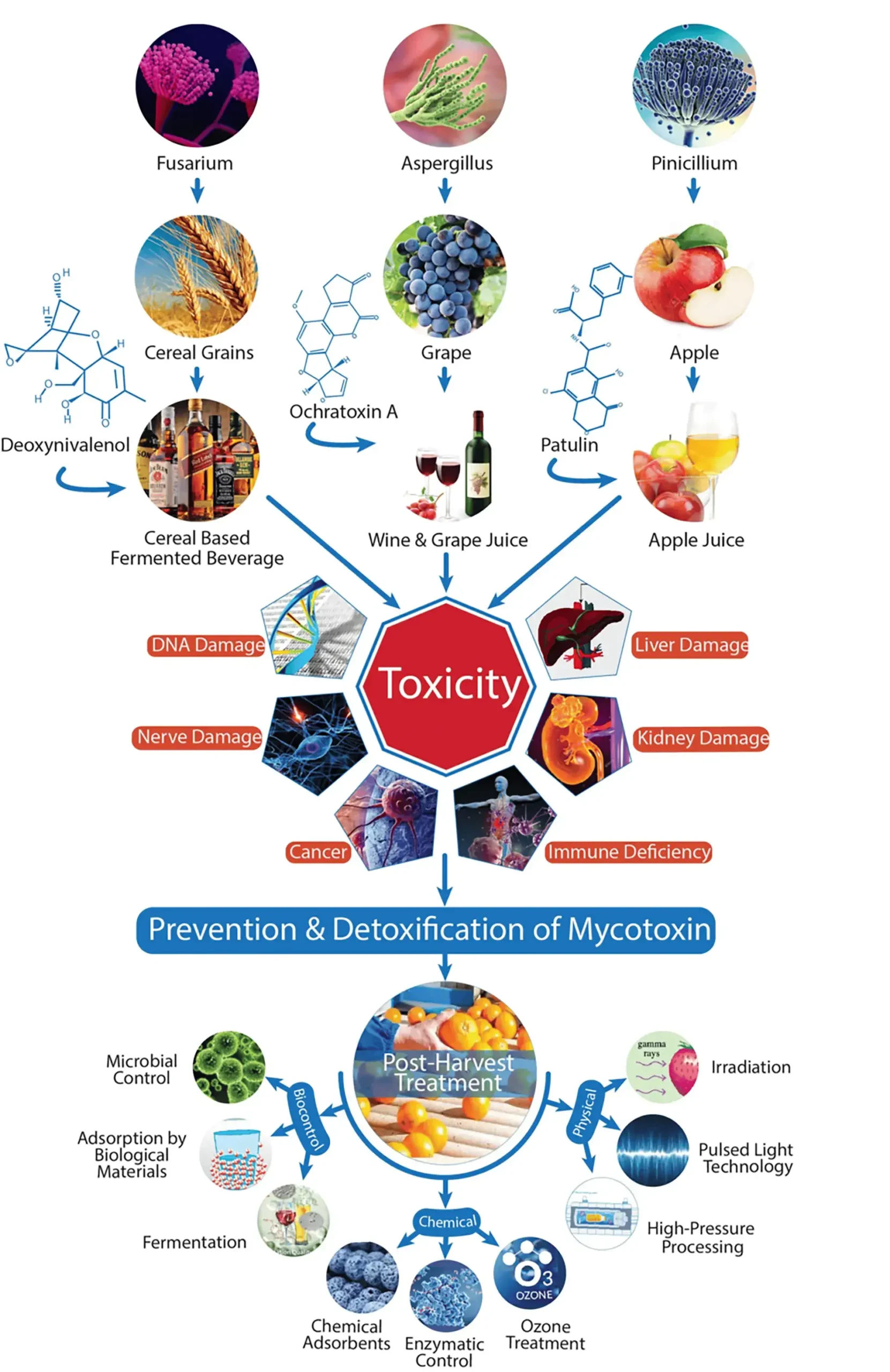
Which Molds Produce Mycotoxins
- Aspergillus Species: Several Aspergillus species are capable of producing mycotoxins under specific environmental conditions. These molds are common indoors and can thrive in moderately damp environments, making them among the most frequently studied in indoor settings.
- Penicillium Species: Penicillium molds are widespread indoors, particularly in areas with recurring humidity or condensation. Some species can produce mycotoxins, while others do not, reinforcing the importance of environmental conditions rather than mold presence alone.
- Fusarium Species: Fusarium molds are more commonly associated with severe water damage or flooding events. Certain species can produce mycotoxins, especially when materials remain saturated for extended periods.
- Stachybotrys (Contextualized): Stachybotrys species are less common indoors than often assumed and typically require continuous moisture to grow. When present, they may produce specific mycotoxins, but only under sustained, high-moisture conditions. Their presence signals chronic water saturation rather than routine humidity problems.
Major Mycotoxin Groups Found Indoors
These classifications group mycotoxins based on the molds that produce them and where they are most often found.
- Aflatoxins: Aflatoxins are produced by certain Aspergillus species. They are among the most studied mycotoxins because of their long-term health relevance. Indoors, they are most commonly associated with chronically damp environments and water-damaged materials rather than brief humidity issues.
- Trichothecenes: Trichothecenes are most often linked to Stachybotrys and some Fusarium species. These compounds are typically associated with materials that have remained wet for long periods, such as water-saturated drywall or wood.
- Ochratoxins: Ochratoxins are produced by several Aspergillus and Penicillium species. They are known for their chemical stability and their ability to persist in indoor dust, especially in buildings with ongoing moisture problems.
- Fumonisins: Fumonisins are primarily associated with Fusarium species. They are more common in agricultural settings but may appear indoors after significant water damage involving organic building materials.
- Zearalenone: Zearalenone is also produced by certain Fusarium species. It is classified separately because it behaves differently in the body, showing hormone-like activity. Indoors, it is typically linked to severe moisture events rather than everyday humidity.
Classification by Health Impact
Mycotoxins are also grouped by which body systems they tend to stress most. This helps explain why symptoms can look very different from one situation to another.
- Hepatotoxic (Liver-Targeting): Some mycotoxins primarily affect the liver, the body’s main detoxification organ, especially with long-term exposure.
- Nephrotoxic (Kidney-Targeting): Certain mycotoxins tend to stress kidney filtration systems, particularly when exposure is ongoing.
- Neurotoxic: Some compounds can affect the nervous system, contributing to cognitive, sensory, or coordination-related symptoms under specific exposure conditions.
- Immunosuppressive: Several mycotoxins are known to interfere with immune signaling or immune cell function, which may reduce resilience to infections over time.
- Carcinogenic: A small number of mycotoxins have been classified as carcinogenic based on strong long-term evidence. This classification reflects chronic exposure risk, not short-term contact.
Why Visual Inspection Cannot Confirm Mycotoxins
Mycotoxins are invisible to the naked eye. They do not form visible coatings, stains, or residue that can be distinguished from ordinary dust or surface debris. Because mycotoxins cannot be seen or smelled, visual inspection alone cannot confirm their presence.
Laboratory analysis is required to detect and identify specific mycotoxins. This limitation is why professional testing becomes necessary when risk assessment goes beyond surface-level mold identification. Visual inspection can indicate moisture problems and mold growth, but it cannot answer toxin-related questions.
Get a Free Mold Testing for Your Long Island, Brooklyn, Queens, or Bronx Property Now!
Key Characteristics of Mycotoxins (Quick Facts)
They Aren’t Living Organisms
Mycotoxins are chemical compounds produced by certain molds as secondary metabolites. (chemical substances created when an organism processes nutrients to survive) Once produced, they exist independently of the mold itself whether it is present or has been removed.
You Can’t See or Smell Them
Mycotoxins are invisible, odorless, and non-volatile.(not easily vaporized at room temperature) A musty smell may suggest mold growth, but it does not confirm whether mycotoxins are present.
Mold Doesn’t Always Make Them
Mycotoxin production is conditional, not automatic. The same mold species may produce toxins in one environment and none in another.
Stress Triggers Production
Molds are more likely to produce mycotoxins when stressed by prolonged moisture, limited nutrients, temperature fluctuations, or competition with other microorganisms.
They’re Chemically Stable
Many mycotoxins resist breakdown from heat, time, and surface exposure. Drying a surface or removing visible mold does not necessarily eliminate them.
They Can Persist After Mold Changes
Mycotoxins may remain in dust and porous materials even after visible mold growth is disturbed or removed, especially when moisture problems were long-standing.
Why These Characteristics Matter
These traits explain why mycotoxins cannot be identified by appearance alone and why visual inspection has clear limits. Because they are invisible, condition-dependent, and chemically stable, meaningful risk assessment requires environmental context and, when appropriate, professional testing rather than assumptions based on what can be seen or smelled.
What To Do If You Think You Have Mold
If you suspect mold in a home or commercial building, the most important thing is to slow down and assess the situation before taking action. Mold concerns are common, but the right response depends on moisture history, location, and scope rather than panic or assumptions.
Step 1: Look For Moisture, Not Just Mold
Mold is a symptom of moisture. Before focusing on visible growth, identify whether water is entering or lingering in the building.
- Recent Or Past Water Damage: Leaks, flooding, roof issues, or plumbing failures.
- Persistent Dampness Or Humidity: Condensation, musty odors, or materials that never fully dry.
- Areas With Limited Airflow: Basements, crawl spaces, bathrooms, attics, or mechanical rooms.
If moisture is ongoing, mold is likely to return regardless of surface cleaning.
Step 2: Avoid Disturbing Suspected Mold
Disturbing mold can spread spores and contaminated dust throughout a space.
- Do Not Scrape Or Dry Brush: This can aerosolize particles.
- Avoid Bleach Or Strong Chemicals: These do not address underlying moisture and can worsen air quality.
- Limit Access If Possible: Especially in occupied commercial spaces or homes with vulnerable individuals.
If the area is small and isolated on a non-porous surface, limited cleaning may be appropriate. Larger or recurring issues require further evaluation.
Step 3: Consider Professional Inspection
Professional inspection is appropriate when conditions are unclear or concerns persist.
- Hidden Or Recurring Mold: Mold returns after cleaning or appears in multiple areas.
- Water Damage History: Past leaks or flooding with no documented drying.
- Health Or Occupancy Concerns: Symptoms that improve outside the building or affect multiple occupants.
- Commercial Properties: Offices, retail, healthcare, schools, and rental properties require documented assessment.
Inspections focus on moisture pathways, building materials, and environmental conditions rather than visible mold alone.
Step 4: Use Testing Strategically
Testing should answer specific questions, not replace judgment.
- Environmental Testing: Helps assess potential exposure patterns.
- Dust Sampling: Often the most informative for long-term indoor exposure.
- Air Sampling: Useful in limited scenarios but not definitive on its own.
Testing is most useful when paired with moisture assessment and building history.
Step 5: Address The Source Before Remediation
Effective remediation must correct the moisture source first.
- Fix Leaks And Intrusion Points: Roofs, plumbing, foundations, and drainage.
- Improve Ventilation And Drying: Bathrooms, HVAC systems, and enclosed spaces.
- Remove Affected Materials When Necessary: Porous materials that cannot be fully dried or cleaned.
Surface cleaning without moisture control almost always leads to recurrence.
Guidance For Homeowners And Commercial Properties
- Homeowners: Focus on moisture history, not just visible mold. Small issues may be manageable, but recurring problems deserve professional evaluation.
- Commercial Properties: Documentation, occupant safety, and liability matter. Professional assessment protects both people and property value.
Free Mold Testing For Long Island Properties
If you are located on Long Island and are unsure whether mold or moisture is a concern, we offer free mold testing and professional guidance for residential and commercial properties. Our team helps identify moisture sources, assess risk clearly, and explain next steps without pressure or alarmism.
Mycotoxins and Indoor Mold: Final Thought
Mycotoxins are real, well-studied compounds, but they are not everywhere, and their presence cannot be assumed based on mold alone. Mold does not automatically produce toxins, and symptoms alone do not confirm exposure.
Understanding the relationship between moisture, mold growth, and toxin production brings clarity. Testing can provide useful information when applied appropriately, and moisture control remains the most effective long-term safeguard.
If uncertainty remains, especially when symptoms, water damage history, or repeated mold issues overlap, professional assessment offers clarity without panic. Informed decisions protect both health and property.
Don’t Chance Leaving Mold in Your Home! Protect Your Home and Your Health with a Free Mold Inspection Now!
Frequently Asked Questions About Mycotoxins and Mold:
Are Mycotoxins Common In Homes?
Mycotoxins are not present in every home. They are more likely in buildings with ongoing or past moisture problems that created conditions for certain molds to produce them.
Can A Home Have Mold Without Mycotoxins?
Yes. Many molds do not produce mycotoxins, and even molds capable of producing them do so only under specific conditions.
Do New Buildings Have Lower Risk?
New buildings may have lower risk initially, but construction moisture, tight building envelopes, and ventilation issues can still create conditions for mold and mycotoxin concerns.
Can Mycotoxin Symptoms Mimic Allergies?
Yes. Symptoms such as congestion, irritation, fatigue, or headaches can overlap with allergy or environmental sensitivity patterns.
Why Do Symptoms Improve Outside The Home?
Improvement outside the home may suggest an environmental factor, but it does not confirm mycotoxin exposure on its own.
Can Symptoms Appear Months After Exposure?
Yes. Chronic low-level exposure may lead to delayed or gradual symptom patterns rather than immediate reactions.
Is Testing Always Necessary?
No. Testing is most useful when combined with moisture history, persistent concerns, or unresolved environmental questions.
Which Test Is Most Reliable For Homes?
Dust sampling is often the most informative environmental method because it reflects exposure over time rather than a single moment.
Can Testing Give False Reassurance?
Yes. Normal results do not always rule out hidden moisture issues or future risk, which is why context matters.
Can HVAC Systems Spread Mycotoxins?
HVAC systems can distribute dust and particles throughout a building, which may contribute to broader exposure if contamination is present.
Does Visible Mold Always Mean Exposure?
No. Visible mold does not automatically indicate mycotoxin exposure, and absence of visible mold does not guarantee absence of risk.
Can Past Water Damage Still Matter Years Later?
Yes. Past water damage can leave behind conditions that continue to influence indoor environments long after visible signs fade.
Are Children More Vulnerable Than Adults?
Children may be more sensitive due to developing immune and respiratory systems, but response varies between individuals.
Is Professional Remediation Always Required?
No. Small, isolated mold issues may be manageable, but chronic moisture or recurring problems often require professional assessment.
Can Moisture Alone Cause Problems Without Mold?
Yes. Excess moisture can contribute to poor indoor air quality and material degradation even before visible mold develops.