
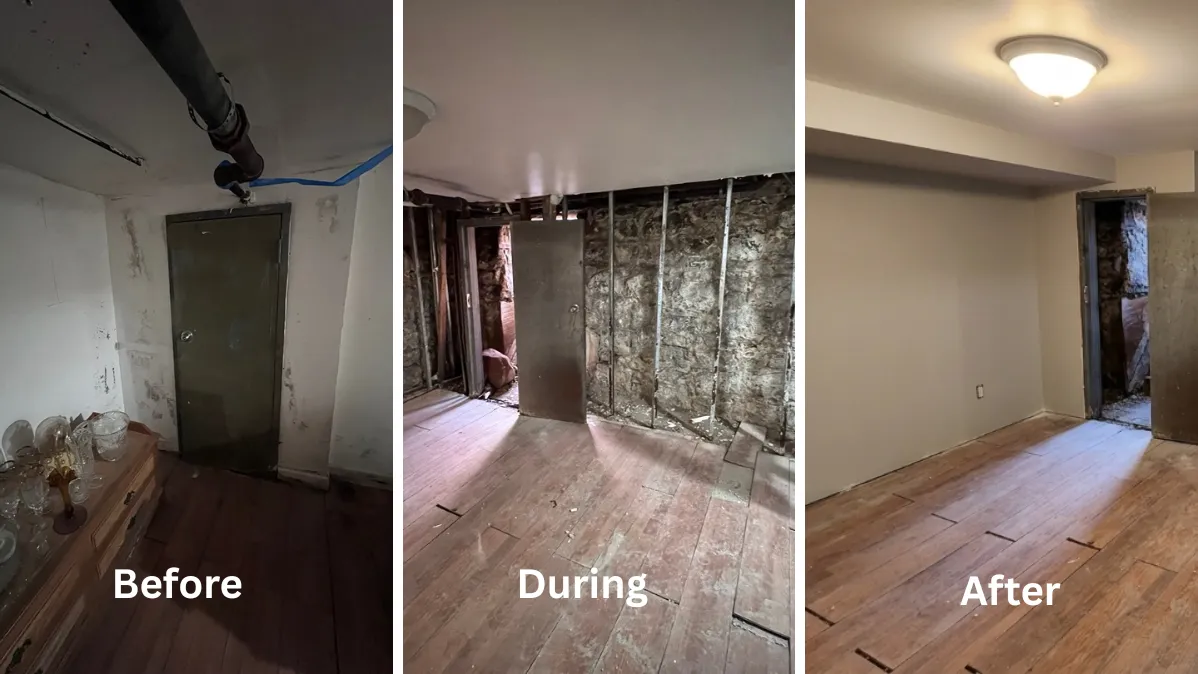
When the Alvarados called Mold Removal Experts, they weren’t starting from scratch — they were starting from a mess someone else had left behind. A previous contractor had begun finishing their Bedford-Stuyvesant basement, then walked away partway through, leaving construction debris on the slab and framing built from ordinary, moisture-prone lumber. Within months, the space had turned against them: musty air, dark staining creeping up the studs, and a floor that no longer felt solid underfoot.
The homeowners were clear about what they wanted. Before another dollar went into finishing the basement, they needed the existing work torn out, the contamination dealt with properly, and the space returned to a clean, healthy starting point. In their words, they didn’t want to “build a nice room on top of a hidden problem.” That’s exactly the kind of job our team is built for.
| Field | Detail |
|---|---|
| Client | Marcus & Renée Alvarado (illustrative) |
| Location | Bedford-Stuyvesant, Brooklyn, NY |
| Property Type | Residential single-family basement |
| Service Performed | Structural demolition + mold remediation |
| Root Issue | Prior contractor’s debris + non-mold-resistant materials |
| Inspection Date | May 6, 2025 |
| Project Completed | May 2025 |
| Outcome | Fully cleared, decontaminated shell ready for a safe rebuild |
Initial Inspection
A senior estimator from Mold Removal Experts walked the property on May 6, 2025, and the picture came into focus fast. This wasn’t surface mildew that a spray bottle could handle. It was contamination baked into the structure itself.
The inspection turned up four compounding problems:
- Framing built directly over buried debris. Instead of clearing the slab first, the prior crew had framed straight over piles of leftover construction waste, sealing moisture and pest bait inside the wall cavities.
- Rusted, mold-embedded studs and plates. Nearly every framing stud and plate showed rust staining and embedded mold growth, a sign the wood had been damp for a long time and was never going to dry out clean.
- Saturated, failing wood flooring. The wood floor system had warped, buckled, and soaked through in multiple areas. The damage was irreversible; there was nothing left to save.
- A contaminated bathroom vanity. A vanity had been installed against an already-infected wall, with plumbing tied in, making it both a contamination source and a demolition obstacle.
The verdict was straightforward: partial fixes would only trap the problem behind new drywall. The basement needed a full, contained tear-out before any rebuild could safely begin.
Scope of Work
We broke the project into four coordinated demolition and decontamination tasks, each handled under mold-safe protocols to keep spores from spreading through the rest of the home.
Clearing the Hidden Debris Behind the Framing
The first job was the one no one could see. Our crew opened up the framed walls and removed the construction debris the previous contractor had buried behind them. Left in place, that trapped material would have kept feeding moisture and inviting pests for years. Hauling it out eliminated a hidden fuel source for future mold before the rebuild ever started.
Removing the Mold-Embedded & Rusted Framing
Because rust and mold had worked their way into nearly 100% of the studs and plates, spot-treating wasn’t an option. The framing itself had become the problem. Working inside a contained area and in full personal protective equipment (PPE), the team took the compromised framing down to the structure. Every removed piece was bagged and disposed of under proper protocols so airborne spores stayed controlled throughout.
Tearing Out the Water-Damaged Wood Flooring
Next came the failed floor. The wood flooring showed warping, buckling, and deep saturation across the affected zones, well past the point of drying and salvaging. Our crew removed the entire floor system, exposing the substrate beneath so it could dry out and be evaluated for a clean, moisture-resistant rebuild.
Removing the Mold-Contaminated Vanity
Finally, the bathroom vanity that had been mounted to the infected wall was safely disconnected at the plumbing and removed. Because it was fastened directly to contaminated material, it had to come out as part of the remediation rather than be worked around. With the plumbing capped and the unit disposed of, the last contamination source was gone.
How We Kept It Safe: Our Method
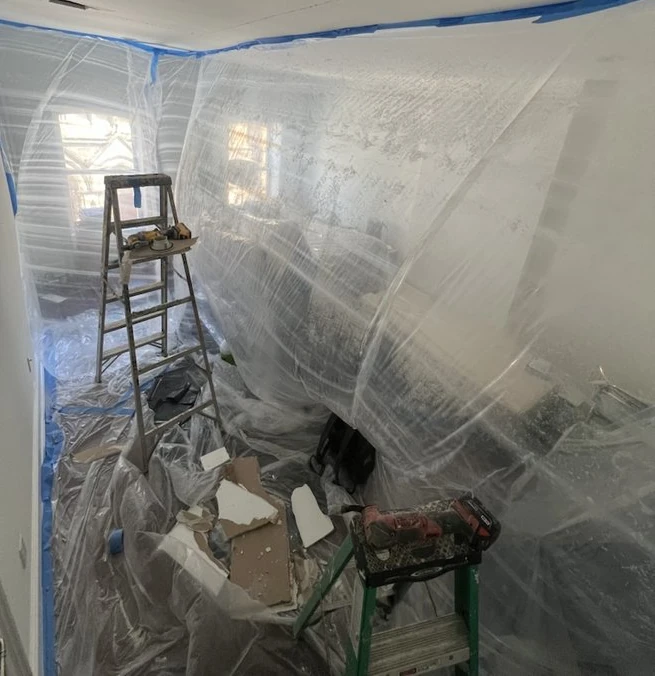
Demolition in a mold-contaminated space isn’t just knocking things down. Done carelessly, it launches millions of spores into the air and spreads the problem upstairs. Every step of this project followed the same disciplined approach:
- Containment first. The work zone was isolated so airborne spores couldn’t migrate into living areas during demolition.
- Full PPE. Crew members wore appropriate respiratory and skin protection throughout the tear-out to minimize exposure.
- Controlled removal and disposal. Contaminated framing, flooring, and fixtures were bagged and hauled out under proper protocols rather than piled on-site.
- Root-cause mindset. Rather than covering damage, we removed every affected material so the rebuild could start on a genuinely clean, dry base.
The Takeaway for Homeowners
This project is a textbook example of a lesson we see over and over: finishing a basement over a moisture problem doesn’t hide it, it feeds it. When a previous job leaves behind debris and non-mold-resistant materials, the fix isn’t more drywall on top. It’s a proper, contained remediation that removes the contamination at its source so the rebuild lasts. Catching it at the “tear it out and start clean” stage is far cheaper than discovering it again after a beautiful new basement is already in place.
The Result: A Healthier Basement, Ready for What's Next
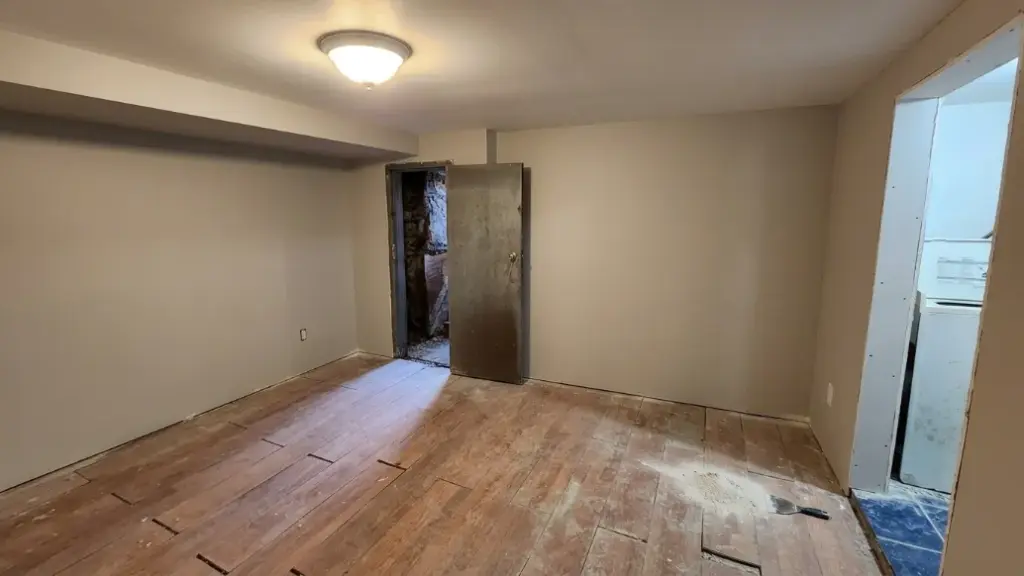
By the end of the project, the Alvarados’ basement was unrecognizable, in the best way. The buried debris was gone, the mold-embedded framing and ruined flooring were removed, and the contaminated vanity had been safely extracted. What remained was a clean, decontaminated shell with the moisture problems addressed at the source instead of hidden behind fresh paint.
Most importantly, the family got what they actually came for: peace of mind. The space is now clear of hidden hazards and ready for a safe, moisture-resistant rebuild, the kind of foundation that supports a healthier indoor environment for years to come, not another round of the same problem.