
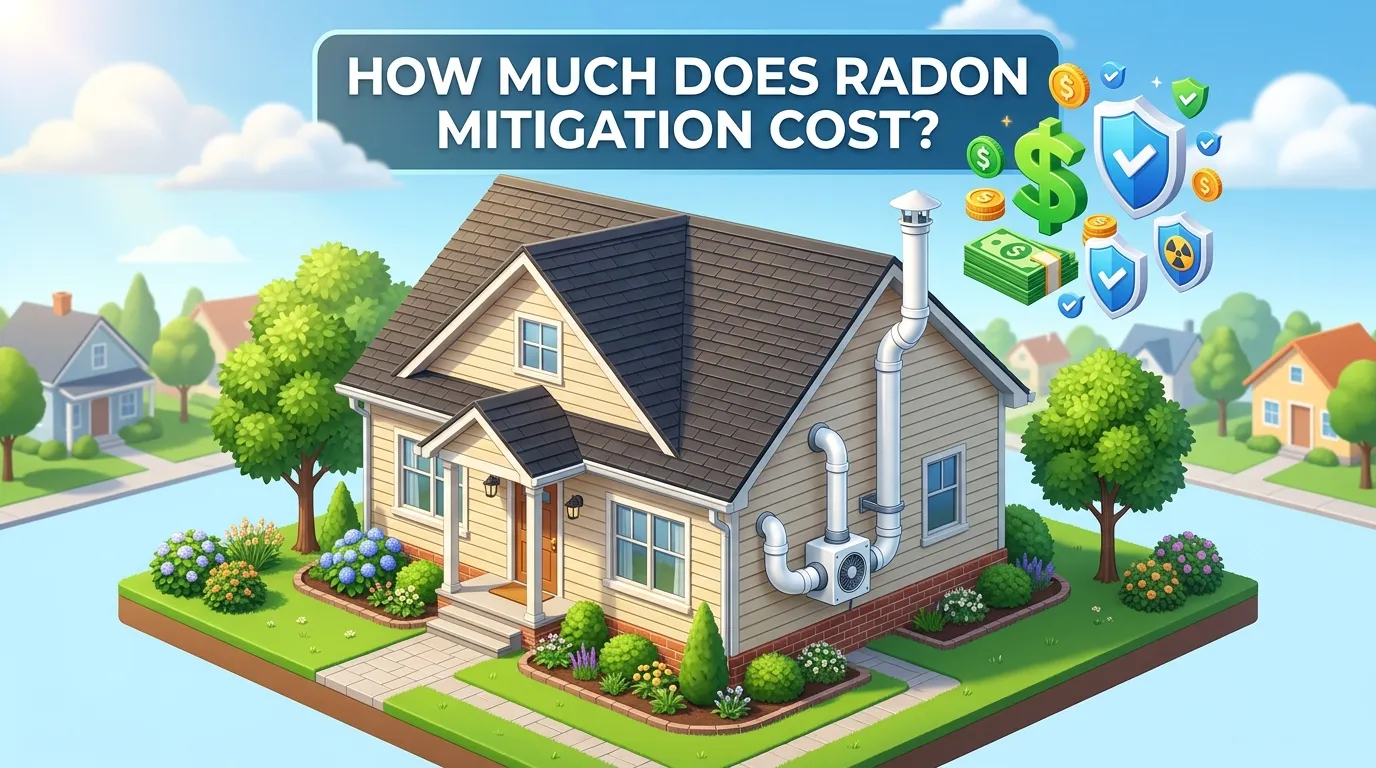
If your radon test came back high, you probably want a straight answer before anyone shows up at your door, so here it is. Most homeowners pay somewhere between $800 and $1,500 for a standard radon mitigation system, and the radon mitigation cost can climb to $2,500 or more on larger or more complicated homes.
The real number depends on your foundation, your radon level, how the system has to be designed, where the fan goes, how easy the home is to access, and whether the job needs electrical work, sealing, crawl space treatment, or more than one suction point. The EPA recommends fixing any home that tests at 4 pCi/L or higher, and it suggests considering action between 2 and 4 pCi/L too, because there is no known safe level of radon exposure.
Below, you will see why two nearly identical houses can get two very different quotes, and how to tell a good system from a cheap one that will let you down. Long Island, Brooklyn, Queens, and The Bronx homeowners can count on Zavza Seal for proven solutions and hassle-free inspections!
Schedule Your Free Inspection Today and Take the First Step Toward a Radon-Free Home!
| Project Type | Typical Cost Range | Best For |
|---|---|---|
| Basic Sub-Slab Depressurization | $800–$1,500 | Most basement or slab homes |
| More Complex Active System | $1,500–$2,500+ | Larger homes, multiple foundations, difficult routing |
| Crawl Space Radon Mitigation | $1,500–$3,000+ | Dirt-floor or vented crawl spaces needing sealing |
| Radon Fan Replacement | $200–$600 | Existing system with a failed fan |
| Post-Mitigation Radon Test | $25–$150+ | Confirming the system worked |
Radon Mitigation Cost at a Glance
Most homeowners pay between $800 and $1,500 for a standard radon mitigation system. Simple installations can come in lower, and large, complex, or hard-to-reach homes can run $2,500 or more once you factor in multiple suction points, crawl space sealing, slab work, electrical upgrades, or more advanced ventilation. The only way to price your home accurately is to test it, inspect the foundation, and design the system around how radon is actually getting in.
What Is Radon Mitigation?
Let’s clear up the biggest misunderstanding first. Radon mitigation is not about removing radon from the soil. You cannot do that, and no honest contractor will tell you otherwise. What a mitigation system actually does is stop radon gas from building up inside your home by redirecting it safely outdoors before it ever reaches the air you breathe.
The most common setup is an active sub-slab depressurization system. In plain terms, a pipe and a quiet fan pull radon out from underneath your slab and send it up and out above the roofline, where it disperses harmlessly.
A few things worth knowing:
- Radon is invisible and odorless, and it forms naturally as uranium in soil and rock breaks down.
- It sneaks in through cracks, slab openings, crawl spaces, sump pits, construction joints, and foundation gaps.
- A working system creates negative pressure under the home, so radon gets vented outside instead of seeping into your living space.
- Testing before and after installation is what proves the system is doing its job.
Already tested above 4 pCi/L? Schedule a radon mitigation inspection before you commit to any particular system.
How Much Does Radon Mitigation Usually Cost?
Here is the part you came for. The common range is genuinely useful for budgeting, but treat it as a starting point and not a fixed menu. The quote always comes down to the house.
Average Radon Mitigation Cost
Most systems land in that $800 to $1,500 window, with national averages often sitting closer to $1,000 to $1,200 depending on who you ask and where you live. EPA consumer guidance frames it well: fixing a home for radon usually costs about the same as plenty of other routine home repairs, and the exact price depends on the size of the home, its design, and the reduction method it needs.
Low-End Radon Mitigation Cost
You will see the lower end of the range when the home cooperates. Think easy pipe routing, an accessible slab, a single suction point, and a power source already close to where the fan needs to go. A clean, simple slab home with a straight shot to the roofline is about as affordable as radon work gets.
High-End Radon Mitigation Cost
The price climbs when the home fights back. Large square footage, finished basements you don’t want torn into, mixed foundation types, crawl spaces, sump integration, awkward vent routing, an upgraded high-suction fan, cosmetic interior piping, and added electrical work can all push a job toward the top of the range or past it.
Why Two Homes With the Same Radon Level Can Cost Different Amounts
This trips up a lot of homeowners, so it is worth slowing down on. Your radon level matters, but the pathway radon takes into your house matters more. A home that reads 6 pCi/L over a simple slab can easily cost less to fix than a home reading 4.5 pCi/L that sits over a dirt crawl space with two additions and no clean route for the vent pipe. The number on your test report tells you whether to act. It does not tell you what the system will cost.
Radon Mitigation Cost by System Type
If you only read one section before you call around for quotes, make it this one. This is where the price difference between contractors actually comes from.
- Foundation Type: Basements, slab-on-grade, crawl spaces, mixed foundations, additions, and older layouts all behave differently. The more foundation types under one roof, the more the system has to account for.
- Home Size and Layout: Bigger homes can call for stronger fans, longer pipe runs, or additional suction points to keep the pressure field consistent underneath
- Radon Level: A higher reading does not automatically mean a pricier system, but it can call for a stronger design, more testing, or extra suction points to get results down where they belong.
- Number of Suction Points: A straightforward home might need a single suction point. A complex or compartmentalized foundation may need two or more, and each one adds labor and materials.
- Pipe Routing and Appearance: Running the pipe along the exterior is often the simplest and cheapest path. Interior routing can look cleaner, but it costs more when it has to be planned around finished space.
- Electrical Requirements: Active systems need a fan, and a fan needs power. If there is no suitable electrical access nearby, you may need an electrician, and that adds to the total.
- Crawl Space Sealing: Crawl spaces usually need membrane sealing, air sealing, and careful vapor control before the system can do its job, which is a real part of the cost.
- Permits, Codes, and Local Labor Rates: Local labor rates, permit requirements, and state or municipal radon rules all factor into the final number.
- Post-Mitigation Testing: Testing after the system is running is how you prove it actually pulled your levels down. A good contractor builds this into the plan rather than treating it as an afterthought.
Radon Mitigation Cost by System Type
You will feel a lot more confident on the phone with a contractor if you understand the basic system types. None of this is complicated once someone explains it without the sales pitch.
- Active Sub-Slab Depressurization: Best for basement and slab-on-grade homes. This is the most common and usually the most cost-effective approach. The contractor cores a hole through the slab, runs PVC piping, and installs a radon fan that pulls gas from beneath the foundation and vents it outdoors.
- Drain Tile or Sump-Based Radon Mitigation: Best for homes with drain tile systems or a sump pit. This can be an efficient route when the existing drainage system can be sealed and used as part of the design. The contractor ties the radon system into a drain tile layer or a sealed sump cover.
- Crawl Space Radon Mitigation: Best for homes with dirt-floor or open crawl spaces. This one tends to cost more because it often requires installing a vapor barrier, sealing the space, and adding dedicated venting. A sealed membrane goes down over the crawl space floor, and radon gets pulled from underneath it.
- Passive Radon Mitigation System: Best for newer homes built with radon-resistant features already in place. These rely on natural airflow rather than a fan, so they cost little to operate. The catch is that a passive system may not bring radon down far enough on its own.
- Active System Upgrade From a Passive System: Best for homes that already have passive piping but still test high. This is frequently cheaper than starting from scratch because the pipe route is often already there. The contractor adds a fan and then confirms performance with follow-up testing.
| Service | Typical Cost | Purpose |
|---|---|---|
| DIY Short-Term Radon Test | Low-cost | Initial screening |
| Professional Radon Test | Moderate | Real estate, confirmation, documentation |
| Radon Mitigation Inspection | Varies | Determines system design |
| Radon Mitigation System | $800–$1,500+ | Reduces indoor radon levels |
| Post-Mitigation Test | Low to moderate | Confirms system performance |
Radon Mitigation Cost vs. Radon Testing Cost
A lot of people mix these two up, so let’s separate them cleanly. Testing tells you whether you have a problem. Mitigation fixes it. You only pay for mitigation after a test confirms elevated levels.
DIY short-term radon test kits are inexpensive and fine for an initial screening. Professional testing costs more, but it is often preferred for real estate transactions where documentation matters. And remember the EPA guidance: fix at or above 4 pCi/L, and seriously consider it between 2 and 4 pCi/L.
What Should Be Included in a Radon Mitigation Quote?
A good quote explains the system. It does not just hand you a number and a signature line. Before you agree to anything, make sure the proposal covers:
- Your current radon test results
- The recommended mitigation method
- The number and location of suction points
- Fan type and placement
- The pipe route
- The discharge location
- Electrical requirements
- Any sealing work included
- Permits and code compliance where applicable
- Warranty information
- A post-installation testing plan
- The expected radon reduction goal
If a contractor can walk you through every line above, you are dealing with someone who designs systems. If all you get is a price, keep calling.
How Long Does Radon Mitigation Installation Take?
For most homes, this is a one-day job. A standard system goes in, the fan gets wired and mounted, and the pipe is routed to its discharge point. Crawl spaces, complex foundations, finished basements, and multi-suction-point systems can take longer. Follow-up radon testing happens after the system has run long enough to give a meaningful reading, not the same afternoon.
How Long Does a Radon Mitigation System Last?
The bones of the system last a long time. PVC piping can run for decades with no attention at all. The fan is the part that eventually wears out, and replacing one typically runs $200 to $600, with the average sitting around $350. It is worth glancing at the manometer (the small pressure gauge on the pipe) now and then to confirm the system is still pulling, and you should retest after any major renovation, foundation change, or HVAC change, since those can shift how radon moves through the home.
Get a Radon Mitigation Estimate
If your test came back high, the next step is not guessing what a system should cost. It is having your foundation, slab, crawl space, sump area, and venting options inspected so the system gets designed for your home specifically. A proper estimate should explain where radon is entering, what system is recommended, how it will vent, and how the results will be verified once it’s running.
- Get a Radon Mitigation Estimate
- Schedule a Radon Inspection
- Test High for Radon? Get Help Now
- Request a Radon System Quote
Radon Mitigation Cost: Final Thoughts
The honest answer to “how much does radon mitigation cost?” is that most homes land somewhere around $800 to $1,500, but the right number for your house depends on how radon is getting in and what it takes to vent it safely back out. A simple slab system can be quick and affordable. A crawl space, finished basement, mixed foundation, or awkward vent route will raise the radon mitigation cost because the system has to be built around your structure rather than dropped in off a shelf.
What matters most is not landing the lowest quote, it is getting a system that actually lowers your radon level and proves it with follow-up testing. If your home tested at or above the EPA action level, get a professional inspection and a clear mitigation estimate before the problem sits any longer.
Schedule Your Free Assessment Today!
Frequently Asked Questions About Radon Mitigation Cost
How much does radon mitigation cost on average?
Most radon mitigation systems cost about $800 to $1,500, though complex homes can run $2,500 or more. The final price depends on foundation type, home size, system design, fan placement, pipe routing, electrical work, and whether crawl space sealing is needed.
Why is radon mitigation so expensive?
It costs more than a simple repair because the contractor is designing an active ventilation system for your foundation. The work can involve slab coring, PVC piping, a radon fan, electrical connections, sealing, roofline venting, crawl space membrane work, and post-installation testing.
Is radon mitigation worth it?
Yes, if your home has elevated radon. The EPA recommends fixing homes at 4 pCi/L or higher and considering action between 2 and 4 pCi/L. Mitigation reduces long-term exposure and can also head off problems during a future home sale.
Does homeowners insurance cover radon mitigation?
Usually not. Radon is typically treated as an environmental or maintenance issue rather than sudden accidental damage. Check your specific policy, but most mitigation systems are paid out of pocket.
Can I reduce radon by opening windows?
Opening windows can lower indoor radon temporarily, but it is not a reliable long-term fix. Levels rise again once windows close or air pressure shifts. A mitigation system is built to vent radon from beneath the home continuously.
Can sealing cracks fix radon?
Sealing can help, but it usually does not fix elevated radon on its own. Radon enters through many foundation openings, joints, sump pits, and soil pathways, so most elevated homes need an active system that pulls radon from beneath the slab or crawl space.
How long does radon mitigation take to install?
Many standard systems install in a single day. More complicated projects, including crawl spaces, finished basements, multiple suction points, or difficult pipe routing, can take longer.
How do I know if the radon system worked?
Retest after installation. A post-mitigation radon test confirms whether the system brought your level below the action threshold and whether any adjustments are needed.
Who should install a radon mitigation system?
A qualified radon mitigation contractor, especially if the home tested at or above 4 pCi/L, has a crawl space, is part of a real estate transaction, or needs electrical work, sump sealing, or complex vent routing.
Does radon mitigation increase home value?
It may not add value the way a kitchen remodel does, but it protects resale confidence. A documented system reassures buyers, smooths negotiations, and shows that an elevated radon result was handled the right way.