
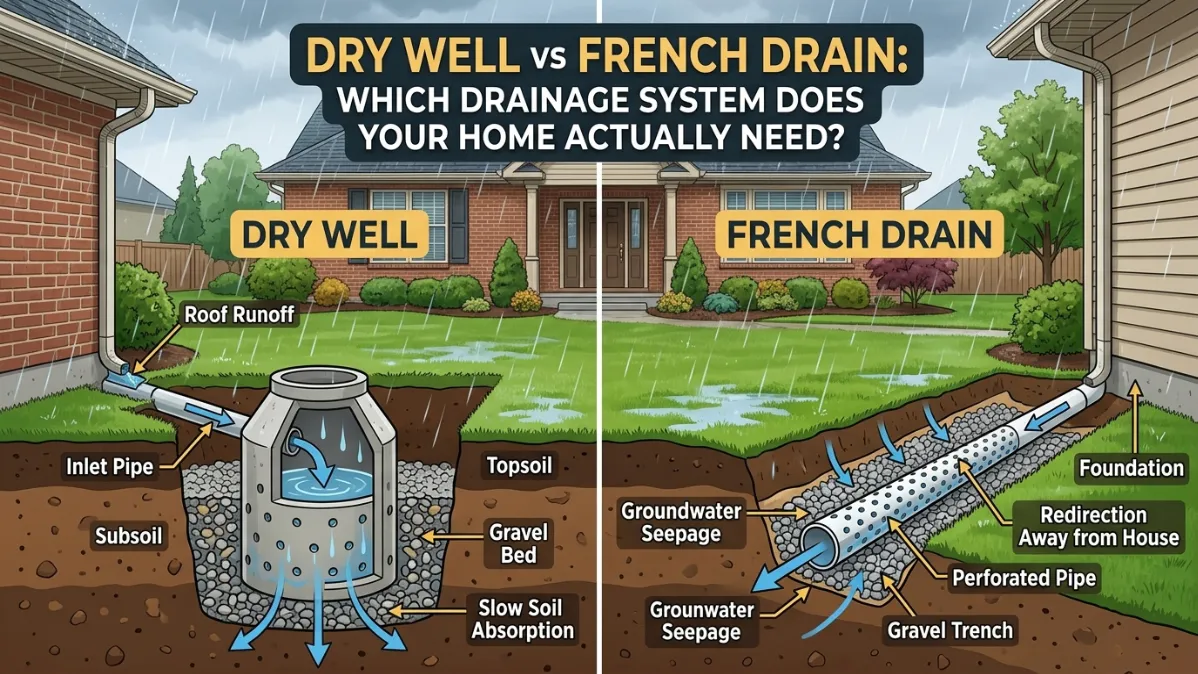
If you have water pooling in your yard, a soggy lawn, or a basement that floods after every storm, you have probably run into the dry well vs french drain question and found a lot of conflicting answers. The confusion is understandable, because the two systems look similar in a trench and are often installed together, yet they do completely different jobs. The short version: a french drain collects water and moves it somewhere else, while a dry well stores water and lets it soak slowly into the ground. One is about conveyance. The other is about dispersal. Getting the dry well vs french drain decision right is the difference between a yard that finally drains and an expensive system that simply relocates the problem. This guide breaks down how each one works, when to use which, and how to untangle the related terms that homeowners constantly mix up.
In the Long Island Area? Get a Professional Drainage Assessment and Find Out Which Drainage System is Right for Your Home!
What Is a French Drain?
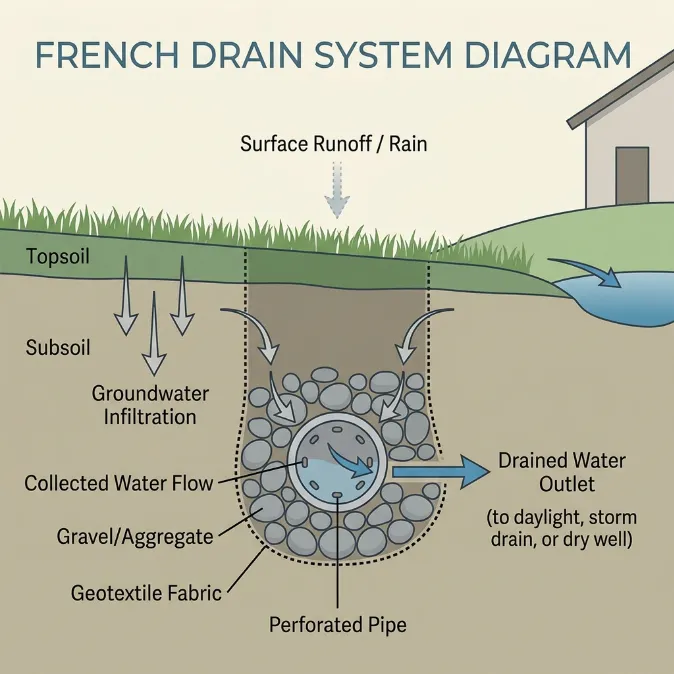
A French drain is a gravel-filled trench with a perforated pipe running along the bottom. Water enters the trench through the gravel, drops into the perforated pipe, and travels by gravity along the length of the pipe to a discharge point somewhere away from your home. That discharge point might be a lower spot on a sloped lot (called daylighting), a storm drain, a sump pit, or, often, a dry well.
The defining feature of a french drain is that it is linear. It is built to intercept water across a distance and channel it in a chosen direction. Homeowners use french drains to pull groundwater away from a foundation, to dry out a perpetually wet section of yard, to relieve pressure behind a retaining wall, or to capture water along the base of a slope before it reaches the house. Inside a basement, the same principle becomes an interior perimeter drain that feeds a sump pump.
The thing to understand is that a french drain does not get rid of water on its own. It moves water. That water still has to end up somewhere, and where it ends up matters as much as the drain itself.
What Is a Dry Well?
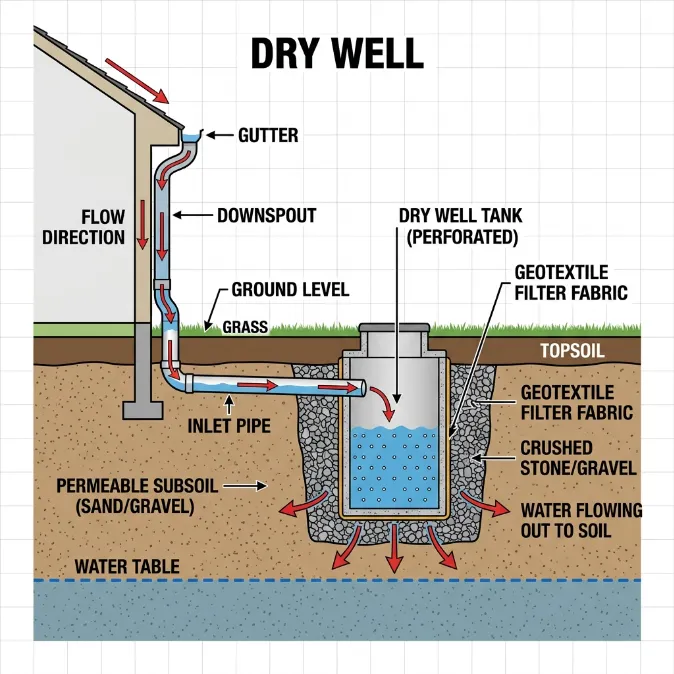
A dry well is an underground pit or chamber that receives water and lets it percolate slowly into the surrounding soil. Older versions are simply a hole filled with stone. Modern versions use a hollow perforated plastic chamber wrapped in landscape fabric and surrounded by gravel, which holds far more water per cubic foot than stone alone. Water flows in, fills the void space, and then disperses out through the sides and bottom into the earth over the following hours.
The defining feature of a dry well is that it is a destination, not a path. It does not carry water across your property. It accepts a concentrated volume of water at a single point and gives it time and surface area to soak away. Homeowners use dry wells to handle roof runoff from downspouts, to receive sump pump discharge, and to absorb water collected by a french drain or a catch basin.
A dry well only works if the soil around it can actually absorb water. In sandy soil it can be very effective. In dense clay or where the seasonal water table sits high, a dry well fills faster than it can empty and becomes a buried bathtub. That soil reality is central to the entire dry well vs french drain conversation, and it is where many homeowner installs go wrong.
Not Sure Which Kind is Best for Your Property?
Dry Well vs French Drain: The Benefits and Drawbacks of Each
A French drain is the better choice when water needs to be intercepted and moved away from a wet area. It is especially useful along foundations, retaining walls, soggy yards, and low spots where water keeps collecting after rain. The main limitation is that a French drain still needs somewhere to send the water, which means the property needs a safe discharge point, slope, dry well, storm system, or another approved outlet.
French Drain Benefits and Drawbacks
Looking at the benefits of French drains and drawbacks side by side makes the dry well vs French drain choice much clearer. Both systems solve drainage problems, but they do it in different ways. A French drain is built to collect and redirect water across a property, while a dry well is built to hold water temporarily and release it slowly into the surrounding soil. Once you understand that difference, it becomes easier to see why some homes need one system, while others need both working together.
French Drain Benefits:
- Excellent Water Redirection: A French drain is excellent at intercepting and redirecting water across a distance.
- Foundation Pressure Relief: It helps relieve hydrostatic pressure against foundations and retaining walls.
- Strong Fit for Sloped Lots: It works well on lots with a slope it can drain toward.
- Steady Groundwater Control: It handles steady groundwater, not just storm surges.
French Drain Drawbacks:
- Needs a Viable Discharge Point: A French drain needs somewhere safe to send the water, which not every lot has.
- Can Clog Over Time: The pipe can clog with silt and roots if it is not built with proper fabric and stone.
- Limited on Flat Lots: On a flat lot with nowhere to send the water, a French drain alone may simply collect water without solving the real drainage problem.
Dry Wall Benefits and Drawbacks
A dry well is the better choice when water needs to be stored and dispersed underground. It is commonly used for downspouts, sump pump discharge lines, catch basins, and other concentrated water sources that release a large amount of water at once. The main limitation is soil performance. If the surrounding soil does not drain well, or if the groundwater table is too high, the dry well may fill faster than it can empty.
Dry Well Benefits:
- Concentrated Water Dispersal: A dry well disperses a large slug of water from one concentrated source, such as a downspout or sump line.
- No Slope Required: It does not need slope or a distant discharge point to function.
- Foundation Protection: It keeps roof and sump water from being dumped next to the foundation.
- Strong System Endpoint: It pairs perfectly as the endpoint for a French drain or catch basin.
Dry Well Drawbacks:
- Depends on Soil Drainage: A dry well is completely dependent on how well the surrounding soil absorbs water.
- Limited in Clay or High Water Tables: It loses capacity in clay soil or areas where the water table is high.
- Can Silt Up Over Time: It can clog and fail over the years without a sediment trap or catch basin upstream.
- Limited Storage During Heavy Rain: Its performance is limited by its volume during very heavy or prolonged storms.
The pattern that emerges is that these are not true competitors. A French drain is good at gathering and moving water, but it needs an exit. A dry well is good at absorbing water, but it needs the water delivered to it. On many properties, the correct answer is not one or the other. It is a French drain that discharges into a dry well, with each part doing what it does best.
Choosing the Best Option: Dry Well vs French Drain for Your Property
The best option in the dry well vs French drain decision comes down to three property-specific facts, and you cannot judge it from a blog post alone. First, how does your soil percolate? A simple percolation test tells you whether a dry well will actually empty or just sit full. Second, do you have anywhere to send water? A lot with a slope or a street storm drain opens up daylighting options that a flat lot does not. Third, what kind of water are you fighting, a concentrated discharge or area-wide saturation? Match the tool to the water. A contractor who skips the soil and discharge assessment and immediately quotes one system without checking the other is guessing, and on drainage work, guessing gets expensive.
NY Metro Considerations: Soil, Water Table, and Code
Local conditions decide a lot of this. Parts of Long Island sit on sandy soil that drains beautifully and makes dry wells genuinely effective. Other neighborhoods sit on dense clay or have a seasonal high water table, where a dry well fills and stops accepting water exactly when you need it most. In those areas a french drain that carries water to a better location, or a tie-in to an interior drainage and sump system, often outperforms a dry well.
Local stormwater and drainage codes also govern where you can discharge water, how far structures must sit from property lines, and whether a permit is required. Discharging onto a neighbor’s property or into the street without authorization can create both a legal problem and a bad relationship. A contractor who works in your municipality knows these rules and designs around them.
Cost and Installation Realities
A basic dry well install commonly runs from a few hundred dollars for a small downspout soakaway up to a few thousand for a large engineered chamber with a catch basin and sediment control. A french drain typically runs higher per project because of the trenching length involved, often from one to several thousand dollars depending on distance, depth, and access. A combined system that collects with a french drain and disperses into a dry well costs more than either alone but solves problems that neither could solve by itself.
Treat these as planning ranges, not quotes. The real number depends on soil, length, depth, the number of downspouts or discharge points, and how much the route has to work around existing landscaping and utilities.
Dry Well vs French Drain: Final Thoughts
The dry well vs french drain debate has a frustrating answer for anyone hoping for a simple winner: they are different tools, and the right one depends entirely on your water, your soil, and your lot. A french drain gathers water and moves it. A dry well takes water and lets it soak away. Neither is universally better, and on many NY metro properties the best result comes from using them together, with a catch basin protecting the dry well and keeping the whole system alive for years. The terms around them, wet well, catch basin, gravel pit, drain field, and leach field, all describe genuinely different things, and confusing the septic terms with the stormwater ones can be both dangerous and illegal. Before committing to a dry well vs french drain plan, get your soil and discharge options assessed on site, because that single step decides which system will actually keep your home dry. If you want a straight answer for your specific property, our team can trace where your water is going and tell you honestly what it needs.
Frequently Asked Questions Dry Well vs French Drain
Is a Dry Well or a French Drain Better for a Wet Yard?
A French drain is usually better for a wet yard when water is spread across a large area and there is a safe place to discharge it. A dry well is better when the water comes from one concentrated source, such as a downspout, sump pump, or catch basin, and the soil drains well. On flat lots with no natural outlet, a French drain and dry well often work best together.
Can a French Drain Empty Into a Dry Well?
Yes, a French drain can empty into a dry well, and this is one of the most effective drainage combinations. The French drain collects and carries water from the wet area, while the dry well stores that water and lets it soak slowly into the surrounding soil. A catch basin or sediment trap upstream helps keep silt out of the dry well and extends the system’s lifespan.
What Is the Difference Between a Dry Well and a French Drain?
A French drain moves water from one area to another, while a dry well stores water underground and disperses it into the soil. French drains are best for collecting groundwater, yard runoff, and water near foundations. Dry wells are best for handling concentrated water from downspouts, sump pump lines, and catch basins.
What Is the Difference Between a Dry Well and a Leach Field?
A dry well handles clean stormwater from sources such as roof runoff, yard drains, and sump discharge. A leach field, also called a drain field, disperses treated wastewater from a septic system. They are completely separate systems with different purposes and should never be connected.
Do Dry Wells Work in Clay Soil?
Dry wells usually do not work well in clay soil because clay absorbs water slowly. When the surrounding soil cannot drain fast enough, the dry well fills up and stays full, which can cause water to back up into the yard or drainage line. In clay soil, a French drain, sump system, storm drain connection, or another approved discharge option is often a better fit.
Do French Drains Work on Flat Land?
French drains can work on flat land, but only if the system has a reliable way to move or collect the water. Since a French drain depends on slope or a discharge point, flat yards may need a sump pump, dry well, catch basin, or engineered outlet. Without somewhere to send the water, a French drain may collect water without truly solving the drainage problem.
How Long Do French Drains and Dry Wells Last?
A well-built French drain can last for decades when it is installed with proper pipe, washed stone, filter fabric, and a clear discharge point. A dry well can also last many years, but it depends heavily on soil drainage and sediment control. The most common reason either system fails early is silt, roots, poor fabric, crushed pipe, or lack of a catch basin upstream.
Can a Dry Well Overflow?
Yes, a dry well can overflow if it receives more water than it can store or absorb. Overflow is more likely during heavy storms, prolonged rainfall, clay soil conditions, high groundwater, or when the dry well has filled with sediment. A properly sized dry well should include overflow planning so excess water has a safe place to go.
Do I Need a Permit for a Dry Well or French Drain?
Permit requirements depend on local codes, drainage rules, and where the water will discharge. Some areas allow basic yard drainage work, while others require approval for dry wells, stormwater systems, sump discharge, or connections near property lines. Before installation, it is best to confirm local requirements so the system does not create runoff problems for neighbors or violate municipal drainage rules.
Which Is Better for Basement Water Problems, a Dry Well or a French Drain?
A French drain is usually better for basement water problems when groundwater or hydrostatic pressure is building up around the foundation. A dry well can help if the issue is caused by roof runoff or sump pump discharge being dumped too close to the house. Many basement drainage problems need both: a French drain to move water away from the foundation and a dry well to disperse it safely underground.