
Signs You Need a French Drain
Water damage rarely leaves subtle clues long before it becomes a major problem. If you’re noticing any of the signs below, your property is likely struggling to manage excess groundwater.
Use quick icons or checkmarks in your design for easy scanning:
- Standing water near the foundation
- Basement or crawl space flooding
- Constant soggy or muddy areas in the yard
- Water stains on foundation walls
- Persistent musty or damp odors indoors
- Peeling paint or white, powdery efflorescence on concrete
- Mold growth on lower-level walls or corners
- Cracks forming in foundation walls or floor slabs
If two or more of these warning signs are present, a French drain system is often the most effective next step to stop the source of the problem.
Interior vs. Exterior French Drains
Not all drainage problems start or end in the same place. French drains can be installed either outside your home or inside, depending on where the water is entering and how severe the issue is. In many cases, the most effective solution is a strategic combination of both, creating a full perimeter defense against groundwater intrusion.
Exterior French Drains
- Installed around the outside perimeter of the structure
- Stop water before it reaches the foundation walls
- Best suited for properties with severe surface or soil drainage issues
- Often used on sloped lots or areas with heavy runoff
Interior French Drains
- Installed along basement walls or beneath the floor slab
- Capture water that has already entered the structure
- Direct groundwater to a sump pump system for removal
- Ideal for persistent basement moisture and hydrostatic pressure
French Drain vs. Other Drainage Solutions
Not all water problems originate in the same way, which means not all solutions are created equal. Some handle surface runoff, others manage indoor humidity, and a few deal with groundwater at its source. This side-by-side comparison shows where each method works best and where it falls short:
| Solution | Best For | Limitation |
|---|---|---|
| French Drain | Groundwater management | Requires proper installation |
| Gutters & Downspouts | Roof water control | Does not address groundwater |
| Sump Pump | Water collection & removal | Requires a drain system to feed it |
| Regrading | Surface runoff management | Limited for deep water issues |
| Dehumidifier | Indoor humidity control | Does not stop water entry |
French drains offer the most complete, ground-level water control by intercepting and redirecting groundwater before it can damage foundations or indoor spaces.
How a Professional Installation Makes the Difference
A French drain system is only as effective as the precision behind its installation. When handled by experienced professionals, every detail is engineered for performance and longevity:
Professional installation ensures:
- Proper trench depth and slope for efficient water flow
- Correct layering of gravel and filter fabric to prevent clogging
- Installation of high-quality perforated piping
- Safe, code-compliant discharge points
- Long-term durability with minimal maintenance
- Full compliance with local building and drainage codes
An incorrect DIY installation can unintentionally trap water or send it toward your foundation, making an existing problem much worse instead of solving it.
Case Study: Brooklyn Home Saved From a Flooded Crawl Space With a Full French Drain System
When homeowners think of drainage problems, they usually imagine exterior pooling. But in Brooklyn, where older homes sit on tight lots and share moisture-heavy soil, groundwater can rise quickly and silently. In this project, the homeowner faced nearly two feet of standing water in the crawl space, threatening structural integrity, indoor air quality, and long-term property value.
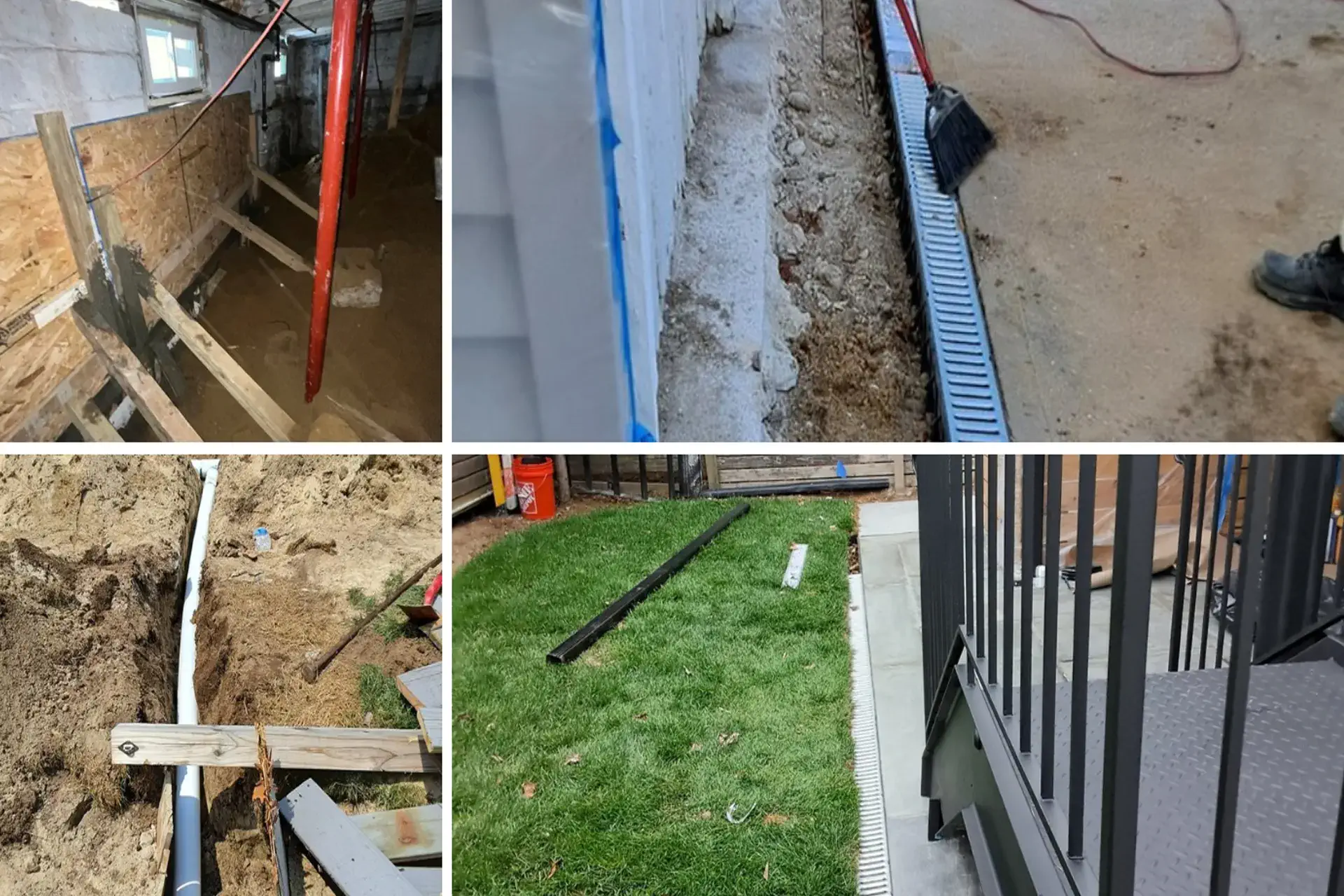
Our team installed a comprehensive interior and exterior French drain system supported by a redesigned back patio and proper grading. The transformation shows how a well-engineered French drain can permanently stop groundwater issues and stabilize an entire property.
Before & After: A Complete Transformation
Before
- Crawl space filled with nearly two feet of standing water
- Musty odor and rising humidity throughout the home
- Foundation walls absorbing moisture under pressure
- Backyard water pooling during storms
- Patio misdirecting flow toward the structure
After
- Crawl space completely dry within 48 hours
- Hydrostatic pressure eliminated around the foundation
- Groundwater now routed safely away from the home
- New patio functioning as part of the drainage system
- Improved indoor air quality and reduced mold risk
- A permanent increase in property stability and resale appeal
Your photos will fit perfectly under this section—especially the 4-image Canva grid.
The Results
With both interior and exterior French drains working together, the home now has:
- Continuous water redirection during storms
- A dry, stable crawl space year-round
- Improved structural protection
- Lower humidity and mold prevention
- A patio that adds protection, not problems
This project shows how French drains can solve even the most severe groundwater issues when designed correctly for both the surface and subsurface conditions.
If your home has standing water, seepage, or musty crawl space odors, a French drain system may be the permanent solution.
Protect Your Property With a No-Cost Drainage Evaluation!
Benefits of French Drains: Final Thoughts
If your property struggles with recurring water intrusion, persistent dampness, or early signs of foundation stress, a French drain is one of the smartest long-term investments you can make. The benefits of French drains is more than just moving water from one place to another. They protect your structural integrity, improves indoor air quality, and preserves your property value for years to come.
Call On Mold Removal Experts to Help You Protect What Matters Most! Get a Free Mold Inspection Here!
Frequently Asked Questions About French Drains
What does a French drain actually do?
A French drain collects excess groundwater through a gravel trench and perforated pipe, then redirects it away from your foundation to prevent leaks, pressure buildup, and moisture damage.
Do French drains stop basement flooding?
Yes. A properly installed interior or exterior French drain intercepts water before it enters the basement and directs it to a sump pump or safe discharge point.
How do I know if my home needs a French drain?
Common signs include standing water near the foundation, musty odors in the basement, efflorescence on concrete, mold growth, foundation cracks, or consistently soggy yard areas.
What’s the difference between an interior and exterior French drain?
Exterior French drains block water before it reaches the foundation, while interior French drains capture water that has already entered and guide it to a sump pump.
Are French drains better than sump pumps?
They do different jobs. A French drain collects and manages groundwater; a sump pump removes water after it reaches a basin. The best systems combine both.
How long does a French drain last?
A professionally installed French drain can last 25–50 years or longer when built with high-quality gravel, filter fabric, and perforated piping.
Can I install a French drain myself?
DIY installations often fail due to poor slope, improper gravel layering, or incorrect discharge locations. Professional installation prevents clogs, backups, and foundation damage.
Where does the water go after entering a French drain?
It typically flows to a safe discharge point such as a yard, storm drain connection (where permitted), dry well, or a sump pump system.
Do French drains work on flat properties?
Yes. As long as the trench and pipe are properly sloped, the system will move water away even on flat lots or tight urban spaces.
How much does a French drain cost?
Costs vary by depth, length, soil conditions, and whether it’s installed inside or outside. Most residential systems range from moderate to high investment but prevent far more expensive foundation repairs.