
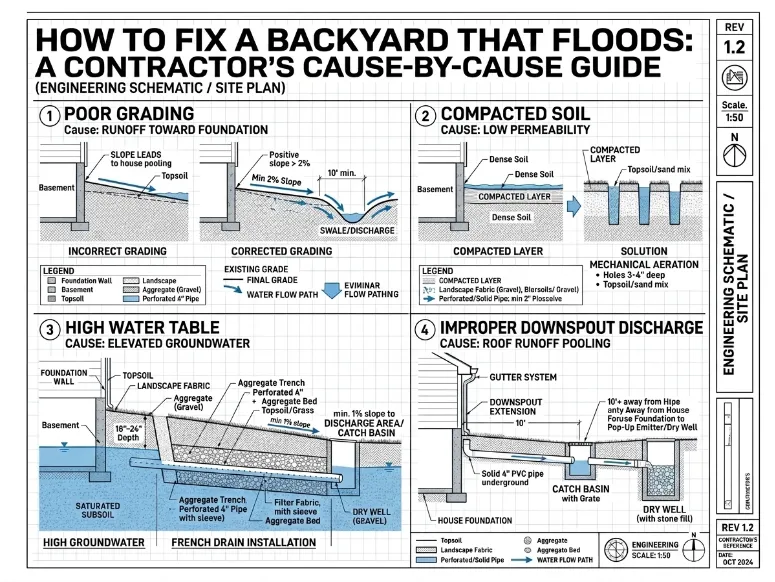
The most honest answer to “what does it cost to fix a flooding backyard” is the one no cost calculator gives you. It depends entirely on why your yard floods. A downspout fix might run $200. A full drainage system on a flat, high-water-table lot can run past $12,000. The gap between those numbers isn’t a markup. It’s the difference between treating a symptom and solving the actual problem. This guide breaks down 2026 pricing for every common fix, what drives the number up or down, and what New York metro homeowners specifically should expect to pay.
The figures below reflect typical U.S. ranges for professionally installed drainage systems in 2026. Because we operate in the New York area, we’ve also flagged where Long Island and NYC pricing tends to land, which is usually toward the top of these ranges or above, for reasons we explain at the end.
In Long Island? We Are Only One Call Away with Proven Solutions, Expert Advice, and Free Estimates! Schedule Yours Today!
Backyard Drainage Cost at a Glance
| Solution | Typical 2026 Cost | Best For |
|---|---|---|
| Downspout extensions (surface) | $5–$25 each | Roof water dumping near the foundation |
| Buried downspout drain line | $150–$350 per downspout | Carrying roof water well away from the house |
| Yard regrading | $500–$5,000 | Yards sloping toward the house or containing low spots |
| Grassed swale | $5–$15 per linear ft | Redirecting surface water across a broad area |
| French drain (exterior/yard) | $10–$35 per linear ft Approximately $1,000–$4,000+ typical | Intercepting surface water and shallow groundwater |
| Catch basin plus pipe | $1,000–$4,000 installed | Draining a persistent low-spot puddle |
| Channel or trench drain | $30–$150 per linear ft | Runoff sheeting off driveways and patios |
| Dry well | $1,500–$4,000 installed Materials: $50–$3,000 by type | Storing or dispersing runoff where there is no discharge point |
| Sump pump system | $500–$2,500 | Actively removing water on high-water-table lots |
| Full-yard drainage system | $3,000–$15,000+ | Chronic flooding requiring a connected, engineered solution |
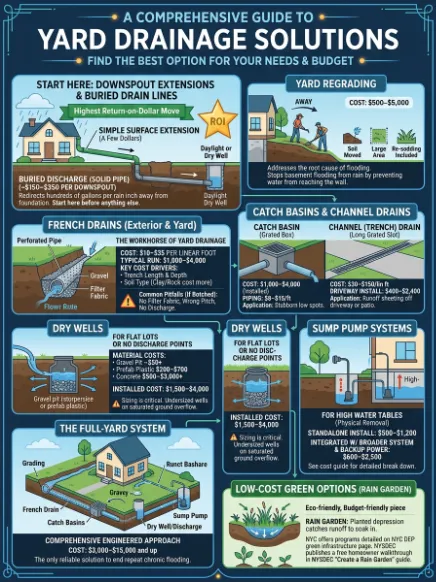
Cost by Solution, and What Moves the Number
Downspout Extensions & Buried Drain Lines
The cheapest meaningful fix there is. A simple surface extension is a few dollars. Burying the discharge in solid pipe and running it to daylight or a dry well costs roughly $150–$350 per downspout. Given that one inch of rain on an average roof produces hundreds of gallons, redirecting that water away from the foundation is the highest return-on-dollar move in this entire guide. Start here before anything else.
Yard Regrading
Regrading, which means reshaping the ground to slope away from the house, runs $500 to $5,000 depending on how much soil is moved, how large the area is, and whether re-sodding is included. It’s unglamorous, but it fixes the root cause of a huge share of flooding cases, especially where the yard has settled to pitch back toward the foundation.
Regrading is often what makes basement flooding from rain stop for good, because it addresses the water before it ever reaches the wall.
French Drains
The workhorse of yard drainage. Exterior and yard French drains run about $10–$35 per linear foot, putting a typical residential run in the $1,000–$4,000 range, though longer or deeper systems climb from there. Price is driven by trench length and depth, soil type (clay and rock cost more to dig), and the discharge solution at the end. It’s also the fix most often botched by DIYers and cheap crews, whether that’s no filter fabric, the wrong pitch, or a discharge that goes nowhere. Our guide to the benefits of French drains explains what a properly built one actually involves.
Catch Basins & Channel Drains
A catch basin (a grated collection box piped to a discharge) to drain a stubborn low spot typically runs $1,000–$4,000 installed, with the piping itself around $8–$15 per foot. A channel or trench drain, the long grated slot that catches runoff sheeting off a driveway or patio, runs $30–$150 per linear foot, so a driveway-width install commonly lands between $400 and $2,400.
Dry Wells
When there’s no natural place to send collected water, which is common on flat lots, a dry well buries a chamber that stores runoff and lets it disperse into the surrounding soil over time. Materials alone range widely by type (gravel pits from $50, prefab plastic units $200–$700, concrete $500–$3,000+), but a professionally installed, correctly sized dry well typically lands $1,500–$4,000. Sizing is everything here. An undersized dry well on saturated ground just overflows.
Sump Pump Systems
On high-water-table lots, surface drainage isn’t enough, because you need to physically remove water. A sump pump runs $500–$1,200 as a standalone install and $600–$2,500 when integrated with a broader drainage system and backup power. We break the numbers down further in our cost to install a sump pump in a basement guide, which applies directly to yards where groundwater is the real culprit.
The Full-Yard System
For chronic flooding, whether from flat lots, high water tables, clay soil, or water already reaching the house, the real solution is a connected, engineered system rather than a single product: grading, plus a French drain, plus catch basins, plus a dry well or discharge, plus a sump where needed. That comprehensive approach runs $3,000 to $15,000 and up, and it’s the only thing that reliably ends repeat flooding. See how the pieces work together in our overview of exterior drainage solutions.
Low-cost green options that also count: a rain garden, which is a planted depression that catches runoff and lets it soak in, can be a budget-friendly piece of the puzzle, especially on lots where infiltration is realistic. New York State publishes a free homeowner walkthrough in the NYSDEC “Create a Rain Garden” guide, and NYC offers stormwater programs detailed on the NYC DEP green infrastructure page.
What Makes One Yard Cost 5x More Than the Next
Two homes on the same street can get wildly different quotes for “fixing the backyard.” Here’s what drives the spread.
| Cost Driver | Cheaper | More Expensive |
|---|---|---|
| Root Cause | Downspout problem or minor low spot | High water table, clay soil, or negative grading |
| Soil and Digging | Loose, sandy soil with shallow digging | Clay, rock, or deep trenching |
| Discharge Point | Natural slope allowing water to drain to daylight | Flat lot requiring a dry well or pump |
| Scope | One targeted drainage fix | Connected full-yard drainage system |
| Access and Obstacles | Open lawn with easy equipment access | Patios, mature trees, landscaping, or tight urban lots |
| Permits | No permits required | Municipal permits and inspections required |
What New York Homeowners Should Actually Budget
If you’re on Long Island or in Brooklyn, Queens, or the Bronx, plan for the upper end of every range above, or beyond it. Three local factors push metro pricing up. Labor and permitting costs run higher than the national average. The region’s flat terrain and high, coastal water table often force the more expensive active solutions (dry wells and sump systems instead of simple gravity drainage). And clay-heavy North Shore soil is slow and costly to trench. On tight urban lots, limited access and existing hardscape add labor, too. A minor downspout-and-grading fix might still be a few hundred dollars, but a genuine solution for a chronically flooding metro backyard more often lands in the $5,000–$15,000+ range.
The cost comparison that actually matters: weigh drainage against what flooding costs if you don’t fix it. Standing water drives moisture into the foundation and basement, where mold can colonize within 24 to 48 hours and framing can rot over time. Mold remediation, structural repair, and lost resale value routinely dwarf the price of drainage. Where water is already reaching the structure, coordinate the work with the people who protect it. Our overview of the benefits of hiring a foundation repair company explains why drainage and structural defense belong in the same conversation.
How to Get an Accurate Quote (and Avoid a Redo)
Skip the phone estimate. Any contractor who quotes a flooding fix without walking the yard is guessing, and guessing is how you end up paying twice. A real assessment identifies the cause (grading, downspouts, soil, or water table), maps the water’s full path, and prices a solution that matches it. Get the scope in writing: trench length and depth, drain type, filter fabric, discharge point, and what happens to the water at the end. That last detail is where cheap jobs fail.
Get a real number for your yard, not a guess.
We’ll diagnose why your backyard floods and price a fix that actually ends it, built for Long Island and NYC conditions. Request a drainage inspection and quote →
Backyard Drainage Cost Guide: Final Thoughts
Backyard drainage costs in 2026 can range from a simple, inexpensive downspout correction to a complete engineered system costing $15,000 or more. The key is identifying the actual source of the water before choosing a solution. Mold Removal Experts is a contractor-owned resource serving Long Island, Brooklyn, Queens, and the Bronx, with experience in yard drainage, waterproofing, foundation protection, and mold remediation. A professional property evaluation can determine whether your yard needs one targeted repair or a connected drainage system designed for long-term protection.
Frequently Asked Questions About Backyard Drainage Cost:
How Much Does It Cost to Fix a Flooded Backyard?
The cost to fix a flooded backyard typically ranges from about $200 for a simple downspout correction to more than $15,000 for a full engineered drainage system. Targeted solutions, such as French drains, catch basins, and dry wells, commonly cost between $1,500 and $4,000 each. The final price depends on the cause of the flooding, yard size, soil conditions, access, and drainage discharge requirements.
What Is the Cheapest Way to Fix Backyard Drainage?
Extending or redirecting downspouts is usually the cheapest backyard drainage solution, costing as little as $5 to $25 for a basic surface extension. Other affordable options include clearing blocked drains, filling minor low spots, and correcting small grading problems. Persistent flooding caused by clay soil, negative grading, or a high water table usually requires professional drainage installation.
How Much Does a French Drain Cost in 2026?
An exterior French drain typically costs between $10 and $35 per linear foot in 2026. Most residential yard French drain installations cost approximately $1,000 to $4,000, although long runs, deep trenches, difficult soil, landscaping restoration, and complicated discharge points can increase the total.
How Much Does It Cost to Regrade a Backyard?
Backyard regrading generally costs between $500 and $5,000. A small low spot may only require additional soil and minor grading, while a large yard sloping toward the foundation may need excavation, soil removal, new fill, and landscape restoration. Regrading works best when water can be directed safely away from the house.
What Is the Best Drainage System for a Flooded Backyard?
The best backyard drainage system depends on where the water comes from. Downspout drains control roof runoff, swales redirect surface water, French drains intercept shallow groundwater, catch basins drain low spots, and dry wells store runoff when no natural outlet is available. Chronically flooded yards may need several of these components working together.
How Much Does a Full-Yard Drainage System Cost?
A full-yard drainage system typically costs between $3,000 and $15,000 or more. These systems may combine regrading, catch basins, underground pipes, French drains, channel drains, dry wells, and sump pumps. Large properties, difficult access, clay soil, deep excavation, and municipal requirements can push the cost higher.
Can penicillium mold grow behind walls without visible signs?
Yes. Penicillium frequently grows behind drywall, under flooring, or inside wall cavities after leaks or flooding, even when surfaces appear dry.
How Long Does Backyard Drainage Installation Take?
A targeted backyard drainage project usually takes one to three days. Larger systems involving extensive trenching, regrading, dry wells, hardscape removal, or several connected drainage components may take one to two weeks. Weather, permits, underground utilities, soil conditions, and equipment access can affect the schedule.
Can I Fix Backyard Drainage Myself?
Homeowners can often handle simple improvements such as extending downspouts, cleaning blocked drains, filling small depressions, and creating shallow surface drainage paths. Professional help is recommended when water reaches the foundation, returns after every storm, covers a large part of the yard, or appears to come from groundwater rather than surface runoff.
Is Fixing Backyard Drainage Worth the Cost?
Fixing backyard drainage is usually worth the cost because uncontrolled water can damage landscaping, erode soil, saturate the foundation, and contribute to basement moisture and mold. Addressing the drainage problem early is generally less expensive than paying for repeated cleanup, mold remediation, foundation repair, and damaged hardscaping.