
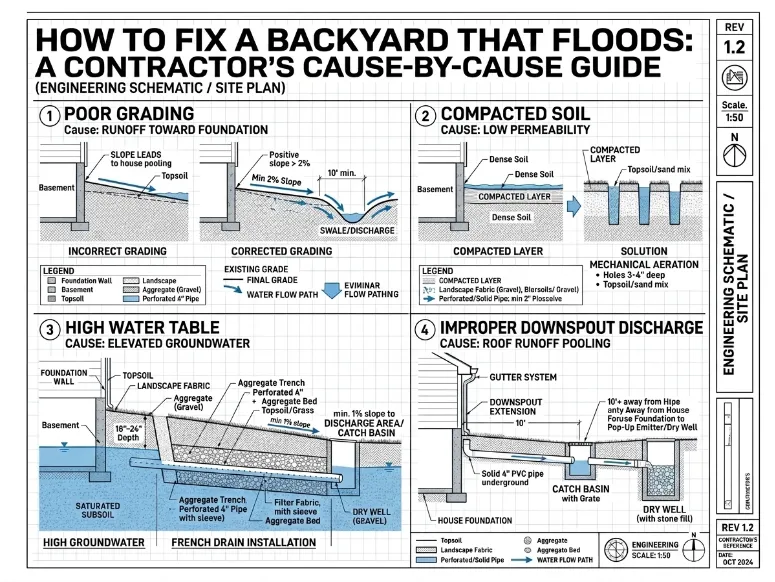
After twenty-plus years of digging up wet yards and drying out the basements underneath them, we can tell you the truth most homeowners never hear. A flooded backyard is almost never a “bad luck” problem. It’s a plumbing problem you can see. Water is landing on your property faster than the ground can move it or soak it up, so it pools at the lowest, weakest point it can find. Fix the reason the water has nowhere to go and the flooding stops. Guess at it, and you’ll spend thousands moving the puddle three feet to the left.
This guide walks through every common cause of backyard flooding and the exact fix that matches it, in the order a contractor actually diagnoses them. We wrote it for homeowners anywhere in the country. But because we’re on the ground every week in the New York metro, we’ve added a section near the end on why Long Island, Brooklyn, Queens, and the Bronx flood harder than almost anywhere else, and why those yards can’t afford to wait.
The one rule that governs all backyard flooding: water always does exactly two things. It flows downhill, and it soaks in. Flooding happens when it can’t do either one fast enough. Every fix below either gets water flowing again (drainage) or gets it soaking in again (infiltration). That’s the whole game.
Cause #1: Poor Grading (The Yard Slopes the Wrong Way)
What’s Happening: Your yard, or the few critical feet right around your foundation, is either flat or pitched toward the house instead of away from it. Builders are supposed to grade the ground so it falls at least six inches over the first ten feet away from the foundation. Over the years, soil settles, gardens get added, and that slope disappears or reverses. Now every rain runs back toward the structure and pools in the low spot.
The Fix is Regrading. This is the single most important and most overlooked repair in the whole conversation. Regrading means bringing in soil (and sometimes cutting down high spots) to re-establish a positive slope away from the home and toward a place you actually want the water to go. It’s not glamorous, but it fixes more chronic flooding than any drain product on the market. If the low spot is a broad, shallow area, a related fix is a swale: a gently sloped, shallow channel, often planted with grass, that acts like a hidden gutter for your yard and carries surface water to the street, a dry well, or a rain garden.
Contractor’s note: grading toward the house is also the number-one hidden cause of a wet basement. If your yard floods and your basement gets damp, they are almost certainly the same problem. See our breakdown of what causes basement flooding from rain. The culprits overlap almost perfectly with what’s drowning your lawn.
Cause #2: Downspouts Dumping at the Foundation
What’s Happening: your roof is the biggest water-collection surface on the property. A single inch of rain on a 1,500-square-foot roof produces roughly 900 gallons of water. If your downspouts release all of that four inches from the wall, you’ve built a private flood right where you least want one: against the foundation, feeding the very low spot that’s already pooling.
The Fix is to Extend and Redirect. This is the cheapest high-impact move in the entire guide. Add downspout extensions, or better, bury the discharge in solid pipe and carry it to daylight, a dry well, or the curb, well away from the house. While you’re at it, make sure the gutters themselves aren’t overflowing and defeating the whole drainage system. A clogged or undersized gutter creates the exact same pooling. We cover the warning signs in why your gutters are overflowing and whether it will damage your home.
Cause #3: Compacted or Clay-Heavy Soil
What’s Happening: water isn’t just supposed to run off. A healthy yard also drinks it. Construction traffic, foot traffic, and years of settling compact the soil until it sheds water like a parking lot. Clay soil makes it worse. Clay particles are so fine that water barely percolates through them, and clay swells when wet and shrinks when dry, which is brutal on foundations and patios.
The Fix is to Restore Infiltration. For mild cases, aeration (pulling plugs of soil to break up compaction) and top-dressing with two to three inches of compost or organic matter measurably improves how fast the ground absorbs water. For stubborn clay, you often can’t fix the soil across a whole yard economically, so you give the water an engineered path instead (a French drain or dry well) and add high-infiltration features like a rain garden, a planted depression designed to catch runoff and let it soak in slowly. New York State’s environmental agency has a straightforward homeowner walkthrough for building one in the NYSDEC “Create a Rain Garden” guide.
Cause #4: Low Spots and Impermeable Surfaces
What’s Happening: every yard has a lowest point, and water obeys gravity to find it. Add patios, driveways, and walkways, which are impermeable surfaces that produce 100% runoff, and you’re funneling even more water into that low basin with nowhere to drain.
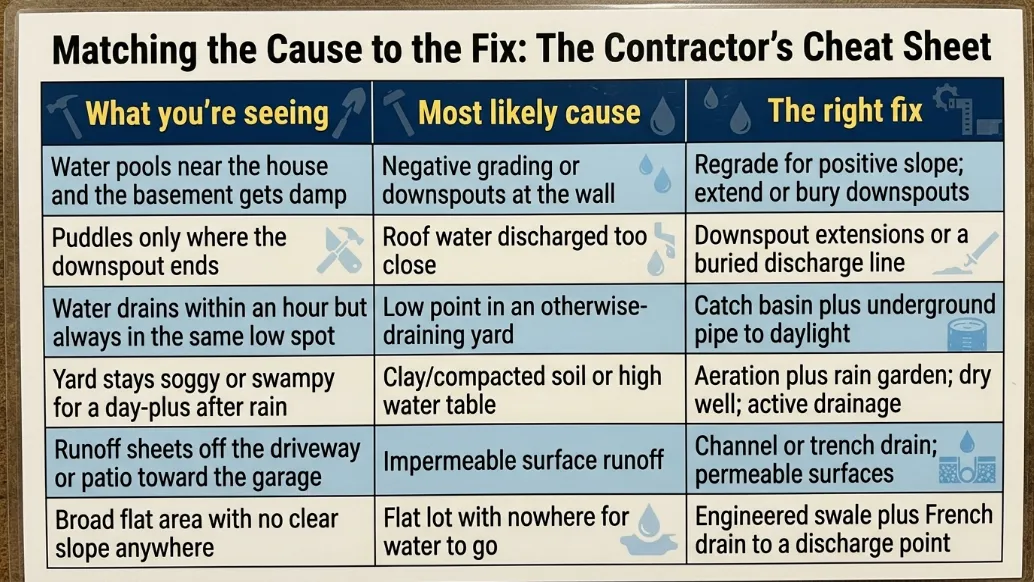
The Fix is to Catch it and Channel it. For a pooling low spot in the open lawn, a catch basin (a grated box set at the low point and piped underground to a discharge) collects the water and moves it out. For runoff sheeting off a driveway or patio, a channel drain (also called a trench drain), which is a long grated slot across the surface, intercepts it before it reaches the low spot or the garage. Where you can, converting solid surfaces to permeable pavers or gravel lets water infiltrate instead of running off.
Cause #5: A High Water Table (The Ground Is Already Full)
What’s Happening: this is the one homeowners rarely diagnose themselves, and it’s the most serious. Sometimes the yard floods not because water is running in, but because the groundwater underneath is rising up. After heavy or sustained rain, or in low-lying, coastal, and flat areas, the water table can rise all the way to the surface. When the ground is already saturated to the top, there’s simply no room left for rain to soak in, so it sits on the surface for days. This is also what drives hydrostatic pressure against your foundation walls, pushing water through cracks and cove joints into the basement.
The Fix is Active Water Management. You can’t lower a regional water table by yourself, so the strategy shifts from “drain the surface” to “control the water actively.” That means a properly sized dry well (a buried chamber that stores runoff and lets it disperse into the surrounding soil over time), a comprehensive exterior drainage system, and, for the water that inevitably reaches the house, interior perimeter drainage and a sump pump to physically remove groundwater before it floods the basement. Our overview of exterior drainage solutions explains how these pieces work together as a system rather than as one-off patches.
The French Drain: The Workhorse Fix (and How Not to Wreck It)
If there’s one solution that ties most of the above together, it’s the French drain: a gravel-filled trench with a perforated pipe at the bottom that intercepts water (both surface runoff and shallow groundwater) and carries it to a safe discharge point. Done right, it’s the backbone of a permanent fix. Done wrong, it’s a $4,000 hole that clogs in two years.
Here are the most common DIY mistakes we get called to fix: no fabric sock or filter fabric, so silt clogs the pipe; not enough pitch, so water sits instead of moving; the perforated pipe installed holes-up instead of holes-down; and worst of all, a drain that discharges toward the house or into a spot with nowhere to go. The same French-drain principles that protect a foundation also protect a yard. We break down the mechanics and applications in our guide to the benefits of French drains for basements, foundations, and landscapes.
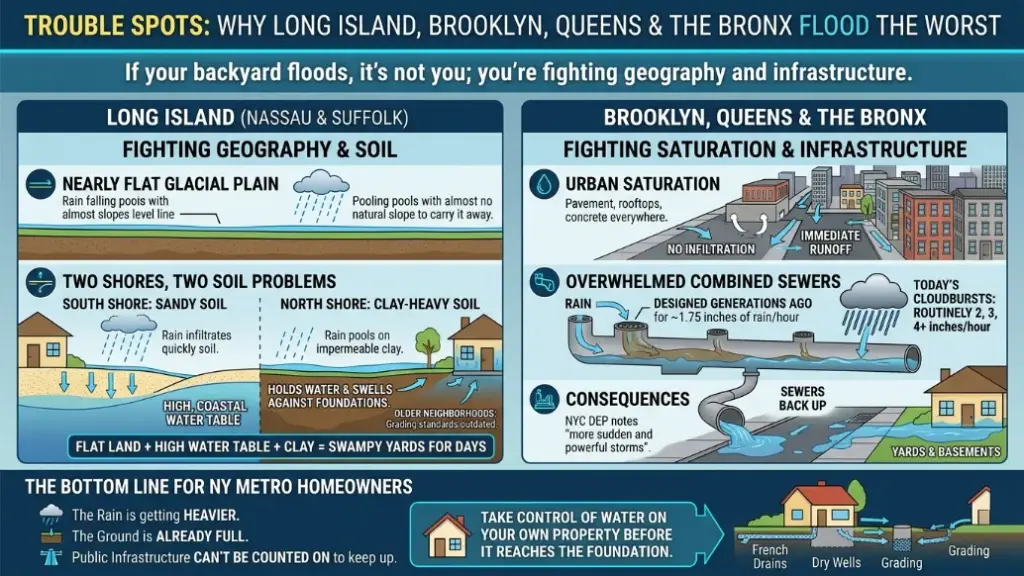
Trouble Spots: Why Long Island, Brooklyn, Queens & the Bronx Flood the Worst
If you own a home in the New York metro and your backyard floods, you’re not doing anything wrong. You’re fighting geography and infrastructure that are stacked against you. Here’s the honest local picture, region by region.
Long Island (Nassau & Suffolk)
Long Island is a nearly flat glacial plain, which means stormwater has almost no natural slope to carry it away. It just sits. The soil works against you on both shores. Sandy South Shore soils drain fast but sit right on top of a high, coastal water table that rises to the surface after big storms, while the North Shore’s clay-heavy soil holds water and swells against foundations. On top of that, older neighborhoods were graded to standards that never anticipated today’s rainfall. Flat land, plus a high water table, plus clay is close to a worst-case combination, and it’s why so many Long Island yards stay swampy for days.
Brooklyn, Queens & the Bronx
In the boroughs, the enemy is saturation plus infrastructure. So much of the ground is covered in pavement, rooftops, and concrete that rain has nowhere to infiltrate, so it all becomes runoff at once. That runoff pours into a combined sewer system that, by the city’s own accounting, was designed generations ago to handle about 1.75 inches of rain per hour. Today’s cloudburst storms routinely drop two, three, even four inches in an hour, so the sewers back up, streets flood, and water pushes into the lowest yards and basements. NYC’s environmental department is candid that climate change is bringing “more sudden and powerful storms,” which you can read about on the NYC DEP flooding and climate change page.
The bottom line for NY metro homeowners: the rain is getting heavier, the ground is already full, and the public infrastructure can’t be counted on to keep up. Waiting for the problem to “get better on its own” isn’t a strategy, because the conditions are moving the wrong direction. The homes that stay dry are the ones where the owner took control of the water on their own property before it reached the foundation.
How to Fix a Backyard That Floods: Final Thoughts
A flooded backyard is not solved by choosing the most popular drainage product. It is solved by matching the repair to the cause. Downspout runoff may need extensions or catch basins, low spots may require regrading, saturated soil may call for a French drain, and a high water table may require an active drainage system with a sump pump. If you treat the wrong problem, the water will return.
For homeowners across Long Island, Brooklyn, Queens, and the Bronx, the right solution begins with a complete property inspection. Mold Removal Experts helps identify where the water originates, how it moves across or beneath the property, and where it can be discharged safely. If your yard floods after storms or remains soggy for days, address the source now before the moisture reaches your foundation, basement, or crawl space.
Standing water in your yard is your foundation's early warning system.
Frequently Asked Questions About How to Fix a Backyard That Floods:
How do I stop my backyard from flooding permanently?
Permanent backyard flood prevention starts with identifying where the water originates and why it cannot drain. Common solutions include correcting the yard’s grading, extending downspouts, installing catch basins, adding a French drain, or directing water into a properly designed dry well. Flat properties and high-water-table areas may require an active drainage system with a sump pump.
Why does my yard flood after only a small amount of rain?
A yard that floods after light rain usually has compacted soil, poor grading, clogged drainage, or an already elevated water table. Because the ground cannot absorb additional water, rainfall collects on the surface. This problem is especially common in flat, coastal, and low-lying areas of Long Island.
Is a flooded backyard a serious problem?
Yes. Standing water can saturate the soil surrounding the foundation, increase hydrostatic pressure, and force moisture into a basement or crawl space. Persistent moisture can contribute to mold growth, wood deterioration, foundation damage, mosquito activity, and unusable landscaping.
What is the cheapest way to fix a flooding yard?
The cheapest fixes include cleaning blocked drains, extending downspouts away from the foundation, filling small low spots, and aerating compacted soil. These improvements may solve minor drainage problems. Negative grading, widespread standing water, and high-water-table conditions usually require a professionally designed yard drainage system.
Will a French drain stop my backyard from flooding?
A French drain can stop backyard flooding when subsurface water or runoff is moving across the property. The system collects water through perforated pipe surrounded by drainage stone and redirects it to a safe discharge point. It must have the correct depth, slope, capacity, and outlet to work reliably.
Is a French drain or dry well better for backyard drainage?
A French drain collects and redirects water, while a dry well temporarily stores water and allows it to soak into the surrounding soil. Dry wells work best in soil that drains effectively and where the water table remains below the system. French drains are often more appropriate for saturated areas, but some properties need both systems working together.
Can regrading fix a backyard that holds water?
Regrading can fix backyard flooding caused by low spots or soil that slopes toward the house. The goal is to establish positive drainage that carries surface water away from the foundation. Regrading alone may not solve flooding caused by groundwater, compacted soil, or a shallow water table.
How much does a backyard drainage system cost?
The cost depends on the property size, soil conditions, access, drainage distance, excavation requirements, and type of system installed. A simple downspout extension costs far less than a complete French drain, catch basin, dry well, or sump pump system. An on-site drainage inspection is the best way to receive an accurate project quote.
Do I need a permit to install yard drainage in New York?
Permit requirements depend on the municipality and the scope of work. Basic downspout improvements and minor grading may not require permits, but drainage connections, major excavation, sump discharge, and work affecting sidewalks, streets, sewers, or neighboring properties often require approval. A local contractor should confirm the applicable town, county, and city requirements before installation.
Who should I call to fix a flooded backyard?
Call a drainage and waterproofing contractor experienced with grading, groundwater, French drains, catch basins, dry wells, sump pumps, and foundation protection. The contractor should inspect the entire property and identify the source of the flooding before recommending a system. Mold Removal Experts serves Long Island, Brooklyn, Queens, and the Bronx with contractor-backed guidance on drainage, waterproofing, foundation protection, and mold remediation.