
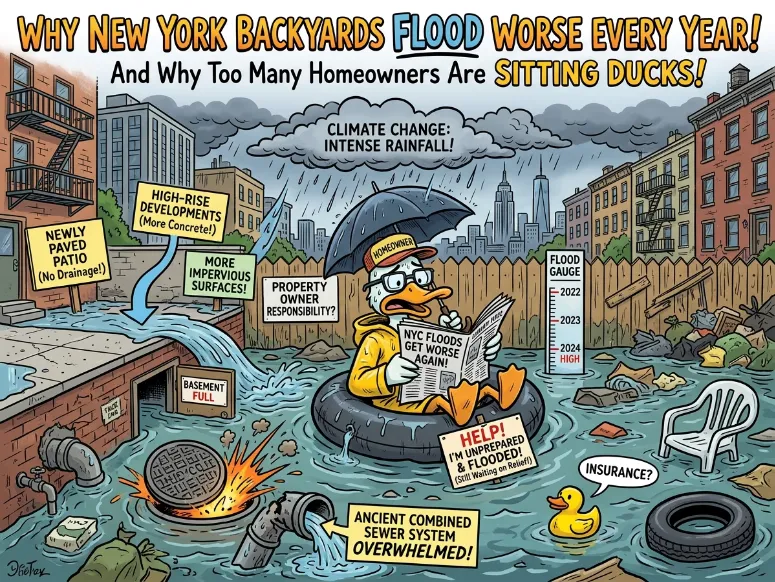
We’ve been pumping water out of New York yards and basements for more than two decades, and we’ll say plainly what the data now backs up. It is not your imagination. Backyards across Long Island, Brooklyn, Queens, and the Bronx really are flooding more often, more severely, and from smaller storms than they did ten or fifteen years ago. The homes that flooded once a decade now flood once a season. And most of the owners have no idea the ground under them has quietly shifted from “occasional nuisance” to “standing structural risk.”
This isn’t a doom piece. It’s a diagnosis. Three forces are converging on the New York metro at the same time, and once you understand them, you can see exactly why the problem keeps compounding, and why the homeowners who act early are the only ones who stay dry.
Force #1: The Rain Itself Changed
The storms hitting New York are no longer the steady, all-day soakers the region was built around. They’re cloudbursts, short and violent downpours that dump an enormous volume of water in a very short window. New York City’s own environmental agency is direct about it, attributing the surge in flooding to climate change bringing “more sudden and powerful storms” with more intense rainfall, as laid out on the NYC DEP flooding and climate change page.
Why does intensity matter more than total rainfall? Because the ground and the drainage system can only absorb water at a certain rate. Two inches spread over a day disappears. Two inches in forty-five minutes has nowhere to go. It sheets across every hard surface, overwhelms every drain at once, and pools in the lowest yards it can find. The same three inches of rain that was a non-event in 2010 is a flooded basement in 2026, purely because it now arrives all at once.
Force #2: The Infrastructure Never Caught Up
The storms hitting New York are no longer the steady, all-day soakers the region was built around. They’re cloudbursts, short and violent downpours that dump an enormous volume of water in a very short window. New York City’s own environmental agency is direct about it, attributing the surge in flooding to climate change bringing “more sudden and powerful storms” with more intense rainfall, as laid out on the NYC DEP flooding and climate change page.
Why does intensity matter more than total rainfall? Because the ground and the drainage system can only absorb water at a certain rate. Two inches spread over a day disappears. Two inches in forty-five minutes has nowhere to go. It sheets across every hard surface, overwhelms every drain at once, and pools in the lowest yards it can find. The same three inches of rain that was a non-event in 2010 is a flooded basement in 2026, purely because it now arrives all at once.
Force #3: The Ground Is Already Full, and Overbuilt
Even before a drop of new rain, the New York metro starts at a disadvantage that most of the country doesn’t share.
Long Island: flat, coastal, and high-water-table
Long Island is a flat glacial plain with a high, coastal water table. On the sandy South Shore, water drains fast but hits saturated ground just below the surface, so it has nowhere left to go after big storms. On the clay-heavy North Shore, the soil barely percolates at all and swells against foundations. Flat land gives stormwater no slope to escape on, and a high water table gives it no room to soak in. That combination is why so many Nassau and Suffolk yards stay swampy for days after a storm the rest of the country would shrug off.
The boroughs: paved over and saturated
Brooklyn, Queens, and the Bronx face the flip side of the same coin. Decades of development have covered the ground in rooftops, driveways, and pavement, so rain that once soaked into open soil now becomes instant runoff, all of it, all at once, into that same overtaxed sewer system. More impervious surface plus more intense rain plus fixed sewer capacity is a math problem with only one outcome: the water finds the low yards and the older basements.
Why “it’ll get better on its own” is the most expensive assumption you can make: every one of these three forces is trending the wrong way. Storms are getting more intense, not less. Impervious surface is increasing, not shrinking. And sewer upgrades are measured in decades. A yard that floods today will, all else equal, flood more next year, not less.
Why a Flooded Yard Is a Structural Countdown, Not a Cosmetic One
The reason we treat this as urgent, and the reason “sitting ducks” isn’t hyperbole, is what standing water does after the puddle forms. Water pooling in the yard saturates the soil packed against your foundation. Saturated soil generates hydrostatic pressure, a relentless sideways and upward force that drives water through hairline cracks, cove joints, and porous concrete into the basement or crawl space. That’s the mechanism behind most cases of basement flooding from rain. The water didn’t come through the walls by accident. It was pushed.
Once it’s inside, the clock starts. Mold needs only moisture and 24 to 48 hours to colonize framing, insulation, and drywall. Repeated saturation cycles rot sill plates and joists and can undermine footings. So the true cost of a flooding backyard is almost never the wet lawn. It’s the remediation, the structural repair, and the resale disclosure that follow if it’s ignored. Every storm that passes without a fix is another draw against the foundation.
Who's Most Exposed, and What Actually Protects a Home
The most vulnerable homes in the metro share a familiar profile: an older house on a flat or low lot, original grading that’s settled over the decades, downspouts dumping at the foundation, and a finished basement the owner would hate to lose. If that’s your home, you’re not overreacting by taking it seriously. You’re reading the situation correctly.
The good news is that the fix is entirely within a homeowner’s control, even when the public infrastructure isn’t. The homes that stay dry are the ones that stopped waiting for the sewer to save them and took command of the water on their own property: re-grading to move surface water away, building an engineered path for it through exterior drainage solutions, and sealing the foundation with waterproofing that prevents mold recurrence rather than just mopping up after each storm. Where the structure has already taken on water, that work is best coordinated with the specialists who protect it. Our take on the benefits of hiring a foundation repair company explains where drainage and structural defense meet.
The conditions aren't improving, but your odds can.
Why New York Backyards Flood Worse Every Year: Final Thoughts
New York’s worsening backyard flooding problem is not something homeowners can safely wait out. More intense rainfall, overburdened infrastructure, high groundwater, settled grading, and expanding paved surfaces are placing increasing pressure on residential properties. The sooner water is redirected away from the house, the lower the risk of basement flooding, mold growth, foundation damage, and costly structural repairs.
Mold Removal Experts is a contractor-owned resource serving Long Island, Brooklyn, Queens, and the Bronx, specializing in drainage, waterproofing, foundation protection, and mold remediation. If your backyard floods after storms that never caused problems before, schedule a drainage and moisture assessment before the next storm reaches your foundation.
Frequently Asked Questions About Why New York Backyards Flood Worse Every Year:
Why Are New York Backyards Flooding More Often?
New York backyards are flooding more often because heavier cloudbursts are overwhelming soil, storm drains, and sewer systems faster than they can absorb or carry water away. Aging infrastructure, expanding paved surfaces, settled grading, and high groundwater compound the problem across Long Island, Brooklyn, Queens, and the Bronx.
Why Is My Backyard Flooding All of a Sudden?
A backyard may begin flooding suddenly because the soil is already saturated, the original grading has settled, downspouts are discharging too close to the foundation, or nearby development has changed how runoff moves. More intense rainfall can expose drainage problems that were previously too minor to notice.
Why Does Long Island Have So Many Yard Drainage Problems?
Long Island is relatively flat, surrounded by water, and affected by a high coastal water table. South Shore soil may drain quickly until it reaches saturated ground, while portions of the North Shore contain slower-draining clay and compacted soil. Without enough slope or underground storage capacity, stormwater remains trapped in yards.
Why Do Backyards Flood in Brooklyn, Queens, and the Bronx?
Backyards in Brooklyn, Queens, and the Bronx frequently flood because roofs, driveways, patios, sidewalks, and streets prevent rain from soaking naturally into the ground. That runoff enters aging drainage systems simultaneously, overwhelming available capacity and sending water toward low yards, basement entrances, and older foundations.
Can a Flooded Backyard Cause Basement Flooding?
Yes. Standing water saturates the soil surrounding the foundation and increases hydrostatic pressure against basement walls and floors. That pressure can force moisture through cracks, porous concrete, cove joints, utility penetrations, and other vulnerable openings.
Can Repeated Yard Flooding Damage a Foundation?
Repeated yard flooding can contribute to foundation cracks, soil erosion, settlement, bowing walls, deteriorated concrete, and damaged footings. Saturated soil becomes heavier and places additional pressure against the foundation. Properties with clay soil may also experience repeated expansion and contraction as moisture levels change.
How Quickly Can Mold Grow After Basement Flooding?
Mold can begin growing within 24 to 48 hours when wet drywall, insulation, wood, carpeting, or other organic materials remain damp. Removing standing water is only the first step. The affected area must also be dried, inspected, and corrected so that moisture does not return after the next storm.
What Is the Best Way to Stop a Backyard From Flooding?
The best solution depends on the source and movement of the water. Common fixes include extending downspouts, correcting negative grading, installing catch basins, building swales, adding French drains, using dry wells, and waterproofing the foundation. Chronically flooded properties often need several connected drainage measures.
Will a French Drain Stop My Backyard From Flooding?
A French drain can control shallow groundwater and water moving through saturated soil, but it is not the right answer for every property. Surface runoff may respond better to regrading, swales, catch basins, or channel drains. The drain must also lead to a safe and functional discharge point.
When Should I Call a Yard Drainage or Waterproofing Contractor?
Call a professional when water remains for more than a day, reaches the foundation, repeatedly enters the basement, produces musty odors, or returns after relatively small storms. You should also request an assessment if the yard has no visible slope or safe discharge point. These conditions usually require more than a temporary surface repair.