
Health & Safety · Evidence Reviewed
Can Mold Cause Cancer?
A clear, sourced answer to one of the most searched and most misunderstood questions about mold in your home. The short version may surprise you.
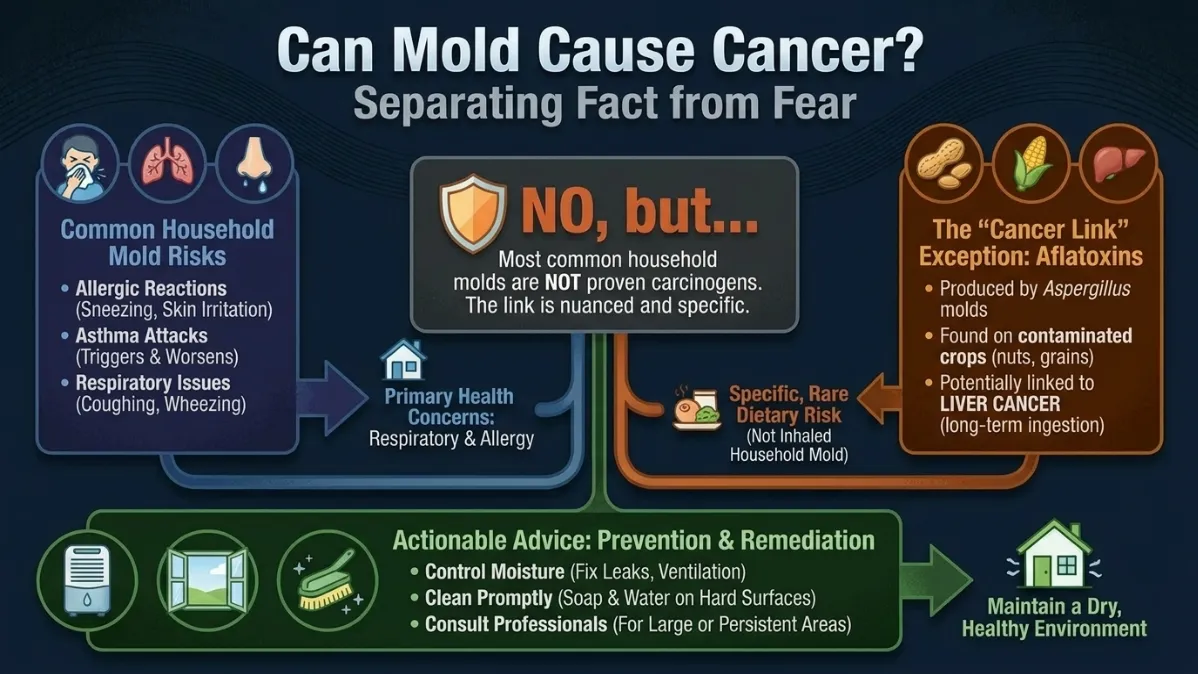
So, can mold cause cancer? Not in the way most people fear. There is no established evidence that breathing indoor or black mold causes cancer. The one clear cancer link is aflatoxins, a toxin made by certain molds, and that exposure comes mainly from contaminated food, not the air in your house.
If Your Mold Problem is in Long Island, Queens, Brooklyn, or The Bronx, Contact Us Right Away for a Free Mold Inspection!
Can Mold Cause Cancer? What the Evidence Actually Shows About Your Risk
If you just found mold in your home and typed “can mold cause cancer” into a search bar at midnight, here is the honest answer up front: for the ordinary household mold you are worried about, the science does not support a cancer link. You can breathe a little easier while you read the rest.
That does not mean mold is harmless. It means the real risks are different from the cancer fear that spreads online. Mold is firmly tied to breathing problems, allergies, and worsened asthma, and the question of whether mold can cause cancer has a more specific and more interesting answer than a flat yes or no.
The confusion comes from a real fact that gets stretched out of shape. A small group of molds produce toxins called mycotoxins, and one family of those toxins, aflatoxins, is one of the most studied cancer-causing substances on earth. Hearing “a mold toxin causes cancer” is easy to scramble into “the mold on my wall causes cancer.” Those are two very different claims. Let us separate them carefully.
Key takeaway:
Breathing indoor or black mold has no established link to cancer. The proven cancer risk comes from aflatoxins in contaminated food, not from spores in your indoor air.
The One Real Cancer Link: Aflatoxins and Aspergillus Mold
Certain molds in the Aspergillus family, mainly Aspergillus flavus and Aspergillus parasiticus, produce a group of mycotoxins called aflatoxins. The International Agency for Research on Cancer (IARC), the cancer arm of the World Health Organization, classifies naturally occurring aflatoxins as a Group 1 known human carcinogen. That is the highest, most certain category, the same group that holds tobacco smoke and asbestos.
Aflatoxins are strongly linked to liver cancer (hepatocellular carcinoma), and the risk climbs much higher in people who also carry the hepatitis B virus. This is well documented and not in dispute.
Here is the part that matters for your home. People are exposed to aflatoxins almost entirely through food, not air. Aflatoxins build up on crops such as peanuts, corn, tree nuts, and dried spices when they are stored warm and damp. The serious, well-proven cancer burden from aflatoxins falls on regions with poorly regulated food storage, not on a homeowner who found a patch of mold behind the drywall.
Does Breathing Indoor or Black Mold Cause Cancer?
This is the real question behind almost every “can mold cause cancer” search, and the answer from health authorities is consistent: there is no evidence that inhaling indoor mold, including black mold, causes cancer.
The U.S. Centers for Disease Control and Prevention states plainly that there is no evidence linking indoor exposure to black mold, or any other mold, with cancer. Black mold, the greenish-black Stachybotrys chartarum that grows on damp drywall and wood, has a frightening reputation that runs far ahead of the science. It can absolutely make you feel unwell, but a cancer diagnosis is not part of the established picture.
Why the gap between fear and evidence? Two reasons. First, the word “mycotoxin” gets attached to indoor mold and then mentally linked to the food-borne aflatoxin cancer story above, even though indoor airborne exposure levels are very different. Second, mold genuinely does cause unpleasant symptoms, so it is easy to assume the worst. Feeling sick from mold is real. Getting cancer from breathing it is not supported by the evidence.
RELATED READING: Stachybotrys (black mold) facts: Is black mold dangerous?
How Scientists Classify Mold-Related Cancer Risk
The clearest way to answer “can mold cause cancer” is to look at how the IARC actually classifies the substances involved. The agency sorts agents by how strong the evidence is, not by how scary they sound. Here is where the mold-related compounds land.
| Substance | Source | IARC Class | Main Exposure Route |
|---|---|---|---|
| Aflatoxins | Aspergillus molds on crops | Group 1 · known carcinogen | Contaminated food |
| Ochratoxin A | Aspergillus & Penicillium molds | Group 2B · possibly carcinogenic | Food, some damp buildings |
| Indoor mold spores (inhaled) | Household mold growth | No carcinogenic classification | Breathing indoor air |
| Black mold (Stachybotrys) | Damp drywall, wood | No cancer link established | Breathing indoor air |
Read down the table and the pattern is obvious. The cancer risk lives on the food side of the ledger. The air in your home, the part you can see and smell and worry about, does not carry an established cancer classification at all.
“`
What Mold Actually Does to Your Health
Clearing up the cancer question is not the same as saying mold is safe. Indoor mold causes real, documented health effects, which is exactly why it should be removed quickly even though it will not give you cancer.
In 2004 the Institute of Medicine reviewed the evidence and found enough proof to link indoor mold and damp indoor spaces with:
- Upper respiratory symptoms such as a stuffy or runny nose, sore throat, and sinus irritation in otherwise healthy people
- Coughing and wheezing
- Worsened asthma symptoms in people who already have asthma
- Hypersensitivity pneumonitis, a serious lung inflammation, in people who are susceptible
Beyond that, the CDC notes that people who are immune-compromised or who have chronic lung disease can develop lung infections from mold. Some mold-sensitive people also report fatigue, headaches, and trouble concentrating that ease once the mold is gone. These effects are common and worth taking seriously, and they are the genuine reason to act on mold, separate from the cancer myth.
Who Is Most at Risk From Mold Exposure
Mold affects different people very differently. Two people can stand in the same damp basement and one feels nothing while the other cannot stop coughing. The groups most likely to react strongly are:
- People with asthma or an existing mold allergy
- Infants and young children
- Older adults
- Anyone who is immune-compromised, including people on chemotherapy or after a transplant
- People with chronic lung conditions such as COPD
If someone in your household falls into one of these groups, mold is not something to monitor and hope it goes away. It is something to remove.
Can Mold Cause Cancer in Your Home? The Best Way to Stop Worrying and Know for Sure
The fastest way to replace anxiety with facts is a professional mold assessment. You do not need to identify the exact species yourself, and the CDC specifically notes that routine sampling is usually unnecessary because the response is the same regardless of type: if mold is there, remove it and fix the moisture source that fed it.
A proper inspection finds the hidden growth behind walls and under floors, traces it back to the leak or humidity problem causing it, and gives you a clear remediation plan. That turns “can mold cause cancer” from a 2 a.m. spiral into a solved, documented problem.
Found mold? Get a clear answer, not a midnight panic.
Can Mold Cause Cancer: Final Thoughts
So, can mold cause cancer? For the household mold growing on your wall, ceiling, cabinet, or basement surface, the evidence says no, and that is reassuring. Breathing black mold or ordinary indoor mold has not been shown to cause cancer. The clear cancer link in the mold conversation is aflatoxins in contaminated food, not the mold spores floating around a damp room. That distinction matters because it separates a scary search query from the real indoor risk.
What mold can do is irritate your airways, inflame your sinuses, worsen asthma, trigger allergies, and slowly damage your home. Those are serious enough reasons to act quickly.
The smartest move is not to keep searching “can mold cause cancer” at midnight. It is to get the mold inspected, find the moisture feeding it, and remove the problem so you can stop guessing about your air and your health.
Editorial & medical review
Frequently Asked Questions About Mold and Cancer
Can Mold Cause Cancer?
Not in the way most people fear. There is no established evidence that breathing household mold or black mold causes cancer. The clearest cancer link involves aflatoxins, which are mycotoxins made by certain Aspergillus molds and are mainly a food contamination risk, not an indoor air risk. Aflatoxins are classified as Group 1 carcinogens by IARC.
Can Black Mold Cause Cancer?
No. Black mold, also called Stachybotrys chartarum, has not been proven to cause cancer when inhaled indoors. The CDC says Stachybotrys and other molds should still be removed when found in a building, but it does not identify black mold as an established cancer cause.
Is Mold in My House Dangerous?
The strongest mold-related cancer concern is aflatoxin exposure. Aflatoxins are produced mainly by Aspergillus molds that can grow on crops such as corn, peanuts, and tree nuts. IARC classifies aflatoxins as carcinogenic to humans, with liver cancer as the main concern.
Who Is Most at Risk From Mold Exposure?
People with asthma, mold allergies, chronic lung disease, weakened immune systems, infants, young children, and older adults are usually at higher risk from indoor mold exposure. For these groups, mold can trigger stronger respiratory symptoms or make existing conditions worse. WHO identifies respiratory symptoms, allergies, and asthma as major health effects associated with dampness and mold.
Can Breathing Mold Spores Cause Lung Cancer?
There is no established evidence that breathing indoor mold spores causes lung cancer. Mold spores can irritate the airways, trigger allergies, worsen asthma, and cause respiratory symptoms, but that is different from causing cancer. The main proven mold-related cancer concern is aflatoxin exposure through contaminated food.
Are Mycotoxins From Indoor Mold Cancerous?
Some mycotoxins are dangerous, but the cancer conversation usually centers on aflatoxins in contaminated food. Indoor mold can produce irritants, allergens, and sometimes toxic substances, but household mold growth has not been given the same established cancer classification as aflatoxins. Mold indoors should still be removed because it can harm air quality and health.
Can Mold Behind Walls Cause Cancer?
Mold behind walls has not been shown to cause cancer simply because it is hidden. The bigger concern is that hidden mold can keep releasing spores and odors into the home while the moisture problem gets worse. If you smell a musty odor, see staining, or have recurring symptoms indoors, the wall cavity should be inspected and the moisture source should be corrected.
Should I Test Mold to See If It Is Cancerous?
Usually, the smarter first step is to find and fix the moisture source, then remove the mold safely. The CDC says if you see or smell mold, you should remove it, and if mold is growing in your home, you need to clean it up and fix the moisture problem. Testing may help in some situations, but visible indoor mold does not need to be proven “cancerous” before it deserves attention.
When Should I Call a Mold Removal Professional?
Call a mold removal professional if the mold covers a large area, keeps returning, appears on drywall or ceilings, follows a leak or flood, causes a musty odor, or may be hidden behind walls, cabinets, flooring, or HVAC components. Professional mold remediation is also the safer choice when people in the home have asthma, allergies, chronic lung disease, or weakened immune systems. Indoor mold may not be a proven cancer cause, but it can still damage your air, your home, and your peace of mind.
What Financing Options Does Mold Removal Experts Offer on Mold Remediation?
Mold Removal Experts offers financing options to help homeowners move forward with needed foundation repair, basement waterproofing, crawl space encapsulation, mold remediation, and other home improvement projects without paying the full cost upfront. Financing can make it easier to protect your Brooklyn, Queens, Bronx, Manhattan, or Long Island home now while spreading the cost into manageable monthly payments.