
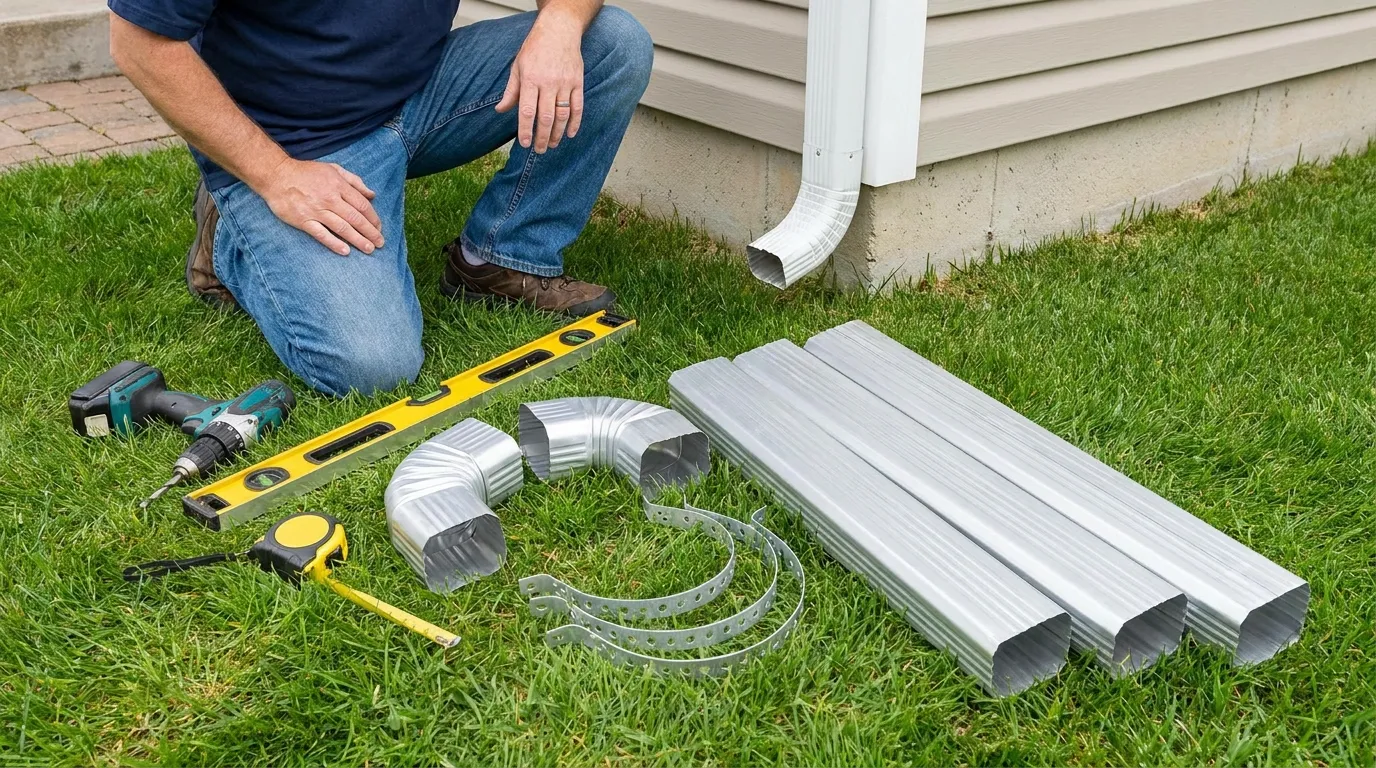
Good downspout gutter installation is the difference between a dry, stable foundation and thousands of dollars in repairs. Your gutters collect roof runoff, but the downspouts are what actually carry that water down and, just as importantly, far enough away from the house that it cannot soak into the soil against your foundation. Water is the single most common cause of residential property damage, and the most frequent culprit is a downspout that dumps roof water right at the base of the wall.
This guide walks through exactly how the system works, how far the water needs to travel, how to install and extend downspouts step by step, what each drainage option costs, and how to avoid the mistakes that quietly wreck foundations over time.
Quick answer: Install one downspout for every 20 to 30 feet of gutter, then route each one so it discharges at least 4 to 6 feet from the foundation (8 to 10 feet is ideal) onto ground that slopes away from the house. Use an extension for a fast fix or a buried pipe with a pop-up emitter for a permanent solution.
Water pooling near your foundation after it rains?
Why Roof Water Near Your Foundation Is a Problem
A single inch of rain on an average roof sheds hundreds of gallons of water. When a downspout releases all of that water in one concentrated spot next to the house, the soil stays saturated and the trouble starts. The most common consequences include:
- Foundation cracks and settling. Saturated soil expands and contracts, and the constant pressure can crack, shift, or settle the foundation.
- Basement and crawl space flooding. Pooled water finds its way through joints, cracks, and window wells.
- Soil erosion. Concentrated runoff washes away the soil that supports your foundation and your landscaping.
- Mold, rot, and pests. Persistent moisture feeds mold, rots siding and fascia, and attracts termites and mosquitoes.
- Sinking concrete. Water eroding the base under patios, walkways, and driveways causes slabs to sink and crack.

Benefits of Proper Downspout Gutter Installation
A correctly installed and extended system pays for itself by preventing far more expensive problems. The benefits of proper downspout gutter installation include:
- A drier, more stable foundation with less risk of cracking and settling.
- Protection against basement and crawl space water intrusion.
- Less erosion, so your grading and landscaping stay intact.
- Lower long-term repair costs, since foundation and waterproofing work runs into the thousands.
- Better curb appeal and resale value from a yard that drains the way buyers and inspectors expect.
In Long Island, Brooklyn, Queens, and The Bronx, Homeowners Can Count on Mold Removal Experts for Proven Solutions and Free Estimates!
How a Downspout and Gutter Drainage System Works
Gutters run along the roof edge and catch runoff, sloping gently toward the downspout openings. The downspouts then carry that water vertically to ground level, where an elbow and some form of extension or buried pipe should move it away from the house. The system only works as well as its weakest link, so a clean gutter with the right slope, a properly sized downspout, and a discharge point far enough from the wall all have to work together.
What a Complete Downspout Gutter Installation Includes
A complete downspout gutter installation is more than the visible vertical pipe. It includes the drop outlet cut into the gutter, the upper and lower elbows, the downspout itself, the brackets or straps that hold it to the wall, and the discharge solution at the bottom that carries water away. Skipping that last piece is the most common reason a brand-new gutter job still leaves water sitting against the foundation.
How Far Should Downspout Water Drain From the Foundation?
This is the question that decides whether the whole system actually protects your home. Discharge water at least 4 to 6 feet from the foundation as a minimum, and aim for 8 to 10 feet for dependable long-term protection. National energy and building guidance recommends terminating surface discharge at least 5 feet from the foundation, and underground drainage systems at least 10 feet out. Soil type adjusts the target: sandy soil drains quickly and tolerates the shorter end, while heavy clay holds water and calls for 10 feet or more. The water also has to land on ground that slopes away from the house, or it simply runs back.
| Situation | Recommended Discharge Distance |
|---|---|
| Minimum acceptable (any home) | 4 to 6 feet from the foundation |
| Ideal for long-term protection | 8 to 10 feet |
| Underground or buried drain line | At least 10 feet, farther where possible |
| Heavy clay soil | 10 feet or more |
| Sandy, fast-draining soil | 4 to 6 feet can be adequate |
How to Install Downspouts and Move Water Away From the Foundation
The work breaks into two parts: installing the downspout itself, then extending the discharge far enough out. Before any digging, call 811 to have underground utilities marked.
Step by step: installing the downspout
- Plan placement. Position downspouts at corners or at the end of gutter runs. Avoid placing them over walkways, driveways, or entryways, and keep them clear of basement windows and stairwells. Plan one downspout per 20 to 30 linear feet of gutter.
- Cut the gutter outlet. Hold the drop outlet against the bottom of the gutter, trace the opening, drill a starter hole, and cut the hole with tin snips. Seal and fit the outlet.
- Build the run. Attach an elbow at the top to bring the pipe back to the wall, measure and cut the downspout to length, and add a lower elbow to turn the water toward your discharge point.
- Secure it. Fasten brackets or straps every few feet so the downspout stays rigid and does not pull away in heavy rain.
- Extend the discharge. Connect an extension, buried pipe, or pop-up emitter so the water exits at least 4 to 10 feet from the foundation.
Step by step: a buried drain line for a permanent solution
- Dig a trench from the downspout extending at least 6 to 10 feet from the house, keeping a slight downward slope of at least 1/8 inch per foot.
- Lay a 4-inch PVC or corrugated drain pipe in the trench and connect it to the downspout, often through a catch basin at the base.
- Terminate the pipe at a safe discharge point: a pop-up emitter, a dry well, daylight at a lower grade, or a storm drain or street if local codes permit.
- If a slab or walkway is in the way, tunnel beneath it rather than forcing water across the surface.
- Backfill, restore the turf, and confirm the emitter or outlet sits where the ground slopes away.
Drainage Termination Options Compared
The bottom of the downspout is where most systems succeed or fail. Here is how the common options stack up.
| Option | Typical Cost | How Far It Moves Water | Best For |
|---|---|---|---|
| Elbow only | A few dollars | Essentially none | Not recommended on its own |
| Splash block | $5 to $20 | 1 to 2 feet | Minor issues, sandy soil, temporary use |
| Above-grade extension | $25 to $40 per kit | 4 to 6 feet | Fast DIY fix, rentals, seasonal needs |
| Buried pipe with pop-up emitter | $150 to $350 per downspout installed | 10 feet or more | Clean look and permanent foundation protection |
| Dry well | $50 to $700, up to $3,000 for concrete | Holds and disperses underground | Lots with nowhere to daylight the water |
| Rain barrel | $80 to $200 each | Captures, then overflow must be managed | Water reuse, supplement to other drainage |
A French drain is sometimes mentioned alongside these, but it solves a different problem. It handles subsurface and groundwater, not roof runoff, so it complements a downspout system rather than replacing it.
Downspout Drainage System Cost
Costs vary with how far you take the project, from a do-it-yourself extension to a full buried system.
| Project | Typical 2026 Cost |
|---|---|
| DIY above-grade extension kit | $25 to $40 |
| Pop-up emitter or bubbler add-on | $30 to $85 |
| Buried underground downspout drain, per downspout | $150 to $350 |
| Rain barrel, each | $80 to $200 |
| Dry well | $50 to $700, concrete up to $3,000 |
| Full yard drainage system | $1,000 to $4,000 |
Get the Grading and Slope Right
Even a perfect downspout fails if the ground works against it. Two slopes matter:
- Gutter slope: about 1/2 inch of fall for every 10 feet of gutter, pitched toward the downspouts.
- Ground grade: the soil should drop roughly 6 inches over the first 6 feet away from the house. Backfill around newer foundations settles over time and can end up sloping toward the wall, so check it.
- Buried pipe slope: at least 1/8 inch per foot so water keeps moving and does not pool inside the pipe.
Common Downspout Installation Mistakes to Avoid
- Ending the downspout right at the foundation with only an elbow or short splash block.
- Discharging near basement windows, window wells, or stairwells where water floods quickly.
- Merging several downspouts into one undersized outlet, which concentrates runoff in a single spot.
- Letting water drain onto a neighbor’s property.
- Ignoring gutter cleaning, so clogs cause overflow that defeats the whole system.
- Trenching without calling 811 to locate buried utilities first.
Maintenance That Keeps the System Working
Clean gutters and downspouts at least twice a year, more often under heavy tree cover. Flush buried lines and check that pop-up emitters open freely and are not buried under turf. After a hard rain, look for pooling near the foundation or a wet spot in the basement, which are the earliest warning signs that a discharge point is too short or clogged.
Downspout Gutter Installation: Final Thoughts
Done right, downspout gutter installation is one of the cheapest forms of insurance a homeowner can buy. The whole strategy comes down to a few principles: enough downspouts for the length of your gutters, a clean path for the water, and a discharge point that carries it 4 to 10 feet from the foundation onto ground that slopes away.
An above-grade extension is the quick win, while a buried pipe with a pop-up emitter is the permanent answer that disappears into the yard. Get the grading right, keep the gutters clear, and check the discharge points after heavy rain. Spending a little time and money on proper downspout gutter installation now protects you from the much larger cost of foundation cracks, basement flooding, and erosion later, which is exactly why this small project belongs at the top of any home’s water-management list.
Schedule Your Free Assessment Now!
Frequently Asked Questions About Downspout Gutter Installation
How Far Should Downspout Water Drain Away From The Foundation?
Downspout water should drain at least 4 to 6 feet away from the foundation. For better long-term protection, 8 to 10 feet is ideal, especially in areas with poor drainage, heavy clay soil, or recurring basement moisture. Buried downspout drains should usually discharge at least 10 feet from the home.
How Many Downspouts Do I Need?
Most homes need one downspout for every 20 to 30 linear feet of gutter. Homes with steep roofs, long gutter runs, large roof sections, or heavy rainfall exposure may need downspouts closer to every 20 feet to prevent overflow.
Can I Install A Downspout Myself?
Yes, many homeowners can install or extend an above-grade downspout themselves with basic tools. Simple extensions, elbows, splash blocks, and roll-out drains are usually DIY-friendly. Buried drain lines, grading corrections, multiple downspout tie-ins, and drainage work near the foundation are better handled by a professional.
How Deep Should A Buried Downspout Drain Be?
A buried downspout drain should be deep enough to cover a 4-inch drainage pipe while maintaining a steady downward slope. In most cases, the pipe sits just below grade with a slope of at least 1/8 inch per foot toward the discharge point. The goal is to keep water moving away from the foundation without creating low spots where water can sit.
Is A Splash Block Enough To Protect My Foundation?
A splash block is usually not enough to protect a foundation by itself. Most splash blocks only move water 1 to 2 feet from the house, which often still allows runoff to soak into the soil near the footing. A downspout extension or buried drain line that moves water 4 to 10 feet away is usually more reliable.
How Much Does A Downspout Drainage System Cost?
A downspout drainage system can cost anywhere from about $25 for a DIY above-grade extension to $150 to $350 per downspout for a buried drain line. Rain barrels usually cost $80 to $200 each, dry wells can range from $50 to $700 or more, and full yard drainage systems may cost $1,000 to $4,000 depending on the property.
What Is The Difference Between A Downspout Extension And A French Drain?
Where Should Downspouts Drain?
Downspouts should drain to a safe discharge area away from the foundation, walkways, driveways, neighboring properties, and low spots near the home. The best discharge point is usually a sloped lawn area, daylight outlet, pop-up emitter, dry well, or approved stormwater system that allows water to move away from the structure.
Can Downspouts Cause Basement Leaks?
Yes, downspouts can cause basement leaks when they discharge water too close to the foundation. Roof runoff can saturate the soil, increase hydrostatic pressure, and force water through cracks, gaps, window wells, or porous foundation walls. Extending downspouts is often one of the first fixes recommended for damp basements and musty crawl spaces.
Are Buried Downspout Drains Worth It?
Buried downspout drains are worth it when roof runoff repeatedly pools near the foundation or above-grade extensions are not practical. A buried drain line creates a cleaner look, moves water farther from the house, and helps reduce foundation moisture risk. The system must be sloped correctly and discharge to a safe location to work properly.