
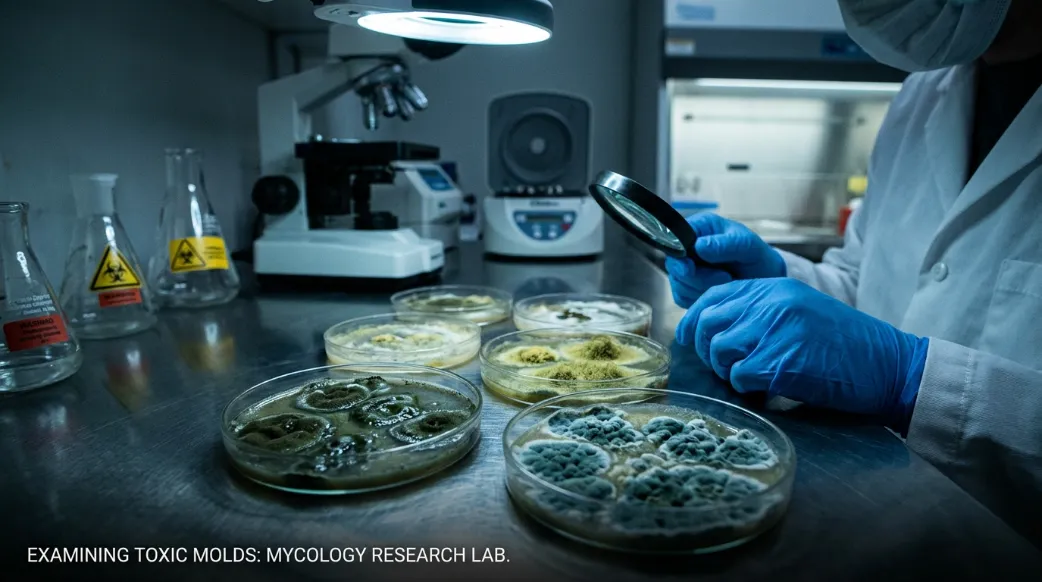
Most articles about the world’s most dangerous mold types are ranked by fear. Black mold sits at the top because it is famous, everything else falls in behind it, and the reader closes the tab knowing a few Latin names and nothing they can act on. That ranking is wrong, and it is wrong in a way that costs people money. The mold that is most dangerous in a Long Island crawl space is not the mold that is most dangerous in a Brooklyn apartment with a newborn in it, and neither one is the mold that is quietly eating the drywall behind a Queens bathroom wall.
Danger is not one scale. It is three. A mold can be dangerous because it produces toxins, because it can infect a person whose immune system is compromised, or because it is structurally destroying the building it grows on. Very few species are dangerous on all three counts, and the species that scare homeowners most are often not the ones doing the most damage.
This guide sorts the world’s most dangerous mold types by those three risks, tells you what water conditions each one needs in order to appear at all, and explains what each one means when it shows up on a lab report. By the end you will be able to look at a mold report and understand what you are actually dealing with.
Don’t chance it. If you believe you have mold, our inspections are always free of charge. Schedule your free mold inspection now.
What Makes a Mold Dangerous? Three Separate Risks, Not One
When people talk about the world’s most dangerous mold types, they usually mean one thing: toxicity. That is only a third of the picture, and it is the third with the least settled science behind it. There are actually toxigenic risks, infectious risks, and structural risks that all come with allowing mold to be left unattended in your home. As a leading mold remediation contractor in Long Island, we see hidden mold issues every day. A lot of the times the homeowner’s don’t even know where the smell or symptoms are coming from. We have to dig around for it, but mold will usually be anywhere there is organic food (wood, sheetrock, etc) to eat and a moisture source.
Here is the honest breakdown of the three ways a mold causes harm, because a species that scores high on one can score at zero on the other two.
1 Toxigenic Risk: The Mold Produces Mycotoxins
Some molds produce secondary metabolites called mycotoxins as a byproduct of growth. Stachybotrys, Chaetomium, Aspergillus, and Fusarium all do. What mycotoxins mean for a person living in a building is genuinely less certain than the internet suggests. Most of the alarming research involves animals fed contaminated grain in controlled doses, not people breathing spores in a house, and the EPA’s position on mold and health reflects that caution.
What is not in dispute: the presence of a toxin-producing species tells you something important about the building. These species do not appear without sustained water. Finding them is a moisture diagnosis before it is a health diagnosis. If you want the deeper version of this, we cover it in detail in our guide to mycotoxins and indoor mold.
2 Infectious Risk: The Mold Can Colonize a Person
This is the risk that gets almost no coverage and deserves the most. A small number of molds are opportunistic pathogens, meaning they can grow inside human tissue when the immune system cannot fight them off. Aspergillus fumigatus is the clearest example. So are Mucor and Rhizopus. For a healthy adult this risk is close to zero. For someone on chemotherapy, someone post-transplant, someone with advanced COPD, or an infant, it is the single most serious category on this page.
This is why the same mold report means different things in different households. If someone in the home is immunocompromised, pregnant, or elderly, the ranking of dangerous species changes completely. Our guides on mold during pregnancy and for babies and mold and COPD cover those situations specifically.
3 Structural Risk: The Mold Is Digesting Your Building
The most overlooked danger. Some molds do not merely sit on a surface, they secrete enzymes that break down cellulose and consume the material itself. Chaetomium and Trichoderma are the two names to know here. When either shows up, the affected drywall, sheathing, or framing is usually not cleanable. It is structurally compromised and has to come out. This is the difference between a $900 cleaning and a $6,000 reconstruction, which is why it belongs in any honest ranking of the world’s most dangerous mold types.
The World's Most Dangerous Mold Types at a Glance
| Species | Appearance | Water needed (aw) | Where it shows up | Primary danger |
|---|---|---|---|---|
| Stachybotrys chartarum | Black, wet, slimy or sooty | Very high (0.94+) | Saturated drywall paper, ceiling tile, wallboard behind chronic leaks | Toxigenic. Indicates prolonged saturation |
| Chaetomium | White and cottony, maturing to olive or black | High (0.90+) | Wet drywall, wallpaper, wood trim, baseboards | Structural. Digests cellulose. Also toxigenic |
| Aspergillus fumigatus | Gray green, powdery, velvet texture | Low to moderate (0.78+) | HVAC systems, dust, insulation, compost, soil | Infectious. The main risk to immunocompromised people |
| Fusarium | Pink, white, or reddish | High (0.90+) | Wet carpet and padding, humidifier trays, drains | Toxigenic and infectious. Eye and skin infections |
| Trichoderma | Bright green with white edges | High (0.90+) | Chronically damp wood, subfloor, sheathing | Structural. Aggressive wood decay |
| Alternaria | Dark brown to black, velvety, wooly | Moderate (0.85+) | Shower surrounds, window sills, damp walls, entry dust | Allergenic. One of the strongest asthma triggers indoors |
| Cladosporium | Olive green to brown or black, suede texture | Moderate (0.85+) | Window frames, textiles, painted surfaces, HVAC coils | Allergenic. The most common indoor genus worldwide |
| Penicillium | Blue green, powdery, with a white rim | Low (0.78+) | Wet insulation, water-damaged paper, food, carpet | Allergenic and toxigenic. Very fast colonizer |
| Mucor and Rhizopus | White to gray, fast, fuzzy, visibly tall | Very high (0.93+) | Post-flood material, spoiled organics, saturated carpet | Infectious. Rare but severe in immunocompromised patients |
| Aureobasidium pullulans | Pink or black, shiny, often on caulk | Moderate (0.87+) | Bathroom caulk, grout, window sealant, painted wood | Allergenic. Common cause of dermatitis in sensitized people |
A note on Memnoniella: older articles list it as a separate dangerous species. Current taxonomy folds it into Stachybotrys, where it behaves nearly identically. If a lab reports it, read it as a Stachybotrys finding.
Why Color and Smell Cannot Rank the World's Most Dangerous Mold Types
Look at the appearance column again. Four of the ten can present as black. Three can present as green. A homeowner standing in front of a dark patch on a wall genuinely cannot tell Stachybotrys from Chaetomium from Alternaria from ordinary Cladosporium, and those four findings carry four different price tags and four different scopes of work.
Smell does not solve it either. The musty odor everyone recognizes comes from microbial volatile organic compounds, and nearly every species on this list produces them. A strong smell tells you there is active growth and roughly how much. It tells you nothing about which organism. That is the entire case for sampling, and it is why we walk through it in our full mold identification guide and in our honest assessment of at-home mold test kits.
Species Profiles: What Each Finding Actually Means
Here is what each of the world’s most dangerous mold types tells a remediator when it comes back on a report, and what it usually costs you in scope.
Stachybotrys chartarum: The Famous One
Stachybotrys needs the wettest conditions of anything on this list. It cannot grow from humidity. It requires liquid water sitting against cellulose for a sustained period, which is why it turns up behind long-running plumbing leaks, under chronically flooded basement walls, and above ceilings that have been leaking through a roof for a season or more. Its reputation is bigger than its science, but its diagnostic value is enormous: finding it means you have a serious, ongoing water intrusion problem, not a ventilation problem.
Full detail lives in our homeowner’s guide to Stachybotrys chartarum, and we answer the question people actually search for in can Stachybotrys kill you.
Chaetomium: The One That Eats the House
Chaetomium is the most underrated entry on this list and the one we argue belongs near the top. It is often called the other black mold because homeowners routinely mistake it for Stachybotrys. It secretes cellulase, an enzyme that breaks cellulose down, which means it does not colonize drywall so much as consume it. Affected board is soft, structurally spent, and cannot be cleaned. It has to be cut out and replaced.
It also carries a distinctly dusty, musty odor that often shows up before any visible growth does, and it is consistently identified as one of the most common genera in water-damaged buildings. Our complete Chaetomium mold guide covers identification, health effects, and removal in full.
Aspergillus fumigatus: The Real Medical Risk
If you are ranking the world’s most dangerous mold types strictly by documented capacity to harm a human being, Aspergillus fumigatus wins and it is not close. It is a genuine opportunistic pathogen, capable of causing invasive aspergillosis in patients with suppressed immune systems. It is also unusually mobile, because it thrives in HVAC systems and dust rather than requiring saturated material, and a contaminated air handler will distribute it through an entire building.
See Aspergillus and health risks for the medical picture, symptoms of Aspergillus mold exposure for what people notice first, and mold in air ducts for the delivery system.
Fusarium: The Wet Carpet Specialist
Pink or reddish, fast, and tied almost exclusively to standing water in soft materials. Carpet padding that stayed wet after a flood is the classic habitat, along with humidifier reservoirs and drain pans. Fusarium is both toxigenic and capable of causing localized infections, notably in the eye. It is a strong argument against trying to dry and save saturated carpet. Details in our Fusarium mold guide.
Trichoderma: Structural Decay in Wood
Bright green, aggressive, and a wood problem rather than a drywall problem. Trichoderma turns up on damp subfloor, sheathing, and framing, and like Chaetomium it degrades what it grows on. On Long Island it is a crawl space organism above all. Read our Trichoderma guide and is Trichoderma mold dangerous.
Alternaria and Cladosporium: The Ones That Actually Make People Sick
Neither of these is toxigenic and neither will infect you, so they rarely make lists of the world’s most dangerous mold types. They should. Between them they account for an enormous share of real, diagnosable, day-to-day misery in occupied buildings, because both are potent allergens and Alternaria in particular is strongly associated with asthma exacerbation. They also need far less water than the toxigenic species, which means they are the ones you are most likely to actually have.
Cladosporium is the most common indoor mold genus in the world. Our page on whether Cladosporium mold is toxic answers the question directly, and how mold affects asthma covers the mechanism. If you are already noticing symptoms, start with mold allergy symptoms.
Penicillium: Fast, Common, and Everywhere Wet Insulation Is
Blue green and fast. Penicillium colonizes water-damaged insulation, paper, and carpet within days of a wetting event, well before the slower toxigenic species arrive. Some species produce mycotoxins, and it is a significant allergen. Its real value is as a timing signal: heavy Penicillium with no Stachybotrys usually means a recent event, not a chronic one. See what homeowners need to know about Penicillium.
Mucor and Rhizopus: Rare, Fast, and Serious
Visibly tall, fuzzy, gray white growth that can cover a surface in a day or two. Both are associated with mucormycosis, an aggressive and rare infection that occurs almost exclusively in immunocompromised patients. In buildings they are a post-flood organism. If you have had standing water and you are seeing fast, tall, gray growth, do not disturb it. Read types of mold from water damage for the full flood picture.
Where the World's Most Dangerous Mold Types Grow in a New York Home
The world’s most dangerous mold types are not evenly distributed through a building. They concentrate where moisture concentrates, and in Long Island, Brooklyn, Queens, and The Bronx that means a predictable short list driven by a high water table, old housing stock, and a long heating season that drives condensation into cold cavities.
- Crawl spaces and basements. Groundwater, capillary rise through slab and block, and summer condensation on cool masonry. The highest-value place to look. See crawl space mold prevention.
- Wall cavities behind bathrooms and kitchens. Supply line weeps and shower pan failures, hidden for months.
- Attics. Bathroom fans venting into the attic instead of through the roof, plus insufficient soffit and ridge ventilation. Our attic mold guide covers the whole pattern.
- HVAC systems and ductwork. Condensate pans, coils, and flex duct in unconditioned space. The main route by which Aspergillus reaches every room in the house.
- Under carpet, padding, and engineered flooring. Especially anywhere that has flooded once.
- Window frames and cold exterior corners. Winter condensation, the classic Cladosporium and Alternaria habitat.
- Behind cabinets, under sinks, and around appliances. Slow drips that nobody sees until the toe kick fails.
Spores from any of these locations do not stay put. Air pressure differences, the stack effect, and forced-air heating move them building-wide, which is covered in how far mold spores travel in the air.
How Professionals Identify and Remove the World's Most Dangerous Mold Types
Handling the world’s most dangerous mold types is a controlled process, not a cleaning job. The reason is simple: every one of these species reproduces by releasing spores when disturbed. Scrubbing a colony without containment converts a localized problem into a building-wide one, and it is the single most common way homeowners make a small job expensive.
A compliant remediation follows this sequence:
- Moisture diagnosis first. Thermal imaging and pin meters to locate the source. Nothing else matters until the water is identified, because remediating without fixing the source guarantees recurrence.
- Assessment and sampling. In New York, assessment and remediation must be performed by separate parties on most jobs. That is not a preference, it is state law under Article 32, which the New York State Department of Labor mold program enforces.
- Containment. Poly barriers, negative air pressure, and a decontamination chamber so spores cannot migrate. We explain the equipment in mold containment explained.
- HEPA filtration and air scrubbing throughout the work, not just at the end.
- Removal of non-salvageable material. With Chaetomium or Trichoderma present, this means cutting out material rather than cleaning it.
- Drying to a documented standard, verified with meter readings, not by feel.
- Clearance testing by an independent third party. The step that turns a job into a documented result, covered in mold clearance testing.
- Source correction. Drainage, ventilation, grading, or waterproofing so the conditions do not return.
Our full walkthrough is in the mold removal process step by step, and pricing is broken out in our complete mold removal cost guide. Before you hire anyone, verify their credentials against the New York mold remediation license requirements. You can review ours on our licenses and certifications page.
How to Keep the World's Most Dangerous Mold Types Out of Your Home
Every species listed here shares one requirement. Take away sustained moisture and none of the world’s most dangerous mold types can establish, no matter how many spores enter the building. That is the whole prevention strategy, and it is why the water activity column in the table above is the most useful thing on this page.
- Hold indoor relative humidity between 35 and 50 percent. Below 50 stops the toxigenic species outright. See the best humidity level to prevent mold.
- Dry any wetting event within 24 to 48 hours. This window is the difference between a fan and a remediation contract.
- Run a dedicated dehumidifier in the basement or crawl space, drained to a pump or drain rather than a bucket you have to remember to empty.
- Vent bathrooms, kitchens, and dryers to the exterior, never into an attic or soffit.
- Move water away from the foundation. Extended downspouts, positive grading, clean gutters. Most basement moisture in this region is a drainage problem wearing a waterproofing costume.
- Encapsulate the crawl space if it is vented and earthen. On Long Island this single change eliminates the majority of crawl space mold conditions.
- Walk the property after every major storm, and check the basement, the attic, and around every window.
The EPA’s guide to mold, moisture, and your home is a solid free reference for the DIY end of this.
World's Most Dangerous Mold Types: Final Thoughts
The species that frightens you is rarely the species that costs you. Stachybotrys gets the headlines, Aspergillus carries the real medical risk, Chaetomium and Trichoderma quietly destroy the structure, and Alternaria and Cladosporium are the ones actually making people in the building feel unwell every day. A useful ranking of the world’s most dangerous mold types depends on your building’s moisture history and on who lives inside it.
What does not change is the response. Identify the organism properly, find and fix the water, contain the work, and verify the result with independent testing. Do those four things in order and the species name stops mattering very much.
Get a Free Inspection for the World’s Most Dangerous Mold Types
Final Thoughts on the World's Most Dangerous Mold Types
Is black mold the most dangerous type of mold?
Black mold (Stachybotrys chartarum) is one of the most well-known and feared molds because it can produce toxic mycotoxins, but it is not the only dangerous type. Other species like Chaetomium, Aspergillus, and Fusarium can also pose serious health and structural risks.
How fast can dangerous mold grow in a home?
Dangerous mold can begin growing within 24 to 48 hours of water exposure if moisture, warmth, and organic material are present. Full colonies can develop in just a few days if the environment remains damp.
Can black mold cause health issues?
Yes. Exposure to dangerous mold can cause symptoms such as persistent coughing, wheezing, headaches, fatigue, sinus infections, skin irritation, and, in severe cases, lung infections or neurological issues.
Is mold testing really necessary?
In most cases, professional testing is not required to begin remediation if visible growth and a moisture source are identified. Fixing the water issue and removing affected materials is more important than naming the exact species.
When should I call a mold professional?
You should call a professional if mold keeps returning, covers more than a small area, causes health symptoms, or appears after water damage, leaks, or flooding.
What does dangerous mold smell like?
Dangerous mold often produces a strong musty, earthy odor similar to rotting wood or wet soil. This smell is often the first sign of hidden growth behind walls or under floors.
Can I remove dangerous mold myself?
Small surface patches can sometimes be cleaned, but dangerous mold that covers a larger area or grows inside walls, insulation, or HVAC systems should be handled by professionals to avoid spreading spores and increasing exposure.
Does bleach kill dangerous mold?
Bleach can kill surface mold on non-porous materials, but it does not penetrate porous materials like drywall or wood. This means the mold roots can remain and grow back if the moisture problem is not corrected.
Where is dangerous mold most commonly found?
Dangerous mold is typically found in basements, crawl spaces, behind drywall, under carpets, inside air ducts, around windows, and under leaking sinks or roofs.
How do I know if my home has hidden mold?
Signs of hidden mold include persistent musty odors, unexplained health symptoms, peeling paint, warped walls, and a history of water leaks or flooding.